

Try this one. What is 2 + 3 × 4?
Your friend says 20. Your cousin says 14. Both did the math carefully. Both are sure they’re right.
Only one of them is.
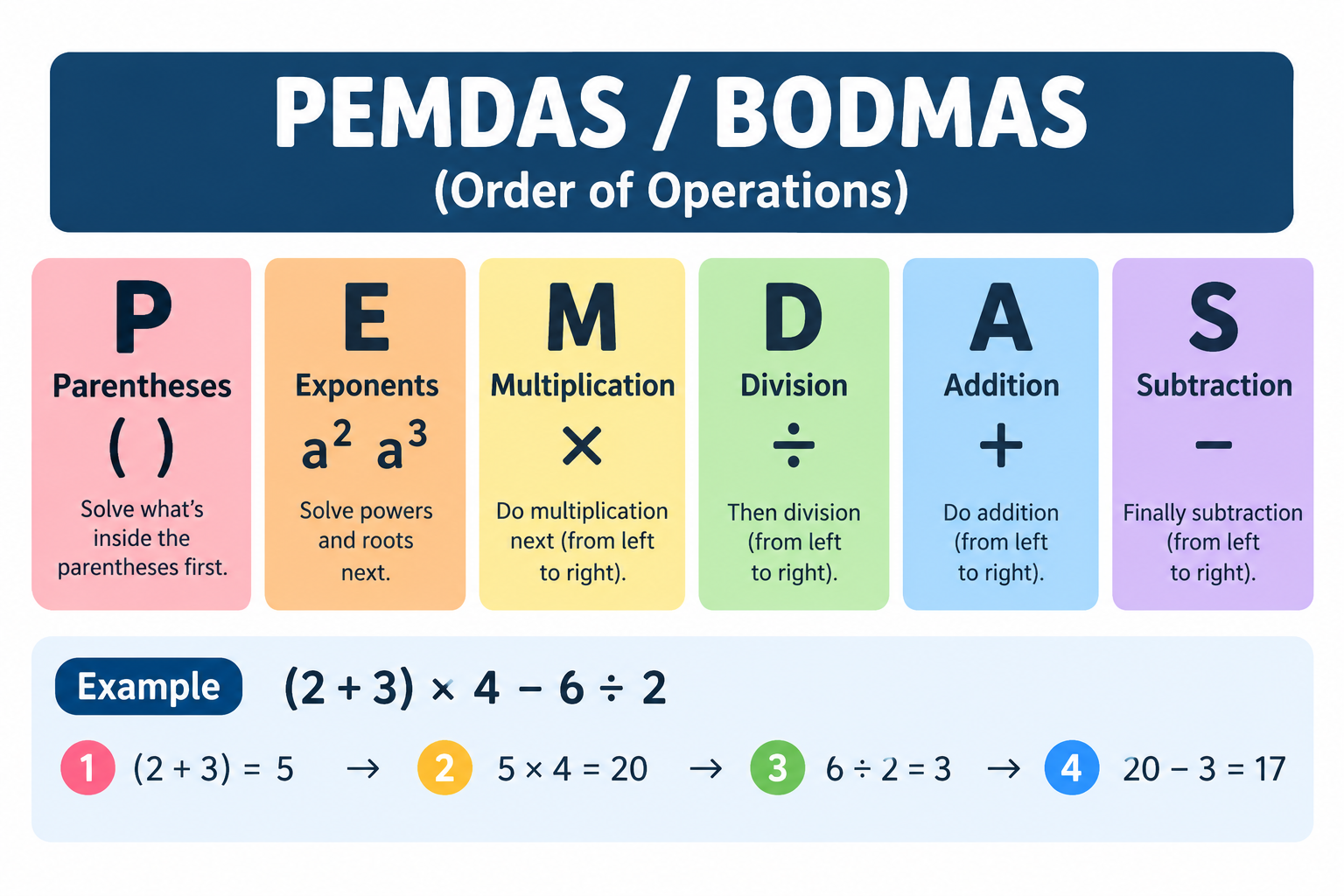
Math can’t work if everyone gets a different answer from the same problem. So mathematicians agreed on a single rulebook. It’s called the order of operations, and you’ll know it as PEMDAS or BODMAS.
Whether you’re a student, a parent helping with homework, or an exam taker tired of viral puzzles, this guide is for you. We’ll break it down step by step. Short, clear, and practical.
Let’s go.
Order of Operations At a Glance
| Priority | PEMDAS (US) | BODMAS (UK / India) | What It Means |
|---|---|---|---|
| 1st | Parentheses | Brackets | Solve anything inside grouping symbols first |
| 2nd | Exponents | Orders | Handle powers and roots next |
| 3rd | Multiplication / Division | Division / Multiplication | Same priority. Work left to right |
| 4th | Addition / Subtraction | Addition / Subtraction | Same priority. Work left to right |
Why Do We Need an Order of Operations?
Let’s go back to our puzzle. Here it is again:
2 + 3 × 4Way 1: Left to right, no rules
2 + 3 = 5
5 × 4 = 20
Way 2: Multiplication first
3 × 4 = 12
2 + 12 = 14
Two methods. Two answers. That’s a problem.
Imagine a bridge engineer, a pharmacist, or a computer programmer getting different results from the same formula. It would be chaos.
So the world picked one rule. Multiplication comes before addition. The correct answer is 14.
That’s the whole reason PEMDAS and BODMAS exist. They keep everyone on the same page.
PEMDAS vs BODMAS: Same Rule, Different Names
Here’s the good news. They are identical. Only the labels change.
-
PEMDAS is popular in the United States. Students often remember it with “Please Excuse My Dear Aunt Sally.”
-
BODMAS is common in the UK, India, and many other countries.
-
Some regions also use BEDMAS or BIDMAS. Same idea again.
Decoding the Letters
| PEMDAS | BODMAS | Meaning |
|---|---|---|
| Parentheses ( ) | Brackets ( ) [ ] { } | Grouping symbols |
| Exponents | Orders | Powers like 3² and square roots |
| Multiplication | Multiplication | × or ⋅ |
| Division | Division | ÷ or / |
| Addition | Addition | + |
| Subtraction | Subtraction | − |
“Orders” just means powers and roots. Don’t let the word throw you off.
The Left-to-Right Rule (The Trap Most People Fall Into)
This is where most mistakes happen. Read this part twice.
Many students think M comes before D. Or that A comes before S. That’s not true.
Multiplication and division share equal priority. So do addition and subtraction. When they sit side by side, you work from left to right.
Think of M and D as two kids sharing one seat. Neither one outranks the other. Whoever appears first in the problem goes first.
Example: Division Before Multiplication
24 ÷ 4 × 3Wrong way (multiplication first):
4 × 3 = 12
24 ÷ 12 = 2   ✗
Right way (left to right):
24 ÷ 4 = 6
6 × 3 = 18   ✓
The correct answer is 18.
Example: Subtraction Before Addition
10 − 3 + 2Wrong way (addition first):
3 + 2 = 5
10 − 5 = 5   ✗
Right way (left to right):
10 − 3 = 7
7 + 2 = 9   ✓
The correct answer is 9.
Remember: Same level? Go left to right. Always.
Example 1: A Simple Multi-Step Problem
Let’s solve this one slowly.
8 + 6 × 2 − 10 ÷ 5Step 1: Scan for brackets and exponents. There are none. Move on.
Step 2: Handle multiplication and division, left to right.
First, 6 × 2 = 12. Then, 10 ÷ 5 = 2.
Division gives you a quotient, which is simply the result of dividing one number by another. If that term is new, here’s a friendly explainer on what is a quotient in math. You always find the quotient before you move on to adding or subtracting.
The expression now looks like this:
8 + 12 − 2Step 3: Handle addition and subtraction, left to right.
8 + 12 = 20
20 − 2 = 18
Final Answer: 18
Want to see operations in action with visual models? The MathisFun Order of Operations page has clear, interactive illustrations.
Example 2: A Complex Problem with Brackets, Exponents, and Fractions
Now let’s level up. This one has everything.
[ 4 + (3 + 2)² ] ÷ 5 + (18 − 6) / (2 × 3)Take a breath. We’ll go layer by layer.
Step 1: Solve the innermost brackets first
Inside the square brackets, we have (3 + 2).
(3 + 2) = 5Also look at the fraction part. The top and bottom each need their own simplifying.
(18 − 6) = 12
(2 × 3) = 6
The expression becomes:
[ 4 + 5² ] ÷ 5 + 12 / 6Step 2: Handle the exponent
5² = 25Now:
[ 4 + 25 ] ÷ 5 + 12 / 6Step 3: Finish the square brackets
4 + 25 = 29Now:
29 ÷ 5 + 12 / 6Step 4: Treat the fraction bar as division, and divide
29 ÷ 5 = 5.8
12 / 6 = 2
Step 5: Add
5.8 + 2 = 7.8Final Answer: 7.8
A Quick Note on Fractions
When a problem is written as a fraction, the bar acts like a grouping symbol. Simplify the numerator and denominator separately first. Then divide.
For example:
(6 + 2) / (3 + 1) = 8 / 4 = 2Sometimes your answer lands as a fraction where the top number is smaller than the bottom, like 3/4. That’s a proper fraction. If you want a refresher, check out this guide on what is a proper fraction.
Working With Multiplication Inside Groupings
Brackets often hide multiplication. Take this:
5 × (2 + 3)Solve the bracket first: 2 + 3 = 5. Then multiply: 5 × 5 = 25.
Each result of multiplying is a multiple of the numbers involved. If you’d like to strengthen that idea, this guide on what is a multiple in math gives plenty of examples. It helps when you scale values inside groupings or check whether your answer makes sense.
Tricky Internet Math Puzzles: Solved
You’ve seen these. A post goes viral. Thousands of comments. Everyone argues. Here’s a classic.
8 ÷ 2(2 + 2)Some people say 1. Others say 16. Who’s right? Let’s walk through it.
Step 1: Brackets first
(2 + 2) = 4Now the expression reads:
8 ÷ 2 × 4Notice we rewrote 2(4) as 2 × 4. Writing a number next to a bracket just means multiplication.
Step 2: Division and multiplication share priority
They’re equals. So go left to right.
8 ÷ 2 = 4
4 × 4 = 16
Final Answer: 16
Why Do People Say 1?
They treat 2(2 + 2) as a single glued-together chunk. That would give:
8 ÷ [2 × 4] = 8 ÷ 8 = 1That’s not what the standard rule says. Under PEMDAS and BODMAS, you process multiplication and division from left to right. So 16 is the answer under the standard convention.
Honest note from your coach: Some older textbooks and scientific calculators treat implied multiplication (a number touching a bracket) as higher priority. That’s why the debate never dies. The real fix is clearer writing. If a problem is ambiguous, add brackets. In exams, follow the standard left-to-right rule.
Another Viral Favorite
6 ÷ 2 × (1 + 2)Step 1: Brackets. (1 + 2) = 3
6 ÷ 2 × 3Step 2: Left to right.
6 ÷ 2 = 3
3 × 3 = 9
Final Answer: 9
Common Mistakes (And How to Dodge Them)
- Treating M before D as a strict rule. They’re equals. Go left to right.
- Treating A before S as a strict rule. Same thing. Left to right.
- Skipping the brackets. Always solve them first.
- Forgetting exponents apply only to the number next to them. In 2 × 3², square the 3 first: 2 × 9 = 18, not 36.
- Dropping negative signs. Write each step on its own line.
- Doing too much in your head. Slow down. One step per line.
Quick Practice Time
Try these before checking the answers.
- 7 + 3 × 5
- 20 − 4 × 2 + 6
- 36 ÷ 6 × 2
- (8 + 4) ÷ 3 + 2²
- 50 − [10 + (2 × 4)]
Answers:
- 22
- 18
- 12
- 8
- 32
Want real-time feedback? The Khan Academy Order of Operations Practice section offers instant hints and is perfect for building speed and confidence.
Final Thoughts
The order of operations isn’t a trick. It’s a shared language that lets everyone get the same answer.
Keep these ideas close:
- PEMDAS and BODMAS are the same rule with different names.
- Solve brackets first, then exponents or orders.
- Multiplication and division are equals. Work left to right.
- Addition and subtraction are equals. Work left to right.
- When a puzzle looks confusing, add brackets and rewrite it clearly.
The next time a viral problem pops up, you won’t need to argue in the comments. You’ll know the rule, and you’ll know why it works.
Practice a little each day. Soon this becomes second nature.
You’ve got this.
📌 Educational Disclaimer
This guide is provided for general informational and academic learning purposes only. It is not a substitute for professional instruction, formal coursework, or personalized tutoring. While every effort has been made to ensure accuracy, learners are encouraged to verify results and consult a qualified teacher or official curriculum materials for specific academic or examination requirements.