

Quick Answer
Random sampling is a method of selecting members from a population by chance. In simple random sampling (SRS), every member has an equal probability of being selected. Researchers commonly use a lottery draw, a random-number table, or a computer-based random number generator.
A valid random sample requires a clearly defined population and a suitable sampling frame—a list that covers the population members the study intends to represent.
Why Random Sampling Matters
Imagine a school prize draw. Every ticket is placed in the same box, the tickets are mixed, and a few are drawn without looking. No one chooses favourites; chance determines the winners. Random sampling applies the same principle to research: selection is controlled by a chance process rather than by a researcher’s personal preference.
Random sampling is one of the probability-based methods discussed in our broader guide to sampling in statistics
This article focuses on simple random sampling: what it means, how to carry it out, and when it is useful.
What Is Random Sampling?
Random sampling is a method of choosing a sample from a population so that each eligible member has an equal chance of selection. The selection is made using a random process, such as drawing numbered slips or generating random numbers with software.
The standard form is called simple random sampling (SRS). In an SRS of a fixed size, every possible sample of that size has an equal chance of being selected. This is a more precise way to describe the method than saying only that everyone has an equal chance.
Two important ideas
- Equal opportunity: eligible population members have the same selection probability.
- Chance-based selection: a lottery, random-number table, or generator determines the selected members—not convenience or personal judgement.
Before selecting a sample, define the population and prepare a sampling frame. A sampling frame is the operational list from which the sample is actually drawn. Read more about a sample in statistics and the population in statistics
Random Does Not Mean Haphazard
In everyday conversation, “random” can mean unplanned. In statistics, random selection is deliberate and follows a defined procedure. Asking whoever happens to walk past is convenience sampling, not simple random sampling. People who are easy to reach may differ from those who are not, creating selection bias.
| Simple random sampling | Haphazard or convenience selection |
| Chance determines who is selected. | The researcher chooses whoever is available. |
| Selection probabilities are defined by the design. | Some people may have little or no chance of inclusion. |
| The procedure can be documented and repeated. | The selection process may be difficult to reproduce. |
Three Ways to Draw a Simple Random Sample
The tools differ, but the principle is the same: number the population members and use chance to select the required number.
1. The Lottery Method
Write each member’s name or ID on an identical slip of paper. Place all slips in a container, mix them thoroughly, and draw the required number without looking.
- Useful for: small populations, classroom demonstrations, and simple group decisions.
- Watch out for: slips that differ in size, folding, or weight, or a container that is not mixed properly.
2. A Random-Number Table
A random-number table contains digits arranged without a predictable pattern. Number the population members, choose a starting point in the table using a rule set in advance, and read the digits in a fixed direction. Keep valid IDs and skip numbers outside the population range. If sampling without replacement, skip any ID already selected.
Example: If 80 people are numbered 01–80, read two digits at a time. From a sequence such as 47, 93, 12, 06, keep 47, skip 93 because it exceeds 80, then keep 12 and 06.
3. A Computer or Spreadsheet Random-Number Generator
For larger lists, a spreadsheet or statistical program is usually more practical.
- Put the complete population list in column A.
- Enter =RAND() in column B beside the first member and fill it down for every row.
- Sort the entire list by the random values in column B.
- Select the first n rows as the sample.
Important: RAND() can recalculate when the workbook changes. Copy the generated values and use Paste Special → Values before sorting or editing, so the selected order does not change unexpectedly. Another option is to use a statistical program that records the random seed and selection procedure.
| Method | Tools needed | Best suited to | Main precaution |
| Lottery | Identical slips and a container | Small groups | Mix thoroughly and make slips indistinguishable. |
| Random-number table | Numbered list and printed table | When a computer is unavailable | Set the starting point and direction before reading. |
| Computer generator | Spreadsheet or statistical software | Large lists and databases | Save the selected IDs and document the procedure. |
Sampling With or Without Replacement
- Without replacement: once a member is selected, that member is not returned to the pool. The same person cannot be selected twice. This is common in surveys.
- With replacement: after each draw, the selected member is returned to the pool and could be selected again.
For most surveys that need a set of distinct people, sampling without replacement is the practical choice. The probability of selection changes slightly from draw to draw because the pool becomes smaller.
How to Carry Out Random Sampling
- Define the target population precisely, including who is eligible and the time period.
- Build or obtain a sampling frame that covers the eligible population.
- Check the frame for missing, duplicate, or outdated entries.
- Assign each member a unique identification number.
- Choose a chance-based method and decide whether sampling is with or without replacement.
- Select the required number of IDs, save the selection, and document the method.
- Contact selected members and record non-response rather than quietly replacing people with convenient alternatives.
Simple Random Sampling Examples
Example 1: Selecting Students for a Class Survey
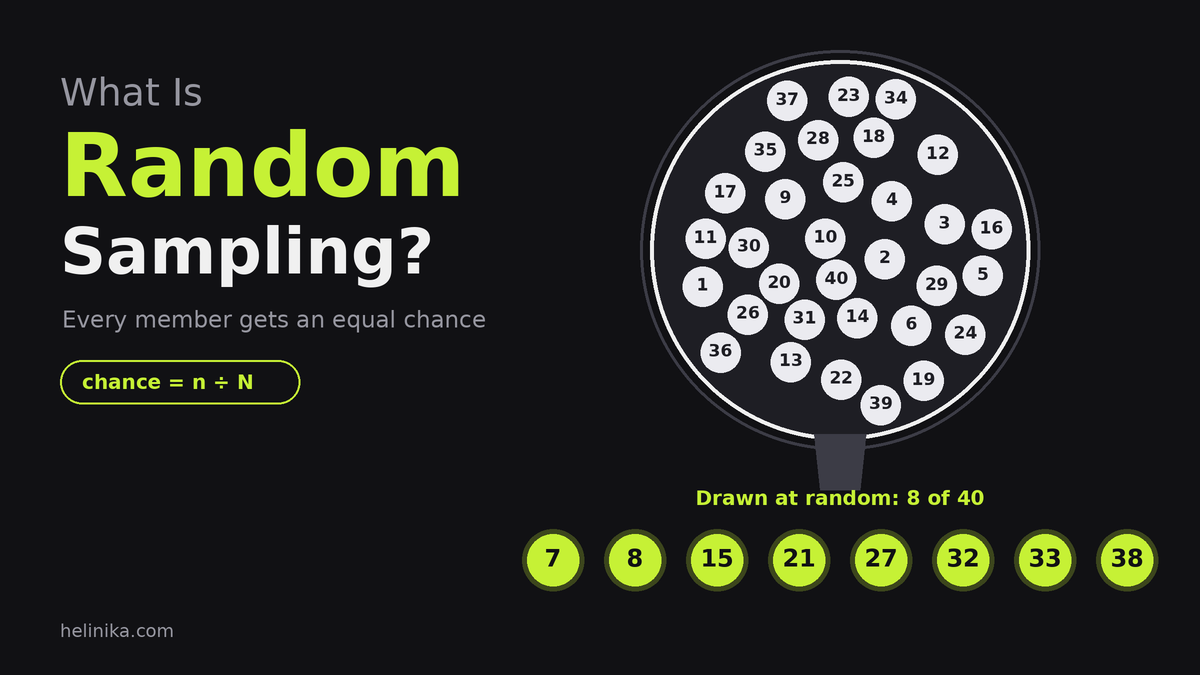
A teacher wants feedback from 8 of the 40 students in a class.
- Number the students from 1 to 40 using the class register.
- Use a random number generator to select 8 different IDs.
- Suppose the selected IDs are 7, 8, 15, 21, 27, 32, 33, and 38.
- Invite those 8 students to complete the survey.
For a simple random sample of 8 students from 40, each student has a selection probability of:
n ÷ N = 8 ÷ 40 = 0.20 = 20%
The selection of neighbouring IDs, such as 7 and 8, does not make the sample non-random. Genuine random selections can contain clusters.
Example 2: A Customer Feedback Call List
An online store has 500 customers but can afford to call only 10. It numbers the customers from 1 to 500 and uses software to select 10 distinct IDs. The store then contacts the selected customers. This avoids choosing only familiar or especially satisfied customers, although non-response can still affect the final results.
Example 3: Different Samples Give Different Results
A class has 40 students with a true average height of 151.9 cm. Three random samples of 8 students might produce the following averages:
| Sample | Average height |
| Sample A | 150.5 cm |
| Sample B | 153.8 cm |
| Sample C | 148.5 cm |
| Full class | 151.9 cm |
The sample averages differ because each sample contains a different group of students. This variation is called sampling error. Random sampling does not eliminate sampling error, but probability sampling provides a basis for estimating uncertainty. A larger sample often reduces sampling variability, provided the sampling design and data collection are sound.
Example 4: Inspecting Machines in a Factory
A supervisor needs to inspect 5 of 60 machines. She numbers the machines from 1 to 60 and draws 5 IDs using identical slips in a thoroughly mixed container. Each machine has a 5/60, or 1/12 (about 8.33%), chance of being selected.
Advantages of Random Sampling
- Reduces selection bias: the researcher does not hand-pick preferred participants.
- Provides a transparent procedure: the selection method can be explained and documented.
- Supports statistical inference: probability-based selection makes it possible to estimate sampling uncertainty under suitable assumptions.
- Allows standard methods for calculating estimates and margins of error.
- Requires relatively little auxiliary information beyond a complete and usable sampling frame.
Limitations of Random Sampling
- A complete sampling frame is needed. Missing members cannot be selected.
- It may be costly when selected people are geographically dispersed.
- Small subgroups may be under-represented by chance in a particular sample.
- It does not automatically use known information about important subgroups; stratified sampling may be more efficient in some situations.
- Non-response can create bias if selected people do not participate and their absence is related to the subject being studied.
- A random sample is not guaranteed to look perfectly representative. Chance variation remains.
| Advantages | Limitations |
| Reduces researcher-driven selection bias | Requires a suitable sampling frame |
| Equal selection probability in an SRS | Can be costly for widely scattered populations |
| Clear and reproducible procedure | Small subgroups may be missed or under-represented |
| Supports estimation of sampling error | Non-response can distort the achieved sample |
| Straightforward to explain | May be less efficient than a design using subgroup information |
Random Sampling vs. Other Sampling Methods
Simple random sampling is one probability sampling method. Other methods—such as systematic, stratified, cluster, and multistage sampling—also use chance, but organize selection differently. Non-probability methods, such as convenience or quota sampling, do not give every population member a known selection probability.
| Method | How selection works | Typical use |
| Simple random | Select IDs directly by chance from the full frame. | A complete list is available and a straightforward design is suitable. |
| Systematic | Choose a random start, then select every kth unit. | A well-ordered list is available and periodic patterns are not a concern. |
| Stratified | Divide the population into strata, then randomly sample within each. | Important subgroups need planned representation. |
| Cluster | Randomly select groups or clusters, then survey units within selected clusters. | A full list of individuals is difficult, but a list of groups exists. |
For a wider comparison, see Helinika’s guide to sampling in statistics
Common Mistakes to Avoid
- Using an incomplete list: members missing from the frame have no chance of selection.
- Replacing hard-to-reach selected people with convenient alternatives: this changes the selection process and may introduce bias.
- Redrawing because the sample does not look balanced: repeating the draw until the result looks pleasing undermines random selection.
- Calling a street-intercept or convenience group a random sample.
- Failing to save the selected IDs: spreadsheet random functions may recalculate.
- Ignoring non-response: report how many selected people could not be contacted or declined.
Frequently Asked Questions
What is random sampling in simple words?
It is choosing members of a population by chance, rather than by personal preference. In simple random sampling, every member has an equal chance of selection.
Is random sampling the same as simple random sampling?
People often use the terms interchangeably. More broadly, random or probability sampling can also include methods such as systematic, stratified, cluster, and multistage sampling.
What do I need before taking a random sample?
You need a clearly defined target population and a suitable sampling frame, usually a complete list of eligible members.
What is the probability of being selected?
In a simple random sample without replacement of fixed size n from a population of size N, each member’s inclusion probability is n/N.
Can a random sample still be unrepresentative?
Yes. A particular sample can differ from the population by chance. Coverage problems and non-response can also affect representativeness.
Should I sample with or without replacement?
For most surveys of distinct people or items, sampling without replacement is used so that no unit is selected twice.
Does random sampling remove all bias?
No. It helps control selection bias at the sampling stage, but it cannot fix an incomplete frame, non-response, measurement errors, or poorly designed questions.
Conclusion
Random sampling selects members of a population through a defined chance process. In simple random sampling, each member has an equal probability of selection, and every possible sample of the chosen size is equally likely. Researchers can use a lottery draw, a random-number table, or a computer generator.
The method is transparent and supports statistical inference, but it depends on a suitable sampling frame and does not prevent non-response or every other source of bias. When the population has important subgroups or a complete list is unavailable, another sampling design may be more appropriate.
References and Further Reading
- Statistics Canada – Probability Sampling
- NIST/SEMATECH e-Handbook of Statistical Methods
- Australian Bureau of Statistics – Sample Design
Disclaimer
This article is for general educational purposes. The names, IDs, and figures in the examples are illustrative. Spreadsheet functions can vary between programs. For official surveys or high-stakes research, consult a qualified statistician and document the sampling design.