

Division is one of the four basic operations in mathematics, and it comes with its own set of vocabulary. Words like dividend, divisor, quotient, and remainder appear constantly in math lessons, textbooks, and standardized tests. Students who understand these terms find division problems much easier to work through because they know what each part of the calculation means.
One term that often causes confusion is quotient. Students frequently confuse it with the remainder or are unsure which number it refers to in a division problem. This article clears all of that up.
By the end of this article, you will understand what a quotient is in math, how to find it, how to check your answer, how quotients relate to other mathematical concepts, and where quotients show up in everyday life. The explanation starts simple and gradually introduces more detail, so whether you are brand new to division or looking to solidify your understanding, this article is built for you.
Quick Answer: What Is a Quotient in Math?
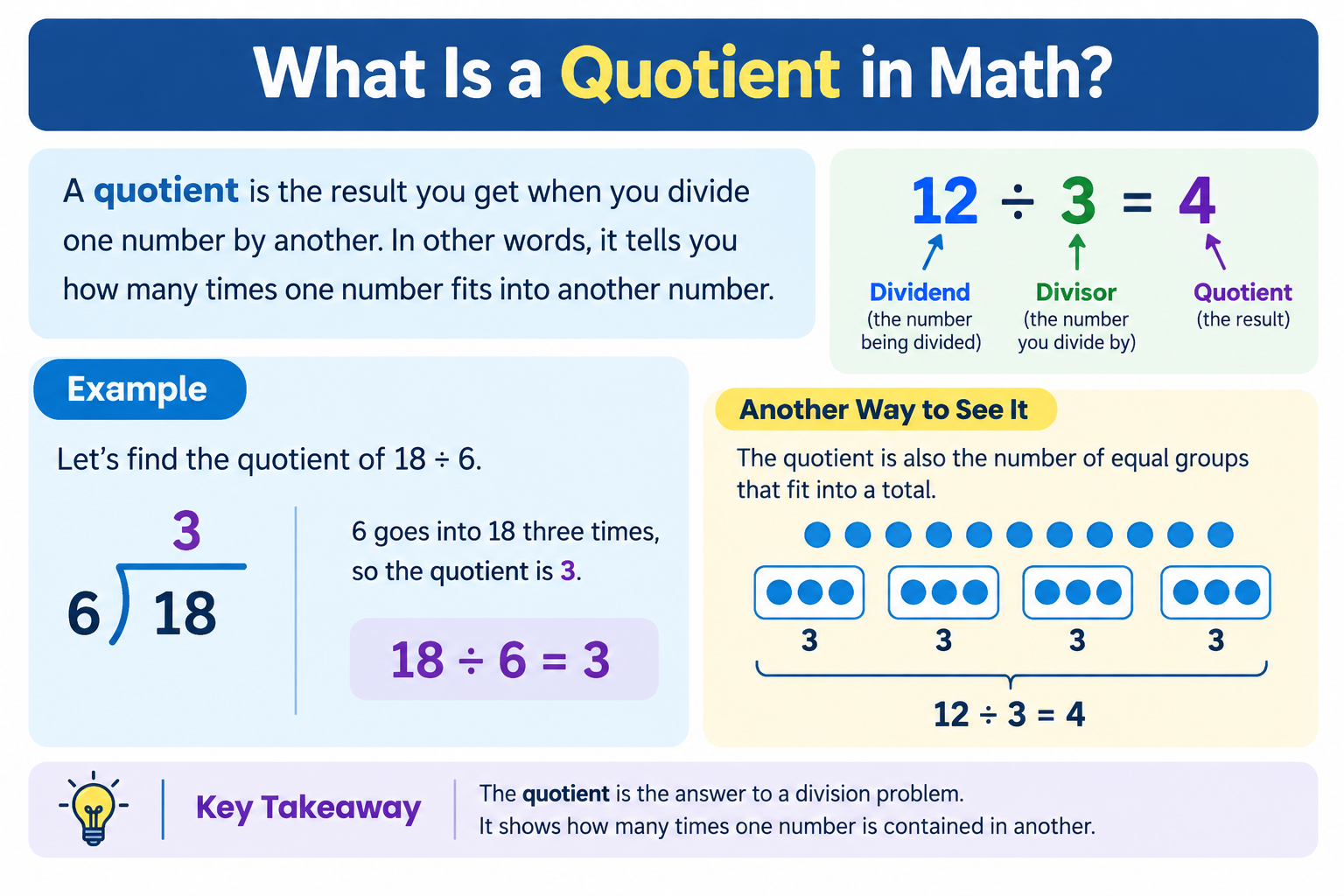
The quotient is the result you get when one number is divided by another. It is the answer to a division problem.
For example, in the problem 20 ÷ 5 = 4:
-
20 is the dividend (the number being divided)
-
5 is the divisor (the number you are dividing by)
-
4 is the quotient (the result of the division)
Every time you divide, the quotient is the number your calculation produces. It is that straightforward.
What Does Quotient Mean in Math?
The word “quotient” comes from the Latin word quotiens, meaning “how many times.” That origin actually describes the concept perfectly. When you divide one number by another, you are essentially asking: how many times does the divisor fit into the dividend?
In 12 ÷ 3 = 4, you are asking how many times 3 fits into 12. The answer is 4 times. That answer, 4, is the quotient.
Students encounter the quotient in nearly every division problem they solve, whether it is simple arithmetic, long division, word problems, or algebra. Knowing this term precisely helps avoid confusion when a teacher or textbook refers to “the quotient” and you need to identify the correct number.
Here are a few straightforward examples of quotients:
- 30 ÷ 6 = 5 — the quotient is 5
- 56 ÷ 8 = 7 — the quotient is 7
- 100 ÷ 10 = 10 — the quotient is 10
In each case, the quotient is the final result on the right side of the equals sign.
Parts of a Division Problem
Before going deeper into quotients, it helps to understand all four parts of a division problem clearly. Division has its own vocabulary, and each term refers to a specific role in the calculation.
Dividend — The dividend is the number being divided. It is the total amount you are splitting up. In 17 ÷ 5, the dividend is 17.
Divisor — The divisor is the number you are dividing by. It tells you how many groups to split into, or how many to put in each group. In 17 ÷ 5, the divisor is 5.
Quotient — The quotient is the result of the division. It tells you how many times the divisor fits into the dividend. In 17 ÷ 5 = 3 remainder 2, the quotient is 3.
Remainder — The remainder is what is left over when the divisor cannot divide the dividend evenly. In 17 ÷ 5 = 3 remainder 2, the remainder is 2.
Let’s look at that example fully:
17 ÷ 5 = 3 remainder 2
Five fits into 17 three complete times (5 × 3 = 15). That gives you 3 as the quotient. After taking 15 away from 17, you have 2 left over. That leftover value is the remainder.
When division comes out exactly with nothing left over, there is no remainder. In 20 ÷ 5 = 4, the remainder is 0, which is typically not written at all.
How to Find the Quotient
Finding the quotient is the process of solving a division problem. The approach depends on the size of the numbers involved, but the logic is always the same: how many times does the divisor fit into the dividend?
Example One: 36 ÷ 4
- Dividend: 36
- Divisor: 4
- Ask: how many times does 4 fit into 36?
- 4 × 9 = 36
- Quotient: 9
Example Two: 63 ÷ 7
- Dividend: 63
- Divisor: 7
- Ask: how many times does 7 fit into 63?
- 7 × 9 = 63
- Quotient: 9
Example Three: 84 ÷ 6
- Dividend: 84
- Divisor: 6
- Ask: how many times does 6 fit into 84?
- 6 × 14 = 84
- Quotient: 14
For smaller numbers, knowing your multiplication tables makes finding quotients fast and straightforward. For larger numbers, long division is the standard method.
Quotient With No Remainder
When a divisor divides evenly into a dividend, the result is a clean quotient with no remainder. These are sometimes called exact division problems.
24 ÷ 6 = 4
Six goes into 24 exactly four times. There is nothing left over. The quotient is 4.
45 ÷ 9 = 5
Nine goes into 45 exactly five times. No remainder. The quotient is 5.
72 ÷ 8 = 9
Eight goes into 72 exactly nine times. The quotient is 9.
Exact division occurs whenever the dividend is a multiple of the divisor. In other words, if the divisor multiplied by a whole number equals the dividend exactly, the quotient will be a whole number with no remainder.
Quotient With a Remainder
Not every division problem works out evenly. When the divisor does not fit perfectly into the dividend, there is a leftover amount called the remainder. The quotient in this situation is still the number of complete times the divisor fits into the dividend.
19 ÷ 4 = 4 remainder 3
Let’s break this down:
- 4 goes into 19 four complete times (4 × 4 = 16)
- After removing 16 from 19, you have 3 left over
- The quotient is 4
- The remainder is 3
The quotient is not 3. The quotient is 4. The 3 is the remainder. This is one of the most common points of confusion for students, and it is worth remembering clearly.
27 ÷ 5 = 5 remainder 2
- 5 goes into 27 five complete times (5 × 5 = 25)
- 27 − 25 = 2
- Quotient: 5
- Remainder: 2
Quotient in Long Division
Long division is a written method used to divide larger numbers. The quotient is built step by step during the process, and understanding where it appears helps students work through problems without losing track.
Let’s work through 156 ÷ 12 using long division.
Step one: Set up the problem. Write 156 under the long division bracket and 12 outside.
Step two: Look at the first digit of the dividend. Can 12 go into 1? No. So extend to the first two digits: can 12 go into 15? Yes, once. Write 1 above the bracket (above the 5 in 156).
Step three: Multiply 12 × 1 = 12. Write 12 below 15.
Step four: Subtract: 15 − 12 = 3. Write 3 below.
Step five: Bring down the next digit from the dividend. The next digit is 6. Bring it down next to the 3, making 36.
Step six: How many times does 12 go into 36? Three times, because 12 × 3 = 36. Write 3 in the quotient above the bracket.
Step seven: Multiply 12 × 3 = 36. Subtract: 36 − 36 = 0.
There is no remainder.
The quotient is 13.
You can verify: 12 × 13 = 156. Correct.
Long division produces the quotient digit by digit, working from left to right through the dividend. Each digit placed above the bracket becomes part of the final quotient.
Quotient and Remainder
The relationship between the quotient, divisor, dividend, and remainder can be expressed with a simple formula:
Dividend = Divisor × Quotient + Remainder
This formula shows how all four parts of a division problem connect to each other. Let’s test it with an example.
19 ÷ 4 = 4 remainder 3
Substituting into the formula:
19 = 4 × 4 + 3
19 = 16 + 3
19 = 19 ✓
The formula balances correctly, confirming the answer is right.
This formula is not just a checking tool. It expresses the mathematical truth of what division means. The dividend equals the number of complete groups (quotient × divisor) plus whatever is left over (remainder).
When there is no remainder, the formula simplifies to:
Dividend = Divisor × Quotient
Which is another way of writing a multiplication fact.
How to Check a Quotient
Checking your answer after a division problem is good mathematical practice. It takes just a few seconds and can catch errors before they cost points on a test.
When there is no remainder:
Multiply the divisor by the quotient. If the result equals the dividend, your quotient is correct.
Divisor × Quotient = Dividend
Example: You calculated 48 ÷ 6 = 8
Check: 6 × 8 = 48 ✓
When there is a remainder:
Multiply the divisor by the quotient, then add the remainder. The result should equal the dividend.
Divisor × Quotient + Remainder = Dividend
Example: You calculated 29 ÷ 4 = 7 remainder 1
Check: 4 × 7 + 1 = 28 + 1 = 29 ✓
If your check does not produce the dividend, review your steps because an error occurred somewhere.
Quotient and Multiplication
Division and multiplication are closely connected. They are inverse operations, meaning one undoes the other. This relationship is one of the reasons that knowing multiplication tables makes division so much faster.
When you know that 6 × 8 = 48, you immediately know that 48 ÷ 6 = 8 and that 48 ÷ 8 = 6. The quotient in both division statements comes directly from the multiplication fact.
This is also why checking a quotient using multiplication works so reliably. The result of a multiplication problem — the product in multiplication — is exactly the number that becomes the dividend when you reverse the operation into division.
Students who are comfortable with multiplication typically find quotients much more quickly because they can work backward from known products rather than counting or guessing.
Quotient and Factors
Factors are numbers that divide evenly into a given number. When one number is a factor of another, dividing produces a whole-number quotient with no remainder.
For example, 6 is a factor of 42, because 42 ÷ 6 = 7 exactly. There is no remainder. The quotient, 7, is also a factor of 42.
Understanding what a factor is in math helps you predict when division will produce a clean quotient versus when there will be a remainder. If the divisor is a factor of the dividend, the quotient will always be a whole number with nothing left over.
This connection becomes especially useful when simplifying fractions, finding greatest common factors, and solving problems where exact division is required.
Quotient and Multiples
Multiples are the numbers you get when you multiply a given number by positive integers. The multiples of 5, for example, are 5, 10, 15, 20, 25, and so on.
When you divide a number by one of its factors, the dividend is always a multiple of that divisor. Knowing multiples in math helps you quickly determine whether a division problem will result in an exact quotient or a remainder.
For instance, if you know that 35 is a multiple of 7, you immediately know that 35 ÷ 7 will give a whole-number quotient with no remainder. If a number is not in the list of multiples of the divisor, there will be a remainder.
This thinking helps students approach division problems strategically rather than calculating blindly.
Quotient and Equations
Quotients frequently appear inside mathematical equations. An equation is a mathematical statement that shows two expressions are equal, and division can appear on either side of that equation.
A simple equation involving a quotient might look like:
n ÷ 6 = 5
To find n, you reverse the division using multiplication:
n = 6 × 5 = 30
You can verify: 30 ÷ 6 = 5 ✓
As you move into algebra, you will encounter equations where the quotient is unknown and you solve for it. Understanding what an equation is in math gives you the broader context for how division and quotients fit into algebraic thinking, not just arithmetic.
Another example:
56 ÷ n = 8
Here the divisor is unknown. To find n, reverse the operation:
n = 56 ÷ 8 = 7
Verify: 56 ÷ 7 = 8 ✓
Recognizing where the quotient fits within an equation is an important skill as math becomes more complex.
Quotients With Decimals
Sometimes dividing one number by another produces a quotient that is not a whole number. When there is a remainder, instead of leaving it as a whole-number remainder, you can continue dividing to get a decimal quotient.
10 ÷ 4 = 2.5
Here is how that works:
- 4 goes into 10 twice (4 × 2 = 8)
- Subtract: 10 − 8 = 2 remainder
- Add a decimal point and a zero: the remainder becomes 20
- 4 goes into 20 exactly five times (4 × 5 = 20)
- Result: 2.5
Other simple examples of decimal quotients:
- 7 ÷ 2 = 3.5
- 9 ÷ 4 = 2.25
- 5 ÷ 4 = 1.25
Decimal quotients appear frequently in real-life situations, such as dividing money or measuring quantities. The important thing to understand is that the quotient, whether a whole number or decimal, is always the result of the division.
Quotients With Fractions
Division can also produce a fractional quotient. In fact, a fraction is itself a form of division. The fraction 3/4 means 3 ÷ 4.
When you divide 3 by 4, the 4 does not fit into 3 even once as a whole number. So the quotient is less than 1, expressed as the fraction 3/4 or the decimal 0.75.
Some more examples:
- 1 ÷ 2 = 1/2 (or 0.5)
- 2 ÷ 5 = 2/5 (or 0.4)
- 7 ÷ 10 = 7/10 (or 0.7)
Fractional quotients come up naturally in problems involving sharing or splitting when equal distribution is not possible with whole numbers. The concept of fractions is closely tied to the idea of quotients, since every fraction represents a division relationship.
Quotient vs. Dividend vs. Divisor vs. Remainder
Students often mix up these four terms. Here is a clear comparison:
| Term | What It Means | Example: 19 ÷ 4 = 4 R 3 |
|---|---|---|
| Dividend | The number being divided | 19 |
| Divisor | The number you divide by | 4 |
| Quotient | The result of the division | 4 |
| Remainder | What is left over | 3 |
A useful way to remember the difference: the quotient is the answer to the division problem. The remainder is the leftover that the divisor could not fully consume. The dividend is what you started with. The divisor is your dividing tool.
Common Mistakes When Finding a Quotient
Even students who understand what a quotient is sometimes make errors when calculating it. Here are the most common mistakes and how to avoid them.
Confusing the quotient with the remainder. After solving 19 ÷ 4, some students write 3 as the quotient because they focus on the leftover number. Remember: the quotient is the number of complete times the divisor fits into the dividend, which is 4 in this case. The remainder is 3.
Confusing the divisor with the quotient. In 48 ÷ 6 = 8, some students forget which number is the divisor and which is the quotient. A good habit is to always label each part before calculating.
Forgetting the remainder entirely. In problems that require you to state the remainder, leaving it out is an incomplete answer. Always check whether your quotient multiplied by the divisor equals the dividend exactly. If not, there is a remainder.
Using multiplication incorrectly to check. Some students multiply the dividend by the divisor instead of the quotient by the divisor when checking their answer. The check is always: Divisor × Quotient + Remainder = Dividend.
Misreading the division problem. In long division, it is easy to mix up the dividend and divisor if the problem is written in different formats. Whether the problem uses ÷, a fraction bar, or the long division bracket, take a moment to identify which number is being divided before starting.
Place value errors in long division. When bringing down digits during long division, students sometimes misalign digits and calculate with the wrong value. Writing work neatly in columns and double-checking each step helps prevent this.
Real-Life Examples of Quotients
Quotients are not just numbers on a worksheet. They solve real problems every day.
Sharing equally: You have 36 cookies to share equally among 9 friends. How many does each person get? 36 ÷ 9 = 4. Each person gets 4 cookies. The quotient tells you the equal share.
Splitting money: A group of 5 friends splits a restaurant bill of $85. How much does each person owe? 85 ÷ 5 = 17. Each person owes $17. The quotient is the per-person amount.
Calculating items per box: A store receives 144 pens packed into boxes of 12. How many boxes are there? 144 ÷ 12 = 12. The quotient is the number of boxes.
Dividing a journey: A runner plans to cover 42 kilometers over 6 days at a steady pace. How far should they run each day? 42 ÷ 6 = 7. The quotient tells them to run 7 kilometers per day.
Classroom groups: A teacher wants to divide 28 students into groups of 4. How many groups will there be? 28 ÷ 4 = 7. The quotient gives the number of groups.
These examples show that quotients directly answer “how many in each group” or “how many groups total” questions, which are among the most practical calculations anyone uses.
Why Is the Quotient Important in Math?
Understanding quotients is not just about division worksheets. The concept builds a foundation for many topics throughout school mathematics and beyond.
In fractions, every fraction is a division expression, and the quotient is what that fraction represents as a number.
In ratios and rates, comparing quantities often involves dividing one by another. The quotient tells you the rate, such as miles per hour or cost per item.
In algebra, equations frequently involve division, and finding the unknown variable often requires calculating a quotient.
In data and statistics, averages (means) are calculated by dividing a total by a count. The mean is a quotient.
In higher mathematics, quotients appear in calculus, probability, and number theory. Understanding what a quotient represents conceptually makes advanced topics much easier to approach.
Tips for Understanding Quotients
Learning your multiplication tables thoroughly is the single most effective way to become faster at finding quotients. Since division reverses multiplication, every multiplication fact you know gives you an instant division answer.
Always identify the dividend and divisor before dividing. Know which number is being divided and which is doing the dividing. Labeling them at the start prevents errors.
Write each step when doing long division. Skipping steps in your head increases the chance of errors, especially with larger numbers.
Check every answer using multiplication. Multiplying the quotient by the divisor (and adding any remainder) should always return the dividend. Make this a habit.
Practice with progressive difficulty. Start with small, exact-division problems, then move to problems with remainders, then to larger numbers requiring long division. Building confidence at each level makes the next one less intimidating.
Understand the formula Dividend = Divisor × Quotient + Remainder. It summarizes everything about division in one line and serves as both a conceptual anchor and a checking tool.
Practice Problems
Try these problems on your own, then check your answers and explanations below.
Problem One: What is the quotient of 54 ÷ 9?
Problem Two: Solve 47 ÷ 5 and identify the quotient and remainder.
Problem Three: What is the quotient of 10 ÷ 4? Express it as a decimal.
Problem Four: A baker has 75 rolls to pack into bags of 8. How many full bags can be packed, and how many rolls are left over?
Problem Five: Write a division equation where the quotient is 6 and the divisor is 7.
Answers and Explanations:
Problem One: 54 ÷ 9 = 6. Nine goes into 54 exactly six times. Check: 9 × 6 = 54 ✓
Problem Two: 47 ÷ 5 = 9 remainder 2. Five goes into 47 nine times (5 × 9 = 45). Remainder: 47 − 45 = 2. Quotient is 9, remainder is 2. Check: 5 × 9 + 2 = 47 ✓
Problem Three: 10 ÷ 4 = 2.5. Four goes into 10 twice (4 × 2 = 8). Remainder of 2 becomes 20 after the decimal. 4 × 5 = 20. Quotient: 2.5.
Problem Four: 75 ÷ 8 = 9 remainder 3. Eight goes into 75 nine times (8 × 9 = 72). Remainder: 75 − 72 = 3. Nine full bags can be packed, with 3 rolls left over.
Problem Five: The dividend = Divisor × Quotient = 7 × 6 = 42. So 42 ÷ 7 = 6 ✓
FAQs About Quotients in Math
What is a quotient in math?
A quotient is the result of dividing one number by another. It is the answer you get when you complete a division problem. For example, in 35 ÷ 7 = 5, the quotient is 5.
Is the quotient the same as the answer to division?
Yes. The quotient is the answer to a division problem. When a teacher or textbook asks for the quotient, they want the result of the division, not the remainder or any other part.
What is the difference between a quotient and a remainder?
The quotient is the number of complete times the divisor fits into the dividend. The remainder is what is left over after those complete divisions. In 19 ÷ 4, the quotient is 4 and the remainder is 3. They are two different values with two different roles.
How do you find the quotient?
To find the quotient, divide the dividend by the divisor. For small numbers, multiplication knowledge helps you find the answer directly. For larger numbers, use long division. The quotient is the number that appears as the result of the division.
What are the dividend, divisor, and quotient?
These are three of the four parts of a division problem. The dividend is the number being divided. The divisor is the number you divide by. The quotient is the result. The fourth part, the remainder, is the leftover amount when division is not exact.
Can a quotient be a decimal?
Yes. When division does not result in a whole number, you can continue dividing beyond the decimal point to get a decimal quotient. For example, 7 ÷ 2 = 3.5. The quotient 3.5 is a decimal.
Can a quotient be a fraction?
Yes. A fraction itself represents a division expression. When 3 is divided by 4, the quotient is 3/4, which is also equal to 0.75. Fractional quotients are common when the divisor is larger than the dividend.
How do you check a quotient?
Multiply the divisor by the quotient. If there is no remainder, the result should equal the dividend. If there is a remainder, multiply the divisor by the quotient and then add the remainder. The result should equal the dividend. This check confirms whether your quotient is correct.
What is the quotient formula?
The standard division relationship is expressed as: Dividend = Divisor × Quotient + Remainder. When there is no remainder, this simplifies to: Dividend = Divisor × Quotient. This formula can be rearranged to find any missing part of a division problem.
Conclusion
The quotient is the result of a division problem. It tells you how many times the divisor fits completely into the dividend. Whether the answer is a whole number, a decimal, or a fraction, the quotient is always the outcome of the division.
Understanding the difference between the quotient and the remainder is essential. The quotient counts the complete groups. The remainder is what is left over. Confusing these two is one of the most common mistakes in division, and being clear on both terms prevents a great deal of frustration.
The quotient connects to multiplication, factors, multiples, fractions, equations, and many other parts of mathematics. Students who have a solid grasp of what a quotient is find these related topics considerably easier to navigate.
Rather than memorizing a definition, focus on understanding what division is actually doing. You are splitting a total into equal groups and finding how many fit. That answer is your quotient, and it is one of the most useful numbers in all of elementary mathematics.
Sources and References
- Khan Academy: Division — Accessible explanations of division concepts including quotients, remainders, and long division for students at multiple levels.
- Encyclopaedia Britannica: Division — Overview of division as a mathematical operation, including terminology and historical context.
- OpenStax: Prealgebra 2e — Chapters covering whole-number division, quotients, and remainders. Available at openstax.org.
- National Council of Teachers of Mathematics (NCTM): nctm.org — Standards and guidance for teaching arithmetic operations including division in K–12 mathematics education.
Disclaimer
This article is provided for general educational and informational purposes only. While every effort is made to keep the information accurate and clear, mathematical methods and explanations may vary depending on the curriculum or educational context. Students should follow the instructions and methods provided by their teachers, textbooks, or educational institutions when completing coursework or examinations.
About the Author
Farzan is an education writer who focuses on mathematics, learning concepts, and easy-to-understand explanations for students. His work aims to make challenging academic topics clearer through simple explanations, practical examples, and well-structured educational content.