

Ask a room full of students what they dread most in arithmetic. LCM and HCF will come up fast.
Here’s the secret. These two ideas are not hard. They just get taught in a confusing way.
I’m going to show you the way that actually sticks. Clear definitions. Two reliable methods. A few mental tricks that save you precious seconds in exams.
Students, you’ll gain speed. Aspirants, you’ll gain marks. Parents, you’ll finally have a clean way to explain it at the kitchen table.
Let’s get started.
Quick Overview
| Detail | Info |
|---|---|
| Subject | Arithmetic / Number Theory |
| Full Forms | Least Common Multiple (LCM) & Highest Common Factor (HCF) |
| Core Methods | Prime Factorization, Shortcut Division (L-Shape) Method |
| Key Formula | LCM × HCF = Product of the Two Numbers |
| Target Audience | School students, competitive exam aspirants, and parents |
| Difficulty | Beginner to Intermediate |
| Reading Time | About 8 minutes |
What Are LCM and HCF in Simple Words?
Forget the textbook language for a moment. Think of it like this.
LCM: The Meeting Point
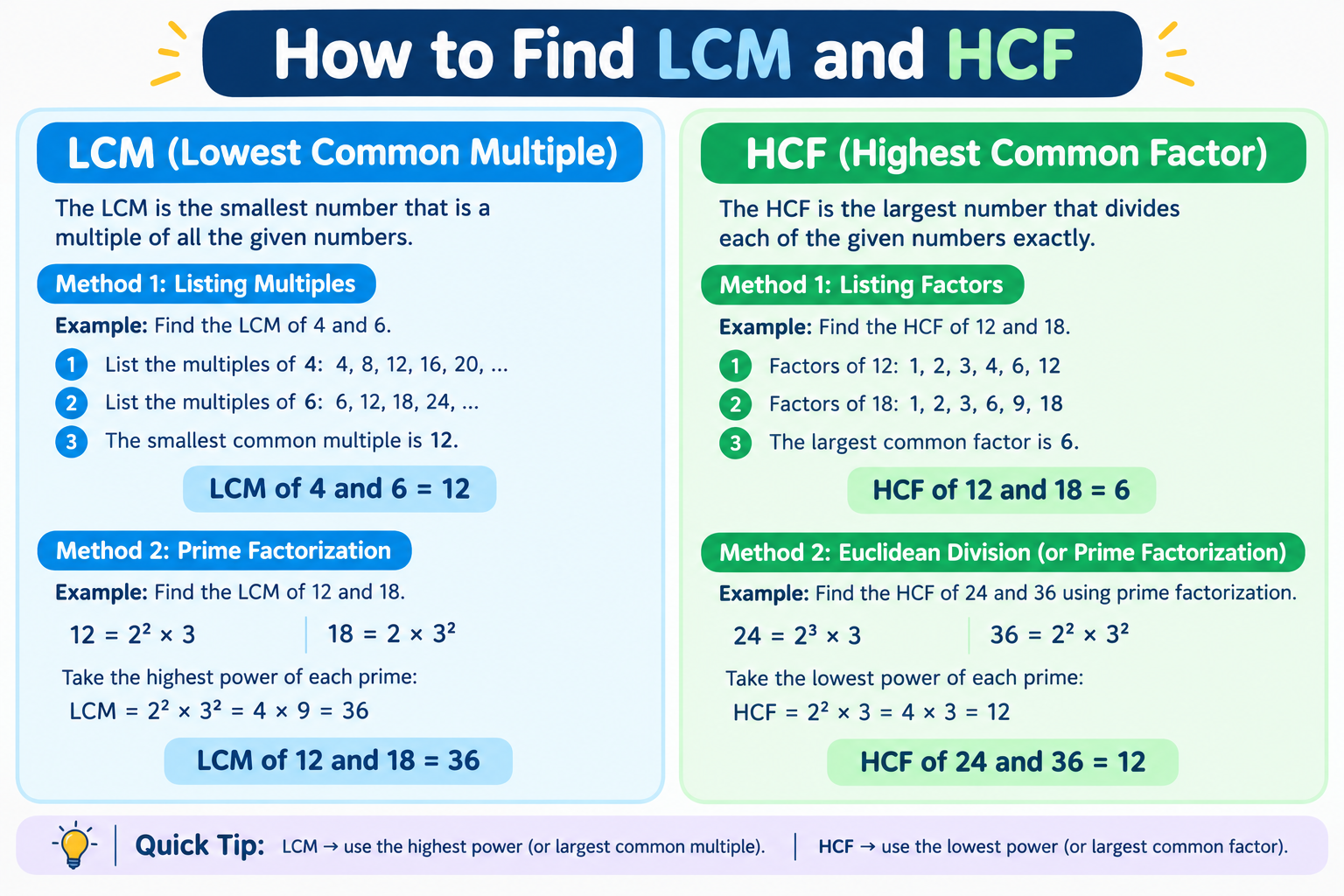
LCM is the smallest number that all your numbers divide into evenly.
Imagine two runners on a track. One finishes a lap every 4 minutes. The other finishes every 6 minutes. When will they cross the starting line together again? After 12 minutes. That’s the LCM of 4 and 6.
To understand LCM, you first need to understand multiples. Multiples are what you get when you keep counting by a number: 4, 8, 12, 16, and onward. They march on forever. If you want a refresher, this guide on what is a multiple in math walks through it with simple examples.
The LCM is simply the first multiple that two or more numbers share.
Want to see common multiples in action? The MathisFun LCM Guide has a clean visual model that makes it click.
HCF: The Biggest Sharer
HCF is the largest number that divides all your numbers perfectly. Some books call it GCD (Greatest Common Divisor). Same thing.
Picture 12 chocolates and 18 candies. You want to make identical gift bags with nothing left over. What’s the most bags you can make? 6 bags. That’s the HCF of 12 and 18.
LCM vs HCF at a Glance
| Feature | LCM | HCF |
|---|---|---|
| Meaning | Smallest common multiple | Largest common factor |
| Size | Always bigger than or equal to the numbers | Always smaller than or equal to the numbers |
| Think of it as | A meeting point | A sharing tool |
| Prime factors used | All primes, highest powers | Common primes, lowest powers |
| Typical word problems | “When will they meet again?” | “Largest equal groups?” |
Memorize that last row. It decodes half of all word problems.
The Golden Formula That Connects Them
Here’s the shortcut that saves countless exam minutes.
LCM × HCF = Product of the Two Numbers
This works for two numbers only. Not three. Remember that.
Example: Numbers 12 and 18.
- HCF = 6
- LCM = 36
- Check: 6 × 36 = 216
- Product: 12 × 18 = 216 ✓
Why This Formula Is a Lifesaver
Say a question gives you the HCF, the LCM, and one number. You need the other number.
Example: HCF of two numbers is 4. LCM is 60. One number is 12. Find the other.
- Product of both numbers = 4 × 60 = 240
- Other number = 240 ÷ 12 = 20
Done in seconds. No factorization needed.
Method 1: The Prime Factorization Method
This is the most dependable method. It never fails, even with big numbers.
The idea: break every number into prime building blocks. Then pick the right blocks.
Step-by-Step Rules
For LCM:
- Write each number as a product of primes.
- List every prime that appears.
- Take the highest power of each prime.
- Multiply them together.
For HCF:
- Write each number as a product of primes.
- List only the primes common to all numbers.
- Take the lowest power of each.
- Multiply them together.
Solved Example: Find the LCM and HCF of 12, 18, and 24
Step 1: Prime factorize each number.
- 12 = 2 × 2 × 3 = 2² × 3
- 18 = 2 × 3 × 3 = 2 × 3²
- 24 = 2 × 2 × 2 × 3 = 2³ × 3
Step 2: Find the LCM.
Highest power of 2 is 2³. Highest power of 3 is 3².
LCM = 2³ × 3² = 8 × 9 = 72
Step 3: Find the HCF.
Common primes are 2 and 3. Lowest power of 2 is 2¹. Lowest power of 3 is 3¹.
HCF = 2 × 3 = 6
Final Answer: LCM = 72 and HCF = 6
Quick sanity check. Does 72 divide evenly by 12, 18, and 24? Yes: 6, 4, and 3. Does 6 divide all three? Yes.
Pro Tip for Prime Factorization
Use a factor tree. Split a number into any two factors. Keep splitting until you only see primes. It’s visual, and it prevents silly mistakes.
Method 2: The Shortcut Division Method (L-Shape)
This is the fan favorite. Toppers love it. It’s fast, tidy, and works beautifully for three or more numbers.
You’ll also hear it called the ladder method or common division method.
How the L-Shape Works
- Write the numbers in a row.
- Draw an L-shaped line on the left.
- Divide by a prime number that goes into at least two of the numbers.
- Write each quotient below. If a number isn’t divisible, bring it down unchanged.
- Repeat until no prime divides two or more numbers.
Each step produces a quotient, which is simply the whole-number result of a division. If that term needs a refresher, here’s a simple explanation of what is a quotient in math.
Solved Example: LCM and HCF of 12, 18, and 24
2 | 12   18   24
  |-----------------
2 |  6    9   12
  |-----------------
3 |  3    9    6  ← wait, let's divide carefully
Let’s redo it cleanly, step by step.
Row 1: Divide by 2.
12 ÷ 2 = 6, 18 ÷ 2 = 9, 24 ÷ 2 = 12
Numbers now: 6, 9, 12
Row 2: Divide by 3.
6 ÷ 3 = 2, 9 ÷ 3 = 3, 12 ÷ 3 = 4
Numbers now: 2, 3, 4
Row 3: Divide by 2. Only 2 and 4 are divisible. Bring 3 down.
2 ÷ 2 = 1, 3 stays 3, 4 ÷ 2 = 2
Numbers now: 1, 3, 2
No prime divides two or more numbers now. Stop.
Reading the Results
For HCF: Multiply the divisors that divided all the numbers.
Rows 1 and 2 divided every number. Those divisors were 2 and 3.
HCF = 2 × 3 = 6
For LCM: Multiply all divisors and the remaining numbers.
LCM = 2 × 3 × 2 × 1 × 3 × 2 = 72
Final Answer: LCM = 72 and HCF = 6
Both methods agree. That’s a great sign.
Which Method Should You Pick?
| Situation | Best Method |
|---|---|
| Two small numbers | Mental tricks (see below) |
| Three or more numbers | L-Shape division |
| Large numbers | Prime factorization |
| Need to show full working | Prime factorization |
| Racing the clock in an exam | L-Shape division |
Exam Mental Tricks: Solve in 5 Seconds
Competitive exams reward speed. These tricks help you skip the paperwork.
Trick 1: The Multiples Climb (For LCM)
Take the bigger number. Keep checking its multiples until the smaller number divides one.
Example: LCM of 8 and 12.
- Multiples of 12: 12, 24 ← does 8 divide 24? Yes.
LCM = 24
Trick 2: The Factor Check (For HCF)
List the factors of the smaller number. Start from the largest. The first one that divides the other number wins.
Example: HCF of 18 and 27.
- Factors of 18, largest first: 18, 9…
- Does 18 divide 27? No. Does 9 divide 27? Yes.
HCF = 9
Trick 3: The Divisibility Shortcut
If the bigger number is a multiple of the smaller one:
- HCF = the smaller number
- LCM = the bigger number
Example: 5 and 20. Since 20 is a multiple of 5, HCF = 5 and LCM = 20.
Trick 4: The Co-Prime Shortcut
If two numbers share no common factor except 1 (they’re called co-prime):
- HCF = 1
- LCM = their product
Example: 7 and 9. HCF = 1. LCM = 7 × 9 = 63.
Trick 5: The Difference Trick (For HCF)
The HCF of two numbers always divides their difference. This narrows your search fast.
Example: HCF of 42 and 70. The difference is 28. Factors of 28: 1, 2, 4, 7, 14, 28. Test the largest ones. 14 divides both 42 and 70.
HCF = 14
Trick 6: The Consecutive Numbers Rule
For two consecutive numbers, they’re always co-prime. So LCM is just the product.
Example: 11 and 12. HCF = 1. LCM = 132.
Bonus: LCM and HCF of Fractions
This shows up often in aptitude tests. The rules are neat.
HCF of fractions = HCF of numerators ÷ LCM of denominators
LCM of fractions = LCM of numerators ÷ HCF of denominators
Important: Reduce each fraction to its simplest form first.
Solved Example: Find the HCF and LCM of 2/3 and 4/9
Both fractions are proper fractions, meaning the numerator is smaller than the denominator. If you’d like a quick review, check out this guide on what is a proper fraction.
HCF:
- HCF of numerators (2, 4) = 2
- LCM of denominators (3, 9) = 9
- HCF = 2/9
LCM:
- LCM of numerators (2, 4) = 4
- HCF of denominators (3, 9) = 3
- LCM = 4/3
Quick Real-Life Word Problems
Problem 1: Two bells ring every 10 and 15 minutes. If they ring together at 8:00 AM, when will they ring together next?
This is an “again together” question, so use LCM. LCM of 10 and 15 = 30. They ring together at 8:30 AM.
Problem 2: A tailor has 24 meters of red cloth and 36 meters of blue cloth. He wants the longest equal pieces with no waste. What length should each piece be?
This is a “largest equal pieces” question, so use HCF. HCF of 24 and 36 = 12. Each piece is 12 meters.
Common Mistakes to Avoid
- Mixing up the words. LCM = “meet again.” HCF = “split equally.”
- Using the formula for three numbers. LCM × HCF = Product works for two numbers only.
- Taking the wrong powers. LCM uses the highest. HCF uses the lowest.
- Skipping the check. Always confirm your LCM divides cleanly by each number.
Practice Makes It Permanent
Reading helps. Doing helps more.
Try these on your own:
- Find the LCM and HCF of 15 and 25.
- Find the LCM and HCF of 16, 24, and 40.
- The HCF of two numbers is 8 and their LCM is 96. If one number is 24, find the other.
Answers: (1) LCM 75, HCF 5. (2) LCM 240, HCF 8. (3) 32.
Want more? The Khan Academy Factors and Multiples section offers interactive practice with instant feedback. It’s excellent for building speed on common divisors.
Final Thoughts
LCM and HCF come down to a handful of habits. Know the difference. Pick the right method. Use the mental tricks when time is tight.
Start with prime factorization to build your foundation. Move to the L-Shape method for speed. Then sprinkle in the shortcuts.
Practice a few problems every day. Soon, you won’t need the steps. You’ll just see the answer.
You’ve got this.
📌 Educational Disclaimer
This guide is provided for general informational and academic learning purposes only. It is not a substitute for professional instruction, formal coursework, or personalized tutoring. While every effort has been made to ensure accuracy, learners are encouraged to verify results and consult a qualified teacher or official curriculum materials for specific academic or examination requirements.