

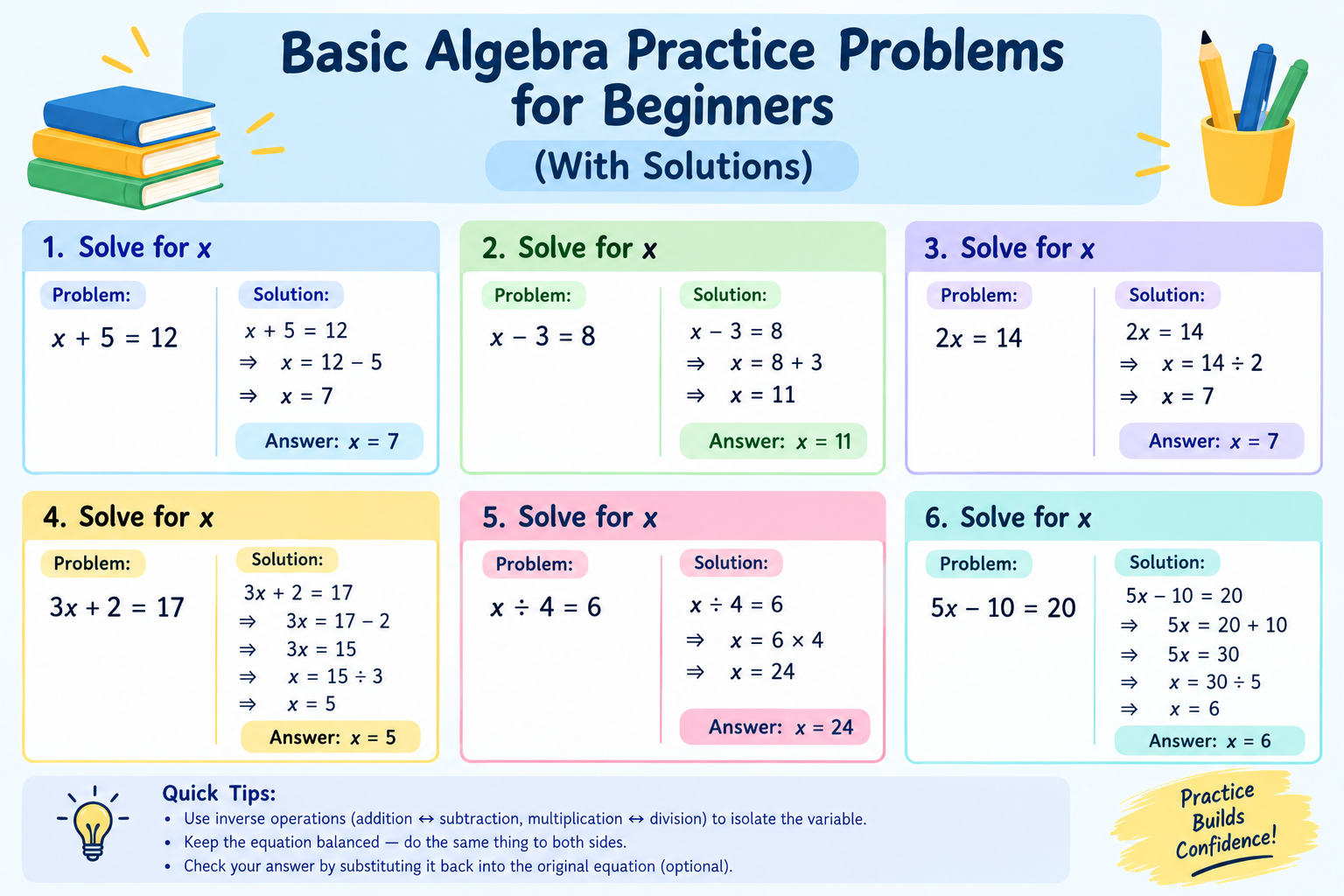
Algebra has a reputation. People hear the word and picture a wall of letters and numbers that makes no sense.
Here’s the truth. Algebra is just a puzzle. You have a mystery number, and your job is to find it.
You don’t need to be a “math person” for this. You need a few simple rules and some honest practice. That’s what this guide gives you.
Whether you’re in middle school, starting high school, or picking math back up as an adult, you’re in the right place. We’ll start easy and build up slowly. By the end, you’ll solve equations with confidence.
Grab a pencil and some scratch paper. Try each problem before you peek at the solution. That’s where the learning happens.
Practice Sheet Overview
| Detail | Info |
|---|---|
| Topic | Introductory Algebra |
| Skill Level | Beginner |
| Number of Problems | 10 Solved Problems |
| Core Concepts Tested | One-step equations, two-step equations, variables on both sides, inverse operations, balancing equations, checking answers |
| Estimated Time | 30 to 45 minutes |
| What You Need | Pencil, paper, and a positive attitude |
Before You Start: The Golden Rule of Algebra
Every equation is a balanced scale. Whatever you do to one side, you must do to the other.
Add 5 to the left? Add 5 to the right. Divide the right by 3? Divide the left by 3. The scale stays level.
Your goal is always the same: get the variable alone on one side. We call this isolating the variable.
To do that, you use inverse operations. These are opposites that cancel each other out:
- Addition undoes subtraction.
- Subtraction undoes addition.
- Multiplication undoes division.
- Division undoes multiplication.
Want a quick refresher on the rules behind all this? The MathisFun Algebra Basics guide explains the fundamentals in plain, friendly language. It’s a great companion to this sheet.
Ready? Let’s go.
Level 1 – Single-Step Equations
These equations need just one move. Think of them as your warm-up. Don’t rush. Build the habit of writing every step.
Problem 1: Addition Equation
Solve for x: x + 5 = 12
<details> <summary>👉 Click to reveal the solution</summary>
Step 1: Look at what’s happening to x. Someone added 5 to it.
Step 2: Undo it by subtracting 5 from both sides.
x + 5 − 5 = 12 − 5
Step 3: Simplify.
x = 7
Step 4: Check your work. Plug 7 back in: 7 + 5 = 12. ✓
Final Answer: x = 7
</details>
Problem 2: Subtraction Equation
Solve for x: x − 9 = 4
<details> <summary>👉 Click to reveal the solution</summary>
Step 1: Here, 9 was subtracted from x.
Step 2: Undo it by adding 9 to both sides.
x − 9 + 9 = 4 + 9
Step 3: Simplify.
x = 13
Step 4: Check. 13 − 9 = 4. ✓
Final Answer: x = 13
</details>
Problem 3: Multiplication Equation
Solve for x: 3x = 18
<details> <summary>👉 Click to reveal the solution</summary>
Step 1: The expression 3x means “3 times x.” So x is being multiplied by 3.
Step 2: Undo multiplication with division. Divide both sides by 3.
3x ÷ 3 = 18 ÷ 3
Step 3: Simplify.
x = 6
Notice that 18 ÷ 3 gives a clean whole number. That result is called a quotient. If that word feels fuzzy, this simple guide on what is a quotient in math breaks it down with easy examples.
Step 4: Check. 3 × 6 = 18. ✓
Final Answer: x = 6
</details>
Problem 4: Division Equation
Solve for x: x ÷ 4 = 7 (you may also see this written as x/4 = 7)
<details> <summary>👉 Click to reveal the solution</summary>
Step 1: x is being divided by 4.
Step 2: Undo division with multiplication. Multiply both sides by 4.
(x/4) × 4 = 7 × 4
Step 3: Simplify.
x = 28
Step 4: Check. 28 ÷ 4 = 7. ✓
Final Answer: x = 28
</details>
Coach’s note: Did you get all four? Great. If one tripped you up, that’s normal. Redo it on a fresh sheet and watch which step slips. Most mistakes come from using the wrong inverse operation.
Level 2 – Two-Step Equations
Now we raise the bar. These equations need two moves instead of one.
Here’s the trick. Undo addition or subtraction first. Then undo multiplication or division. Think of it like unwrapping a gift. You remove the ribbon before you open the box.
Problem 5: Classic Two-Step
Solve for x: 2x + 4 = 14
<details> <summary>👉 Click to reveal the solution</summary>
Step 1: Spot the “+ 4.” Remove it first by subtracting 4 from both sides.
2x + 4 − 4 = 14 − 4
2x = 10
Step 2: Now x is multiplied by 2. Divide both sides by 2.
2x ÷ 2 = 10 ÷ 2
x = 5
Step 3: Check. 2(5) + 4 = 10 + 4 = 14. ✓
Final Answer: x = 5
</details>
Problem 6: Two-Step with Subtraction
Solve for x: 4x − 7 = 21
<details> <summary>👉 Click to reveal the solution</summary>
Step 1: Remove the “− 7” by adding 7 to both sides.
4x − 7 + 7 = 21 + 7
4x = 28
Step 2: Divide both sides by 4.
x = 28 ÷ 4
x = 7
Step 3: Check. 4(7) − 7 = 28 − 7 = 21. ✓
Final Answer: x = 7
</details>
Problem 7: Two-Step with a Fraction Answer
Solve for x: 5x + 2 = 5 + 1… wait, let’s keep it clean. Solve for x: 4x + 1 = 4
<details> <summary>👉 Click to reveal the solution</summary>
Step 1: Subtract 1 from both sides.
4x + 1 − 1 = 4 − 1
4x = 3
Step 2: Divide both sides by 4.
x = 3/4
Surprise! The answer isn’t a whole number. And that’s perfectly fine. Since 3 is smaller than 4, this is a proper fraction. Not sure what that means? Here’s a clear walkthrough of what is a proper fraction with plenty of examples.
Step 3: Check. 4(3/4) + 1 = 3 + 1 = 4. ✓
Final Answer: x = 3/4
</details>
Coach’s note: Don’t panic when answers aren’t whole numbers. Plenty of correct answers are fractions or decimals. A tidy answer is nice. A correct answer is better.
Level 3 – Equations with Variables on Both Sides
This is the boss level. The variable now shows up on both sides of the equals sign.
Your game plan is simple:
- Collect the variables. Move all the x terms to one side.
- Collect the numbers. Move all the plain numbers to the other side.
- Solve like a regular one- or two-step equation.
Before you start, it helps to simplify each side as much as you can. Combining like terms is a lot like finding common ground, similar to how you’d spot patterns when you learn what a multiple in math is and list numbers that share a factor. Tidy expressions make the whole process smoother.
Problem 8: The Standard Version
Solve for x: 5x − 3 = 2x + 9
<details> <summary>👉 Click to reveal the solution</summary>
Step 1: Collect the variables. Subtract 2x from both sides.
5x − 2x − 3 = 2x − 2x + 9
3x − 3 = 9
Step 2: Collect the numbers. Add 3 to both sides.
3x − 3 + 3 = 9 + 3
3x = 12
Step 3: Isolate x. Divide both sides by 3.
x = 12 ÷ 3
x = 4
Step 4: Check. Left side: 5(4) − 3 = 20 − 3 = 17. Right side: 2(4) + 9 = 8 + 9 = 17. Both sides match. ✓
Final Answer: x = 4
</details>
Problem 9: Variable Bigger on the Right
Solve for x: 3x + 8 = 7x − 12
<details> <summary>👉 Click to reveal the solution</summary>
Step 1: Move the smaller x term. Subtract 3x from both sides.
8 = 4x − 12
Step 2: Add 12 to both sides.
20 = 4x
Step 3: Divide both sides by 4.
5 = x
Step 4: Check. Left: 3(5) + 8 = 23. Right: 7(5) − 12 = 35 − 12 = 23. ✓
Final Answer: x = 5
Pro tip: Subtracting the smaller variable term keeps your x positive. It’s not required, but it saves you from messy negatives.
</details>
Problem 10: Simplify First, Then Solve
Solve for x: 2x + 3x + 4 = x + 20
<details> <summary>👉 Click to reveal the solution</summary>
Step 1: Combine like terms on the left side.
2x + 3x = 5x, so the equation becomes:
5x + 4 = x + 20
Step 2: Subtract x from both sides.
4x + 4 = 20
Step 3: Subtract 4 from both sides.
4x = 16
Step 4: Divide both sides by 4.
x = 4
Step 5: Check. Left: 2(4) + 3(4) + 4 = 8 + 12 + 4 = 24. Right: 4 + 20 = 24. ✓
Final Answer: x = 4
</details>
Common Mistakes (And How to Dodge Them)
Every learner makes these. Knowing them ahead of time gives you a head start.
- Changing only one side. Always do the same thing to both sides.
- Using the wrong inverse. Subtract to undo addition. Divide to undo multiplication.
- Forgetting negative signs. Slow down and write them out.
- Skipping the check. Plugging your answer back in takes ten seconds. It catches nearly every error.
Where to Go Next
You just solved ten equations. That’s real progress.
Keep the momentum going with these steps:
- Redo the problems you missed. Wait a day, then try them again from scratch.
- Make your own. Pick an answer like x = 6, then build an equation that leads to it. This is a surprisingly powerful way to learn.
- Practice daily. Even ten minutes beats a two-hour cram session.
- Try interactive exercises. The Khan Academy Linear Equations Practice section gives instant feedback and hints, which is perfect for locking in what you’ve learned.
You’ve Got This
Algebra isn’t about being fast or “naturally gifted.” It’s about patience, good habits, and showing up for the practice.
Every equation you solve builds a little more confidence. Keep your steps neat. Check your answers. Celebrate the wins, even the small ones.
You started with x + 5 = 12. You finished with variables on both sides. That’s growth.
Keep going. You’re doing great.
Educational Disclaimer
This practice guide is provided for general informational and academic self-improvement purposes only. It is not a substitute for professional instruction, formal coursework, or personalized tutoring. While every effort has been made to ensure accuracy, learners are encouraged to verify solutions and consult a qualified teacher or official curriculum materials for specific academic requirements.