

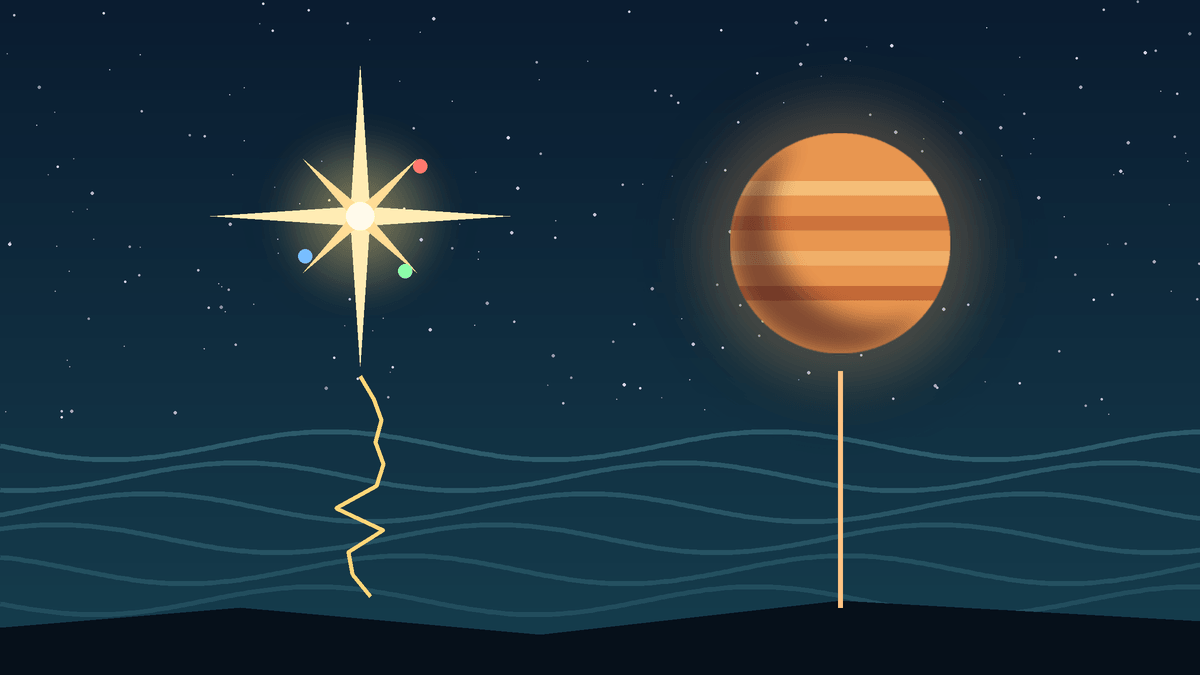
Pick a clear night and find two bright dots, one high in the sky and one a little lower. Watch each for half a minute. One of them may shiver, flash and even change color. The other just sits there, calm and steady.
Here is the short version of why do stars twinkle but planets don’t: stars look like single points of light, so every wobble in our air pushes them around, while planets look like tiny disks, and their many points of light average out into a steady glow.
That one idea (point versus disk) explains almost everything. Once you get it, you can use it to tell a planet from a star without any app or telescope.
In this guide you’ll learn what really causes twinkling, why size matters more than brightness, a simple number experiment that shows the effect, and a quick checklist for your next look at the night sky.
Quick Info
| Topic | Detail |
|---|---|
| Short answer | Moving air bends starlight; stars are points, so they flicker, while planets are tiny disks, so the flicker averages out |
| Science name | Scintillation (from a Latin word meaning “to sparkle”) |
| Main cause | Pockets of warm and cool air in Earth’s atmosphere |
| Why planets stay steady | They can look hundreds to about 1,500 times wider than even a big-looking star |
| Best place to see strong twinkling | Bright stars low near the horizon |
| Common mistake | Thinking stars really switch on and off |
| Reading time | About 12 minutes |
Why Do Stars Twinkle? The Simple Answer
Stars twinkle because their light passes through Earth’s moving, uneven air, which bends the light a tiny bit in a new direction many times each second.
The star itself is shining steadily. The flicker is added in the last few miles of a trip that may have lasted hundreds of years.
Our atmosphere is not one smooth, clear layer. It’s full of pockets and streams of air at different temperatures. Warm air is less dense than cool air, and light bends slightly when it crosses from one to the other. This bending is called refraction.
Each air pocket acts like a very weak, wobbly lens. As wind pushes these pockets across your line of sight, the starlight gets nudged left, right, brighter and dimmer. Your eye sees the result as twinkling.
You have probably seen the same effect on a hot day. Look across a sunbaked parking lot or road, and the cars in the distance seem to ripple. That’s hot air rising and bending light on its way to you. Twinkling is the nighttime, high-altitude version of that shimmer.
If you’ve read our guide on why the sky is blue, you already know that air does more than just let light pass through. It scatters sunlight by day and bends starlight by night.
What scintillation means
Astronomers call twinkling scintillation. It means quick changes in an object’s brightness, position and sometimes color, caused by the air between you and the object.
Britannica sums it up the same way: the star’s light isn’t changing, and the effect comes from shifts in the temperature and density of air flowing high above the ground.
Britannica’s explainer on why stars twinkle also notes that planets usually don’t twinkle because they look like small disks rather than points.
Do stars twinkle in space?
No. Above the atmosphere there is no moving air to bend the light, so stars shine as steady points.
That’s a big reason telescopes such as Hubble were launched into orbit. From up there, they get sharp, still views that ground telescopes can only get on the calmest nights.
Why Don’t Planets Twinkle? It’s About Size, Not Brightness
Many people guess that planets don’t twinkle because they’re brighter. That’s not the real reason. Some stars, like Sirius, are very bright and still twinkle like crazy.
The real reason is how big each object looks from Earth.
Stars are points, planets are tiny disks
Stars are huge, but they are so far away that even the biggest-looking ones are almost pure points. Sky sizes are measured in arcseconds. One arcsecond is 1/3,600 of a degree, and the full Moon spans roughly 1,800 arcseconds.
Betelgeuse, the red star in Orion’s shoulder, is one of the largest-looking stars in the whole sky. When it was first measured in 1920, it came out at only about 0.044 arcseconds wide.
That figure comes from the American Association of Variable Star Observers (AAVSO), which describes the first measurement of a star’s width, made with a special instrument at Mount Wilson.
Planets are much smaller than stars, but they are millions of times closer. That makes them look far wider. NASA lists Jupiter at about 30 to 50 arcseconds wide as seen from Earth.
You can check the numbers on NASA’s Jupiter Fact Sheet, which gives Jupiter’s apparent diameter at its closest and farthest from Earth.
Venus can look even bigger, about 10 to 66 arcseconds wide depending on where it is in its orbit.
Those Venus figures are on NASA’s Venus Fact Sheet, from the same NASA planetary data team.
Here’s how those sizes compare:
| Object | How wide it looks (arcseconds) | Compared with Betelgeuse |
|---|---|---|
| Betelgeuse (a very large-looking star) | about 0.044 | 1x |
| Jupiter | 30.5 to 50.1 | about 690x to 1,140x wider |
| Venus | 9.7 to 66.1 | about 220x to 1,500x wider |
| Most other stars | far smaller than 0.044 | even more point-like |
Your eye can’t see Jupiter’s disk without help, so it still looks like a dot. But the light is coming from a patch of sky hundreds of times wider than a star’s, and the air treats it very differently.
The stadium of phone lights
Imagine one person in a dark stadium holding up a phone flashlight. If someone walks in front of them, or they wave their arm, you see the light blink and jump. That’s a star.
Now imagine 1,000 people in one section all holding up their lights. People still walk in front of some of them, and arms still wave. But at any moment, most lights are shining toward you, so the section’s total glow barely changes. That’s a planet.
Every tiny part of a planet’s disk is twinkling, just like a star. The parts twinkle at different moments, though, so the dips and flashes cancel out. What reaches your eye is close to the mean, or average, of all those flickering points, and an average of many changing numbers is far steadier than any single one.
Worked Example: Why Many Points Make a Steady Light
Let’s test the stadium idea with numbers. This is a simple, illustrative model, not a real measurement of the sky, but it shows exactly why size matters.
Step 1: Give one point a random brightness
Pretend that turbulent air makes a single point of light jump to a random brightness between 0 (blocked) and 2 (doubled) every instant. On average it shines at 1, but any one moment could be anything in that range.
Step 2: Take 10 snapshots of a “star”
A star is one point, so each snapshot is just one random brightness. We ran this with a computer and got the values in the middle column below. They swing from 0.07 to 1.30.
Step 3: Build a “planet” from 1,000 points
A planet is a disk made of many points. For each snapshot, we picked 1,000 random brightnesses and averaged them. Those results are in the right column. They stay between 0.97 and 1.03.
| Snapshot | Star (1 point) | Planet (average of 1,000 points) |
|---|---|---|
| 1 | 0.65 | 0.97 |
| 2 | 0.30 | 1.00 |
| 3 | 1.30 | 0.97 |
| 4 | 0.14 | 1.02 |
| 5 | 1.07 | 0.99 |
| 6 | 0.73 | 0.98 |
| 7 | 0.12 | 1.01 |
| 8 | 1.01 | 0.99 |
| 9 | 0.07 | 1.01 |
| 10 | 0.87 | 1.03 |
Step 4: Compare how much each one wobbles
A handy way to measure wobble is the standard deviation, which tells you how far values typically sit from their average.
- Star: standard deviation of about 0.42
- Planet: standard deviation of about 0.019
The planet is roughly 20 times steadier in this run. Statisticians have a rule for this:
spread of the average ≈ spread of one point ÷ √NHere, N is the number of points being averaged, and √N means its square root. With N = 1,000, √N is about 31.6, so the planet’s flicker shrinks to around one thirty-second of a single point’s. A real planet’s disk holds far more than 1,000 “points,” so the smoothing is even stronger.
That’s the whole secret in one line: more points, less twinkle.
What Makes Stars Twinkle More or Less?
Twinkling isn’t the same every night, or even everywhere in the sky on the same night. These are the main things that change it.
| Factor | More twinkling | Less twinkling |
|---|---|---|
| Height in the sky | Stars near the horizon (their light crosses much more air) | Stars high overhead |
| Air movement | Windy nights, or air with warm and cool layers mixing | Calm, settled air |
| Object size | Point-like stars | Planets and the Moon |
| Your location | Low ground near heat sources like rooftops and pavement | High, dry sites (where big observatories are built) |
| How you look | Bright stars low in the sky can flash red, green and blue | Any object seen from space |
That color flashing has a simple cause. Air bends blue light slightly more than red light. Near the horizon, where starlight passes through a long slab of air, the colors get split and shuffled, so a bright star like Sirius can seem to flash like a tiny disco ball.
Britannica also points out that even a planet can twinkle a little when it sits very low on the horizon, because its light has so much churning air to cross.
How to Tell a Star From a Planet Tonight
The twinkle test works best when you combine it with a few other clues. Use this checklist on any bright dot you’re unsure about.
| Clue | Usually a star | Usually a planet |
|---|---|---|
| Twinkle (when fairly high in the sky) | Flickers and sparkles | Shines steadily |
| Brightness | Bright, but even Sirius (the brightest star) is outshone by Venus and Jupiter | Venus and Jupiter often outshine every star |
| Where it sits | Anywhere in the sky | Close to the path the Sun and Moon follow |
| Night-to-night change | Same spot among the stars all year | Slowly shifts against the stars over weeks |
| Through binoculars | Still a sharp point | A tiny round disk (Jupiter may show small dots beside it, its moons) |
A good rule of thumb: if a dot is high up, very bright and calm, it’s probably a planet. If it’s low and flashing colors, it’s probably a star, even if it’s very bright.
The Moon follows the same rule as planets, only more so. It’s so wide in our sky that it never twinkles at all, though it does change shape through the month. Our guide on why the Moon changes its shape explains those phases.
Common Myths About Twinkling
| Myth | Reality |
|---|---|
| Stars flicker because they are burning unevenly | The star shines steadily; Earth’s air adds the flicker |
| Planets don’t twinkle because they’re brighter | Size is the reason; bright stars like Sirius still twinkle hard |
| Planets never twinkle | A planet very low on the horizon can twinkle slightly |
| A twinkling star is about to explode | Twinkling says nothing about a star’s age or health |
| Astronauts see twinkling stars too | Above the atmosphere, stars look like steady points |
| Blinking airplane lights are twinkling | Aircraft lights really switch on and off; they also move across the sky |
Why Astronomers Care About Twinkling
For stargazers, twinkling is pretty. For astronomers, it’s a headache.
The same air that makes stars sparkle also blurs and shakes images in a telescope. Astronomers call the steadiness of the air “seeing.” Good seeing means sharp views; bad seeing means a planet looks like it’s sitting at the bottom of a swimming pool.
That’s why big observatories are built on high, dry mountaintops with less air above them. Some modern telescopes even use flexible mirrors that reshape themselves hundreds of times per second to undo the air’s wobble, a method called adaptive optics. And for the sharpest views of all, telescopes go to space, where there is no air to twinkle.
Frequently Asked Questions
Does the Sun twinkle?
Not in any way you’d notice. The Sun is a star, but it’s so close that it looks about as wide as the full Moon, a huge disk compared with any other star. Its light comes from countless points, so the flicker averages out completely. Its edge can ripple slightly when it’s low on the horizon. Never look directly at the Sun, even when it’s setting.
Does the Moon twinkle?
No. The Moon spans roughly half a degree of sky, about 1,800 arcseconds, which is tens of thousands of times wider than a star looks. Air still bends its light, and through a telescope you may see its edge shimmer. To the naked eye, though, the Moon shines steadily because millions of tiny wobbles average into one smooth glow.
Why do stars flash different colors when they twinkle?
Air bends blue light a little more than red light. When starlight crosses a lot of air, mostly near the horizon, the colors get separated and shuffled by moving air pockets. For an instant your eye catches more blue, then more red or green. That’s why a bright, low star like Sirius can seem to sparkle in rainbow colors on a clear winter night.
Can a planet ever twinkle?
Yes, a little. When a planet sits very low near the horizon, its light passes through so much turbulent air that even its tiny disk can’t fully smooth things out. Small planets that look tiny in our sky, like Mercury or a far-off Mars, are more likely to show some flicker. Higher up, planets almost always shine steadily.
Why do stars twinkle more on some nights?
Twinkling depends on how much the air above you is churning. Nights with strong winds high up, or with layers of warm and cool air mixing, produce more twinkling. Calm, settled nights produce steadier stars. Astronomers actually prefer the calm nights, because steady air gives sharper telescope views of the Moon and planets.
Would stars twinkle if you stood on the Moon?
No. The Moon has almost no atmosphere, so nothing bends starlight on its way to your eyes. Stars would look like sharp, steady points against a black sky. The same is true for astronauts in orbit and for space telescopes. Twinkling is a gift, or a nuisance, that comes only with living under a blanket of air.
Conclusion
Stars twinkle because their light crosses Earth’s restless air, and a single point of light gets shoved around by every passing air pocket. Planets look like tiny disks, so their light comes from many points at once, and all that flicker averages into a steady shine. Brightness has little to do with it; apparent size is the key.
Next time you see a bright dot in the sky, ask yourself one question: is it a point or a crowd? If it’s calm and high up, you’re probably looking at a whole world in our solar system.
References
- Encyclopaedia Britannica, “Why Do Stars Twinkle?”, britannica.com
- NASA Goddard Space Flight Center (NSSDCA), “Jupiter Fact Sheet”, last updated 2 October 2024, nssdc.gsfc.nasa.gov
- NASA Goddard Space Flight Center (NSSDCA), “Venus Fact Sheet”, last updated 11 January 2024, nssdc.gsfc.nasa.gov
- American Association of Variable Star Observers (AAVSO), “Alpha Orionis (Betelgeuse)”, Variable Star of the Month, aavso.org
Disclaimer
This article is for general educational purposes only. The brightness values in the worked example come from a simple illustrative computer model, not real sky measurements. Never look directly at the Sun, with or without binoculars or a telescope. For observing advice, contact a local astronomy club or planetarium.