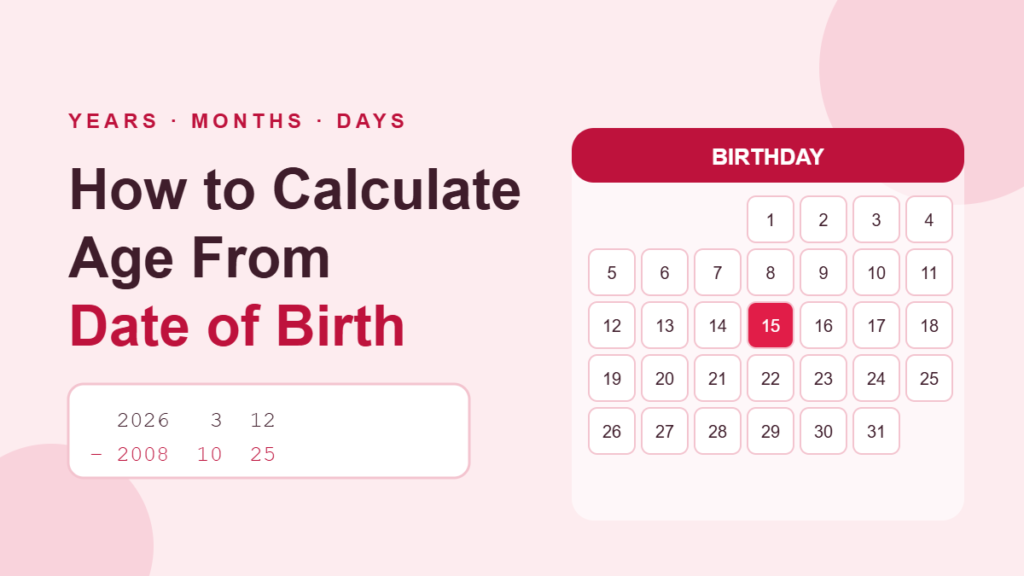
Most forms just want a whole number: “Age: 17.” But some ask for more. A school cutoff might need your age in years and months, a visa form might ask for your exact age on a specific date, and a curious kid might want to know how many days old they are. To calculate age from date of birth accurately, you need a method that handles months of different lengths and the odd leap year.
The good news: it’s simple subtraction with one twist, called borrowing. Once you see it laid out in columns, you can do it on paper in under a minute.
This guide walks through three methods (quick, exact and total days), a full worked example, the tricky cases like February 29 birthdays, and how age is counted differently around the world.
Quick Info
| Topic | Detail |
|---|---|
| Short answer | Subtract the birth date from today’s date, year, month and day, borrowing when needed |
| Quick rule | Current year − birth year, minus 1 if the birthday hasn’t happened yet this year |
| Exact age | Years, months and days, using column subtraction |
| Hardest part | Borrowing days when the day number is smaller |
| Leap-day birthdays | Usually celebrated on February 28 or March 1 in common years |
| Common mistake | Forgetting to check whether this year’s birthday has passed |
| Reading time | About 9 minutes |
Method 1: The Quick Way (Whole Years Only)
Your age in whole years is the current year minus your birth year, minus one more if your birthday hasn’t arrived yet this year.
Ask yourself one question: has my birthday happened yet this year?
- Yes: age = current year − birth year
- No: age = current year − birth year − 1
Someone born on October 25, 2008 is 17 on any date from October 25, 2025 to October 24, 2026. On March 12, 2026, 2026 − 2008 = 18, but the October birthday hasn’t come yet, so they’re 17.
That’s all most forms need. For exact age, keep going.
Method 2: Exact Age in Years, Months and Days
Write the two dates in columns, with the later date on top, and subtract from right to left, just like subtracting large numbers in school.
Step 1: Line up the dates
            Year   Month   Day
Today:      2026     3      12
Born:       2008    10      25
Step 2: Subtract the days (borrow if needed)
The top day (12) is smaller than 25, so you can’t subtract yet. Borrow one month from the month column and add the number of days in the month before today’s month. Today is in March, so borrow February 2026, which has 28 days.
Day:   12 + 28 = 40        40 − 25 = 15 days
Month: 3 becomes 2
Step 3: Subtract the months (borrow if needed)
Now the top month (2) is smaller than 10. Borrow one year, which adds 12 months.
Month: 2 + 12 = 14         14 − 10 = 4 months
Year:  2026 becomes 2025
Step 4: Subtract the years
Year: 2025 − 2008 = 17 years
Step 5: Read the answer
The person is 17 years, 4 months and 15 days old on March 12, 2026.
| Column | Before borrowing | After borrowing | Result |
|---|---|---|---|
| Day | 12 − 25 | 40 − 25 | 15 |
| Month | 3 − 10 | 14 − 10 | 4 |
| Year | 2026 − 2008 | 2025 − 2008 | 17 |
Want to check your own birthday instantly? Our Age Calculator does this borrowing for you, and the interactive chart below shows each step.
Try It: See the Borrowing Step by Step
Change the dates to your own. The table shows the subtraction column by column, including any borrowing, and the bar below shows your life in years with the current partial year highlighted.
| Year | Month | Day |
|---|
Method 3: Age in Total Days
Sometimes you want one number, such as “6,347 days old.” The reliable way is to count:
- Full years: multiply the completed years by 365.
- Leap days: add 1 for every February 29 between the two dates.
- The rest: add the days from your last birthday to today.
For our example, born October 25, 2008 and counting to March 12, 2026:
17 full years × 365     = 6,205 days
Leap days (2012, 2016,
  2020, 2024)           = 4 days
Oct 25, 2025 → Mar 12, 2026 = 138 days
Total                   = 6,347 days
From there you can convert to weeks (6,347 ÷ 7 ≈ 906 weeks) or hours (6,347 × 24 = 152,328 hours). This is also how you find fun milestones, like the day you turn 10,000 days old, which happens a little after your 27th birthday.
Why leap years matter
A year isn’t exactly 365 days. NASA’s Jet Propulsion Laboratory explains that Earth takes about 365.2422 days to orbit the Sun, which is why the calendar adds a leap day roughly every four years. Years divisible by 100 skip the leap day unless they’re also divisible by 400.
NASA JPL: Doing the Math on Why We Have Leap Day
So the year 2000 had a February 29, but 1900 didn’t, and 2100 won’t. If you’re counting days across those century years, the rule matters. Our Day of the Week Calculator also tells you whether any year is a leap year.
Tricky Cases
Born on February 29
People born on a leap day (sometimes called “leaplings”) only see their real birthday every four years. In common years, most celebrate on February 28 or March 1. Calculators differ too: many treat February 28 as the birthday in a common year, so a person born February 29, 2004 turns 22 on February 28, 2026. For legal purposes, rules vary by country and state, so check the official source when it matters.
Born at the end of a month
Months have 28 to 31 days, so “one month after January 31” is fuzzy: there’s no February 31. Different calculators handle this slightly differently, which is why two tools can disagree by a day in the months-and-days part. The years and the total number of days never disagree.
Which month do you borrow from?
The standard method, used above, borrows the length of the month just before the later date. It matches how most people count: from October 25 to February 25 is 4 months, then you count the extra days in the next month.
How Age Is Counted Around the World
The method above is the “international age” used almost everywhere. A few cultures have traditionally counted differently. South Korea’s old system counted a baby as one year old at birth and added a year to everyone each January 1. On June 28, 2023, the country officially switched to the international method, making many people a year or two younger overnight.
Al Jazeera: South Koreans become younger after age counting method changed
| System | Age at birth | When age goes up | Used today |
|---|---|---|---|
| International age | 0 | On each birthday | Almost everywhere |
| Traditional Korean age | 1 | Every January 1 | Phased out officially in 2023 |
Common Mistakes
| Mistake | Fix |
|---|---|
| Subtracting only the years | Check whether this year’s birthday has passed |
| Borrowing 30 days every time | Borrow the actual length of the previous month (28 to 31) |
| Ignoring leap days when counting total days | Add 1 day for each February 29 in the range |
| Putting the birth date on top | The later date always goes on top |
| Mixing up the date order (MM/DD vs DD/MM) | Write dates as year, month, day before you subtract |
Frequently Asked Questions
How do I calculate my exact age?
Write today’s date and your birth date as year, month and day, with today on top. Subtract days, then months, then years, borrowing a month’s worth of days or 12 months when the top number is smaller. The result is your age in years, months and days. An age calculator does the same steps instantly.
How do I calculate age in months?
Multiply your completed years by 12 and add the extra months. Someone who is 17 years and 4 months old is 17 × 12 + 4 = 208 months old. Doctors often use months for babies and toddlers because they change so quickly in the first two years.
How many days old am I?
Multiply your completed years by 365, add one for each February 29 since you were born, then add the days since your last birthday. For example, a person born October 25, 2008 is 6,347 days old on March 12, 2026.
What age is someone born on February 29 in a non-leap year?
They still age every year. Most people born on February 29 celebrate on February 28 or March 1 in common years, and many calculators count February 28 as their birthday. Official rules for legal age vary by place, so check local guidance when it matters.
Why do two age calculators give different answers?
Usually the years match but the months and days differ by one. That happens when the birth date is at the end of a month, because tools borrow days differently. The total number of days lived is the same in every correct calculator.
What is Korean age?
It was a traditional method where a baby is counted as one year old at birth and everyone gains a year on January 1. South Korea officially adopted international age counting on June 28, 2023, so most official ages there now match the rest of the world.
Conclusion
Calculating age from a date of birth comes down to careful subtraction. For a quick answer, subtract the years and take one away if the birthday hasn’t arrived. For an exact answer, subtract days, months and years in columns, borrowing the real length of the previous month and 12 months when needed. For a single number, count the days and remember the leap years.
The one question to always ask first: has the birthday happened yet this year? Get that right, and every other step falls into place.
References
- NASA Jet Propulsion Laboratory, “Doing the Math on Why We Have Leap Day,” jpl.nasa.gov
- Al Jazeera, “S Koreans become younger after age counting method changed,” June 28, 2023, aljazeera.com
Disclaimer
This article is for general educational purposes only. The dates in the worked example are illustrative. For legal, medical or official age requirements, follow the rules of the relevant authority.