

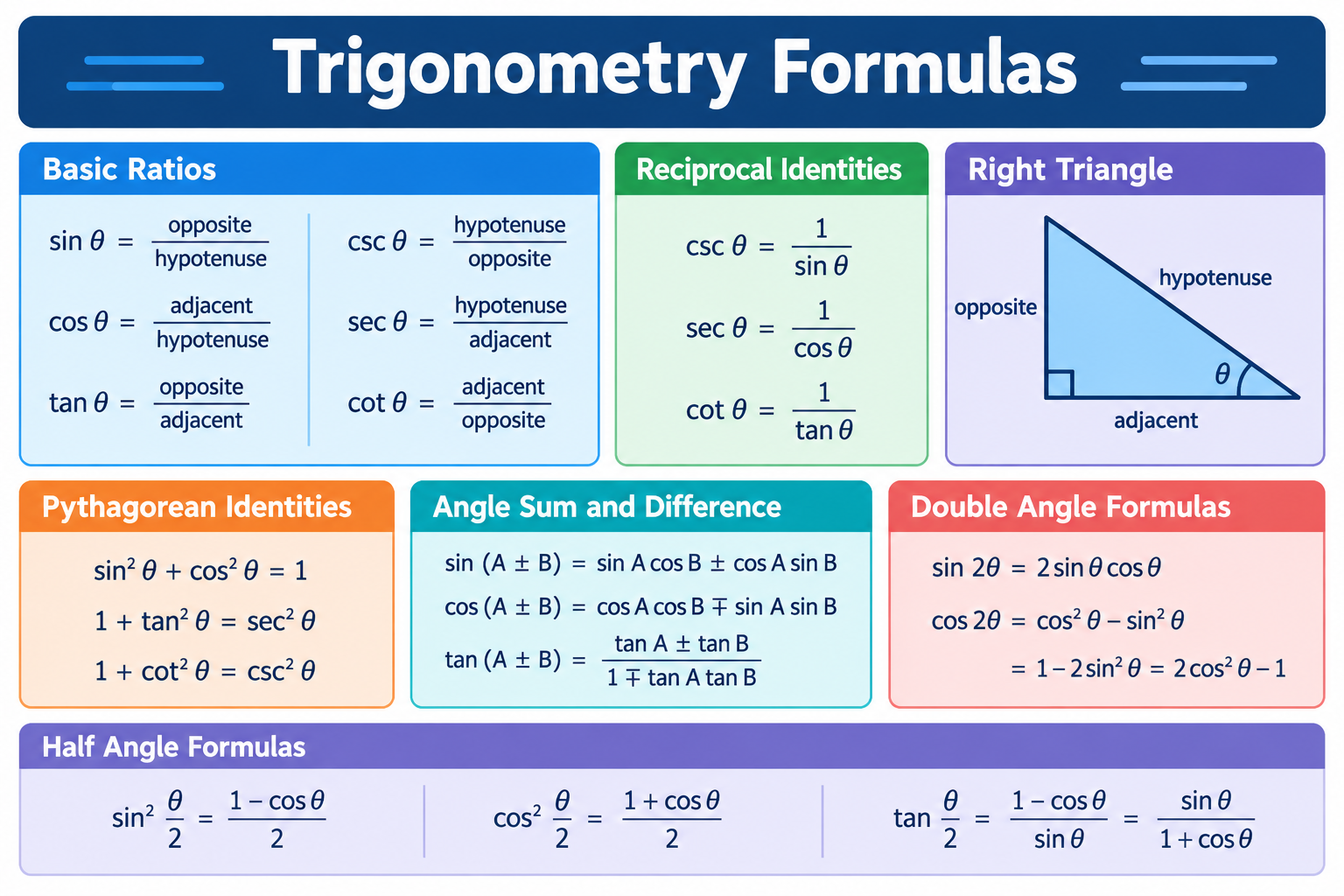
Trigonometry has a reputation. Students hear the word and picture endless pages of sin, cos, and tan scribbled in confusing patterns.
Here’s the truth. Trigonometry is built on a handful of simple ideas. Learn the core ratios, understand where the identities come from, and the rest falls into place.
So what is trigonometry? It’s the study of the relationships between the side lengths and angles of triangles. The word itself comes from Greek: trigonon (triangle) and metron (measure). Engineers use it to design bridges. Pilots use it to navigate. Game developers use it to rotate characters on screen.
And it all starts with one memory trick: SOH-CAH-TOA.
-
SOH → Sine = Opposite ÷ Hypotenuse
-
CAH → Cosine = Adjacent ÷ Hypotenuse
-
TOA → Tangent = Opposite ÷ Adjacent
Say it out loud a few times. “Soh-cah-toa.” It sticks. This guide will walk you through every important formula built on top of it.
Trigonometry At a Glance
| Detail | Information |
|---|---|
| Subject | Advanced Mathematics (Trigonometry) |
| Core Ratios | Sine (sin), Cosine (cos), Tangent (tan) |
| Reciprocal Ratios | Cosecant (csc), Secant (sec), Cotangent (cot) |
| Fundamental Triangle | Right-Angled Triangle |
| Key Memory Trick | SOH-CAH-TOA |
| Angle Symbol | θ (theta) |
| Target Audience | High school students, college students, competitive exam takers |
Meet the Right-Angled Triangle
Every basic trig ratio comes from a right-angled triangle. One angle is exactly 90°. We pick one of the other angles and call it θ (theta).
Then we name the three sides relative to θ:
- Hypotenuse (H): The longest side. Always opposite the 90° angle.
- Opposite (O): The side directly across from θ.
- Adjacent (A): The side next to θ that isn’t the hypotenuse.
Important: “Opposite” and “adjacent” change depending on which angle you pick. The hypotenuse never changes.
Want to see this in action? The MathisFun Trigonometry Index has interactive triangle models where you can drag the corners and watch the sides and ratios update live.
Section 1: Fundamental Trigonometric Ratios
There are six trig ratios in total. Three are the main ones. Three are their flipped versions.
The Three Primary Ratios
sin θ = Opposite / Hypotenuse
cos θ = Adjacent / Hypotenuse
tan θ = Opposite / Adjacent
The Three Secondary Ratios
csc θ (cosecant) = Hypotenuse / Opposite
sec θ (secant)   = Hypotenuse / Adjacent
cot θ (cotangent)= Adjacent / Opposite
Look closely. Each secondary ratio is just a primary ratio turned upside down. That’s the whole secret behind Section 2.
Standard Angle Values You Should Know
Competitive exams love these. Memorize this table and you’ll save minutes on every test.
| Angle (θ) | 0° | 30° | 45° | 60° | 90° |
|---|---|---|---|---|---|
| sin θ | 0 | 1/2 | 1/√2 | √3/2 | 1 |
| cos θ | 1 | √3/2 | 1/√2 | 1/2 | 0 |
| tan θ | 0 | 1/√3 | 1 | √3 | Undefined |
Notice that sin(30°) = 1/2. The numerator is smaller than the denominator, so it’s a proper fraction. That isn’t a coincidence. In a right triangle, the hypotenuse is always the longest side. So sine and cosine values for acute angles always land between 0 and 1. If fractions like this still trip you up, read What Is a Proper Fraction? Examples Explained.
Memory hack: For sin, write √0/2, √1/2, √2/2, √3/2, √4/2 across 0° to 90°. Simplify, and you get the whole row. Cosine is the same row backwards.
Section 2: Reciprocal Identities and Quotient Identities
Identities are equations that are true for every valid angle. They’re your shortcuts. Use them to simplify messy expressions and prove results.
Reciprocal Identities
A reciprocal means “1 divided by the number.” These six identities link each ratio to its flipped partner.
csc θ = 1 / sin θ        sin θ = 1 / csc θ
sec θ = 1 / cos θ        cos θ = 1 / sec θ
cot θ = 1 / tan θ        tan θ = 1 / cot θ
Quick pairing trick: Each pair has exactly one “co-” in it.
- sin pairs with cosec
- cos pairs with sec
- tan pairs with cot
Quotient Identities
These two are powerful. They let you write tangent and cotangent using only sine and cosine.
tan θ = sin θ / cos θ
cot θ = cos θ / sin θ
Why does tan θ = sin θ ÷ cos θ? Let’s check it:
- sin θ = O/H
- cos θ = A/H
- (O/H) ÷ (A/H) = O/A = tan θ
The hypotenuse cancels out. What’s left is the quotient of sine divided by cosine, which is exactly tangent. New to the word “quotient”? Here’s a quick explainer: What Is a Quotient in Math? Simple Explanation.
Exam tip: When an expression looks impossible, rewrite everything in terms of sin and cos. It works surprisingly often.
Section 3: Pythagorean Trigonometric Identities
These come straight from the Pythagorean theorem: O² + A² = H².
Divide both sides by H², and you get the most famous identity in trigonometry.
The Big Three
sin²θ + cos²θ = 1
1 + tan²θ = sec²θ
1 + cot²θ = csc²θ
How to get the second one: Take sin²θ + cos²θ = 1 and divide every term by cos²θ.
How to get the third one: Take the same identity and divide every term by sin²θ.
So you really only need to memorize one. The other two can be derived in seconds.
Useful Rearranged Forms
You’ll see these all the time in proofs and simplifications:
sin²θ = 1 − cos²θ
cos²θ = 1 − sin²θ
sec²θ − tan²θ = 1
csc²θ − cot²θ = 1
Notation note: sin²θ means (sin θ)². It does not mean sin(θ²). A small detail, but it costs marks.
Section 4: Basic Co-Function and Sign Identities
Co-Function Identities
In a right triangle, the two non-right angles always add up to 90°. So the sine of one angle equals the cosine of the other.
sin(90° − θ) = cos θ       cos(90° − θ) = sin θ
tan(90° − θ) = cot θ       cot(90° − θ) = tan θ
sec(90° − θ) = csc θ       csc(90° − θ) = sec θ
Example: sin 30° = cos 60° = 1/2. Check the table above. It matches.
That’s actually where the “co” in cosine comes from. Cosine is the sine of the complementary angle.
Sign (Even–Odd) Identities
What happens when the angle is negative? Some functions flip their sign. Others don’t.
sin(−θ) = −sin θ     (odd)
cos(−θ) =  cos θ     (even)
tan(−θ) = −tan θ     (odd)
csc(−θ) = −csc θ     (odd)
sec(−θ) =  sec θ     (even)
cot(−θ) = −cot θ     (odd)
Easy rule: Only cosine and its partner secant are even. Everything else is odd.
Signs in the Four Quadrants
Angles bigger than 90° land in different quadrants. Use the phrase “All Students Take Calculus” to remember which functions are positive:
| Quadrant | Angle Range | Positive Functions |
|---|---|---|
| I | 0° to 90° | All |
| II | 90° to 180° | Sine (and csc) |
| III | 180° to 270° | Tangent (and cot) |
| IV | 270° to 360° | Cosine (and sec) |
Periodicity: Trig Functions Repeat
Trig functions run in cycles. Rotate an angle by a full turn and you land in the same spot.
sin(θ + 360°n) = sin θ
cos(θ + 360°n) = cos θ
tan(θ + 180°n) = tan θ
Here, n is any whole number. So adding any multiple of 360° to an angle leaves sine and cosine unchanged. Tangent repeats even faster, every 180°. Need a quick refresher on multiples? See What Is a Multiple in Math? Examples and Practice.
Example: sin(390°) = sin(390° − 360°) = sin(30°) = 1/2.
Step-by-Step Practical Problem: The Leaning Ladder
Let’s use a fundamental ratio to solve a real problem.
Problem: A 10-meter ladder leans against a wall. It makes a 60° angle with the ground. How high up the wall does the ladder reach?
Step 1: Draw and label the triangle.
- The ladder is the hypotenuse: H = 10 m
- The angle with the ground: θ = 60°
- The height on the wall is opposite the angle. Call it h.
Step 2: Choose the right ratio.
We know H. We want O. Which ratio uses Opposite and Hypotenuse? SOH → sine.
sin θ = Opposite / HypotenuseStep 3: Plug in the values.
sin 60° = h / 10Step 4: Substitute the known value.
From the table, sin 60° = √3/2 ≈ 0.866.
0.866 = h / 10Step 5: Solve for h.
Multiply both sides by 10.
h = 10 × 0.866
h = 8.66
Answer: The ladder reaches about 8.66 meters up the wall.
Quick sanity check: The height must be shorter than the 10 m ladder. 8.66 m is shorter. The answer makes sense.
Going backwards (finding an angle): If you knew the sides but not the angle, you’d use the inverse function. For example, if h = 5 m and H = 10 m, then sin θ = 5/10 = 0.5, so θ = sin⁻¹(0.5) = 30°.
Common Mistakes to Avoid
- Labeling sides from the wrong angle. Opposite and adjacent depend on θ. Always label from the angle you’re using.
- Calculator in the wrong mode. Degrees vs. radians matters. A huge number of exam errors come from this alone.
- Confusing sin⁻¹θ with 1/sin θ. sin⁻¹ is the inverse function (gives an angle). 1/sin θ is cosecant.
- Reading sin²θ as sin(θ²). They’re completely different.
- Forgetting quadrant signs. cos(120°) is negative, not positive.
How to Master Trig Formulas
- Learn one, derive the rest. Know sin²θ + cos²θ = 1 and the quotient identities. Most others follow.
- Draw the triangle every time. A 10-second sketch prevents most labeling errors.
- Drill the standard values table. Write it from memory once a day for a week.
- Practice on the coordinate plane. Khan Academy Trigonometry Lessons offer free interactive modules for plotting points, exploring the unit circle, and practicing problems with instant feedback.
- Mix easy and hard problems. Confidence grows when you see quick wins alongside tough challenges.
Final Thoughts
Trigonometry looks big, but it rests on a tiny foundation. Three ratios from SOH-CAH-TOA. Their three reciprocals. One Pythagorean identity. A few rules about signs, co-functions, and cycles.
Get those right and you’re ready for almost anything an exam can throw at you. Keep this guide close, practice a little every day, and watch trig go from scary to second nature. You can do this.
Educational Disclaimer
This trigonometry formulas guide is provided for general informational and academic revision purposes only. While every effort has been made to ensure accuracy, students should always follow the specific methods, notation, angle units (degrees or radians), and rounding rules required by their teacher, textbook, or examination board. Decimal approximations such as sin 60° ≈ 0.866 are used for simplicity and may differ slightly from exact values.