

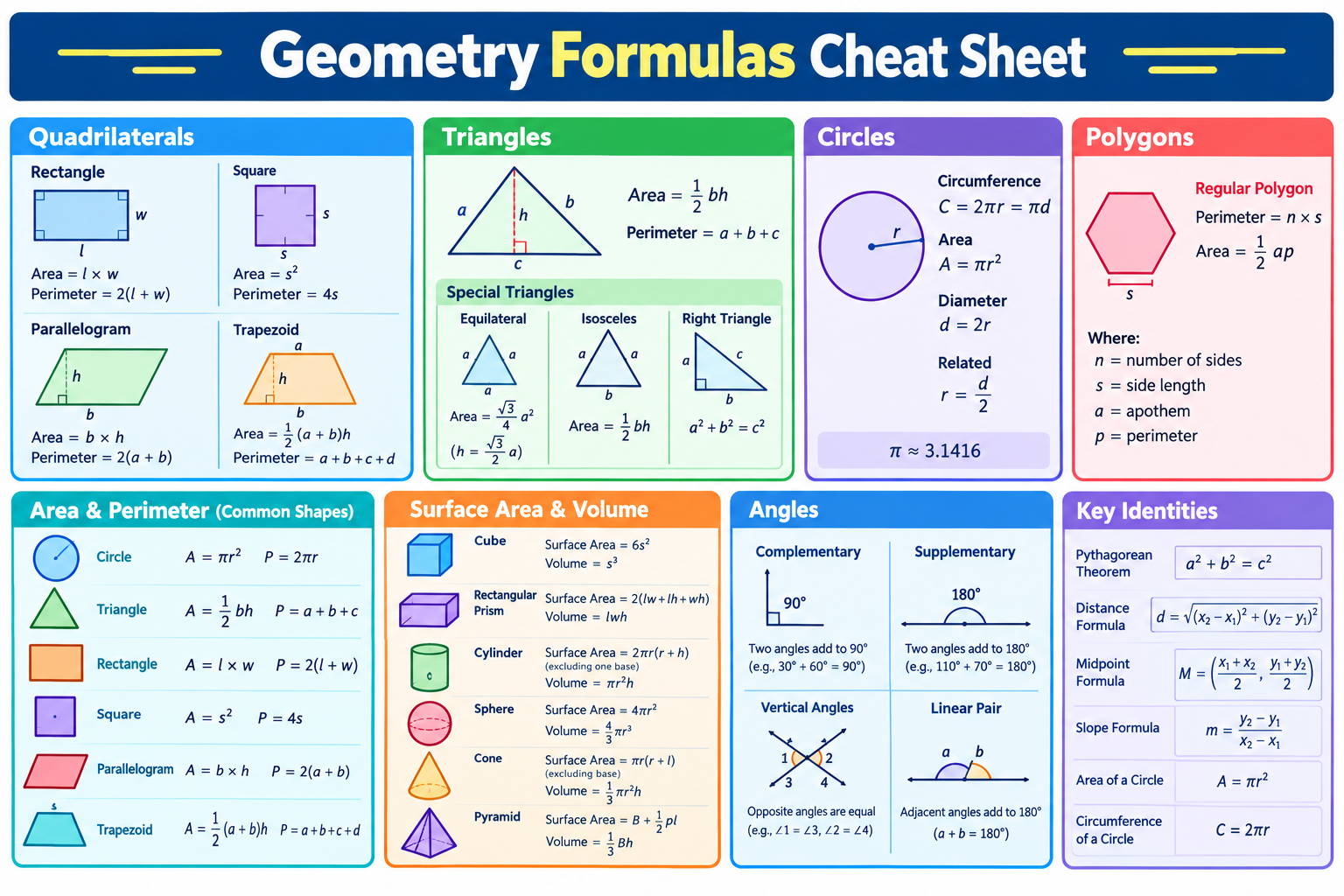
Geometry can feel like a pile of letters and symbols at first. You see A = πr² and your brain freezes. That’s normal.
Most geometry formulas follow simple logic. Once you see why a formula works, you rarely forget it. This cheat sheet puts all the key formulas for perimeter, area, surface area, and volume in one place, grouped by shape and explained in plain English.
Bookmark it. Print it. Keep it next to your homework. It’s built to be the reference you come back to.
Geometry Sheet At a Glance
| Detail | Information |
|---|---|
| Subject | Geometry |
| Target Grades | Grades 6–10 (middle school, high school, and beginners) |
| Core Concepts | Perimeter, Area, Surface Area, Volume |
| Essential 2D Shapes | Square, Rectangle, Triangle, Circle |
| Essential 3D Shapes | Cube, Rectangular Prism, Cylinder, Sphere |
| Key Constant | Pi (π) ≈ 3.14 |
| Best For | Homework, test revision, quick formula lookups |
First, Know What You’re Measuring
Before memorizing anything, get these four ideas straight. Most mistakes happen when students mix them up.
- Perimeter is the distance around a flat shape. Think of a fence around a yard. It’s measured in plain units: cm, m, inches.
- Area is the space inside a flat shape. Think of carpet covering a floor. It’s measured in square units: cm², m², in².
- Surface Area is the total area of all the outside faces of a 3D object. Think of wrapping paper on a gift box. Also measured in square units.
- Volume is how much space a 3D object holds. Think of water filling a tank. It’s measured in cubic units: cm³, m³, in³.
Quick tip: the little number on the unit tells you a lot. One dimension (length) = units. Two dimensions (area) = units². Three dimensions (volume) = units³.
Quick Variable Key
Here are the letters you’ll see in almost every formula below:
- s = side length
- l = length
- w = width
- b = base
- h = height
- r = radius (center to edge of a circle)
- d = diameter (straight across a circle, through the center; d = 2r)
- π = pi, roughly 3.14
Perimeter & Area of 2D Shapes
Flat shapes come first. Master these and the 3D formulas become much easier, because most of them are built from 2D pieces.
Square
A square has four equal sides and four right angles.
Perimeter: P = 4 × s
Area:      A = s × s = s²
Example: A square with side 5 cm has a perimeter of 20 cm and an area of 25 cm².
Notice something cool. Double the side to 10 cm, and the area jumps to 100 cm². That’s four times bigger, not two. When you scale every side by a number, area grows by that number squared. If you want to sharpen your skills with scaling and repeated products, check out What Is a Multiple in Math? Examples and Practice.
Rectangle
A rectangle has two pairs of equal sides and four right angles.
Perimeter: P = 2 × (l + w)
Area:      A = l × w
Example: A rectangle 8 m long and 3 m wide has a perimeter of 2 × (8 + 3) = 22 m. Its area is 8 × 3 = 24 m².
Triangle
A triangle has three sides. The height must be measured straight up from the base, at a right angle. Not along a slanted side.
Perimeter: P = a + b + c   (add all three sides)
Area:      A = ½ × b × h   (or A = (b × h) ÷ 2)
Why the half? Any triangle is exactly half of a rectangle (or parallelogram) with the same base and height. So you find the rectangle’s area, then cut it in two.
Example: A triangle with base 10 cm and height 6 cm.
- Multiply: 10 × 6 = 60
- Divide by 2: 60 ÷ 2 = 30
- Area = 30 cm²
That last division step gives you a quotient, which is your final answer. If the term feels fuzzy, here’s a simple refresher: What Is a Quotient in Math? Simple Explanation.
Circle
Circles are special. They don’t have sides, so we use the radius and a famous number called pi (π).
Pi is the ratio of any circle’s circumference to its diameter. Every circle, from a coin to a planet orbit, has the same ratio: about 3.14159… For school work, π ≈ 3.14 is usually close enough. Some teachers also accept 22/7.
The “perimeter” of a circle has its own name: circumference.
Circumference: C = 2 × π × r   (or C = π × d)
Area:          A = π × r²
Example: A circle with radius 4 cm.
- Circumference = 2 × 3.14 × 4 = 25.12 cm
- Area = 3.14 × 4² = 3.14 × 16 = 50.24 cm²
Common trap: Square the radius first, then multiply by π. Don’t multiply 3.14 × 4 and then square the result. Order matters.
If you like seeing shapes before working with them, the MathisFun Geometry Reference has clean diagrams and interactive models that show exactly where the radius, diameter, and height sit.
Working With Fractional Dimensions
Real measurements aren’t always whole numbers. Sometimes a side is ¾ of a meter.
The formulas don’t change. You just multiply fractions.
Example: A square tile has a side of ¾ m.
- Area = ¾ × ¾ = 9/16 m²
Since 9 is smaller than 16, the answer is a proper fraction. That makes sense, because a tile less than 1 m wide must cover less than 1 m². Need a quick review? See What Is a Proper Fraction? Examples Explained.
Surface Area & Volume of 3D Shapes
Now we step into three dimensions. Here’s the big idea: many volume formulas are just base area × height. Find the area of the bottom face, then stack it up.
Cube
A cube has six identical square faces.
Surface Area: SA = 6 × s²
Volume:       V  = s³
Example: A cube with side 3 cm.
- Surface Area = 6 × 3² = 6 × 9 = 54 cm²
- Volume = 3³ = 3 × 3 × 3 = 27 cm³
Why 6 × s²? Each face is a square with area s², and a cube has six faces. That’s it.
Rectangular Prism (Cuboid)
Think of a shoebox or a brick. It has three pairs of matching rectangular faces.
Surface Area: SA = 2 × (l×w + l×h + w×h)
Volume:       V  = l × w × h
Example: A box 5 cm long, 4 cm wide, and 2 cm high.
- Surface Area = 2 × (20 + 10 + 8) = 2 × 38 = 76 cm²
- Volume = 5 × 4 × 2 = 40 cm³
Cylinder
A cylinder is like a can of soup. Two circles on the ends, one curved side wrapped around.
Surface Area: SA = 2πr² + 2πrh
Volume:       V  = π × r² × h
Break the surface area down:
- 2πr² = the two circular ends (top and bottom)
- 2πrh = the curved side. Unroll it and you get a rectangle. Its length is the circle’s circumference (2πr) and its width is the height (h).
The volume is simply circle area × height. Same “base × height” idea as the prism.
Sphere
A sphere is a perfectly round ball. Every point on its surface is the same distance (r) from the center.
Surface Area: SA = 4 × π × r²
Volume:       V  = (4/3) × π × r³
Example: A ball with radius 3 cm.
- Surface Area = 4 × 3.14 × 9 = 113.04 cm²
- Volume = (4/3) × 3.14 × 27 = 4 × 3.14 × 9 = 113.04 cm³
Fun fact: when r = 3, the surface area and volume happen to share the same number. The units still differ, though: cm² versus cm³.
Master Formula Table
Here’s everything in one quick-scan table:
| Shape | Perimeter / Circumference | Area / Surface Area | Volume |
|---|---|---|---|
| Square | P = 4s | A = s² | — |
| Rectangle | P = 2(l + w) | A = l × w | — |
| Triangle | P = a + b + c | A = ½ × b × h | — |
| Circle | C = 2πr | A = πr² | — |
| Cube | — | SA = 6s² | V = s³ |
| Rectangular Prism | — | SA = 2(lw + lh + wh) | V = l × w × h |
| Cylinder | — | SA = 2πr² + 2πrh | V = πr²h |
| Sphere | — | SA = 4πr² | V = (4/3)πr³ |
Step-by-Step Practical Problem: Volume of a Water Tank
Let’s solve a real-world problem from start to finish.
Problem: A cylindrical water tank has a radius of 3 meters and a height of 10 meters. How much water can it hold? Use π ≈ 3.14.
Step 1: Pick the right formula.
The tank is a cylinder, and “how much it holds” means volume.
V = π × r² × hStep 2: Write down what you know.
- r = 3 m
- h = 10 m
- π ≈ 3.14
Step 3: Square the radius.
r² = 3 × 3 = 9Step 4: Multiply by π.
This gives the area of the circular base.
3.14 × 9 = 28.26 m²Step 5: Multiply by the height.
28.26 × 10 = 282.6Step 6: Add the correct units.
Volume uses cubic units.
Answer: V = 282.6 m³
Bonus fact: 1 m³ holds 1,000 liters. So this tank holds about 282,600 liters of water. That’s a lot of showers.
Common Mistakes to Avoid
Even strong students slip on these. Watch out for them:
- Mixing up radius and diameter. If a problem gives the diameter, divide it by 2 before using any πr² formula.
- Forgetting the ½ in the triangle formula. Without it, your answer is exactly double.
- Using the slanted side as height. Height is always perpendicular to the base.
- Wrong units. Area needs square units. Volume needs cubic units. Teachers often take marks off for this.
- Mixing measurement units. If length is in meters and width is in centimeters, convert first.
- Squaring after multiplying by π. In πr², square r first.
How to Actually Remember These Formulas
Rote memorization fades fast. Try these instead:
- Understand the “why.” A triangle is half a rectangle. A cylinder is a stack of circles. Logic sticks longer than letters.
- Draw every problem. A quick sketch shows you which measurements you have and which you need.
- Practice in short bursts. Ten minutes a day beats a two-hour cram session the night before a test.
- Use interactive tools. Khan Academy Geometry Lessons offer free plane geometry exercises with instant feedback, so you can spot mistakes right away.
- Teach someone else. Explain the circle formula to a friend or sibling. If you can teach it, you know it.
Final Thoughts
Geometry isn’t about memorizing a wall of symbols. It’s about seeing patterns. Perimeter goes around. Area covers. Volume fills. Most 3D volumes are just a base area stacked up by a height.
Keep this cheat sheet handy, work through a few problems each day, and these formulas will start to feel like second nature. You’ve got this.
Educational Disclaimer
This geometry formulas cheat sheet is provided for general informational and academic revision purposes only. While every effort has been made to ensure accuracy, students should always follow the specific methods, notation, rounding rules, and values of π required by their teacher, textbook, or exam board. Approximations such as π ≈ 3.14 are used for simplicity and may produce slightly different results than calculations using more precise values.