

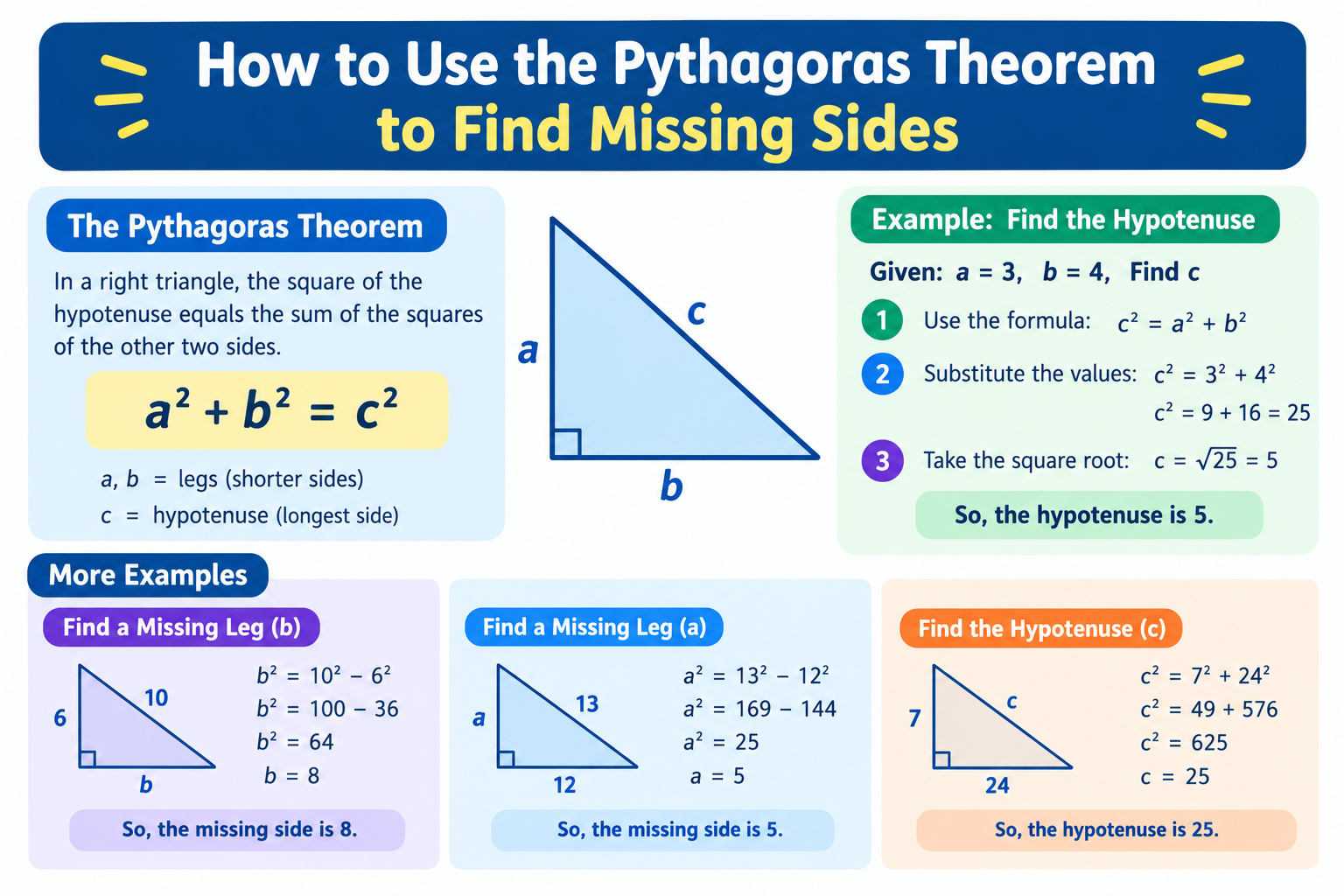
Some math rules feel abstract. This one doesn’t.
Got a right triangle with one side missing? The Pythagoras Theorem fills in the blank. It’s quick, reliable, and it works every single time, as long as your triangle has a 90° angle.
In this guide, you’ll learn a simple 4-step method, see fully worked examples for every type of missing side, and practice with real-world problems. No confusing jargon. Just clear steps.
Pythagoras Theorem: Quick Facts
| Detail | Information |
|---|---|
| Topic | Pythagoras Theorem (Pythagorean Theorem) |
| Branch of Math | Geometry |
| Core Formula | a² + b² = c² |
| Applies To | Right-angled triangles only |
| Find the Hypotenuse | c = √(a² + b²) |
| Find a Leg | a = √(c² − b²) |
| Tools Needed | Squares, square roots, a calculator for decimals |
| Best For | Students in Grades 7–12, exam prep, beginners |
The Theorem in Plain English
Picture a right triangle. Build a square on each of its three sides. The area of the biggest square equals the other two squares combined.
That’s the whole idea. Written as a formula:
a² + b² = c²- a and b → the two shorter sides (the legs). They meet at the right angle.
- c → the longest side (the hypotenuse). It sits across from the right angle.
The name comes from the Greek thinker Pythagoras. But the rule is far older than him. Britannica’s article on the Pythagorean theorem notes that although the theorem has long been linked with Pythagoras, it actually predates him. Britannica also shows a visual proof where four identical triangles are rearranged inside a square, revealing that the two smaller squares exactly fill the space of the larger one.
The 4-Step Method (Works Every Time)
Memorize these four steps. They solve every missing-side problem.
- Label the sides. Mark the hypotenuse as c.
- Decide what’s missing: the hypotenuse or a leg?
- Square the known sides, then add (for c) or subtract (for a leg).
- Square root the result to get your final answer.
Let’s put this method to work.
Type 1: Finding the Hypotenuse
You know both legs. You want the longest side.
Rule: Add the squares.
c = √(a² + b²)Worked Example: Legs of 9 and 12
Step 1 – Label: a = 9, b = 12, c = ?
Step 2 – Decide: c is missing, so we add.
Step 3 – Square and add:
c² = 9² + 12²
c² = 81 + 144
c² = 225
Step 4 – Square root:
c = √225
c = 15
Answer: 15 units.
Always square each number before adding. Exponents come before addition in the order of operations. Need a refresher? See Understanding PEMDAS / BODMAS: The Ultimate Order of Operations Guide.
Worked Example: When the Answer Isn’t a Whole Number
Legs are 3 cm and 8 cm.
c² = 3² + 8²
c² = 9 + 64
c² = 73
c = √73
c ≈ 8.54 cm
Answer: about 8.54 cm.
Don’t panic when the square root isn’t neat. Most real triangles give decimal answers. You can also leave it as √73 (called surd form) if your teacher prefers exact answers.
Type 2: Finding a Missing Leg
You know the hypotenuse and one leg. You want the other leg.
Rule: Subtract the squares.
a = √(c² − b²)Worked Example: Hypotenuse 25, Leg 7
Step 1 – Label: c = 25, b = 7, a = ?
Step 2 – Decide: A leg is missing, so we subtract.
Step 3 – Square and subtract:
a² = 25² − 7²
a² = 625 − 49
a² = 576
Step 4 – Square root:
a = √576
a = 24
Answer: 24 units.
Check yourself: A leg must always be shorter than the hypotenuse. 24 is less than 25. Perfect.
Add or Subtract? A Fast Decision Guide
| You Know… | You Want… | Do This |
|---|---|---|
| Both legs | Hypotenuse | Square, add, square root |
| Hypotenuse + one leg | Other leg | Square, subtract, square root |
Easy way to remember: The hypotenuse is the biggest, so you add to build it. A leg is smaller, so you subtract to shrink down to it.
Real-World Problems
Here’s how the theorem shows up outside the classroom.
Problem 1: The Kite String
A kite flies on a 50 m string. A friend standing directly under the kite is 30 m away from you. How high is the kite?
- The string is the slanted side → c = 50
- The ground distance → b = 30
- The height → a = ?
a² = 50² − 30²
a² = 2500 − 900
a² = 1600
a = 40
The kite is 40 meters high.
Problem 2: Diagonal of a Rectangle
A rectangular garden is 20 m long and 21 m wide. How long is a path cutting straight across from corner to corner?
A rectangle’s diagonal splits it into two right triangles. So the length and width are the legs.
c² = 20² + 21²
c² = 400 + 441
c² = 841
c = 29
The diagonal path is 29 meters long.
Once you know all three sides, you can find the triangle’s area or perimeter too. Keep those formulas close with the Geometry Formulas Cheat Sheet: Area, Volume & Perimeter Made Easy.
More Everyday Uses
- Screens: TV and phone sizes are measured along the diagonal.
- Building: Carpenters use a 3-4-5 measurement to check perfect right-angle corners.
- Maps: Finding the shortest straight-line distance between two points.
- Sports: Calculating the distance of a diagonal throw across a field.
Checking If a Triangle Is Right-Angled
You can run the theorem backwards. Plug in all three sides. If both sides of the equation match, you’ve got a right angle.
Math is Fun’s Pythagorean Theorem guide explains this reverse use clearly. It shows that when a triangle’s three sides satisfy a² + b² = c², the triangle must be right-angled. The page also includes animated diagrams and hands-on proof activities that make the theorem easy to see, not just memorize.
Test 1: Sides 20, 21, 29
20² + 21² = 400 + 441 = 841
29² = 841
✓ Right triangle
Test 2: Sides 5, 6, 8
5² + 6² = 25 + 36 = 61
8² = 64
✗ Not a right triangle
Tip: Always use the longest side as c when testing.
Shortcut: Pythagorean Triples
Some whole-number sets fit the formula perfectly. Learn them and you’ll spot answers instantly.
| Triple | Multiples That Also Work |
|---|---|
| 3, 4, 5 | 6-8-10, 9-12-15, 12-16-20 |
| 5, 12, 13 | 10-24-26, 15-36-39 |
| 8, 15, 17 | 16-30-34 |
| 7, 24, 25 | 14-48-50 |
| 20, 21, 29 | 40-42-58 |
See it? Our first example (9, 12, 15) was just 3-4-5 multiplied by 3.
Mistakes That Cost Marks
- Wrong triangle type. No 90° angle? This theorem won’t work. Use trigonometry instead.
- Mislabeling c. The hypotenuse is always opposite the right angle.
- Adding for a leg. If your “leg” comes out longer than the hypotenuse, you added by mistake.
- Skipping the square root. c² = 225 isn’t the answer. c = 15 is.
- Squaring the sum. (9 + 12)² ≠ 9² + 12². Square separately.
- Unit mix-ups. Convert to the same unit before calculating.
Taking It Further
Mastering this theorem prepares you for bigger topics. The sine, cosine, and tangent ratios all come from right triangles, and the identity sin²θ + cos²θ = 1 is the Pythagoras Theorem rewritten. Continue your learning with the Trigonometry Formulas Guide: Every Important Formula Explained.
Practice Time
Test your skills:
- Legs are 11 and 60. Find the hypotenuse.
- Hypotenuse is 41, one leg is 9. Find the other leg.
- Is a triangle with sides 15, 20, 25 right-angled?
- Legs are 2 and 5. Find the hypotenuse to 2 decimal places.
Answers:
- √(121 + 3600) = √3721 = 61
- √(1681 − 81) = √1600 = 40
- 225 + 400 = 625 = 25² → Yes
- √(4 + 25) = √29 ≈ 5.39
Frequently Asked Questions
Can I use the Pythagoras Theorem on any triangle?
No. It only works on right-angled triangles.
Does it matter which leg is a and which is b?
No. Since you add them, the order doesn’t change the answer. Only c must be the hypotenuse.
What if I only know one side?
You need at least two sides. With one side and an angle, use trigonometry instead.
Why do we take the square root at the end?
The formula gives you c², the area of the square. The square root turns it back into a side length.
Final Thoughts
Label. Decide. Square and add or subtract. Square root. That’s the whole Pythagoras Theorem in four moves.
It’s one of the oldest tools in mathematics, and it’s still one of the most useful. Practice a handful of problems each day, and finding missing sides will soon feel like second nature.
📘 Educational Disclaimer
This article is for general informational and academic revision purposes only. While every effort has been made to ensure accuracy, students should always follow the methods, notation, rounding rules, and answer formats required by their teacher, textbook, or examination board. Decimal values are rounded for simplicity and may differ slightly from exact surd answers.