

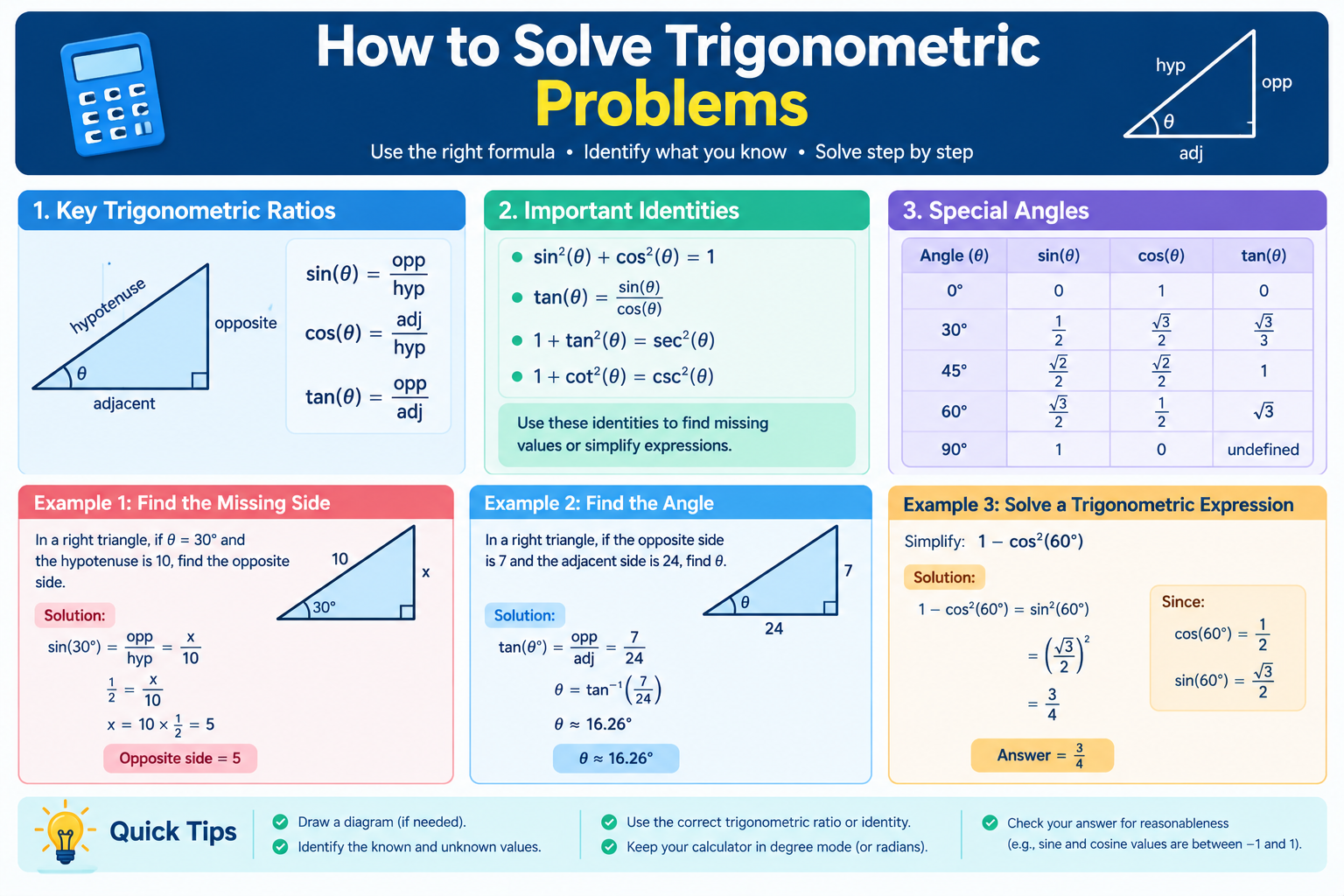
You open your trig homework. The question says: “Prove that sec θ − cos θ = sin θ · tan θ.”
Your mind goes blank. Where do you even start?
Here’s the good news. Proving trig identities isn’t about genius. It’s about following a few reliable strategies, in order. Once you learn them, most identity problems start to feel like puzzles instead of nightmares.
This guide walks you through the identities you must know, a proven step-by-step method, six key strategies, fully solved examples, common mistakes, and practice problems with answers.
Trigonometric Identities At a Glance
| Detail | Information |
|---|---|
| Subject | Trigonometry |
| What You’re Doing | Showing both sides of an equation are always equal |
| Golden Rule | Work on one side only, usually the more complex one |
| Must-Know Identities | Reciprocal, Quotient, Pythagorean, Even-Odd |
| Most Useful Identity | sin²θ + cos²θ = 1 |
| Top Strategy | Convert everything to sin and cos |
| Algebra Skills Needed | Factoring, common denominators, conjugates, expanding |
| Target Readers | High school students, college students, exam takers |
What Is a Trigonometric Identity?
A trigonometric identity is an equation that is true for every valid angle.
That’s different from a normal trig equation. An equation like sin θ = 0.5 is only true for certain angles. An identity like sin²θ + cos²θ = 1 is true for all angles.
When a question asks you to “prove,” “verify,” or “show” an identity, your job is to transform one side step by step until it looks exactly like the other side.
Think of it like a translation. Both sides say the same thing, just in different words. You’re proving they match.
The Identities You Must Know
You can’t solve identity problems without your toolkit. Memorize these first.
Britannica’s article on trigonometry describes trigonometry as the branch of mathematics concerned with specific functions of angles, built around six functions: sine, cosine, tangent, cotangent, secant, and cosecant. Britannica notes that simple relationships follow directly from their definitions, such as cosecant being the reciprocal of sine, and tangent equaling sine divided by cosine. Those relationships form the core of every identity proof.
1. Reciprocal Identities
csc θ = 1 / sin θ        sin θ = 1 / csc θ
sec θ = 1 / cos θ        cos θ = 1 / sec θ
cot θ = 1 / tan θ        tan θ = 1 / cot θ
2. Quotient Identities
tan θ = sin θ / cos θ
cot θ = cos θ / sin θ
3. Pythagorean Identities
sin²θ + cos²θ = 1
1 + tan²θ = sec²θ
1 + cot²θ = csc²θ
These come straight from the Pythagoras theorem applied to a right triangle. If you want to see where that comes from, read How to Use the Pythagoras Theorem to Find Missing Sides.
4. Rearranged Pythagorean Forms (Super Useful)
Most proofs use these versions:
sin²θ = 1 − cos²θ
cos²θ = 1 − sin²θ
tan²θ = sec²θ − 1
cot²θ = csc²θ − 1
sec²θ − tan²θ = 1
csc²θ − cot²θ = 1
5. Even-Odd Identities
sin(−θ) = −sin θ       cos(−θ) = cos θ
tan(−θ) = −tan θ       sec(−θ) = sec θ
csc(−θ) = −csc θ       cot(−θ) = −cot θ
Only cosine and secant are even. The other four are odd.
For the complete list, including co-function identities, standard angle values, and quadrant signs, keep the Trigonometry Formulas Guide: Every Important Formula Explained open while you practice.
The Golden Rules Before You Start
Break these rules, and your proof won’t count, even if the math looks right.
- Work on one side only. Don’t move terms across the equals sign.
- Never cross-multiply both sides like you would in a normal equation.
- Start with the more complicated side. It’s easier to simplify than to build up.
- Show every step. Teachers and examiners want to see your reasoning.
- Stop when both sides match exactly. Write “= RHS” or “LHS = RHS” at the end.
Quick terms:
- LHS = Left-Hand Side
- RHS = Right-Hand Side
The Step-by-Step Method
Use this process on every identity problem.
Step 1: Look at both sides. Which side is longer or more complex? Start there.
Step 2: Check what the target side contains. If the RHS only has sine, aim to end with sine.
Step 3: Try an algebra move. Factor, combine fractions, expand brackets, or multiply by a conjugate.
Step 4: Substitute an identity. Replace parts using the reciprocal, quotient, or Pythagorean identities.
Step 5: Still stuck? Convert everything to sin and cos. This works more often than any other trick.
Step 6: Simplify until it matches the other side.
OpenStax’s Precalculus textbook section on verifying identities recommends a very similar routine. It advises working on one side, usually the more complex one, then looking for chances to factor, square a binomial, or add fractions. If those steps don’t lead anywhere, it suggests rewriting all terms in sines and cosines. OpenStax also compares identities to a spy carrying multiple passports: different-looking expressions that all represent the same thing.
6 Strategies That Solve Most Identities
Strategy 1: Convert Everything to Sin and Cos
When in doubt, replace tan, cot, sec, and csc with their sin and cos forms. This turns a messy expression into something easier to simplify.
Strategy 2: Combine Fractions
If you see two fractions being added or subtracted, find a common denominator and merge them into one.
Strategy 3: Spot the Pythagorean Identity
Whenever you see sin²θ + cos²θ, replace it with 1. Whenever you see 1 − cos²θ, replace it with sin²θ. These swaps unlock most proofs.
Strategy 4: Factor
Look for common factors or special patterns. The difference of squares is especially common:
a² − b² = (a − b)(a + b)Need a refresher on algebra patterns like this? See the Complete Algebra Formulas List: Downloadable PDF for Students.
Strategy 5: Multiply by the Conjugate
If a denominator looks like (1 − cos θ) or (1 + sin θ), multiply the top and bottom by its “partner” (the conjugate). This creates a difference of squares, which often turns into a Pythagorean identity.
| Expression | Conjugate |
|---|---|
| 1 − cos θ | 1 + cos θ |
| 1 + sin θ | 1 − sin θ |
| sec θ − tan θ | sec θ + tan θ |
Strategy 6: Expand Brackets
If you see a squared bracket or two brackets multiplied together, expand them. Hidden identities often appear once everything is spread out.
Solved Examples (Easy to Hard)
Example 1: Easy
Prove: sin θ · sec θ = tan θ
Start with the LHS (it has two terms).
LHS = sin θ · sec θ
    = sin θ · (1 / cos θ)       ← Reciprocal identity
    = sin θ / cos θ
    = tan θ                     ← Quotient identity
    = RHS ✓
Strategy used: Convert to sin and cos.
Example 2: Easy
Prove: (1 − cos²θ) / sin θ = sin θ
LHS = (1 − cos²θ) / sin θ
    = sin²θ / sin θ             ← Pythagorean identity
    = sin θ                     ← Cancel one sin θ
    = RHS ✓
Strategy used: Spot the Pythagorean identity.
Example 3: Medium
Prove: sec θ − cos θ = sin θ · tan θ
This is the problem from the introduction. Let’s solve it.
Start with the LHS.
LHS = sec θ − cos θ
    = (1 / cos θ) − cos θ               ← Reciprocal identity
    = (1 / cos θ) − (cos²θ / cos θ)     ← Common denominator
    = (1 − cos²θ) / cos θ               ← Combine fractions
    = sin²θ / cos θ                     ← Pythagorean identity
    = sin θ · (sin θ / cos θ)           ← Split the fraction
    = sin θ · tan θ                     ← Quotient identity
    = RHS ✓
Strategies used: Convert to sin/cos, combine fractions, Pythagorean swap.
Example 4: Medium
Prove: tan θ + cot θ = sec θ · csc θ
LHS = tan θ + cot θ
    = (sin θ / cos θ) + (cos θ / sin θ)        ← Quotient identities
    = (sin²θ + cos²θ) / (sin θ · cos θ)        ← Common denominator
    = 1 / (sin θ · cos θ)                       ← Pythagorean identity
    = (1 / cos θ) · (1 / sin θ)
    = sec θ · csc θ                             ← Reciprocal identities
    = RHS ✓
Strategies used: Convert to sin/cos, combine fractions, Pythagorean swap.
Example 5: Harder (Conjugate Method)
Prove: sin θ / (1 − cos θ) = (1 + cos θ) / sin θ
Start with the LHS. Multiply top and bottom by the conjugate (1 + cos θ).
LHS = sin θ / (1 − cos θ)
    = [sin θ (1 + cos θ)] / [(1 − cos θ)(1 + cos θ)]
    = [sin θ (1 + cos θ)] / (1 − cos²θ)          ← Difference of squares
    = [sin θ (1 + cos θ)] / sin²θ                ← Pythagorean identity
    = (1 + cos θ) / sin θ                         ← Cancel one sin θ
    = RHS ✓
Strategies used: Conjugate, difference of squares, Pythagorean swap.
Example 6: Harder (Factoring Method)
Prove: cos⁴θ − sin⁴θ = cos²θ − sin²θ
Notice that cos⁴θ − sin⁴θ is a difference of squares: (cos²θ)² − (sin²θ)².
LHS = cos⁴θ − sin⁴θ
    = (cos²θ − sin²θ)(cos²θ + sin²θ)     ← Difference of squares
    = (cos²θ − sin²θ)(1)                  ← Pythagorean identity
    = cos²θ − sin²θ
    = RHS ✓
Strategies used: Factoring, Pythagorean swap.
Example 7: Using Even-Odd Identities
Prove: sin(−θ) · cot(−θ) = cos θ
LHS = sin(−θ) · cot(−θ)
    = (−sin θ) · (−cot θ)                ← Even-odd identities
    = sin θ · cot θ                       ← Two negatives make a positive
    = sin θ · (cos θ / sin θ)             ← Quotient identity
    = cos θ
    = RHS ✓
Quick Strategy Chooser
Not sure where to begin? Match what you see:
| If You See… | Try This |
|---|---|
| tan, cot, sec, csc mixed together | Convert to sin and cos |
| Two fractions added or subtracted | Find a common denominator |
| sin²θ + cos²θ | Replace with 1 |
| 1 − sin²θ or 1 − cos²θ | Replace with cos²θ or sin²θ |
| (1 ± sin θ) or (1 ± cos θ) in a denominator | Multiply by the conjugate |
| A fourth power like sin⁴θ − cos⁴θ | Factor as difference of squares |
| A squared bracket | Expand it |
| Negative angles like sin(−θ) | Use even-odd identities |
Common Mistakes to Avoid
- Working on both sides at once. Treating the identity like a normal equation breaks the proof.
- Cross-multiplying. You can’t assume the two sides are equal before you’ve proven it.
- Splitting functions like brackets. sin(A + B) is not sin A + sin B.
- Cancelling terms instead of factors. In (sin θ + cos θ) / sin θ, you can’t just cross out sin θ.
- Misreading notation. sin²θ means (sin θ)², not sin(θ²).
- Forgetting signs with even-odd identities. Only cos and sec stay positive with negative angles.
- Giving up too early. If one path stalls, go back and try converting to sin and cos.
Bonus: Identities You’ll Meet Next
Once you’re comfortable with the basics, you’ll move on to these:
Double-Angle Identities
sin 2θ = 2 sin θ cos θ
cos 2θ = cos²θ − sin²θ
       = 2cos²θ − 1
       = 1 − 2sin²θ
tan 2θ = 2 tan θ / (1 − tan²θ)
Sum and Difference Identities
sin(A ± B) = sin A cos B ± cos A sin B
cos(A ± B) = cos A cos B ∓ sin A sin B
Notice Example 6’s answer, cos²θ − sin²θ, is actually cos 2θ. Identities often connect in surprising ways.
Practice Questions
Prove each identity. Answers with key steps are below.
- csc θ · tan θ = sec θ
- cot θ · sin θ = cos θ
- (1 − sin²θ) · sec θ = cos θ
- (1 + tan²θ) · cos²θ = 1
- 1/(1 − sin θ) + 1/(1 + sin θ) = 2sec²θ
- (sec θ − 1)(sec θ + 1) = tan²θ
Answers:
- (1/sin θ)(sin θ/cos θ) = 1/cos θ = sec θ ✓
- (cos θ/sin θ)(sin θ) = cos θ ✓
- cos²θ · (1/cos θ) = cos θ ✓
- sec²θ · cos²θ = (1/cos²θ)(cos²θ) = 1 ✓
- Combine: [(1 + sin θ) + (1 − sin θ)] / (1 − sin²θ) = 2/cos²θ = 2sec²θ ✓
- Difference of squares: sec²θ − 1 = tan²θ ✓
Frequently Asked Questions
What does it mean to prove a trig identity?
It means showing that one side of the equation can be rewritten step by step until it matches the other side exactly.
Which side should I start with?
Usually the more complicated side. Simplifying is easier than building up.
What’s the most useful trig identity?
sin²θ + cos²θ = 1. Its rearranged forms appear in most proofs.
What should I do when I’m stuck?
Convert every function to sine and cosine. Then look for common denominators or Pythagorean swaps.
Can I work on both sides?
Some teachers allow simplifying each side separately until they meet in the middle. But you should never move terms across the equals sign or cross-multiply. Check your teacher’s rules.
How can I check if an identity is true before proving it?
Plug in a test angle like 30° or 45° on both sides. If the values don’t match, the identity is false. If they do match, it’s likely true, but you still need a full proof.
Final Thoughts
Proving trig identities is a skill, not a talent. Follow the same steps every time:
- Start with the complex side
- Use algebra: combine, factor, expand, or use conjugates
- Swap in identities, especially sin²θ + cos²θ = 1
- Convert to sin and cos when stuck
- Simplify until both sides match
Practice three or four identities a day, and you’ll start spotting the patterns almost instantly. Before long, that blank-page feeling will turn into “I know exactly where to start.”
Sources:
- Trigonometry – Britannica
- 7.1 Simplifying and Verifying Trigonometric Identities – OpenStax Precalculus 2e
📘 Educational Disclaimer
This guide is for general informational and academic revision purposes only. While every effort has been made to ensure accuracy, students should always follow the specific methods, notation, and proof formats required by their teacher, textbook, or examination board. Some identities are undefined at certain angles where a denominator equals zero.