

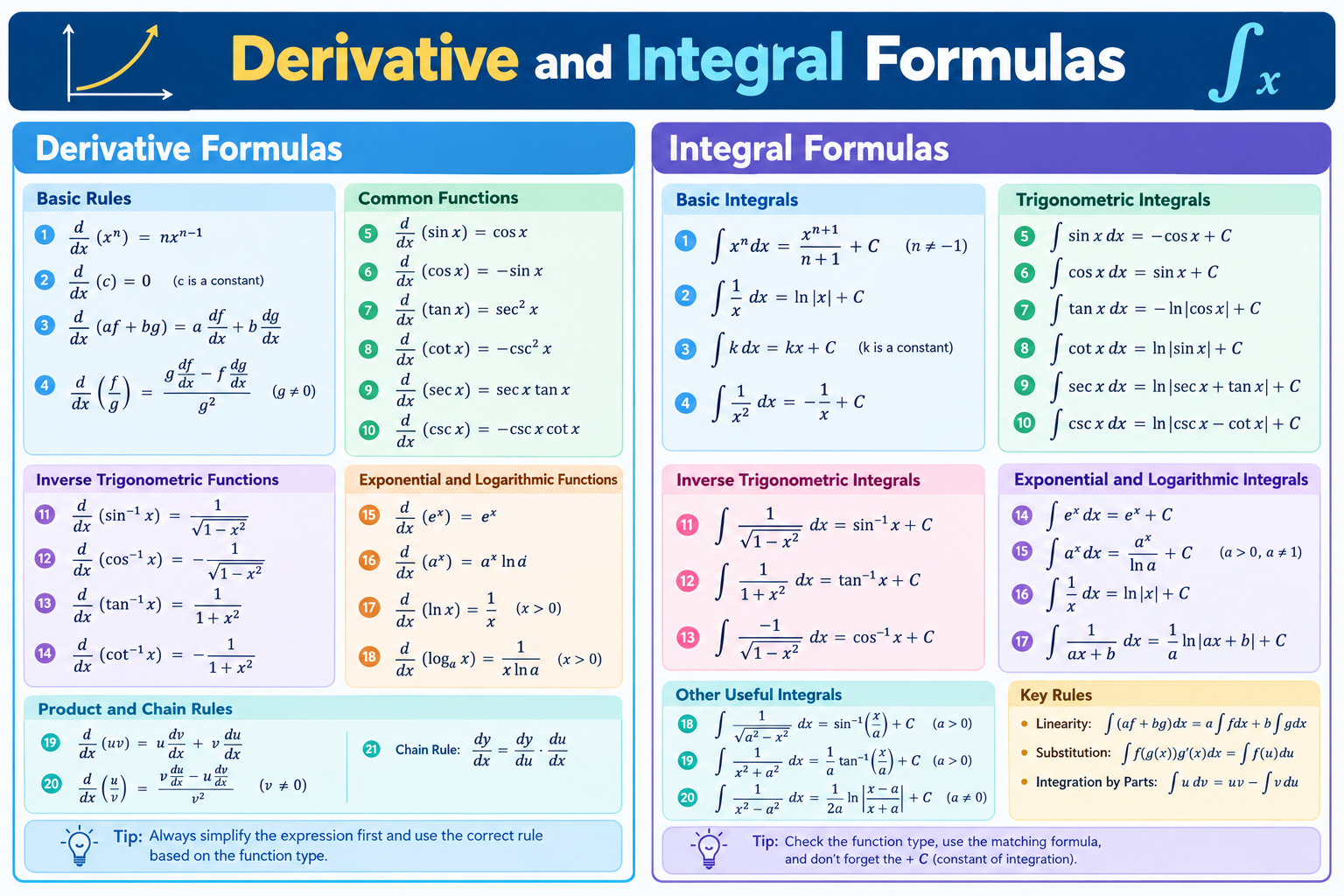
Calculus has a scary reputation. All those dx’s, curly integral signs, and strange symbols can make anyone nervous.
But here’s a secret every top student knows: most calculus problems use the same few dozen formulas over and over. Learn them, understand when to use each one, and calculus becomes far more manageable.
This guide is your all-in-one formula sheet. You’ll get every essential derivative and integral formula, the key rules, integration techniques, fully solved examples, common mistakes, and practice questions. Bookmark it. Print it. Keep it next to your notes.
Calculus Formula Sheet At a Glance
| Detail | Information |
|---|---|
| Subject | Calculus (Differential & Integral) |
| Derivative Measures | Instantaneous rate of change (slope) |
| Integral Measures | Accumulation (area under a curve) |
| Key Derivative Rules | Power, Product, Quotient, Chain |
| Key Integration Techniques | u-Substitution, Integration by Parts, Partial Fractions, Trig Substitution |
| Big Link | Fundamental Theorem of Calculus |
| Don’t Forget | + C for indefinite integrals |
| Target Readers | High school (AP/A-Level), college students, engineering and science learners |
What Is Calculus?
Calculus is the mathematics of change.
It has two main branches:
- Differential calculus studies how fast things change. Its main tool is the derivative.
- Integral calculus studies how things add up. Its main tool is the integral.
Britannica’s article on calculus describes it as the branch of mathematics concerned with instantaneous rates of change and the summation of infinitely many small factors. Britannica lists Isaac Newton among its key figures, along with later mathematicians such as Leonhard Euler and Augustin-Louis Cauchy, who helped shape the subject into the form students learn today. Its diagrams show how a secant line’s average rate turns into the instantaneous rate of a tangent line as the interval shrinks to zero, which is the heart of the derivative.
Derivative vs Integral: The Big Picture
| Feature | Derivative | Integral |
|---|---|---|
| Question it answers | “How fast is it changing?” | “How much has built up?” |
| Geometric meaning | Slope of a tangent line | Area under a curve |
| Real-life example | Speed from a distance graph | Distance from a speed graph |
| Notation | f′(x), dy/dx | ∫ f(x) dx |
| Relationship | Opposite of integration | Opposite of differentiation |
The derivative extends the idea of slope from straight lines to curves. If slope is new to you, start with Linear Equations Explained: How to Graph and Solve Them Easily.
PART 1: DERIVATIVE FORMULAS
The Definition of a Derivative
Every derivative formula comes from this limit:
f′(x) = lim (h → 0) [f(x + h) − f(x)] / hYou rarely use it directly. The shortcut rules below do the work for you.
Basic Derivative Rules
| Rule | Formula |
|---|---|
| Constant Rule | d/dx (c) = 0 |
| Constant Multiple | d/dx [c · f(x)] = c · f′(x) |
| Sum Rule | d/dx [f + g] = f′ + g′ |
| Difference Rule | d/dx [f − g] = f′ − g′ |
| Power Rule | d/dx (xⁿ) = n · xⁿ⁻¹ |
Power Rule in action:
- d/dx (x⁵) = 5x⁴
- d/dx (x) = 1
- d/dx (√x) = d/dx (x^½) = ½x^(−½) = 1 / (2√x)
- d/dx (1/x²) = d/dx (x⁻²) = −2x⁻³
The Big Four Differentiation Rules
1. Product Rule
For two functions multiplied together:
d/dx [f · g] = f′ · g + f · g′Memory trick: “Derivative of the first times the second, plus the first times the derivative of the second.”
2. Quotient Rule
For one function divided by another:
d/dx [f / g] = (f′ · g − f · g′) / g²Memory trick: “Low d-high minus high d-low, over the square of what’s below.”
3. Chain Rule
For a function inside another function:
d/dx [f(g(x))] = f′(g(x)) · g′(x)Memory trick: “Derivative of the outside, keep the inside, times derivative of the inside.”
4. Power Chain Rule (General Power Rule)
A common special case of the chain rule:
d/dx [g(x)]ⁿ = n · [g(x)]ⁿ⁻¹ · g′(x)Exponential and Logarithmic Derivatives
| Function | Derivative |
|---|---|
| eˣ | eˣ |
| e^(g(x)) | g′(x) · e^(g(x)) |
| aˣ | aˣ · ln a |
| ln x | 1/x (x > 0) |
| ln |x| | 1/x (x ≠ 0) |
| ln(g(x)) | g′(x) / g(x) |
| logₐ x | 1 / (x · ln a) |
Fun fact: eˣ is the only function (apart from multiples of it) that is its own derivative.
Trigonometric Derivatives
| Function | Derivative |
|---|---|
| sin x | cos x |
| cos x | −sin x |
| tan x | sec²x |
| cot x | −csc²x |
| sec x | sec x · tan x |
| csc x | −csc x · cot x |
Pattern tip: Every function starting with “co” (cos, cot, csc) has a negative derivative.
Important: These formulas only work when x is in radians, not degrees. For a refresher on trig functions, identities, and radians, see the Trigonometry Formulas Guide: Every Important Formula Explained.
Inverse Trigonometric Derivatives
| Function | Derivative |
|---|---|
| sin⁻¹ x | 1 / √(1 − x²) |
| cos⁻¹ x | −1 / √(1 − x²) |
| tan⁻¹ x | 1 / (1 + x²) |
| cot⁻¹ x | −1 / (1 + x²) |
| sec⁻¹ x | 1 / (|x| √(x² − 1)) |
| csc⁻¹ x | −1 / (|x| √(x² − 1)) |
Hyperbolic Derivatives
| Function | Derivative |
|---|---|
| sinh x | cosh x |
| cosh x | sinh x |
| tanh x | sech²x |
Solved Derivative Examples
Example 1: Power Rule
Find the derivative of f(x) = 4x³ − 2x + 7.
f′(x) = 4(3x²) − 2(1) + 0
f′(x) = 12x² − 2
Example 2: Product Rule
Find d/dx [x² · sin x].
Let f = x², g = sin x. So f′ = 2x and g′ = cos x.
d/dx = f′g + fg′
     = (2x)(sin x) + (x²)(cos x)
     = 2x sin x + x² cos x
Example 3: Quotient Rule
Find d/dx [(x + 1) / (x − 1)].
Let f = x + 1, g = x − 1. So f′ = 1 and g′ = 1.
d/dx = (f′g − fg′) / g²
     = [(1)(x − 1) − (x + 1)(1)] / (x − 1)²
     = (x − 1 − x − 1) / (x − 1)²
     = −2 / (x − 1)²
Example 4: Chain Rule
Find d/dx [(3x² + 1)⁵].
Outside: ( )⁵. Inside: 3x² + 1, whose derivative is 6x.
d/dx = 5(3x² + 1)⁴ · 6x
     = 30x(3x² + 1)⁴
Example 5: Exponential and Log with Chain Rule
d/dx [e^(2x)]       = 2e^(2x)
d/dx [ln(x² + 1)]   = 2x / (x² + 1)
d/dx [sin(5x)]      = 5cos(5x)
PART 2: INTEGRAL FORMULAS
Indefinite vs Definite Integrals
Indefinite integral (antiderivative): gives a family of functions.
∫ f(x) dx = F(x) + CDefinite integral: gives a number, often an area.
∫ₐᵇ f(x) dx = F(b) − F(a)Never forget + C on indefinite integrals. It represents any constant that disappears when you differentiate.
Basic Integration Rules
| Rule | Formula |
|---|---|
| Constant | ∫ k dx = kx + C |
| Constant Multiple | ∫ k · f(x) dx = k ∫ f(x) dx |
| Sum / Difference | ∫ [f ± g] dx = ∫ f dx ± ∫ g dx |
| Power Rule | ∫ xⁿ dx = xⁿ⁺¹ / (n + 1) + C, n ≠ −1 |
| Reciprocal | ∫ (1/x) dx = ln |x| + C |
Power Rule for integrals: Add 1 to the power, then divide by the new power.
Exponential and Logarithmic Integrals
| Integral | Result |
|---|---|
| ∫ eˣ dx | eˣ + C |
| ∫ e^(ax) dx | (1/a) e^(ax) + C |
| ∫ aˣ dx | aˣ / ln a + C |
| ∫ ln x dx | x ln x − x + C |
| ∫ 1/(ax + b) dx | (1/a) ln |ax + b| + C |
Trigonometric Integrals
| Integral | Result |
|---|---|
| ∫ sin x dx | −cos x + C |
| ∫ cos x dx | sin x + C |
| ∫ sec²x dx | tan x + C |
| ∫ csc²x dx | −cot x + C |
| ∫ sec x tan x dx | sec x + C |
| ∫ csc x cot x dx | −csc x + C |
| ∫ tan x dx | ln |sec x| + C |
| ∫ cot x dx | ln |sin x| + C |
| ∫ sec x dx | ln |sec x + tan x| + C |
| ∫ csc x dx | ln |csc x − cot x| + C |
Tip: Most trig integrals are just derivative formulas read backwards.
Inverse Trig Integral Forms
| Integral | Result |
|---|---|
| ∫ 1/√(a² − x²) dx | sin⁻¹(x/a) + C |
| ∫ 1/(a² + x²) dx | (1/a) tan⁻¹(x/a) + C |
| ∫ 1/(x√(x² − a²)) dx | (1/a) sec⁻¹(|x|/a) + C |
Properties of Definite Integrals
∫ₐᵃ f(x) dx = 0
∫ₐᵇ f(x) dx = −∫ᵦᵃ f(x) dx
∫ₐᵇ f(x) dx = ∫ₐᶜ f(x) dx + ∫ᶜᵇ f(x) dx
∫ₐᵇ k dx = k(b − a)
The Fundamental Theorem of Calculus
This theorem connects derivatives and integrals.
Part 1: If F(x) = ∫ₐˣ f(t) dt, then F′(x) = f(x).
Part 2: ∫ₐᵇ f(x) dx = F(b) − F(a), where F is any antiderivative of f.
In plain words: integration and differentiation undo each other.
Major Integration Techniques
1. u-Substitution
Use when you see a function and its derivative inside the integral.
Let u = g(x), then du = g′(x) dx
∫ f(g(x)) · g′(x) dx = ∫ f(u) du
2. Integration by Parts
Use for products of different function types (like x · eˣ).
∫ u dv = uv − ∫ v duChoosing u (LIATE rule): Pick u from the earliest type in this list:
- Logarithmic (ln x)
- Inverse trig (tan⁻¹ x)
- Algebraic (x², x)
- Trigonometric (sin x)
- Exponential (eˣ)
3. Partial Fractions
Use for rational functions where the top’s degree is smaller than the bottom’s. Break the fraction into simpler pieces, then integrate each one. Factoring skills are essential here, so keep the Complete Algebra Formulas List: Downloadable PDF for Students handy.
| Denominator Factor | Partial Fraction Term |
|---|---|
| (ax + b) | A / (ax + b) |
| (ax + b)² | A/(ax + b) + B/(ax + b)² |
| (ax² + bx + c) | (Ax + B) / (ax² + bx + c) |
4. Trigonometric Substitution
Use when you see square roots of these forms:
| Expression | Substitution | Identity Used |
|---|---|---|
| √(a² − x²) | x = a sin θ | 1 − sin²θ = cos²θ |
| √(a² + x²) | x = a tan θ | 1 + tan²θ = sec²θ |
| √(x² − a²) | x = a sec θ | sec²θ − 1 = tan²θ |
For a printable reference with extra rules, including hyperbolic integrals and trig-power strategies, Lamar University’s Common Derivatives and Integrals sheet by Paul Dawkins is a free and widely used resource. It covers the same core rules in this guide plus advanced integrals, and it outlines how to handle powers of sine, cosine, tangent, and secant by stripping out one factor and converting the rest with Pythagorean identities.
Solved Integral Examples
Example 6: Power Rule
Find ∫ (6x² − 4x + 3) dx.
= 6(x³/3) − 4(x²/2) + 3x + C
= 2x³ − 2x² + 3x + C
Example 7: Definite Integral
Find ∫₀² x² dx.
= [x³/3] from 0 to 2
= (2³/3) − (0³/3)
= 8/3
Answer: 8/3 ≈ 2.67. That’s the area under y = x² from x = 0 to x = 2.
Example 8: u-Substitution
Find ∫ 2x(x² + 3)⁴ dx.
Let u = x² + 3. Then du = 2x dx.
∫ 2x(x² + 3)⁴ dx = ∫ u⁴ du
                 = u⁵/5 + C
                 = (x² + 3)⁵ / 5 + C
Example 9: Integration by Parts
Find ∫ x eˣ dx.
Using LIATE: u = x (algebraic), dv = eˣ dx.
So du = dx and v = eˣ.
∫ x eˣ dx = uv − ∫ v du
          = x eˣ − ∫ eˣ dx
          = x eˣ − eˣ + C
          = eˣ(x − 1) + C
Example 10: Integration by Parts with Trig
Find ∫ x cos x dx.
u = x, dv = cos x dx → du = dx, v = sin x.
∫ x cos x dx = x sin x − ∫ sin x dx
             = x sin x − (−cos x) + C
             = x sin x + cos x + C
Real-World Applications
| Field | Derivatives Used For | Integrals Used For |
|---|---|---|
| Physics | Velocity and acceleration | Distance and work done |
| Economics | Marginal cost and revenue | Total cost and consumer surplus |
| Engineering | Rates of stress and flow | Areas, volumes, centers of mass |
| Biology | Population growth rates | Total population change |
| Medicine | Drug absorption rates | Total drug concentration over time |
| Computer Graphics | Smooth curve slopes | Lighting and rendering calculations |
Quick physics link:
- Position → (derivative) → Velocity → (derivative) → Acceleration
- Acceleration → (integral) → Velocity → (integral) → Position
Common Mistakes to Avoid
- Forgetting + C on indefinite integrals.
- Forgetting the chain rule. d/dx [sin(3x)] is 3cos(3x), not cos(3x).
- Using the power rule on ∫ 1/x dx. The answer is ln|x| + C, not x⁰/0.
- Mixing up signs in trig derivatives and integrals. d/dx(cos x) = −sin x, but ∫ sin x dx = −cos x + C.
- Product rule mistakes. The derivative of f·g is not f′·g′.
- Using degrees in trig calculus. Always use radians.
- Forgetting to change limits in definite u-substitution, or forgetting to substitute back.
- Dropping the absolute value in ln|x|.
Quick Memory Tricks
- Power Rule (derivative): “Bring the power down, subtract one.”
- Power Rule (integral): “Add one to the power, divide by the new power.”
- Quotient Rule: “Low d-high minus high d-low, over low squared.”
- Trig signs: “Co-functions get a negative.”
- Integration by Parts: “Ultraviolet voodoo”: ∫u dv = uv − ∫v du.
- LIATE: Logs, Inverse trig, Algebra, Trig, Exponentials.
Practice Questions
Derivatives:
- d/dx (5x⁴ − 3x² + 8)
- d/dx (x³ eˣ)
- d/dx [sin(x²)]
- d/dx [ln(4x)]
Integrals:
5. ∫ (3x² + 2x) dx
6. ∫ cos(2x) dx
7. ∫₁³ 2x dx
8. ∫ x sin x dx
Answers:
- 20x³ − 6x
- Product rule: 3x²eˣ + x³eˣ = x²eˣ(3 + x)
- Chain rule: 2x cos(x²)
- 4/(4x) = 1/x
- x³ + x² + C
- ½ sin(2x) + C
- [x²] from 1 to 3 = 9 − 1 = 8
- By parts: −x cos x + sin x + C
Frequently Asked Questions
What is the difference between a derivative and an integral?
A derivative measures how fast something changes (slope). An integral measures how much something adds up (area). They are opposite operations.
What are the most important derivative rules?
The power rule, product rule, quotient rule, and chain rule. Almost every derivative problem uses at least one of them.
Why do we add + C to integrals?
Because many functions share the same derivative. For example, x² + 5 and x² − 3 both have derivative 2x. The + C covers all of them.
When should I use integration by parts?
When integrating a product of two different types of functions, like x · eˣ or x · sin x.
Do I need to memorize all these formulas?
Memorize the basic rules and common derivatives first. Many integral formulas are just derivative formulas reversed, so understanding the connection saves a lot of memorization.
Why must trig calculus use radians?
The derivative formulas like d/dx(sin x) = cos x only hold true when angles are measured in radians.
Final Thoughts
Calculus becomes much easier once the formulas stop feeling random. Remember the core ideas:
- Derivatives find rates of change using the power, product, quotient, and chain rules.
- Integrals find accumulated totals using basic rules, u-substitution, and integration by parts.
- The Fundamental Theorem ties them together: they undo each other.
Keep this sheet nearby, practice a handful of problems daily, and focus on why each rule works. Before long, you’ll recognize which formula fits a problem almost instantly.
Sources:
📘 Educational Disclaimer
This formula sheet is for general informational and academic revision purposes only. While every effort has been made to ensure accuracy, students should always follow the specific notation, methods, and formula sheets permitted by their teacher, course, or examination board. Some formulas have domain restrictions (for example, ln x requires x > 0), so always check the conditions that apply to each problem.