

You’re halfway through a problem. You know the method. Then you blank on one formula, and the whole thing stalls.
Every student has been there. The fix isn’t memorizing harder. It’s keeping one clean, organized list within reach.
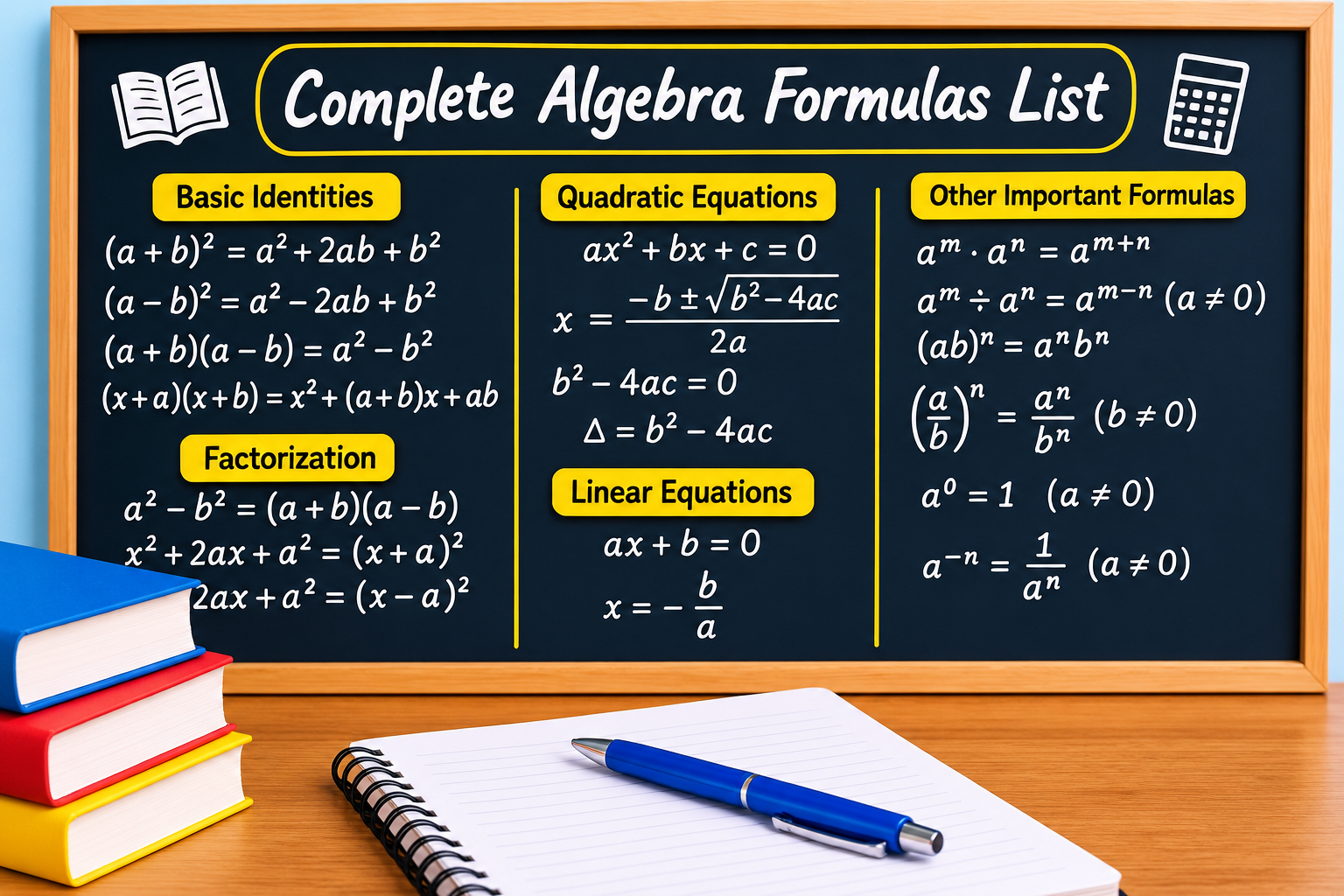
This guide gives you exactly that. You’ll find the most-used algebra formulas, grouped by topic, with short notes on when to use each one. Whether you’re prepping for a school exam, a college course, or a competitive test, this is your go-to cheat sheet.
Grab the PDF version for printing, or bookmark this page for quick lookups.
Quick Overview
| Detail | Information |
|---|---|
| Subject | Algebra |
| Target Grades | High school (9-12), college freshmen, competitive exam aspirants |
| Core Topics | Algebraic identities, exponents, radicals, quadratic equations, logarithms |
| Total Formulas | 50+ |
| Format | Printable PDF cheat sheet |
| PDF Size | [PDF SIZE PLACEHOLDER, e.g., 1.2 MB] |
| Best For | Quick revision, homework checks, exam prep |
How to Use This Formula List
Don’t just read it. Use it.
- Print it and stick it above your desk.
- Cover the right side of each formula and try to recall it.
- Test each rule with small numbers. If a² − b² = (a + b)(a − b), try a = 5 and b = 3. You get 16 on both sides. Now it feels real.
- Solve one problem per formula before moving on.
Full pdf for students
Helinika_Algebra_Formulas_Cheat_Sheet
Understanding beats memorizing every time. Formulas you’ve tested yourself stay in your head far longer.
1. Basic Algebraic Identities
Identities are equations that are true for every value of the variables. They help you expand, simplify, and factor expressions fast.
Square Formulas
(a + b)² = a² + 2ab + b²
(a − b)² = a² − 2ab + b²
a² − b² = (a + b)(a − b)
(a + b)² − (a − b)² = 4ab
(a + b)² + (a − b)² = 2(a² + b²)
Quick example: Expand (x + 4)².
Using the first formula: x² + 2(x)(4) + 4² = x² + 8x + 16
Common slip: Many students write (a + b)² = a² + b². That’s wrong. Don’t forget the middle term, 2ab.
Cube Formulas
(a + b)³ = a³ + 3a²b + 3ab² + b³
(a − b)³ = a³ − 3a²b + 3ab² − b³
a³ + b³ = (a + b)(a² − ab + b²)
a³ − b³ = (a − b)(a² + ab + b²)
Quick example: Factor x³ − 27.
Since 27 = 3³, use the difference of cubes:
(x − 3)(x² + 3x + 9)
Three-Variable Identities
(a + b + c)² = a² + b² + c² + 2ab + 2bc + 2ca
a³ + b³ + c³ − 3abc = (a + b + c)(a² + b² + c² − ab − bc − ca)
If a + b + c = 0, then a³ + b³ + c³ = 3abc. Competitive exams love this shortcut.
Where Factoring Fits In
Most identities above work in two directions. You can expand them, or you can use them in reverse to factor. Factoring is easier when you’re comfortable spotting common factors and shared terms. If that part feels shaky, review What Is a Multiple in Math? Examples and Practice to sharpen your sense of how numbers and terms divide evenly.
2. Exponents and Powers Rules
Exponents show repeated multiplication. In aⁿ, a is the base and n is the exponent.
Core Exponent Laws
aᵐ × aⁿ = aᵐ⁺ⁿ
aᵐ ÷ aⁿ = aᵐ⁻ⁿ     (a ≠ 0)
(aᵐ)ⁿ = aᵐⁿ
(ab)ⁿ = aⁿ × bⁿ
(a/b)ⁿ = aⁿ / bⁿ    (b ≠ 0)
Special Cases
a⁰ = 1               (a ≠ 0)
a⁻ⁿ = 1 / aⁿ         (a ≠ 0)
a¹ = a
Why the Division Rule Matters
When you divide powers with the same base, you subtract the exponents. The result is a quotient. For example:
x⁷ ÷ x³ = x⁷⁻³ = x⁴
If the word “quotient” ever feels fuzzy, What Is a Quotient in Math? Simple Explanation breaks it down in plain language.
Fractional Exponents
A fractional exponent is just a root in disguise.
a^(1/n) = ⁿ√a
a^(m/n) = (ⁿ√a)ᵐ = ⁿ√(aᵐ)
Example: 8^(2/3)
- Take the cube root of 8: 2
- Square it: 2² = 4
Notice that the exponent 2/3 is a proper fraction, with the numerator smaller than the denominator. If you want more practice reading fractions like this, check out What Is a Proper Fraction? Examples Explained.
Pro tip: Take the root first, then the power. The numbers stay smaller and easier to handle.
3. Roots and Radicals Properties
A radical is the root symbol (√). The square root of 25 is 5, because 5 × 5 = 25.
Key Radical Properties
√(ab) = √a × √b          (a, b ≥ 0)
√(a/b) = √a / √b         (a ≥ 0, b > 0)
(√a)² = a                (a ≥ 0)
√(a²) = |a|
ⁿ√(ab) = ⁿ√a × ⁿ√b
ᵐ√(ⁿ√a) = ᵐⁿ√a
Simplifying Radicals
Pull out perfect squares.
Example: Simplify √72.
- 72 = 36 × 2
- √72 = √36 × √2
- = 6√2
Rationalizing the Denominator
You don’t leave a radical in the bottom of a fraction. Multiply top and bottom by the same radical.
1/√a = √a / a
1/(√a + √b) = (√a − √b) / (a − b)
The second formula uses the difference of squares identity from earlier. Everything connects.
Watch out: √(a + b) is not equal to √a + √b. Test it with a = 9 and b = 16. √25 = 5, but 3 + 4 = 7.
4. Quadratic Equation Formula and Discriminant Rules
A quadratic equation looks like this:
ax² + bx + c = 0 (a ≠ 0)The Quadratic Formula
x = (−b ± √(b² − 4ac)) / 2aThis formula works every single time. It’s your safety net.
The Discriminant
The expression under the root is called the discriminant:
D = b² − 4acIt tells you what kind of roots to expect.
| Discriminant | Type of Roots |
|---|---|
| D > 0 | Two distinct real roots |
| D = 0 | One repeated real root |
| D < 0 | No real roots (two complex roots) |
| D is a perfect square | Rational roots (and the quadratic factors neatly) |
Sum and Product of Roots
If the roots are α and β:
α + β = −b/a
α × β = c/a
You can build a quadratic from its roots:
x² − (α + β)x + αβ = 0Example: Roots are 2 and 5.
- Sum = 7, product = 10
- Equation: x² − 7x + 10 = 0
Vertex Form and Vertex Point
y = a(x − h)² + k          Vertex = (h, k)
h = −b / 2a
The vertex is the highest or lowest point of the parabola.
Solving With Fractional Coefficients
Sometimes your coefficients are fractions, like (1/2)x² + (3/4)x − 1 = 0. Multiply the whole equation by the common denominator first. That clears the fractions and makes the formula easier to use. Reviewing What Is a Proper Fraction? Examples Explained can help if fractions slow you down here.
5. Logarithm Properties
A logarithm answers one question: what power do I need?
logₐ(x) = y means aʸ = xFor example, log₂(8) = 3, because 2³ = 8.
Basic Logarithm Rules
logₐ(1) = 0
logₐ(a) = 1
logₐ(aˣ) = x
a^(logₐ x) = x
The Three Power Tools
logₐ(xy) = logₐ(x) + logₐ(y)       Product rule
logₐ(x/y) = logₐ(x) − logₐ(y)      Quotient rule
logₐ(xᵏ) = k · logₐ(x)             Power rule
Example: Simplify log₂(32) − log₂(4).
- Use the quotient rule: log₂(32 ÷ 4) = log₂(8)
- = 3
Change of Base Formula
Your calculator only has log (base 10) and ln (base e). Use this to handle any base:
logₐ(x) = log(x) / log(a) = ln(x) / ln(a)Natural Log Basics
ln(x) = logₑ(x)       where e ≈ 2.71828
ln(e) = 1
ln(eˣ) = x
Remember: You can only take logs of positive numbers. Log of zero or a negative number is undefined in the real number system.
Common Mistakes That Cost Marks
Even top students trip on these. Keep an eye out:
- (a + b)² ≠ a² + b². You need the 2ab.
- √(a + b) ≠ √a + √b. Roots don’t split over addition.
- log(x + y) ≠ log x + log y. Logs split over multiplication, not addition.
- Sign errors in the quadratic formula. If b is negative, −b becomes positive.
- Forgetting a ≠ 0. Without it, the equation isn’t quadratic.
Study Tips for Exam Aspirants
Competitive exams reward speed. Here’s how to build it:
- Group formulas by topic. Review one section per day.
- Make flashcards. Put the name on the front and the formula on the back.
- Practice mixed problems. Real exams don’t tell you which formula to use.
- Time yourself. Aim for under two minutes per medium-level question.
- Re-derive one formula weekly. Proving a formula once makes it unforgettable.
Go Deeper With Trusted References
Want to see how these formulas are proven? The WolframMathWorld Algebra Guide offers precise definitions and advanced proofs for nearly every topic above.
If you prefer a textbook approach, OpenStax College Algebra Reference provides free, peer-reviewed math textbooks with worked examples and practice sets. They’re excellent for building depth after you’ve mastered the basics.
Download Your Free Algebra Formulas PDF
Ready to take this offline?
[DOWNLOAD PDF LINK PLACEHOLDER]
The PDF includes every formula on this page in a clean, printable layout. Print it, fold it into your notebook, or save it on your phone for quick checks before class.
Final Word
You don’t need to cram a hundred formulas overnight. Start with the identities. Add exponents next. Then roots, quadratics, and logs. A little each day beats a long, stressful night before the exam.
Keep this list close, test each rule with real numbers, and watch your confidence grow.
Educational Disclaimer:
This formula list is provided for general informational and academic revision purposes only. While every effort has been made to ensure accuracy, readers should verify formulas against their official textbooks, course materials, or exam syllabi. This content does not replace instruction from a qualified teacher or tutor.