

Circles are everywhere. Pizza. Wall clocks. Car wheels. Coins. The rim of your coffee mug.
At some point, you’ll need to measure one. Maybe it’s a homework question. Maybe you’re buying a tablecloth for a round table or fencing a circular garden bed.
Either way, you need two key measurements: circumference (the distance around) and area (the space inside). Both rely on one special number called pi (π).
This guide walks you through both formulas step by step. You’ll get clear worked examples, reverse problems, real-life uses, and quick practice questions.
Circle Formulas At a Glance
| Detail | Information |
|---|---|
| Subject | Geometry |
| Key Constant | Pi (π) ≈ 3.14 or 22/7 |
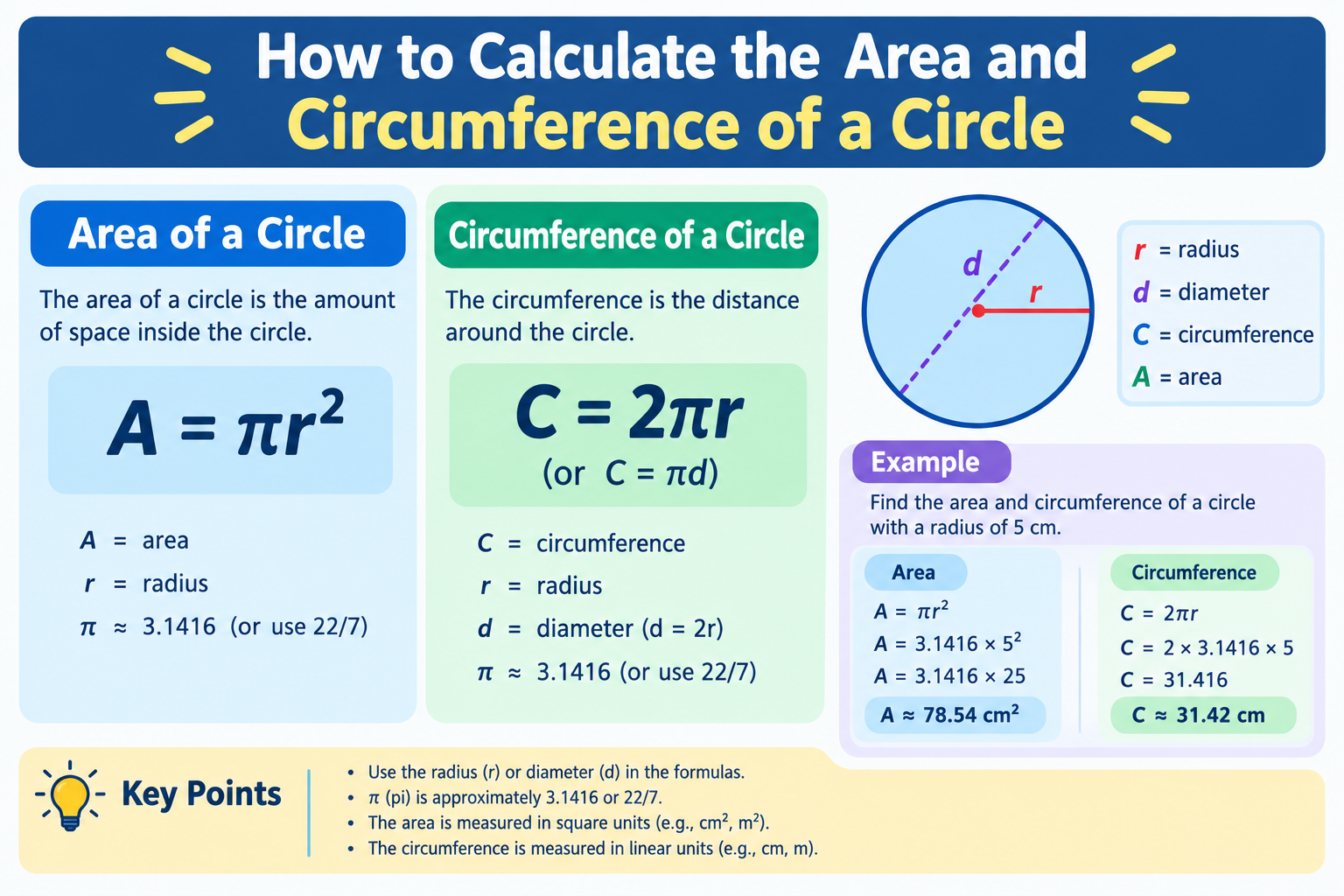
| Circumference (using radius) | C = 2πr |
| Circumference (using diameter) | C = πd |
| Area | A = πr² |
| Radius ↔ Diameter | d = 2r, r = d ÷ 2 |
| Units | Circumference: cm, m. Area: cm², m² |
| Target Readers | Middle school, high school, geometry beginners |
Parts of a Circle You Need to Know
Before using any formula, learn these four terms. Every circle problem uses them.
- Center: The exact middle point of the circle.
- Radius (r): The distance from the center to the edge.
- Diameter (d): The distance straight across the circle, passing through the center.
- Circumference (C): The total distance around the outside edge.
The most important relationship:
Diameter = 2 × Radius     →   d = 2r
Radius = Diameter ÷ 2     →   r = d ÷ 2
The diameter is always exactly twice the radius. Mixing these two up is the number one cause of wrong answers. So always check which one the question gives you.
What Is Pi (π)?
Pi is the star of every circle formula.
Take any circle. Measure its circumference. Divide by its diameter. You’ll always get the same number: about 3.14159…
It doesn’t matter if the circle is a tiny coin or a giant Ferris wheel. The ratio never changes.
Britannica’s article on pi defines pi as the ratio of a circle’s circumference to its diameter. It explains that pi is irrational, meaning it can’t be written as a fraction of two whole numbers, so its decimal digits continue forever without repeating. That’s why, for everyday math, people use handy approximations like 3.14 or 22/7.
Which value should you use?
| Value | When to Use It |
|---|---|
| 3.14 | Most school problems and quick estimates |
| 22/7 | When the radius or diameter is a multiple of 7 |
| π button | When you need a precise calculator answer |
| Leave as π | When the question asks for an “exact answer” (e.g., 25π) |
How to Calculate the Circumference
Circumference is the perimeter of a circle. It tells you how far you’d travel walking once around the edge.
The Formulas
C = 2 × π × r      (when you know the radius)
C = π × d          (when you know the diameter)
Both formulas give the same result. Since d = 2r, the expression 2πr is just πd written another way.
Example 1: Circumference From the Radius
A circle has a radius of 7 cm. Find its circumference. Use π = 22/7.
Step 1: Write the formula.
C = 2πrStep 2: Plug in the values.
C = 2 × 22/7 × 7Step 3: Simplify. The 7s cancel out.
C = 2 × 22
C = 44
Answer: The circumference is 44 cm.
See why 22/7 works so well here? When the radius is a multiple of 7, the fraction cancels cleanly.
Example 2: Circumference From the Diameter
A circular plate has a diameter of 10 cm. Find its circumference. Use π = 3.14.
C = πd
C = 3.14 × 10
C = 31.4
Answer: The circumference is 31.4 cm.
How to Calculate the Area
Area tells you how much flat space the circle covers. Think of paint on a round table or grass in a circular lawn.
The Formula
A = π × r²Key point: r² means r × r. You multiply the radius by itself first, then multiply by π.
That order matters. Exponents come before multiplication. If you need a quick reminder of why, read Understanding PEMDAS / BODMAS: The Ultimate Order of Operations Guide.
Example 3: Area From the Radius
A circle has a radius of 7 cm. Find its area. Use π = 22/7.
Step 1: Write the formula.
A = πr²Step 2: Square the radius.
r² = 7 × 7 = 49Step 3: Multiply by π.
A = 22/7 × 49
A = 22 × 7
A = 154
Answer: The area is 154 cm².
Example 4: Area From the Diameter
A round rug has a diameter of 10 m. Find its area. Use π = 3.14.
Step 1: Convert diameter to radius.
r = 10 ÷ 2 = 5 mStep 2: Square the radius.
r² = 5 × 5 = 25Step 3: Multiply by π.
A = 3.14 × 25
A = 78.5
Answer: The area is 78.5 m².
Never skip Step 1. If you square the diameter instead of the radius, your answer becomes four times too big.
A Handy Way to Picture Circle Area
Here’s a cool fact. Draw a square, then fit a circle perfectly inside it so the circle touches all four sides. The circle covers roughly 78.5% of the square’s area.
Math is Fun’s area of a circle page explains this comparison and shows why it works: a circle’s area equals π/4 times its width squared, while the square’s area is just the width squared. The page also lists alternative area formulas for when you only know the diameter or circumference, and includes a live calculator that converts between all four measurements.
So a circle that’s 10 m wide covers about 78.5% of 100 m², which is 78.5 m². That matches Example 4 exactly. Want to get comfortable working with percentages like this? See How to Calculate Percentage: A Step-by-Step Guide with Examples.
Circumference vs. Area: What’s the Difference?
Students often confuse these two. Here’s the quick breakdown:
| Feature | Circumference | Area |
|---|---|---|
| What it measures | Distance around the circle | Space inside the circle |
| Formula | C = 2πr or C = πd | A = πr² |
| Units | cm, m, inches (length) | cm², m², in² (square units) |
| Real-life example | Fencing around a pond | Grass inside a pond area |
| Memory tip | “Circum” = around | “Area” = covers |
Unit check: If your answer is an area, it must have a little ² on the unit. No ² means something went wrong.
Working Backwards: Finding the Radius
Sometimes a problem gives you the circumference or area and asks for the radius. Just reverse the formula.
Example 5: Radius From Circumference
A circular track has a circumference of 62.8 m. Find the radius and area. Use π = 3.14.
Step 1: Start with the circumference formula.
C = 2πr
62.8 = 2 × 3.14 × r
62.8 = 6.28 × r
Step 2: Divide both sides by 6.28.
r = 62.8 ÷ 6.28
r = 10 m
Step 3: Use the radius to find the area.
A = 3.14 × 10²
A = 3.14 × 100
A = 314 m²
Answer: Radius = 10 m. Area = 314 m².
Example 6: Radius From Area
A circle has an area of 50.24 cm². Find the radius. Use π = 3.14.
Step 1: Start with the area formula.
50.24 = 3.14 × r²Step 2: Divide both sides by 3.14.
r² = 50.24 ÷ 3.14
r² = 16
Step 3: Take the square root.
r = √16
r = 4 cm
Answer: The radius is 4 cm.
Real-Life Problems
Problem 1: The Bicycle Wheel
A bicycle wheel has a diameter of 70 cm. How far does the bike travel in one full turn of the wheel? How far in 100 turns? Use π = 22/7.
One turn equals one circumference.
C = πd
C = 22/7 × 70
C = 22 × 10
C = 220 cm
One turn = 220 cm (2.2 m). 100 turns = 22,000 cm, or 220 meters.
Problem 2: Fencing a Circular Garden
You want to put a fence around a circular flower bed with a radius of 5 m. How much fencing do you need? Use π = 3.14.
C = 2πr
C = 2 × 3.14 × 5
C = 31.4 m
You need 31.4 meters of fencing.
Problem 3: Soil for the Same Garden
Now you want to cover that same 5 m garden with soil. How much ground does it cover?
A = πr²
A = 3.14 × 25
A = 78.5 m²
The garden covers 78.5 square meters.
Notice how the same circle gives two very different answers depending on what you need. Fence = circumference. Soil = area.
Common Mistakes to Avoid
- Using the diameter in A = πr². Always halve the diameter first.
- Squaring after multiplying by π. Square the radius first, then multiply.
- Forgetting square units. Area answers need cm², m², etc.
- Mixing up formulas. Circumference uses 2πr. Area uses πr². Don’t swap them.
- Rounding too early. Keep full numbers until the final step for better accuracy.
- Using 22/7 when it doesn’t simplify. It’s best when the radius or diameter is a multiple of 7.
Quick Formula Summary
Diameter:       d = 2r
Radius:         r = d ÷ 2
Circumference:  C = 2πr  or  C = πd
Area:           A = πr²
Find r from C:  r = C ÷ (2π)
Find r from A:  r = √(A ÷ π)
For more formulas covering squares, triangles, cylinders, and spheres, keep the Geometry Formulas Cheat Sheet: Area, Volume & Perimeter Made Easy handy.
Practice Questions
Use π = 3.14 unless told otherwise.
- Find the circumference of a circle with radius 3 cm.
- Find the area of a circle with radius 6 m.
- A coin has a diameter of 2 cm. Find its area.
- Find the circumference of a circle with radius 14 cm. Use π = 22/7.
- A circle has a circumference of 18.84 m. Find its radius.
Answers:
- 2 × 3.14 × 3 = 18.84 cm
- 3.14 × 36 = 113.04 m²
- r = 1 → 3.14 × 1 = 3.14 cm²
- 2 × 22/7 × 14 = 88 cm
- 18.84 ÷ 6.28 = 3 m
Frequently Asked Questions
What’s the difference between circumference and perimeter?
They mean the same thing. “Circumference” is just the special name for a circle’s perimeter.
Why is pi always the same?
All circles are scaled versions of each other. When a circle grows, its circumference and diameter grow at the same rate, so their ratio stays fixed.
Should I use 3.14 or 22/7?
Follow your teacher’s instructions. If none are given, 3.14 is the standard choice. Use 22/7 when it cancels neatly with multiples of 7.
Can I find area if I only know the circumference?
Yes. First find the radius using r = C ÷ (2π), then plug it into A = πr².
Final Thoughts
Circles look tricky, but they only need two formulas:
- Circumference = 2πr (the distance around)
- Area = πr² (the space inside)
Find the radius first. Pick the right formula. Square before multiplying. Add the right units. That’s it.
Practice a few problems daily, and you’ll be calculating circles in seconds, whether it’s for an exam or a real-life project.
Sources:
📘 Educational Disclaimer
This guide is for general informational and academic revision purposes only. While every effort has been made to ensure accuracy, students should always follow the specific methods, values of π, rounding rules, and answer formats required by their teacher, textbook, or examination board. Answers using approximations such as π ≈ 3.14 or 22/7 may differ slightly from calculator results.