

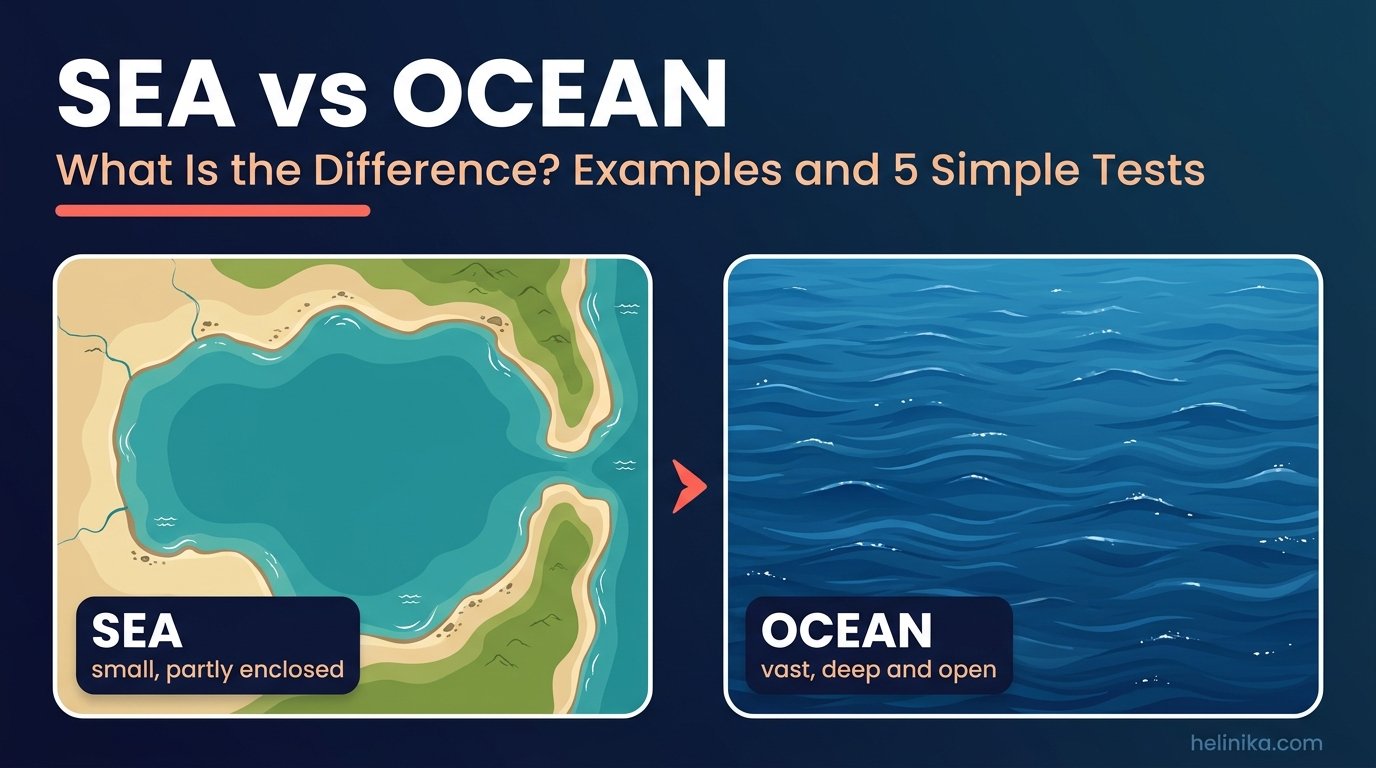
Stand on a beach and look out at the water. Is it a sea or an ocean? Most people shrug and use both words for the same thing. Mapmakers don’t, and the split is real.
The difference between a sea and an ocean comes down to size, depth and how much land wraps around the water. An ocean is a vast, deep, open body of salt water. A sea is a smaller part of an ocean that land partly encloses.
NOAA’s National Ocean Service puts it the same way: seas are smaller than oceans, usually sit where land and ocean meet, and are typically partly enclosed by land.
Here’s the twist most guides skip. The oceans on your globe are really one connected body of water that people have divided into named parts. A sea is simply one of those parts, closer to shore and much smaller. You can read how that division works in our guide to the five named oceans.
This article gives you five easy tests, a worked example with real numbers, and the famous exceptions: a sea with no coastline, a giant “sea” that is often called a lake, and a “sea” that is really a salt lake.
Quick Info
| Topic | Detail |
|---|---|
| Short answer | An ocean is a huge open body of salt water. A sea is a smaller, shallower part of an ocean, partly enclosed by land. |
| The 5 tests | Size, depth, enclosure by land, salinity, and how the name is used |
| Oceans | Pacific, Atlantic, Indian, Southern, Arctic |
| Seas | Mediterranean, Baltic, Bering, Red |
| Biggest exception | Sargasso Sea: a sea with no land boundary |
| Common mistake | Treating every body of water with “Sea” in its name as a true sea |
| Reading time | About 12 minutes |
What Is an Ocean, and What Is a Sea?
Let’s define both words first, then compare them.
What is an ocean?
An ocean is one of the major divisions of Earth’s global body of salt water: huge, deep and open between continents. The five named oceans are the Pacific, Atlantic, Indian, Southern and Arctic. If you’re curious about the land that sits between them, see our explainer on how many continents there are.
Oceans are enormous. The world ocean covers about 139 million square miles and holds roughly 97% of Earth’s water, according to WorldAtlas.
They’re deep, too. NOAA reports an average ocean depth of about 3,682 meters (12,080 feet), with the deepest spot, Challenger Deep in the Pacific’s Mariana Trench, reaching roughly 10,935 meters (35,876 feet).
What is a sea?
A sea is a smaller, usually shallower part of an ocean that sits where the ocean meets land and is partly or mostly enclosed by it. Think of the ocean as a huge room and a sea as an alcove off the side.
The Bering Sea is a clean example. NOAA shows it as part of the Pacific Ocean, and land on several sides keeps it from being open water in every direction.
Sea vs ocean at a glance
| Feature | Ocean | Sea |
|---|---|---|
| Size | World ocean: about 139 million sq mi in total | Mediterranean: about 970,000 sq mi. Baltic: about 149,000 sq mi |
| Depth | Average about 3,682 m. Deepest point about 10,935 m | Mediterranean deepest about 4,900 m. Baltic deepest 459 m |
| Land around it | Spread between continents, with boundaries drawn by convention | Partly or mostly enclosed by land |
| Salinity | About 35 parts per thousand on average | Varies widely: Baltic about 10 at its highest, Mediterranean surface about 38 |
| Examples | Pacific, Atlantic, Indian | Mediterranean, Baltic, Bering, Red |
The 5 Tests That Separate a Sea From an Ocean
No single rule settles every case, so geographers look at several clues together. Run any body of water through these five tests and you’ll usually know which label fits.
Test 1: Size
Oceans are the giants. Each of the five named oceans dwarfs any sea. The Pacific alone is more than 60 times the size of the Mediterranean, one of the largest seas on Earth.
Takeaway: if it’s one of the five giants, it’s an ocean. If it’s a named piece of one, it’s likely a sea.
Test 2: Depth
Seas sit mostly over shallower water near the coast, while oceans plunge to the deep basins. Compare the deepest spots we can measure:
| Body of water | Type | Deepest point (m) | Deepest point (ft) |
|---|---|---|---|
| Baltic Sea | Sea | 459 | 1,506 |
| Caspian Sea | Salt lake often called a sea | 1,025 | 3,360 |
| Mediterranean Sea | Sea | about 4,900 | about 16,000 |
| Challenger Deep, Pacific Ocean | Ocean | about 10,935 | about 35,876 |
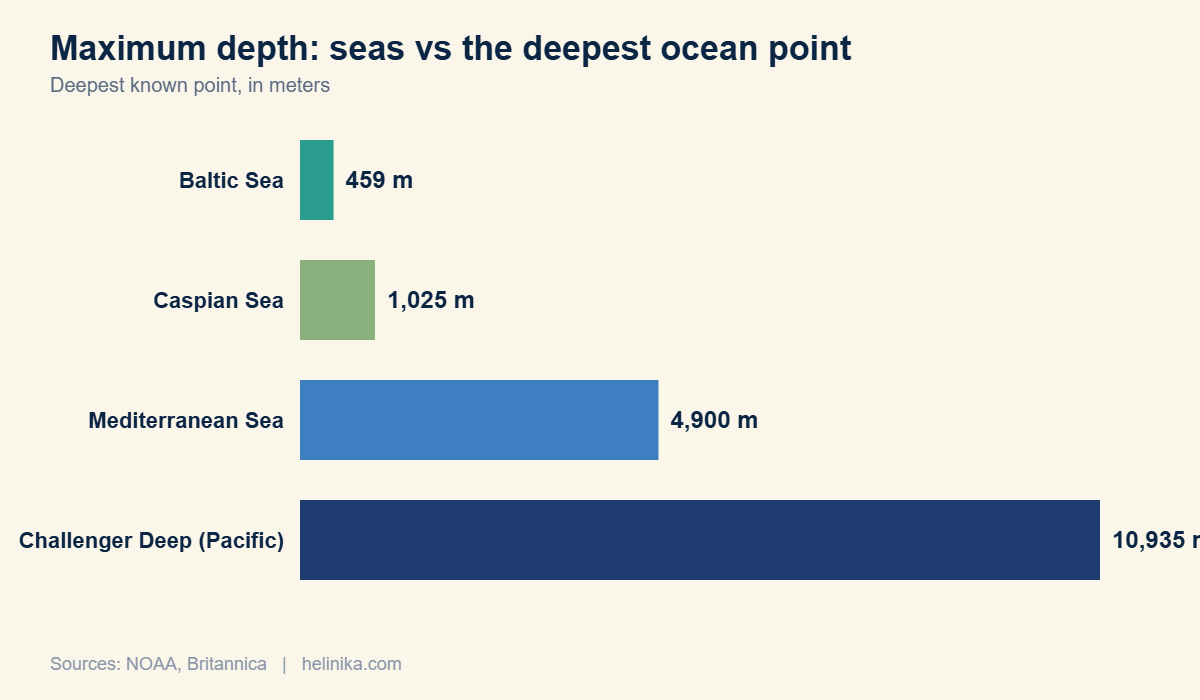
Takeaway: even a deep sea like the Mediterranean tops out at less than half the depth of the deepest ocean point.
Test 3: Land around the water
This is the clearest test. A sea is partly or mostly enclosed by land, and it connects to the ocean through a gap or a wide opening.
The Mediterranean shows the idea well. It links to the Atlantic through the Strait of Gibraltar, which is only about 8 miles (13 km) wide at its narrowest, and a canal ties it to the Red Sea.
Takeaway: the more land hugs the water, the more likely it’s a sea.
Test 4: Salinity
Because seas are small and close to land, rivers, rain and evaporation can change their saltiness a lot. Open ocean water averages about 35 parts per thousand, but seas swing both ways.
The Baltic is nearly landlocked, so rivers keep it fresh. Britannica notes its saltiest water, in the west, is only about 10 parts per thousand at the surface. The Mediterranean goes the other direction: its surface averages about 38 parts per thousand because evaporation outpaces the water that rivers deliver.
Takeaway: a sea’s salt level can differ sharply from the open ocean’s.
Test 5: The name itself
Names came from sailors and mapmakers long before oceanography. That’s why some bodies of water have “Sea” in the name without matching the usual rules, and why you’ll find exceptions in the last section.
Takeaway: treat the name as a clue, not proof. Check size, depth and land first.
Examples of Seas and Oceans
Theory is easier when you can point to a map. Here are real examples, with the ocean each sea belongs to.
Examples of oceans
The five named oceans are the Pacific, Atlantic, Indian, Southern and Arctic. A single ocean can hold several seas. Geography Realm shows the northern Pacific containing the Chukchi Sea, the Bering Sea and the Sea of Okhotsk, all partly enclosed by land.
Examples of seas
| Sea | Parent ocean | What makes it a sea |
|---|---|---|
| Bering Sea | Pacific | NOAA uses it as its example of a sea on an ocean’s margin |
| Mediterranean Sea | Atlantic | Almost landlocked, linked to the Atlantic by a narrow strait, about 970,000 sq mi |
| Baltic Sea | North Atlantic | Semienclosed, shallow and brackish, about 149,000 sq mi |
| Red Sea | Indian | A partly enclosed arm of the Indian Ocean, and one of NOAA’s two named examples |
Notice the pattern. Each sea hangs off a bigger ocean, and land shapes its edges.
One more connection: the Mediterranean and the Red Sea are tied together by the Suez Canal, so two seas from two different oceans meet there.
Same color science, different names
Whether you stand on a sea coast or an ocean shore, water gets its blue from the same physics. If you want the details, read why the ocean looks blue even though a glass of water looks clear.
Worked Example: How Much Smaller Is a Sea Than the Ocean?
Words like “smaller” and “shallower” feel vague, so let’s put numbers on them. We’ll compare the Mediterranean Sea with the world ocean as a whole.
Step 1: Gather the measurements
| Measure | World ocean | Mediterranean Sea | Source |
|---|---|---|---|
| Surface area | about 139,000,000 sq mi | about 970,000 sq mi | WorldAtlas, Britannica |
| Average depth | about 3,682 m | about 1,500 m | NOAA, Geography Realm |
| Deepest point | about 10,935 m | about 4,900 m | NOAA, Britannica |
Step 2: Set up the comparison
To find how many times larger the ocean is, divide the ocean’s value by the sea’s value:
ratio = ocean value ÷ sea value
The ratio tells you how many Mediterranean-sized pieces fit into the ocean for that measure.
Step 3: Compare area
139,000,000 ÷ 970,000 ≈ 143.3. The world ocean is about 143 times larger in area than the Mediterranean.
Step 4: Compare depth
Average depth is a mean: add up many depth readings and divide by how many you took. If you’d like a refresher, see our guide to the mean in statistics.
3,682 ÷ 1,500 ≈ 2.45. The ocean is about 2.5 times deeper on average.
Deepest points tell a similar story: 10,935 ÷ 4,900 ≈ 2.23, so Challenger Deep is about 2.2 times deeper than the Mediterranean’s deepest spot. Against the shallow Baltic (459 m), the same math gives about 23.8 times.
Step 5: Read the result
Here’s the surprise. A large sea is dramatically smaller than the ocean in area (about 143 times) but only moderately shallower (about 2.5 times). Size is the loudest difference, depth the quieter one.
The Mediterranean’s deepest point, about 4,900 m, is even deeper than the ocean’s average depth of 3,682 m. So depth alone can’t define a sea. You need size and land cover as well.
Note: this compares the whole world ocean with one sea. Against the Pacific alone, WorldAtlas says the Pacific is more than 60 times the size of the Mediterranean.
The Famous Exceptions: Sargasso, Caspian and Dead Sea
The tests above work most of the time. These three cases break the pattern, and they’re the ones quiz writers love.
The Sargasso Sea: a sea with no coast
Every other sea is defined at least partly by land. The Sargasso Sea is different. NOAA explains that it sits entirely inside the Atlantic Ocean and is the only sea without a land boundary.
Its edges come from ocean currents instead: the Gulf Stream on the west, the North Atlantic Current on the north, the Canary Current on the east and the North Atlantic Equatorial Current on the south. Because currents shift, its borders move too.
Lesson: a sea doesn’t always need a shoreline. Sometimes water itself draws the border.
The Caspian Sea: sea or lake?
The Caspian is the world’s largest inland body of water, according to Britannica. It covers about 149,200 square miles (386,400 square km), reaches a depth of 3,360 feet (1,025 meters), and its surface sits about 90 feet (27 meters) below sea level.
Britannica also calls it the largest salt lake in the world. It was linked to the world ocean roughly 11 million years ago, but it isn’t connected to any ocean now. Its salinity averages about 12.8 parts per thousand, far lower than the open ocean’s 35.
Lesson: a body of water can look and act like a sea, yet geographers still call it a lake when it’s cut off from the ocean.
The Dead Sea: a sea by name only
The Dead Sea is a landlocked salt lake between Israel and Jordan, not part of any ocean. Britannica reports that its surface sat about 1,410 feet (430 meters) below sea level by the mid-2010s, making it the lowest body of water on Earth’s surface.
Lesson: “Sea” in a name is a label, not a guarantee.
Quick comparison of the three
| Body of water | Connected to an ocean? | What it really is |
|---|---|---|
| Sargasso Sea | Yes, it lies inside the Atlantic | A sea defined by currents, not land |
| Caspian Sea | No | A huge salt lake often called a sea |
| Dead Sea | No | A landlocked salt lake |
Common Myths About Seas and Oceans
| Myth | Reality |
|---|---|
| Seas are always saltier than oceans | No. The Baltic is far less salty (about 10 parts per thousand at most), while the Mediterranean surface is saltier (about 38). |
| A sea is just a small, separate ocean | A sea is a part of an ocean and stays connected to it, apart from special cases like the Caspian. |
| Every sea has a coastline | The Sargasso Sea has none. Currents mark its edges. |
| The Mediterranean is shallow | Its deepest point is about 4,900 m, deeper than the ocean’s average depth of 3,682 m. |
| Anything named “Sea” is a true sea | The Dead Sea is a landlocked salt lake, and the Caspian is often called one too. |
Frequently Asked Questions
Is a sea bigger than an ocean?
No. Oceans are far larger. The world ocean covers about 139 million square miles, while even the Mediterranean, one of the biggest seas, covers about 970,000. A sea is normally a named section of an ocean, so the ocean contains the sea, not the other way around.
Is the Mediterranean a sea or an ocean?
It’s a sea. NOAA names the Mediterranean as one of two examples of a sea, and it connects to the Atlantic Ocean through the narrow Strait of Gibraltar. Land from Europe, Africa and Asia nearly surrounds it, which fits the classic definition of an enclosed sea.
What’s the difference between a sea, a gulf and a bay?
Geography Realm explains that gulfs and bays are marginal water bodies, partly bounded by land. A gulf forms where a large inlet pushes into a landmass. A bay is similar but usually smaller and less enclosed. Many named places break these rules, so treat them as general guides.
Is seawater saltier than ocean water?
Not as a rule. Open ocean water averages about 35 parts per thousand. Seas vary in both directions: the Baltic is much fresher because rivers feed it, while the Mediterranean surface runs about 38 because evaporation is strong.
Why do people use the words sea and ocean interchangeably?
In everyday speech both mean a big stretch of salt water. NOAA notes many people swap the terms, but geography separates them by size and land enclosure. That’s why a beach vacation can be “at the sea” while a map labels the same water as part of an ocean.
Is the Dead Sea a real sea?
No. Britannica describes it as a landlocked salt lake between Israel and Jordan. It has no connection to any ocean, so it doesn’t meet the geographic definition of a sea even though the word is in its name.
Conclusion
An ocean is a vast, deep, open body of salt water. A sea is a smaller, usually shallower part of an ocean that land partly encloses. Size, depth, land cover and salinity give you the clues, and exceptions like the Sargasso, the Caspian and the Dead Sea remind you that names don’t always follow the rules.
Next time you look at a map, ask one question: is land hugging this water? If it is, you’re probably looking at a sea.
Disclaimer
This article is for general educational purposes only. Area, depth and salinity figures vary by source and year, and the worked example uses published figures rounded for clarity. For navigation, legal or scientific work, consult official charts and a qualified oceanographer.