

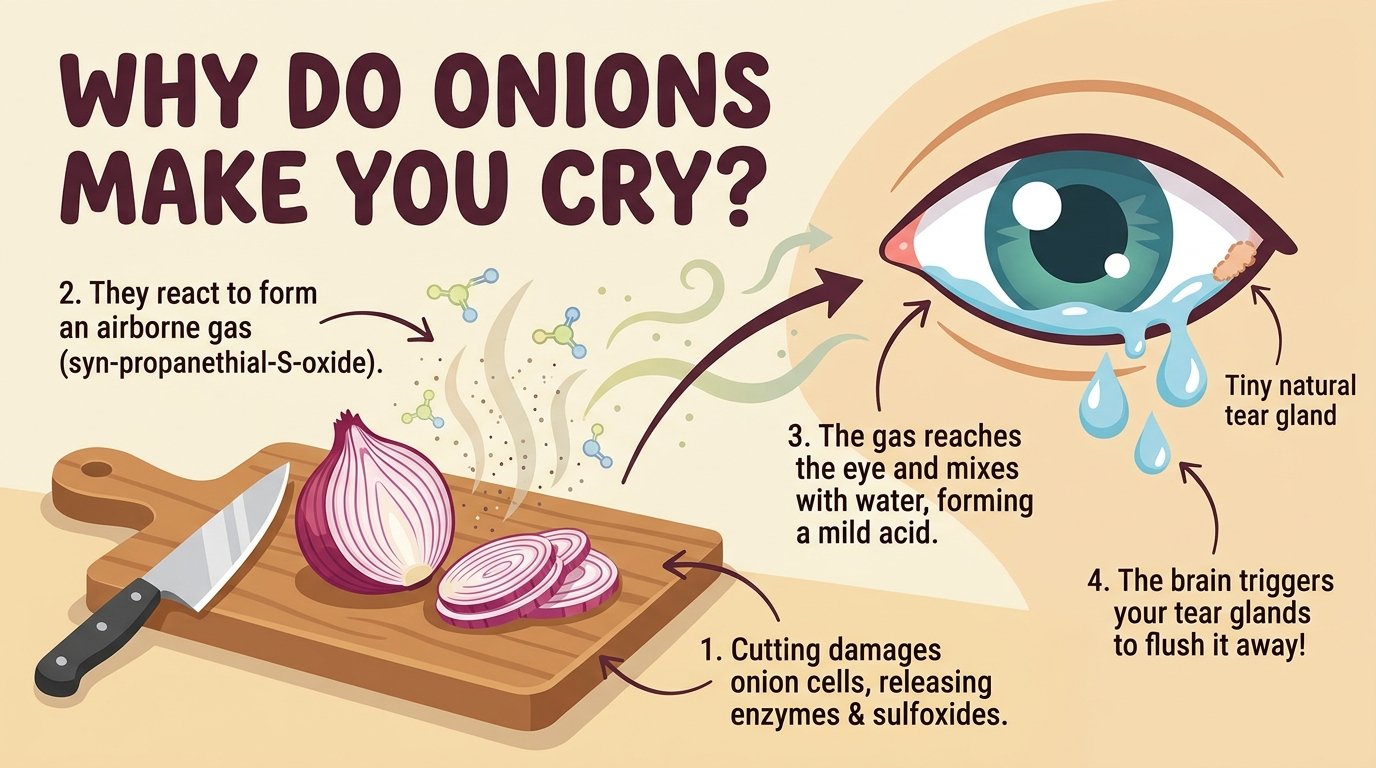
You slice into an onion, and within seconds your eyes sting and water. Nobody is sad. Your eyes are reacting to a chemical the onion throws into the air the moment the knife goes in.
So, why do onions make you cry? Cutting breaks open the onion’s cells, which lets enzymes meet sulfur-rich compounds and produce a gas called syn-propanethial-S-oxide. When that gas reaches your eyes, nerves there sound an alarm, and your brain sends tears to rinse it away.
The good news is that you can reduce how much gas reaches your face. This guide walks through the chemistry step by step, explains what new lab research says about how onions spray droplets, ranks eight prevention tips by evidence, and shows a worked example you can copy to test them fairly in your own kitchen.
Quick Info
| Topic | Detail |
|---|---|
| Short answer | Cutting an onion releases an irritating gas that triggers reflex tears |
| Irritant | Syn-propanethial-S-oxide, a volatile sulfur compound |
| Where it comes from | Sulfur the onion absorbs from the soil, plus enzymes released when cells break |
| Why your eyes water | Eye nerves detect the irritant, and the brain triggers tears to flush it out |
| Best-supported fix | A sharp knife and slower cuts, which release fewer and slower droplets |
| Common mistake | Trusting folk tricks such as a lit match or a slice of bread |
| Reading time | About 10 minutes |
Why Onions Make You Cry: The Short Answer
An onion is a plant that stores two things in separate places: sulfur-containing compounds and the enzymes that can change them. While the onion is whole, those two never meet.
Your knife changes that. Slicing breaks cells open, the enzymes reach the sulfur compounds, and a short chain of reactions begins. A few seconds later, a gas is drifting up from the cutting board toward your eyes.
Three things then happen almost at once:
- The gas escapes. It is volatile, which means it turns to vapor easily.
- Your eye nerves react. The surface of your eye is packed with sensitive nerve endings.
- Your brain orders tears. The tears wash the irritant away, which is why the stinging fades when you step back.
The Chemistry, Step by Step
Encyclopaedia Britannica lays out the process in five stages. Here they are as a table, followed by the plain-language version.
| Stage | What happens | Where it happens |
|---|---|---|
| 1. Sulfur uptake | The growing onion absorbs sulfur from the soil and builds it into amino acids | In the soil and the onion’s roots |
| 2. Cell rupture | Cutting releases the liquid inside cells, so enzymes meet those amino acids | At the knife edge |
| 3. First product | The enzymes turn the amino acids into unstable sulfenic acids | In the cut onion |
| 4. Rearrangement | Sulfenic acids rearrange into syn-propanethial-S-oxide | In the cut onion |
| 5. Irritation | The compound vaporizes, drifts upward and stings your eyes | In the air and on your eye |
You can read the full explanation in Britannica’s story on why onions make you cry.
Think of it like a two-part glue. Each part is harmless alone, but once you mix them, a reaction starts. The onion keeps the parts apart until something damages it, such as a hungry animal or your chef’s knife.
Why Your Eyes Water: A Reflex, Not a Feeling
The tears you shed over onions are called reflex tears. Healthline describes them as a way to flush the irritant out of your eyes, and notes that they are not emotional tears.
A reflex works without any decision from you. The nerve signals that make your fingertips wrinkle in a bath are automatic too, as our guide on why fingers wrinkle in water explains. Your body does many things on autopilot, from reflex tears to catching a yawn when someone nearby yawns.
This also explains why onion tears feel so different from sad tears. They arrive fast, they come with stinging, and they stop soon after the gas clears.
The New Physics: How an Onion Sprays You
For years, the chemistry was the whole story. Then researchers led by Sunghwan Jung at Cornell University asked a different question: how does the irritant physically get out of the onion? Their results appeared in the Proceedings of the National Academy of Sciences, and an early version is public on arXiv.
The team built a guillotine-style rig with a thin steel blade, then filmed cuts at 5,000 to 20,000 frames per second. They found that droplets leave the onion in two stages. First, pressure builds inside the outer layer and ejects a fast burst. Then thin threads of liquid break into smaller droplets in the air. The initial droplets leave at roughly 1 to 40 meters per second.
Here is how the blade changed the result:
| What changed | Range tested | Effect on droplets |
|---|---|---|
| Cutting speed | 0.44 to 2.03 m/s | About 4 times more droplets at the faster speed |
| Blade tip radius (bluntness) | 0.91 to 13.3 micrometers | Up to 40 times more droplets with the blunter tip |
| Blade sharpness overall | Sharp versus blunt | Sharper blades gave fewer and slower droplets |
Physics World adds that droplets can rise as high as 60 centimeters, which is well above a typical cutting board and right at face height if you lean over it. See the Physics World report for the details.
One caution: the experiment used a steel guillotine blade, not a hand-held chef’s knife, and the paper reports small sample counts for some measurements. Treat the results as strong evidence for a direction (sharper and slower is better), not as exact numbers for your kitchen.
8 Ways to Prevent Onion Tears, Ranked by Evidence
Not every tip works equally well. This table sorts them by how well the claim is supported.
| Tip | Why it may help | Evidence |
|---|---|---|
| Use a sharp knife | Fewer, slower droplets | Lab study |
| Cut slowly | About 4 times fewer droplets than fast cuts | Lab study |
| Run a fan or hood | Moves vapor away from your face | Reasonable, suggested by Healthline |
| Wear goggles | Blocks vapor from reaching your eyes | Reasonable, suggested by Healthline |
| Pick sweet onions | Less sulfur, so less irritant | Britannica |
| Chill the onion | Slows the reactions, but see the debate below | Mixed |
| Rinse your eyes | Relieves irritation after it starts | Healthline |
| Match, bread, mouth breathing | No real effect | Britannica, Healthline |
Sharpen the knife and slow down
This is the best-supported tip. A sharp blade slices cleanly instead of crushing, so less liquid is forced out of the onion. Slower cuts reduce the pressure that sprays droplets. A honing steel or a quick pass on a sharpening stone is enough to see the difference.
Move the air
A fan or a cooking hood pulls vapor away before it reaches your eyes. Healthline lists ventilation as a way to help. Even opening a window and working near it can shift the gas away from you.
Protect your eyes
Goggles block vapor physically. They look a little silly, but they do not depend on the onion or the knife. If you chop onions often, they are the most reliable backup.
Choose a milder onion
Britannica notes that sweet onions are less sulfurous and less likely to make you cry. Less sulfur in the onion means there is less raw material to turn into irritant.
The chilling debate
Here the sources disagree. Britannica says chilling or freezing an onion slows the enzymes behind the reaction. Healthline says soaking an onion in ice water for about 30 minutes may help.
However, the Cornell results as reported by Physics World found that chilled onions produced more droplets at similar speeds, and the researchers suggested thinking twice about refrigerating onions before cutting. So chilling may slow the chemistry yet increase the spray. If you chill an onion, also use a sharp knife and good airflow.
Rinse for relief
If your eyes already sting, cool, clean water or lubricating eye drops can ease the irritation, according to Healthline. Keep your hands away from your eyes while you cook, because they can carry onion juice.
Worked Example: A Fair Onion Tear Test
Want to find out which tip works best in your own kitchen? Test them fairly. The scenario below is illustrative: the numbers are made up to show the method, not measured results.
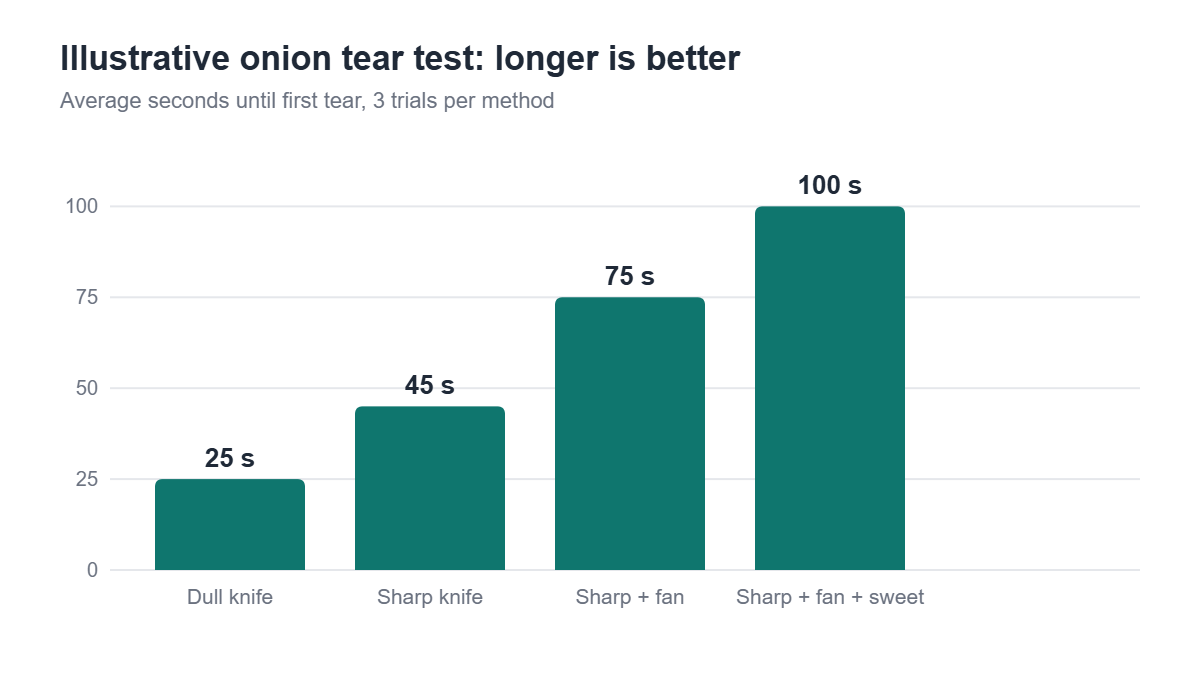
You time how many seconds pass after you start cutting until your eyes first sting. A longer time means the method works better. You repeat each method three times.
Step 1: Name the variables
The method you use (dull knife, sharp knife, and so on) is a categorical variable, because it sorts trials into groups. The seconds until your first tear is a numerical variable, because it is measured on a scale. Our guide on what a variable in statistics is covers both types.
Step 2: Record the trials
| Method | Trial 1 (s) | Trial 2 (s) | Trial 3 (s) |
|---|---|---|---|
| Dull knife, room temperature | 20 | 25 | 30 |
| Sharp knife, room temperature | 40 | 45 | 50 |
| Sharp knife + fan | 70 | 75 | 80 |
| Sharp knife + fan + sweet onion | 95 | 100 | 105 |
Step 3: Add each row
- Dull knife: 20 + 25 + 30 = 75
- Sharp knife: 40 + 45 + 50 = 135
- Sharp knife + fan: 70 + 75 + 80 = 225
- Sharp knife + fan + sweet onion: 95 + 100 + 105 = 300
Step 4: Divide by 3 to get the average
| Method | Average time to first tear |
|---|---|
| Dull knife | 75 ÷ 3 = 25 seconds |
| Sharp knife | 135 ÷ 3 = 45 seconds |
| Sharp knife + fan | 225 ÷ 3 = 75 seconds |
| Sharp knife + fan + sweet onion | 300 ÷ 3 = 100 seconds |
Step 5: Compare
Moving from the dull knife to the full combination adds 100 − 25 = 75 seconds. That is four times as long (100 ÷ 25 = 4) before the first sting. Sharpening the knife alone adds 45 − 25 = 20 seconds.
Step 6: Check the limits
Three trials with one cook and one onion are a small sample. If you tested only your own eyes on one afternoon, the result might not apply to anyone else, which is how a biased sample sneaks into everyday experiments. To make the test fairer, use onions of the same size and age, keep the room the same, and take a break between trials so your eyes recover.
Takeaway: stack small fixes. No single tip is magic, but sharp knife, slow cuts and good airflow together can change a kitchen from teary to comfortable.
Common Myths About Onion Tears
| Myth | Reality |
|---|---|
| Lighting a match near the cutting board stops tears | Britannica lists tricks like this as considerably less effective or not effective at all |
| Chewing bread while you cut prevents tears | Healthline says there is no supporting evidence for the bread tip |
| Breathing through your mouth stops tears | Britannica lists it among the tricks that are considerably less effective or not effective at all |
| Onion tears mean you are sensitive | They are a normal reflex, not an emotional response |
| Chilling always helps | Evidence is mixed: it may slow the chemistry yet raise droplet counts |
| All onions are equally tearful | Sweeter, lower-sulfur varieties tend to cause fewer tears |
Frequently Asked Questions
Are onion tears the same as sad tears?
No. Onion tears are reflex tears, an automatic response to an irritant. Healthline says they are not emotional tears. They start fast, come with stinging, and stop soon after the gas clears or you move away. Sad tears are triggered by feelings, not by something touching your eye.
Does putting an onion in the fridge stop tears?
Maybe, but the evidence is mixed. Britannica says chilling slows the enzymes that make the irritant. On the other hand, Physics World reports that the Cornell researchers saw more droplets from chilled onions. If you chill onions, pair it with a sharp knife, slow cuts and a fan to cover both sides.
Do sweet onions really make you cry less?
Usually, yes. According to Britannica, sweet onions are less sulfurous and less likely to cause tears. Less sulfur leaves less raw material for the irritant. They are not tearless, so you may still need the other tips.
How far can onion droplets travel?
Physics World reports that droplets can reach up to 60 centimeters high. The Cornell team measured initial speeds of about 1 to 40 meters per second. That means leaning close to the cutting board puts your eyes right in the spray zone.
Does cutting an onion under water work?
Some cooks swear by it because the water keeps the irritant out of the air. We found no lab test that measures it, so treat it as unproven. A sharp knife, slow cuts and good ventilation have far better support.
Can onion tears damage my eyes?
Onion irritation is usually temporary and fades once the gas clears. Rinsing with cool, clean water can ease the sting, as Healthline notes. If pain, redness or blurred vision lasts well after you stop cutting, see a doctor or eye care professional.
Conclusion
Onions make you cry because cutting them starts a chemical chain reaction that ends in an irritating gas, and new physics shows the blade decides how much of it sprays out. The tears are a reflex that rinses your eyes, nothing more.
You do not have to suffer through it. Sharpen the knife, cut slowly, move the air, and choose a sweeter onion when you can. Next time you reach for an onion, ask yourself: what is the one change I can make before the first cut?
References
- Encyclopaedia Britannica. Why Do Onions Make You Cry?
- Healthline. Why Do Onions Make You Cry?
- Jung, S. and colleagues. Droplet Outbursts from Onion Cutting. arXiv preprint 2505.06016.
- Physics World. The physics behind why cutting onions makes us cry. October 10, 2025.
Disclaimer
This article is for general educational purposes only. The tear-test numbers in the worked example are illustrative, not measured results. If eye pain, redness or blurred vision continues after cutting onions, consult a doctor or eye care professional.