

You’re sitting in class, or in a quiet meeting, and someone across the room opens wide in a long, slow yawn. A few seconds later, you feel it coming too. You try to hold it back. You fail. And now the person next to you is yawning as well.
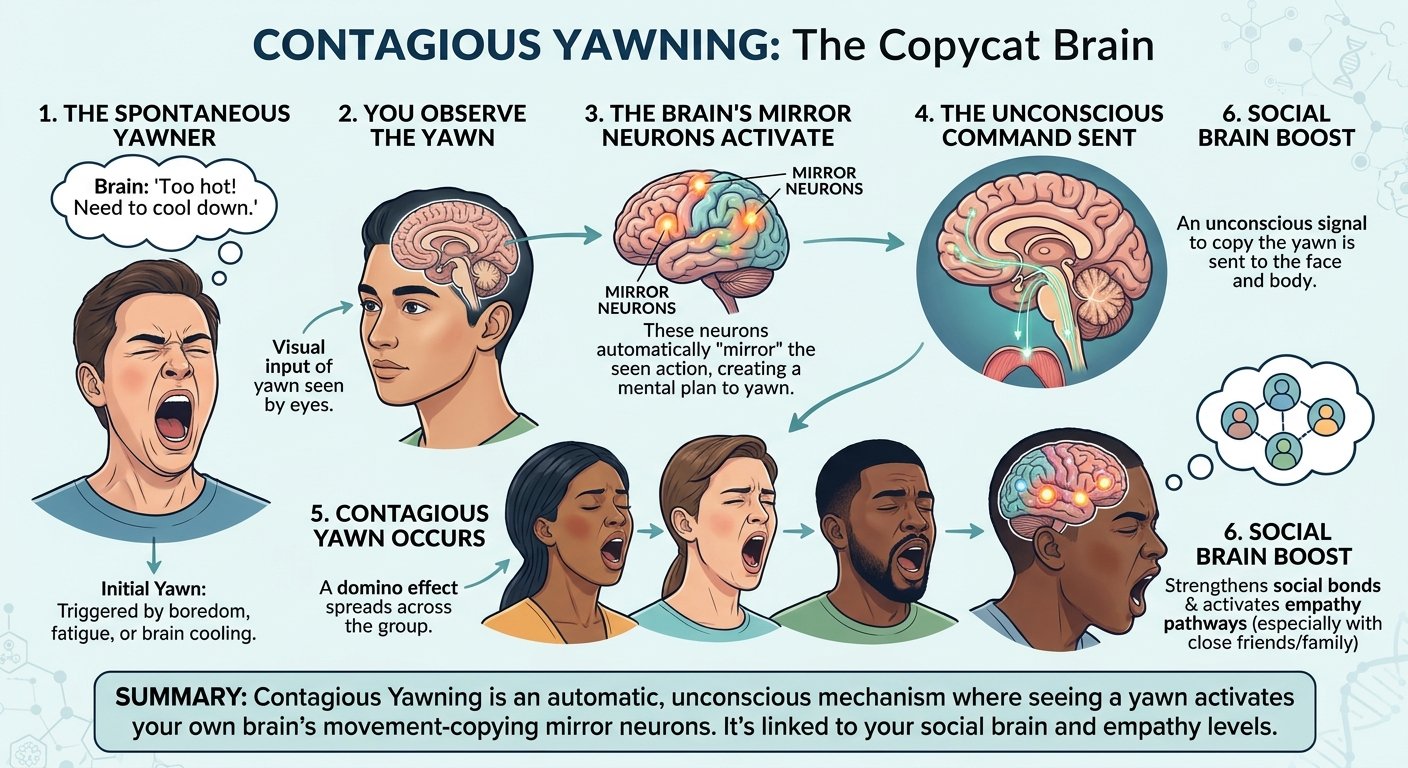
Here is the short answer to why do we yawn when we see someone else yawn: scientists think it’s a built-in social reflex. Seeing a yawn seems to switch on brain areas that copy other people’s actions, and it works best between people who are close. Researchers still debate the exact reason, but the leading ideas point to social bonding and keeping a group alert together.
Even reading about yawning can set one off. If you’ve yawned once already, you’re in good company.
In this guide you’ll learn what contagious yawning is, the main theories behind it, what real studies have found, a step-by-step “yawn chain” model, who catches yawns most easily, and the myths worth dropping.
Quick Info
| Topic | Detail |
|---|---|
| Short answer | Seeing a yawn triggers a social copying reflex in the brain |
| Science name | Contagious yawning (or yawn contagion) |
| How common it is | In one large lab study, about 68% of adults yawned while watching yawn videos |
| Who you catch it from most | Family and close friends, then acquaintances, then strangers |
| Biggest surprise | Age predicted it better than empathy or tiredness |
| Common mistake | Thinking you yawn because the room is low on oxygen |
| Reading time | About 11 minutes |
What Is Contagious Yawning?
Contagious yawning is when you yawn because you saw, heard or even thought about someone else yawning, rather than because you were tired or bored.
Scientists split yawns into two kinds:
| Type | What triggers it | Example |
|---|---|---|
| Spontaneous yawn | Your own body state, like sleepiness, boredom or waking up | Yawning at your desk late at night |
| Contagious yawn | Seeing, hearing, reading about or thinking about another yawn | Yawning seconds after your friend does |
Spontaneous yawning is very old. Many animals do it, including fish, reptiles and birds. Contagious yawning is much rarer. It shows up mainly in humans and some social animals, such as chimpanzees and dogs.
That rarity is a big clue. If catching yawns only happens in social species, it probably has something to do with living in groups.
What actually happens in a yawn
A yawn is more than an open mouth. You take a long, deep breath in, your jaw stretches wide, the muscles in your face and neck tighten, and then you breathe out quickly. Your eyes may water. Many people stretch their arms at the same time.
The whole thing usually lasts about six seconds. That’s long enough for someone watching to notice it, and that’s where contagion begins.
Why Do Yawns Spread? The Main Theories
There’s no single proven answer yet. Here are the ideas scientists take most seriously.
Theory 1: Your brain’s copying system
Our brains contain networks that respond both when we do something and when we watch someone else do it. Some researchers call these mirror systems, built around so-called mirror neurons.
When you watch a yawn, parts of that copying network may light up as if you were yawning yourself. Sometimes the signal is strong enough that your body follows through.
It’s a little like how you might wince when you see someone stub a toe. Your brain partly acts out what it sees.
Theory 2: Social bonding and empathy
Yawns seem to travel along social ties. People catch yawns more often from family and friends than from strangers.
That pattern led many researchers to link contagious yawning to empathy, the ability to tune in to what others feel. The link is real in some studies but weak or missing in others, so scientists now treat empathy as one possible piece rather than the full answer.
Theory 3: Keeping the group alert
Another idea is that yawning helps a group switch states together, such as going from resting to active, or staying watchful at the same time.
Some researchers think a yawn may briefly boost alertness. If one member of a group yawns and the others follow, everyone gets that small boost at once, which could help a group spot danger.
Theory 4: Brain cooling
One well-known theory says yawning helps cool the brain. The deep breath of cool air and the stretch of the jaw may increase blood flow and swap warmer blood for cooler blood.
If that’s true, contagious yawning could be a way for a group to “cool down” and sharpen up together. The theory is supported by some studies on temperature and yawning, which we’ll look at below, but it’s still debated.
The theories at a glance
| Theory | Main idea | How strong is the evidence? |
|---|---|---|
| Copying system | The brain mirrors actions it sees | Moderate; brain-scan results are mixed |
| Social bonding | Yawns spread more between close people | Fairly strong for the closeness pattern |
| Group alertness | A shared yawn keeps a group in sync | Early but growing |
| Brain cooling | Yawns cool the brain, and catching them helps groups cool together | Some support from temperature studies; still debated |
What the Research Actually Shows
Scientists have tested contagious yawning in labs and in everyday life. Three studies stand out.
Study 1: About two in three adults catch yawns
In a 2014 study, researchers had 328 healthy adults, aged 18 to 83, watch a three-minute video of people yawning. Of those, 222 people (about 68%) yawned at least once. The number of yawns per person ranged from 0 to 15.
The biggest surprise came next. Age, a variable the researchers measured alongside empathy, tiredness and energy, was the only factor that clearly predicted contagious yawning: younger people yawned more. The other factors did not explain it once age was taken into account. Even so, age explained only about 8% of the differences between people.
You can read the full results in Bartholomew and Cirulli’s 2014 PLOS ONE study on contagious yawning susceptibility, which also found that people who catch yawns tend to keep doing so when tested again.
That last point matters. Whether you’re a “yawn catcher” seems to be a fairly stable trait, a bit like being naturally tall or short.
Study 2: Family first, strangers last
A 2011 study took a different approach. Instead of using videos, researchers watched 109 adults in daily life, at work, during meals, in waiting rooms and on public transport, for about a year.
They found that yawns spread most often between family members and life partners, then between friends, then acquaintances, and least between strangers. People also caught yawns faster from friends and family than from strangers or acquaintances. Sex, nationality and setting didn’t make a meaningful difference.
The details are in Norscia and Palagi’s 2011 study “Yawn Contagion and Empathy in Homo sapiens”, published in PLoS ONE and available free through the US National Library of Medicine.
Study 3: Yawns change with the weather
To test the brain-cooling idea, researchers in Tucson, Arizona, asked 160 people outdoors to look at pictures of people yawning. Half were tested in winter, when it averaged about 71°F, and half in summer, when it averaged about 98.6°F, roughly body temperature.
Nearly half of people yawned in the winter session, but fewer than a quarter did in summer. The idea is that when the outside air is as warm as your body, a yawn can’t cool your brain, so you’re less likely to do it.
Princeton University’s summary of that work appears on ScienceDaily’s report “Yawning may cool the brain”, based on research by Andrew Gallup and Omar Eldakar.
Why these studies look at averages
Notice that each study reports group patterns, not rules for every person. The 2014 study, for example, reported an average of about 2.7 yawns per person. If you’re curious how that kind of average, or mean, is worked out, our statistics guide explains it step by step.
The way people are chosen matters too. Lab volunteers watching videos may not behave like people on a busy bus. Our guide to what a biased sample is shows why researchers worry about who ends up in a study.
Worked Example: How a Yawn Spreads Through a Room
Let’s model a quiet meeting and see why one yawn so often turns into several. The numbers here are illustrative, chosen to fit the general range researchers report, not taken from any single study.
Step 1: Set the scene
Eight people sit around a table. One person yawns. The other seven all see it.
Step 2: Pick a catch chance
Assume each person who sees the yawn has a 40% chance (0.4) of catching it within the next minute. Each person reacts on their own.
Step 3: Find the chance that nobody catches it
The chance one person does not catch it is 1 − 0.4 = 0.6. For all seven to resist:
chance nobody yawns = (1 − p)^n
                    = (0.6)^7
                    ≈ 0.028, or about 2.8%
Here, p is the chance one person catches the yawn, and n is how many people saw it. The small raised number means you multiply 0.6 by itself seven times.
So there’s about a 97% chance that at least one more person yawns.
Step 4: Find the expected number of new yawns
On average, the number of people who catch the yawn is:
expected new yawns = n × p
                   = 7 × 0.4
                   = 2.8 people
Here’s how likely each outcome is in this model:
| New yawners (out of 7) | Chance |
|---|---|
| 0 | 2.8% |
| 1 | 13.1% |
| 2 | 26.1% |
| 3 | 29.0% |
| 4 | 19.4% |
| 5 or more | 9.6% |
Step 5: Watch the chain grow
Those two or three new yawns are now seen by the others, giving each person another chance to catch one. That’s why a single yawn in a quiet room can roll around the table for a minute or two.
Make the group a family instead of strangers, and the catch chance goes up, so the chain spreads faster. That fits what real-world studies found about closeness.
Who Catches Yawns Most (and Least)?
Contagious yawning isn’t the same for everyone. Here’s what research and expert reviews suggest.
| Factor | Effect on catching yawns |
|---|---|
| Closeness to the yawner | Strong: family and friends spread yawns most |
| Age | Younger adults tend to catch more yawns than older adults |
| Paying attention | Looking at the yawner’s face makes contagion more likely |
| Air temperature | Fewer contagious yawns when the outside air is as warm as the body |
| Personal “yawn catcher” trait | Fairly stable over time for each person |
| Empathy | Linked in some studies, but not in others |
| Tiredness | Surprisingly weak link in controlled studies |
Can animals catch yawns from us?
Some can. Dogs, in particular, have been reported to yawn more after watching familiar people yawn than after watching strangers. Chimpanzees and some other social animals catch yawns from each other too.
That cross-species pattern supports the idea that contagious yawning grew out of social life, not just tiredness.
Common Myths About Yawning
| Myth | Reality |
|---|---|
| We yawn because we need more oxygen | Studies have not found that low oxygen or high carbon dioxide reliably triggers yawning |
| Yawning means you’re bored or rude | Yawns can be spontaneous or contagious, and they’re largely automatic |
| If you don’t catch yawns, you lack empathy | Many people with normal empathy rarely catch yawns; age and attention matter more in some studies |
| Only tired people catch yawns | Controlled studies found tiredness explains little once age is considered |
| Contagious yawning is just in humans | Chimpanzees, dogs and some other social animals show it too |
| You can always stop a yawn by force | A yawn can be partly held back, but it’s very hard to stop once it starts |
Frequently Asked Questions
Why do I yawn when I read about yawning?
You don’t need to see a yawn to catch one. Reading the word, hearing a yawn or even thinking about one can trigger the same reflex. Your brain seems to bring up a picture or memory of yawning, and that’s enough to start the copying system. That’s why many people yawn while reading articles like this one.
Is it true that contagious yawning shows empathy?
Partly. Yawns do spread more between close family and friends, which fits an empathy link. But a large 2014 study of 328 adults found empathy didn’t predict who caught yawns once age was considered. Most researchers now see empathy as one possible factor, not proof. Not catching yawns doesn’t mean someone is uncaring.
Can you catch a yawn from a pet?
It mostly works the other way around. Dogs have been reported to catch yawns from their owners more than from strangers. Some pet owners say they catch yawns from their dog or cat too. That’s very plausible, since humans can catch yawns from many cues, but there’s much less research on people catching yawns from animals.
Why can’t I stop yawning once it starts?
A yawn is largely an automatic reflex controlled by deep, older parts of the brain. Once it begins, the jaw, breathing and face muscles move through a set pattern. You can make it smaller or hide it behind your hand, but fully stopping it is hard. Trying to hold it back often just makes it feel less satisfying.
Do some people never catch yawns?
Yes. In the 2014 study, about one in three adults didn’t yawn at all during a three-minute yawn video. Researchers found that people tended to stay in the same group when tested again, so not catching yawns seems to be a stable personal trait. It isn’t a sign of a health problem on its own.
Is yawning a lot a sign of a health problem?
Usually not. Most yawning is linked to sleepiness, boredom or simply seeing others yawn. But very frequent yawning that’s new, lasts for days, or comes with dizziness, fainting, chest pain or other symptoms can sometimes point to a medical issue or a medication side effect. In that case, talk to a doctor.
Conclusion
We catch yawns because our brains are wired to copy the people around us, especially the people we’re closest to. Researchers don’t yet agree on exactly why, with social bonding, group alertness and brain cooling all in the running. Real studies show it’s common, about two in three adults in one large lab test, and that age and closeness matter more than tiredness.
Next time a yawn sweeps through a room, ask yourself: who yawned first, and how close are you to them? The answer may tell you a lot about why you couldn’t resist.
Disclaimer
This article is for general educational purposes only. The catch chances and numbers in the worked example come from a simple illustrative model, not a real study. It is not medical advice: if you notice frequent yawning with other symptoms, consult a doctor.