

You stay in the bath or pool a little too long, look down, and your fingertips look like raisins. Most people grow up hearing that skin “soaks up water” and puckers like a wet sponge. It sounds right. It’s also mostly wrong.
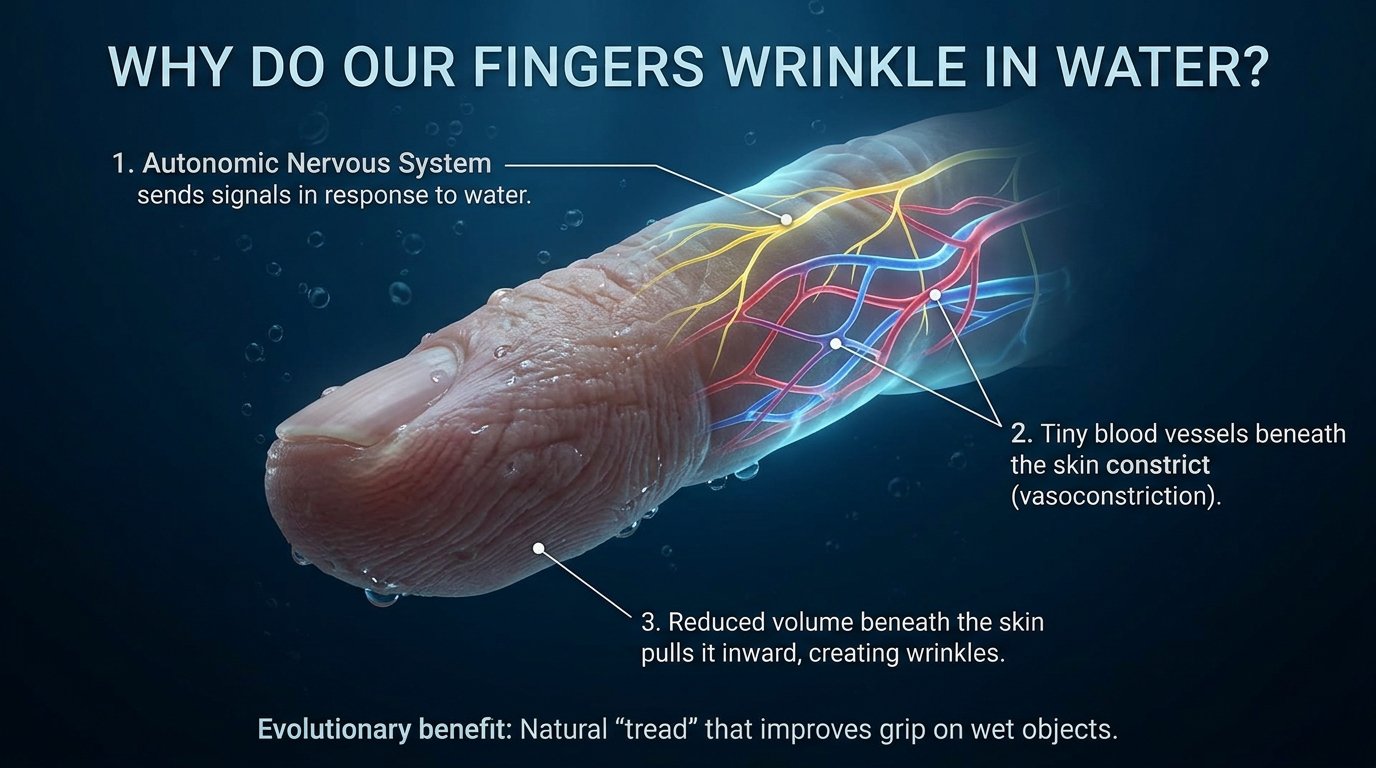
Here is the short answer to why do our fingers wrinkle in water: your nervous system does it on purpose. After a few minutes in water, nerves in your fingers signal tiny blood vessels under the skin to narrow. The soft pads of your fingertips shrink a little, and the skin on top folds into wrinkles.
The proof is surprising. People with damaged nerves in their fingers don’t get wrinkly at all, no matter how long they soak.
In this guide you’ll learn the old theory and why it failed, the step-by-step nerve process, why wrinkles might help you grip, how doctors use wrinkly fingers as a medical test, and the myths worth dropping.
Quick Info
| Topic | Detail |
|---|---|
| Short answer | Nerves tell blood vessels in your fingertips to narrow, so the pads shrink and the skin folds |
| Science name | Water-induced skin wrinkling (often called “pruney fingers”) |
| Body system in charge | The autonomic (automatic) nervous system, through sympathetic nerves |
| When it starts | Usually within about 5 to 30 minutes of soaking |
| Possible purpose | Better grip on wet objects (still debated) |
| Big clue | Fingers with damaged nerves don’t wrinkle |
| Reading time | About 10 minutes |
The Old Theory: Skin Soaks Up Water Like a Sponge
For a long time, the common explanation went like this. The outer layer of your skin absorbs water, swells up, and has nowhere to go, so it buckles into wrinkles.
There’s a grain of truth in it. The outermost skin layer does soak up some water. But that idea can’t explain the full picture, and one discovery from the 1930s knocked it down.
The clue that broke the sponge theory
Doctors noticed something strange in patients whose finger nerves had been cut or damaged. When those patients soaked their hands, the fingers with healthy nerves wrinkled as usual, but the fingers with damaged nerves stayed smooth.
That’s a big deal. If wrinkling were just water soaking into skin, nerve damage shouldn’t matter at all. Skin would swell either way.
Nature’s science news team summed up the history plainly: researchers have known since the 1930s that the effect doesn’t happen when there is nerve damage in the fingers, and the wrinkling is caused by blood vessels constricting below the skin.
That summary comes from Nature’s 2013 news story “Science gets a grip on wrinkly fingers”, which reported on new grip research that year.
Old theory vs new theory
| Sponge theory (old) | Nerve theory (current) | |
|---|---|---|
| What causes wrinkles | Outer skin swells with water and buckles | Nerves trigger blood vessels to narrow, shrinking the finger pads |
| Is it automatic or passive? | Passive, like a wet paper towel | Active, controlled by your body |
| Should nerve damage stop it? | No | Yes, and it does |
| Explains why only fingers and toes wrinkle? | Not well | Yes: those areas have special skin and dense nerve supply |
The Nervous System Secret: How Wrinkles Actually Form
Water-induced finger wrinkling is an automatic reflex: your sympathetic nerves narrow the blood vessels in your fingertips, the soft tissue underneath loses volume, and the skin on top pulls down into folds.
Let’s break that into parts.
Your autopilot nervous system
Your nervous system has a part you control, like moving your hand, and a part that runs on autopilot. The autopilot side is called the autonomic nervous system. It handles things like heart rate, sweating and blood flow without you thinking about it.
One branch of it, the sympathetic nervous system, is the same branch involved in your “fight or flight” response. It’s also the branch that wrinkles your fingers.
Why fingers and toes are special
The skin on your palms, fingertips and soles is different from skin elsewhere. It has no hair, it’s thicker, it’s packed with sweat glands and sensory nerves, and it’s firmly anchored to the tissue underneath in a pattern of tiny attachment points.
That anchoring is part of the trick. When the pad under the skin shrinks, the skin can’t slide around freely. It stays pinned at certain points and folds between them, creating the familiar ridges.
The step-by-step chain
Here’s the sequence scientists describe, from the moment your hand goes into the water:
| Step | What happens | Why it matters |
|---|---|---|
| 1. Water reaches the skin | Water soaks the outer layer and is thought to enter through sweat ducts | This may be the signal that tells nerves the hand is wet |
| 2. Nerves react | Sympathetic nerve fibers in the fingertip switch on | This only works if the nerves are healthy |
| 3. Blood vessels narrow | The tiny vessels under the fingertip pads constrict (vasoconstriction) | Less blood means less volume in the pad |
| 4. The pad shrinks | The soft tissue under the skin loses a little volume | The skin above now has “extra” surface area |
| 5. Skin folds | Anchored at many points, the skin buckles into wrinkles | You get pruney fingers |
The timing fits this chain. A 2013 medical study notes that wrinkling appears about 5 to 30 minutes after water immersion, and it describes the process as vasoconstriction in hairless skin, driven by sympathetic nerve fibers.
You can read that description in the 2013 Frontiers in Neurology study on skin wrinkling and diabetic neuropathy, by Ng and colleagues, which tested wrinkling as a way to spot nerve damage.
A simple way to picture it
Think of a balloon with a sticker pressed onto it. Let a little air out of the balloon, and the sticker wrinkles because the surface underneath got smaller. Your finger pad is the balloon, your skin is the sticker, and your nerves are the hand letting the air out.
Why Would Our Bodies Do This? The Grip Theory
If wrinkling is an active reflex, it probably has a job. The most popular idea is that wrinkly fingers work like the tread on a tire, helping you grip things when they’re wet.
The marble test
In a well-known 2013 experiment at Newcastle University in the UK, volunteers soaked their hands in warm water for 30 minutes. Then they moved marbles of different sizes from one container to another, sometimes with dry marbles and sometimes with marbles sitting in water.
With wrinkled fingers, people moved the wet marbles about 12% faster. With dry marbles, wrinkles made no difference.
Those results come from Newcastle University’s press release “Get a grip” on the study by Kareklas, Nettle and Smulders, published in the journal Biology Letters.
The researchers suggested the trait may have helped early humans gather food from wet plants and streams, or walk on wet rocks without slipping.
Is the grip theory proven?
Not fully. Some later experiments by other teams didn’t find a clear grip advantage, while others did. Different tasks, objects and soaking times can change the results.
Each study measures a few variables, such as soaking time and how wet the object is, and small changes to those can tip the outcome. So the best summary is: the nerve mechanism is well established, but why we evolved it is still an open question.
Worked Example: What a 12% Speed Boost Looks Like
A “12% faster” result can sound small. Let’s see what it means in real time. The times below are illustrative; only the 12% figure comes from the Newcastle study.
Step 1: Pick a starting time
Imagine it takes you 50 seconds to move a set of wet marbles with smooth, dry-skinned fingers.
Step 2: Apply the speed boost
Being 12% faster means you save 12% of the time:
new time = old time × (1 − 0.12)
         = 50 seconds × 0.88
         = 44 seconds
Here, 0.12 is 12% written as a decimal, and (1 − 0.12) is the share of the original time you still need.
Step 3: Check it with the percent-change formula
percent faster = (old time − new time) ÷ old time × 100
               = (50 − 44) ÷ 50 × 100
               = 12%
The numbers match, so the math checks out.
Step 4: Scale it up
One round only saves 6 seconds. But tasks repeat. Here’s what happens over many rounds:
| Rounds of the task | Time with smooth fingers | Time with wrinkly fingers | Time saved |
|---|---|---|---|
| 10 | 8.3 minutes | 7.3 minutes | 1 minute |
| 20 | 16.7 minutes | 14.7 minutes | 2 minutes |
| 40 | 33.3 minutes | 29.3 minutes | 4 minutes |
Step 5: Think about why it matters
For a modern swimmer, a few minutes don’t matter much. But for early humans gathering shellfish or crossing streams every day, a steadier grip could mean less wasted effort and fewer falls.
Studies like this report an average, or mean, across volunteers, so some people improve more than 12% and some less.
Wrinkly Fingers as a Medical Test
Because wrinkling depends on healthy nerves, doctors can use it as a quick, low-cost nerve check. It’s called the skin wrinkling test.
How the test works
A doctor soaks the patient’s hand in warm water (or applies a numbing cream that has a similar effect), then looks at or photographs the fingertips. Wrinkles are graded on a simple scale. Fewer wrinkles than expected can point to a problem with the small nerve fibers that control blood flow.
What the 2013 study found
In the Frontiers in Neurology study, researchers tested 210 people with diabetes in Singapore, using a numbing cream to trigger wrinkling. They graded wrinkles from 0 (none) to 4 (fingertip fully distorted) and compared the results with standard nerve tests.
| Finding | Result |
|---|---|
| People tested | 210 adults with diabetes |
| Wrinkle grading scale | 0 (no wrinkles) to 4 (fully wrinkled pad) |
| Correctly flagged people with nerve damage (sensitivity) | 81.3% |
| Correctly cleared people without nerve damage (specificity) | 67.0% |
| Key takeaway | A possible low-cost screening tool for diabetic nerve damage |
The test isn’t perfect, and it doesn’t replace full nerve exams. But it shows how a bathtub curiosity can become a real clinical clue.
Conditions linked to reduced wrinkling
Doctors have looked at reduced wrinkling in several conditions that affect small nerves, including some types of diabetic nerve damage and other neuropathies. If your fingers don’t wrinkle, that alone isn’t a diagnosis. Many things, including skin thickness, water temperature and how long you soaked, can change the result.
Common Myths About Pruney Fingers
| Myth | Reality |
|---|---|
| Fingers wrinkle because skin soaks up water like a sponge | The main driver is nerves narrowing blood vessels, which shrinks the finger pad |
| Wrinkling is just damage to your skin | It’s a normal, reversible reflex that fades once your hands dry |
| All your skin wrinkles in water | It mostly happens on palms, fingertips, toes and soles |
| Wrinkly fingers mean you’re dehydrated | Water-induced wrinkling isn’t a sign of dehydration |
| If your fingers don’t wrinkle, something is definitely wrong | It can vary for many reasons; only a doctor can tell if it means anything |
| The wrinkle pattern is random every time | A 2025 Binghamton University study found the pattern is largely the same each time you soak |
Frequently Asked Questions
How long does it take for fingers to wrinkle in water?
Most people start to see wrinkles within about 5 to 30 minutes of soaking, depending on water temperature, skin thickness and the person. Warm water tends to work faster than cold water. Once you dry off, the wrinkles usually smooth out within a short time as blood flow returns to normal.
Do fingers wrinkle in salt water?
Yes, but often more slowly. Ocean water is saltier than fresh water, which seems to change how quickly water enters the skin’s outer layer. Many swimmers notice their fingers prune faster in a pool or bath than in the sea. If you’re curious how seawater differs in other ways, our guide on why the ocean is blue if water is clear looks at it from a light-and-color angle.
Why don’t the rest of my body wrinkle in water?
The skin on your fingers, palms, toes and soles is special. It has no hair, a thick outer layer, lots of sweat glands and a dense supply of nerves that control blood flow. It’s also tightly anchored to the tissue below. Skin elsewhere lacks that combination, so it doesn’t fold the same way.
Is it bad if my fingers don’t wrinkle?
Not necessarily. Wrinkling varies from person to person, and things like water temperature and soaking time change it. In some cases, though, reduced wrinkling can be linked to nerve problems. If you also have numbness, tingling, burning or weakness in your hands or feet, talk to a doctor.
Do babies’ fingers wrinkle in water?
Babies’ fingers can wrinkle in water too, since the reflex depends on the nervous system rather than age. Parents often notice it after bath time. As always, keep baths short and warm rather than hot, and never leave a baby alone in or near water, even for a moment.
Do the same wrinkles appear every time?
Mostly, yes. In a 2025 study at Binghamton University, researchers photographed volunteers’ fingers after 30-minute soaks on different days, at least 24 hours apart. They found the wrinkle patterns were repeatable and consistent, likely because they follow the same fixed attachment points under the skin.
Conclusion
Your fingers don’t wrinkle in water because skin is a sponge. They wrinkle because your nervous system tells tiny blood vessels in your fingertips to narrow, the pads shrink, and the anchored skin folds into ridges. The best guess for why is better grip on wet things, and doctors even use the reflex to check for nerve damage.
So next time you see pruney fingers, think of it this way: those wrinkles are a sign your nerves are working.
Disclaimer
This article is for general educational purposes only. The times in the worked example are illustrative; only the 12% figure comes from the cited study. It is not medical advice: if your fingers don’t wrinkle and you also notice numbness, tingling or weakness, consult a doctor.