

Fill a glass with seawater and hold it up to the window. It’s clear. Now picture the open ocean from a boat or a plane: deep, rich blue as far as you can see. It’s the same water. So what changed?
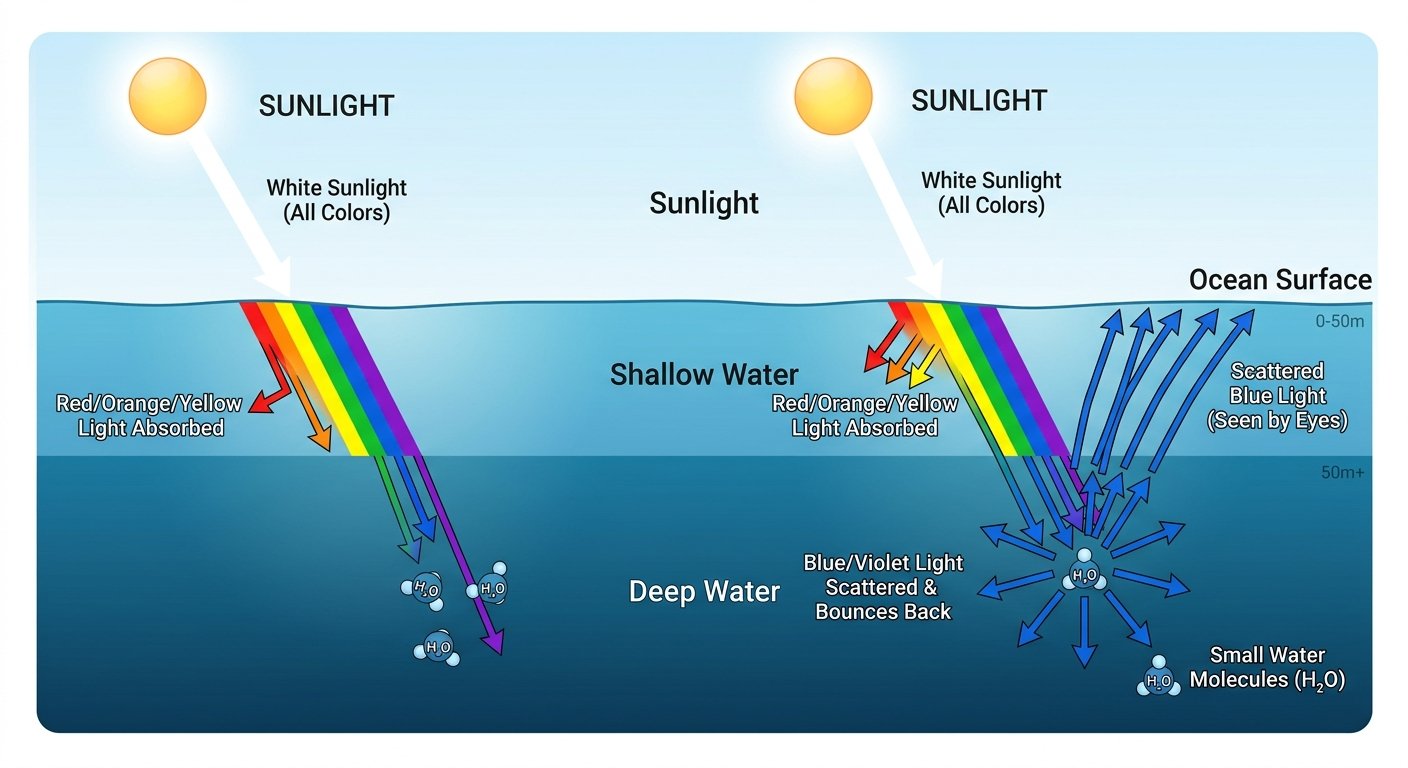
Here is the short answer to why is the ocean blue if water is clear: water isn’t perfectly colorless. It soaks up a tiny bit of red light, so little that you can’t notice it in a glass. Stack up many feet of water, though, and almost all the red is gone, leaving mostly blue light to bounce back to your eyes.
In other words, water has a very faint blue tint, and the ocean is simply a giant amount of it.
In this guide you’ll learn how light and water interact, why depth is the secret ingredient, a simple step-by-step depth model, why some seas look green or turquoise, and the myths that keep getting repeated.
Quick Info
| Topic | Detail |
|---|---|
| Short answer | Water absorbs red light; with enough depth, mostly blue is left |
| Why a glass looks clear | Too little water to absorb a noticeable amount of red |
| Main process | Absorption (water soaking up light), plus some scattering |
| Biggest myth | “The ocean is blue because it reflects the sky” |
| Why some water is green or brown | Algae, sediment and sand change the color |
| Depth sunlight can reach | Rarely much past 200 meters (656 feet) |
| Reading time | About 10 minutes |
Is Water Really Clear?
Mostly, but not completely.
Pure water is very slightly blue, because it absorbs a small amount of red, orange and yellow light while letting blue light pass through.
The effect is so weak that you need a lot of water to see it. A glass holds only a few inches. That’s nowhere near enough for the missing red to show.
Think of it like a pair of very pale sunglasses. One thin lens barely changes what you see. Stack 100 of those lenses together, and suddenly everything looks tinted. The ocean is that stack of lenses, only many feet deep.
Sunlight is a mix of colors
White sunlight is really a blend of every color in the rainbow: red, orange, yellow, green, blue and violet. Each color is light with a different wavelength. Red has the longest waves, and blue and violet have the shortest.
When light enters water, these colors don’t all get treated the same way. That difference is the whole story of the blue ocean.
Air changes light too, just in a different way. Moving pockets of air bend starlight, which is the reason behind our guide on why stars twinkle but planets don’t. Water does something stronger: it removes some colors entirely.
How Water Turns the Ocean Blue
Two things happen to sunlight inside the ocean: some colors get absorbed, and the light that’s left gets scattered around.
Absorption: water eats the red first
Water molecules absorb light, turning it into a tiny bit of heat. They’re much better at absorbing long, red wavelengths than short, blue ones.
The National Ocean Service, part of NOAA, puts it in one line: the ocean is blue because water absorbs colors in the red part of the light spectrum.
That explanation comes from NOAA’s “Why is the ocean blue?” fact page, which also notes that particles in the water can tint the ocean green, red or other colors.
So as sunlight travels down, red fades first, then orange and yellow, then green. Blue survives the longest.
Scattering: the blue comes back up
Absorption alone would just make deep water dark. To see blue, some light has to come back up to your eyes.
That happens through scattering. Light bumps off water molecules and tiny particles and gets bounced in new directions. Some of it heads back toward the surface. Because red has mostly been absorbed by then, the light that returns is mostly blue.
If you’ve read our guide on why the sky is blue, you might notice a family resemblance. The sky and sea both look blue, but for different main reasons: the sky because air scatters blue light, and the sea mainly because water absorbs red.
Why depth is the secret ingredient
The more water light passes through, the more red it loses. That’s why:
- A glass of water looks clear.
- A swimming pool looks light blue (white or blue paint on the bottom helps too).
- The open ocean, hundreds or thousands of feet deep, looks deep navy blue.
It’s the same water every time. Only the amount changes.
Worked Example: Follow Sunlight Down Into the Ocean
Let’s put numbers on this with a simple model. The absorption rates below are illustrative values chosen to show the pattern, not exact lab measurements. Real water absorbs red many times more strongly than blue, and this model keeps that relationship.
Step 1: Set the starting light
Imagine 100 units each of red, green and blue sunlight hitting the surface of very clear water.
Step 2: Pick an absorption rate for each color
In our model, every meter of water absorbs a share of each color:
| Color | Share absorbed per meter (illustrative) |
|---|---|
| Red | about 30% (rate 0.35) |
| Green | about 6% (rate 0.06) |
| Blue | about 1% (rate 0.01) |
Step 3: Use the light-fading formula
Light fades exponentially as it goes deeper. That means it loses the same share, not the same amount, each meter:
light left = starting light × e^(−rate × depth)Here, e is a math constant (about 2.718), rate is how strongly water absorbs that color, and depth is how many meters the light has traveled. The minus sign means the light shrinks as depth grows.
Step 4: Calculate light left at different depths
Running the formula for each color gives this:
| Depth | Red left | Green left | Blue left | What you’d notice |
|---|---|---|---|---|
| 0.1 m (a glass) | 96.6% | 99.4% | 99.9% | Looks clear |
| 1 m | 70.5% | 94.2% | 99.0% | Very faint tint |
| 5 m | 17.4% | 74.1% | 95.1% | Clearly blue-green |
| 10 m | 3.0% | 54.9% | 90.5% | Strong blue |
| 30 m | under 0.01% | 16.5% | 74.1% | Deep blue, red gone |
Step 5: Read the result
In the glass, all three colors are almost untouched, so the water looks clear. By 10 meters, red is nearly wiped out while most of the blue remains. Mix what’s left, and your eye sees blue.
In this model, red drops below 1% at about 13 meters. Blue doesn’t fall that low until roughly 460 meters. That huge gap is why the deep ocean glows blue and never red. (Real seawater holds particles and tiny life, so light fades faster than in this pure-water model.)
Why the Ocean Isn’t Always Blue
Look at different coastlines and you’ll see emerald green, turquoise, brown and even reddish water. Something besides pure water is adding color.
| Water color | Main cause | Where you’ll often see it |
|---|---|---|
| Deep navy blue | Clear, deep water with very little life or sediment | Open ocean far from land |
| Turquoise or light blue | Shallow, clear water over white sand that reflects light back up | Tropical beaches and reefs |
| Green | Phytoplankton (tiny floating algae) with green chlorophyll | Coastal waters, nutrient-rich areas |
| Brown or muddy | Sand, silt and soil washed in or stirred up | River mouths, after storms |
| Red or rusty | Blooms of certain algae, often called red tides | Some coastal areas during blooms |
| Gray | Cloudy skies reflecting on the surface, less sunlight overall | Stormy or overcast days |
Phytoplankton: the ocean’s green tint
Phytoplankton are microscopic plant-like organisms that float near the surface. They use chlorophyll to catch sunlight, and chlorophyll absorbs blue and red light while reflecting green. Where they grow thickly, the water turns green.
That also means the bluest seas on Earth are the emptiest. A NASA ocean-color lesson describes the clearest, bluest open-ocean water as having low nutrients, low phytoplankton and low chlorophyll.
You can read that explanation in NASA’s “The Blue, Bluer, and the Bluest Ocean”, which uses satellite data to map chlorophyll in the open ocean.
Scientists use this color link on purpose. Satellites measure ocean color from space to estimate how much phytoplankton is growing in each region.
How Deep Does Sunlight Go?
Even blue light can’t travel forever. Eventually, all of it is absorbed or scattered away, and the ocean goes dark.
| Ocean zone | Depth | How much light |
|---|---|---|
| Sunlight zone (euphotic) | Surface to 200 m (656 ft) | Enough light for plants and algae to grow |
| Twilight zone (dysphotic) | 200 to 1,000 m (656 to 3,280 ft) | Faint blue glow, too dim for plant growth |
| Midnight zone (bathypelagic) | 1,000 to 4,000 m (3,280 to 13,100 ft) | No sunlight at all |
Those zone depths come from NOAA’s “How far does light travel in the ocean?”, which says significant light is rarely found beyond 200 meters.
This also explains a neat trick of deep-sea animals. Many are red. In a place where no red light reaches, a red animal looks black and nearly invisible.
Most of the ocean lies far below that thin sunlit layer. If you want the big picture of Earth’s five oceans, our guide on how many oceans there are covers each one.
Try It Yourself: See the Blue at Home
You don’t need a boat to test this idea. Here’s a simple way to see depth change water’s color.
- Find a long, clear container. A tall clear vase, a long glass tube or a clear plastic bottle works.
- Fill it with clean tap water. Put a sheet of plain white paper behind or under it.
- Look through the short side. The water looks clear.
- Look straight down the long side. With enough length, you may notice a faint blue-green tint.
- Compare with a white pool or bathtub. A full white tub often looks slightly blue, while a cupful from it looks clear.
The color is faint at home because even a long vase holds only a foot or two of water. The ocean has thousands of feet.
Common Myths About Ocean Color
| Myth | Reality |
|---|---|
| The ocean is blue only because it reflects the sky | Reflection adds some color at the surface, but deep water stays blue because water absorbs red |
| Seawater is blue because of salt | Salt doesn’t make it blue; pure fresh water shows the same tint in large amounts |
| Water is perfectly colorless | Water is very faintly blue; you just need a lot of it to see |
| The ocean is blue for the same reason as the sky | The sky’s blue comes from air scattering light; the ocean’s comes mainly from water absorbing red |
| Green water is always dirty | Green often means healthy phytoplankton, the base of the ocean food chain |
| Fish in photos look blue because of the camera | Underwater, red and yellow light really are missing, so colors shift toward blue |
Frequently Asked Questions
Does the ocean reflect the color of the sky?
Partly. The surface acts a bit like a mirror, so a gray sky can make the sea look gray and a sunset can tint it pink. But the deep blue you see on a sunny day comes mostly from inside the water. Light enters, red gets absorbed, and the blue that’s left scatters back to your eyes. That’s why deep water stays blue even when you look straight down into it.
Why does the ocean look turquoise near beaches?
In shallow water, sunlight travels down, hits pale sand and bounces back up. On that short trip, the water absorbs only some of the red and a bit of green. The light that returns is a bright mix of blue and green, which our eyes see as turquoise. The whiter and cleaner the sand, and the clearer the water, the more vivid that color becomes.
Is lake water blue for the same reason?
Yes. Very deep, clear lakes look blue for exactly the same reason as the ocean: water absorbs red light. Many lakes look green or brown instead because they hold more algae, plant material or soil. A clear, deep mountain lake with little life in it can look as blue as the open sea.
Why is the Red Sea called red?
The name doesn’t mean the water itself is red. Most of the time, the Red Sea is blue like other deep, clear seas. Historians suggest several possible origins for the name, including seasonal blooms of a reddish algae and the color of nearby mountains. The exact origin is still debated, so treat any single explanation with some caution.
Why do things look blue in underwater photos?
Underwater, red, orange and yellow light fade away within a few meters, because water absorbs those colors first. Without that light, a red fish or a yellow coral can look dull, gray or bluish. Divers often carry their own lights or use special camera filters to bring the missing warm colors back.
Would the ocean be blue on another planet?
It depends on what the liquid is made of and what kind of starlight shines on it. A deep ocean of water under a Sun-like star would likely look blue for the same reasons it does on Earth. A sea of a different liquid, or one lit by a redder star, could look very different.
Conclusion
Water only looks clear because a glass holds so little of it. Water absorbs a small share of red light, and over many feet, that small share adds up until mostly blue is left to scatter back to your eyes. Algae, sand and sediment can change the color, but deep, clear water always heads toward blue.
Next time you look at the sea, ask yourself one question: how much water is the light passing through? More water means less red, and less red means more blue.
Disclaimer
This article is for general educational purposes only. The absorption rates and percentages in the worked example come from a simple illustrative model, not exact laboratory measurements. Never swim in water during a harmful algal bloom, and follow local beach advisories. For detailed ocean optics, consult an oceanographer or university marine science department.