

Last night, you probably spent about two hours dreaming. By breakfast, you may remember almost none of it. Yet while those dreams played out, your brain was anything but idle.
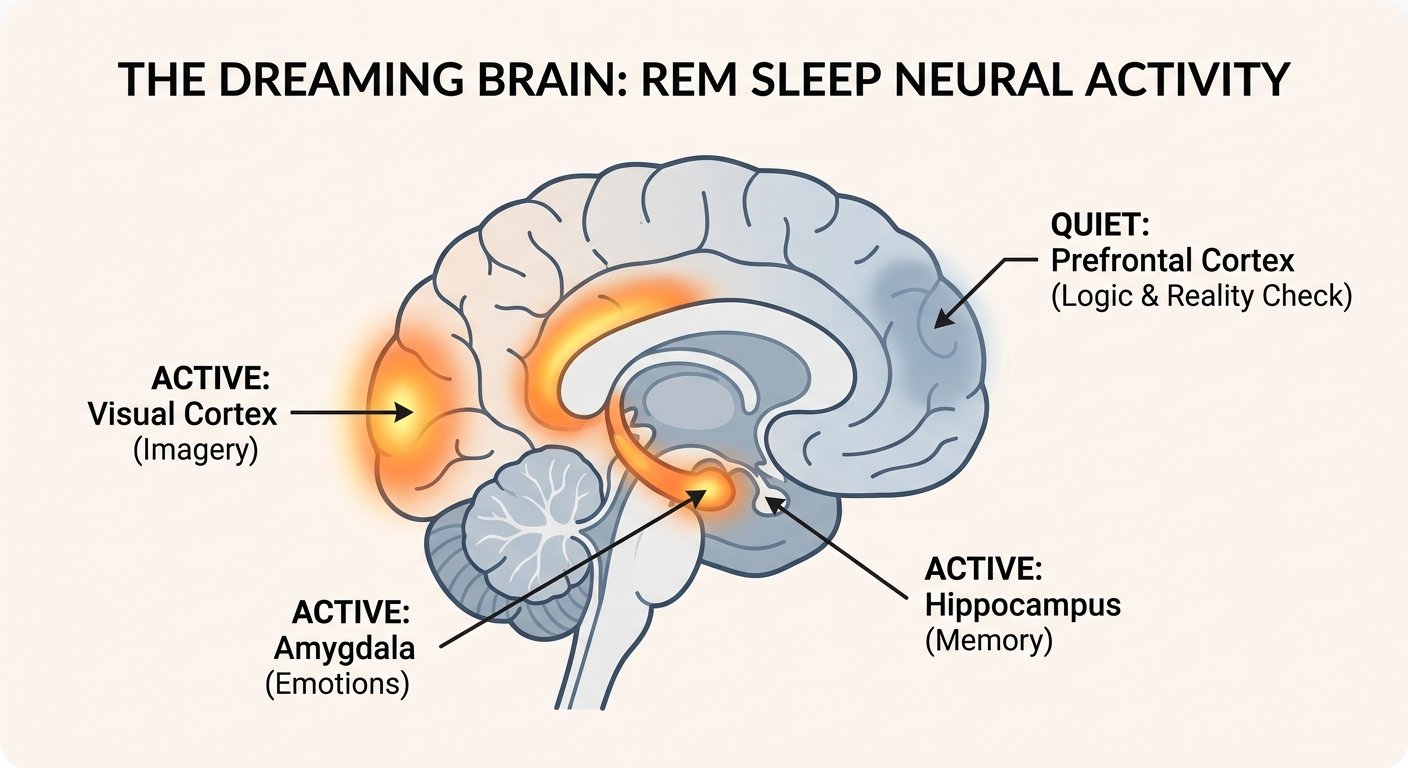
So, what happens to the brain when we dream? In short, it switches on. Vision, emotion and sensation areas get busy, the planning and self-checking areas quiet down, and your muscles go limp so you stay put while the show runs.
That mix explains why dreams feel real while you’re inside them and bizarre once you wake up. This guide covers the sleep stages, the brain regions involved, a worked example of one night of dreaming, the leading ideas about why we dream, and the myths worth dropping.
Quick Info
| Topic | Detail |
|---|---|
| Short answer | The brain becomes highly active, sensory and emotion areas switch on, and the body’s muscles are temporarily paralyzed |
| Main dream stage | REM (rapid eye movement) sleep, which first starts about 90 minutes after you fall asleep |
| Also possible | Dreaming in non-REM sleep, usually in a calmer, more coherent form |
| Key brain areas | Thalamus, visual cortex, amygdala, brainstem and a “hot zone” at the back of the cortex |
| Time spent dreaming | About two hours per night |
| Biggest open question | Why we dream at all |
| Reading time | About 10 minutes |
What Happens to the Brain When We Dream: The Short Answer
During most vivid dreams, your brain runs in a state that looks surprisingly like waking life. Brain waves speed up, and heart rate and breathing rise. At the same time, signals from the brainstem relax your arm and leg muscles so you don’t act out what you dream.
Three things happen together:
- Some parts switch on. The thalamus, the visual areas and the emotion centers become busy.
- Some parts dim. Regions in the front of the brain that handle logic and self-monitoring quiet down.
- The body goes still. The brainstem sends a “stay put” signal to your muscles.
Keep those three in mind. Every strange feature of dreaming, from flying to showing up at school in pajamas, traces back to this pattern.
The Four Stages of Sleep and Where Dreams Fit
Your night is not one long block of identical sleep. The U.S. National Institute of Neurological Disorders and Stroke (NINDS) explains that you cycle through non-REM and REM sleep several times a night, with REM periods getting longer and deeper toward morning. Read the details on the NINDS “Brain Basics: Understanding Sleep” page.
| Stage | What happens in the brain and body |
|---|---|
| Stage 1 (non-REM) | The changeover from awake to asleep. Brain waves begin to slow, and the stage lasts several minutes |
| Stage 2 (non-REM) | Light sleep. Heartbeat and breathing slow, body temperature drops, eye movements stop, and you spend more of the night here than in any other stage |
| Stage 3 (non-REM) | Deep sleep, found in longer stretches during the first half of the night. Heartbeat and breathing reach their lowest levels, and waking you is difficult |
| REM | Eyes move side to side, brain waves look closer to waking, breathing turns fast and irregular, and arm and leg muscles are temporarily paralyzed. Most dreaming happens here |
NINDS adds that dreams can occur in every sleep stage, though they are usually most vivid in REM sleep. That detail matters later, because it changes how scientists think about dreams.
Inside the Dreaming Brain: What Switches On
Brain waves look almost awake
Deep non-REM sleep produces slow brain waves. Once REM begins, they change to a mixed pattern that resembles wakefulness. Your heart rate and blood pressure rise to near waking levels too. Scientists sometimes call REM sleep “paradoxical” for this reason: the body is asleep, but the brain acts as if it isn’t.
The thalamus feeds the cortex
Most of the night, the thalamus (a relay station for the senses) goes quiet, which lets you tune out the world. In REM sleep, it becomes active again and sends the cortex images, sounds and other sensations. Nothing outside is producing them. Your brain is generating its own sensory feed, and that feed fills your dreams.
The emotion center speeds up
The amygdala, an almond-shaped structure that helps process emotions, becomes increasingly active during REM sleep. That fits what most of us notice: dreams can carry fear, joy, embarrassment or panic that feels completely real.
The brainstem switches off your muscles
The brainstem, especially the pons and medulla, sends signals that relax the muscles needed for posture and limb movement. This temporary paralysis keeps you from physically acting out your dreams. Your eyes still move, though, which is where the name “rapid eye movement” comes from.
What Quiets Down: Why Dreams Feel So Strange
If parts of the brain are working overtime, why are dreams so illogical? Because other parts are working less. A neuroscience review in PsyPost describes how the visual cortex becomes highly activated in REM sleep, matching the vivid imagery of dreams. Meanwhile, regions such as the dorsolateral prefrontal cortex and the right inferior parietal cortex become less active. Researchers suggest this may explain why we accept absurd events as normal, feel unsure about time and place, and rarely control what happens. The same article notes that about a quarter of REM sleep contains no emotion at all, so dreams are not always dramatic. Read the full piece in PsyPost’s overview of dream neuroscience.
| Brain area | Activity in REM dreaming | What you may notice |
|---|---|---|
| Visual cortex | Highly active | Vivid images, color and movement |
| Amygdala | More active | Fear, joy, anxiety or excitement |
| Thalamus | Active, sending signals to the cortex | Sights and sounds with no outside source |
| Dorsolateral prefrontal cortex | Less active | Strange events feel normal, and time and place feel uncertain |
| Right inferior parietal cortex | Less active | A weak sense of control over events |
Think of it as a theater where the lights, props and music are all running, but the stage manager who normally says “that can’t be real” has left the building.
Dreaming Is Not Just a REM Event: The “Hot Zone” Discovery
For decades, many people treated dreaming and REM sleep as the same thing. A 2017 study changed that picture. According to the University of Wisconsin–Madison’s research summary, 46 volunteers slept in a lab wearing caps with 256 electrodes. A tone woke them at various points, and they reported whether they had been dreaming. In both REM and non-REM sleep, dream reports lined up with activity in a “posterior hot zone” at the back of the brain. Dream content tracked brain location, too: a dream that involved speech, for example, was tied to activity in Wernicke’s area, a language region on the left side of the cortex. Using EEG readings alone, the researchers predicted the presence of dreaming 92 percent of the time and its absence 81 percent of the time.
This result suggests dreaming depends on that region being active, not on which sleep stage you are in. It also hints that dreams are real experiences during sleep, not stories your brain invents after you wake.
Dreams from different stages do tend to feel different. The Sleep Foundation’s dream guide reports that REM dreams are typically more vivid, fantastical or bizarre, while non-REM dreams usually involve more coherent thoughts or memories tied to a specific time and place.
| Feature | REM dreams | Non-REM dreams |
|---|---|---|
| Typical style | Vivid, fantastical, often bizarre | More coherent and grounded |
| Content | Mix of waking-life elements and odd scenes | Thoughts or memories tied to a time and place |
| When they dominate | Later in the night | Earlier, but they can occur all night |
A small caution is worth adding. Many dream studies rely on groups like those 46 volunteers, who sleep in a lab with electrodes on their heads and get woken to describe their dreams. A small group like that cannot speak for everyone, which is why scientists repeat results with larger and more varied groups. Our guide on what a biased sample is shows how to spot this kind of limit in any study.
Worked Example: One Night of Dreaming, Step by Step
Let’s turn the numbers into something concrete. The scenario below is illustrative: the minutes are made up to match the roughly two hours of nightly dreaming that NINDS reports, not measured from a real sleeper.
Step 1: Set the length of the night
Say you sleep 8 hours. That is 8 × 60 = 480 minutes.
Step 2: Mark the REM period in each cycle
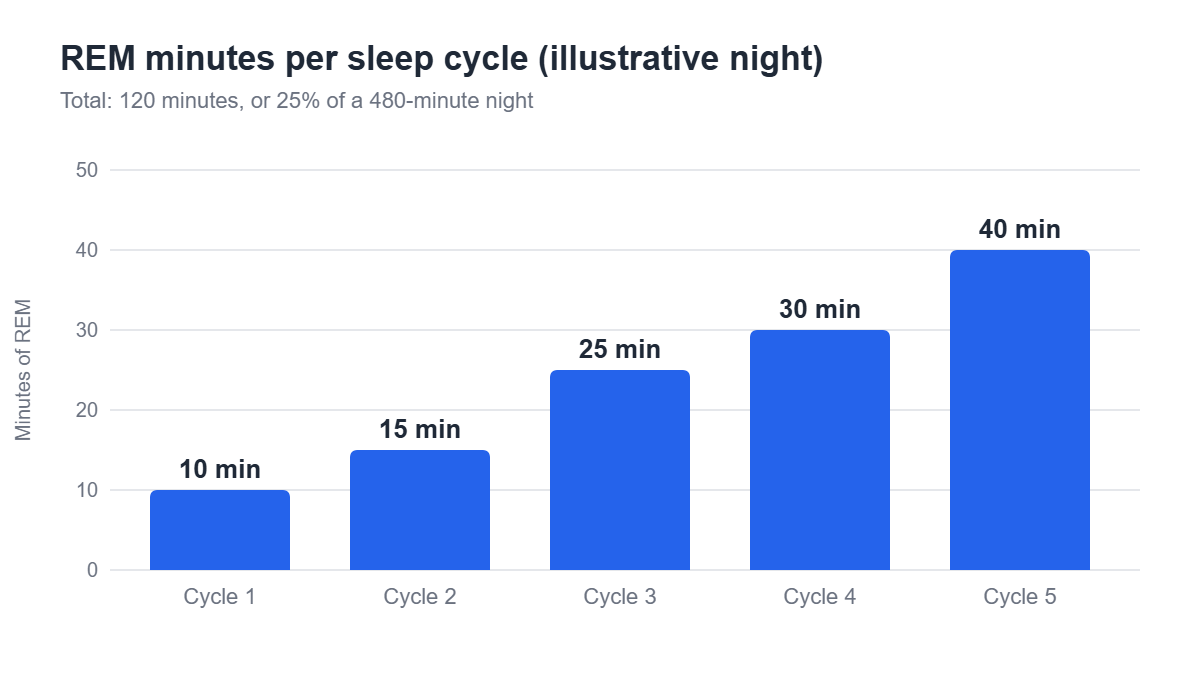
A typical night has several cycles, and REM periods grow longer toward morning. Our imaginary sleeper has five cycles:
| Cycle | Minutes of REM |
|---|---|
| 1 | 10 |
| 2 | 15 |
| 3 | 25 |
| 4 | 30 |
| 5 | 40 |
Step 3: Add up the REM time
10 + 15 + 25 + 30 + 40 = 120 minutes, which is 2 hours of REM sleep, the stage where most dreaming happens.
Step 4: Find the share of the night
120 ÷ 480 = 0.25, so about 25% of this imaginary night is REM sleep. Notice that this is a percentage (a share of the whole), not a percentile (a rank within a group). If that difference ever trips you up, our guide on what a percentile is clears it up.
Step 5: Classify the variables
Researchers treat “minutes of REM sleep” as a numerical variable, because it is measured on a scale. “Did the sleeper report a dream when woken? Yes or no” is a categorical variable, because it sorts answers into groups. The article on what a variable in statistics is explains both types in more detail.
Takeaway: the longest REM stretch sits in the last cycle (40 minutes), which is why the dreams you remember in the morning often come from the final hours of sleep.
Why Do We Dream? The Leading Ideas
Here is the honest answer: nobody knows for sure. NINDS says the exact purpose of dreaming isn’t known, though it may help process emotions. The Sleep Foundation lists five common ideas and notes that it may be impossible to conclusively prove any of them.
| Idea | What it says |
|---|---|
| Building memory | Dreaming is linked to strengthening memory and recall |
| Processing emotion | The brain rehearses feelings in different imagined settings to manage them |
| Mental housekeeping | Dreaming clears out partial, wrong or unneeded information |
| Instant replay | Dreams replay and reshuffle recent events |
| Incidental activity | Dreaming is a by-product of sleep with no special purpose |
On the memory idea, NINDS says memory consolidation most likely needs both non-REM and REM sleep. That points to sleep as a whole doing the work, which leaves open how much dreams themselves contribute.
Common Myths About Dreaming
| Myth | Reality |
|---|---|
| Dreams happen only in REM sleep | Most vivid dreams do, but dreams can occur in every sleep stage |
| If you don’t remember a dream, you didn’t have one | Everyone dreams. In the Wisconsin study, even forgotten dream experiences left a distinct EEG signature |
| The brain rests while you sleep | Brain and body stay remarkably active, and REM brain waves resemble waking ones |
| Everyone dreams in color | Some people dream in color, and others recall only black and white |
| Dreams are invented after you wake up | The hot zone findings suggest dreams are experienced during sleep |
| Every dream has one hidden meaning | Experts disagree about whether dreams carry reliable meaning at all |
Frequently Asked Questions
Does the brain shut down when we dream?
No. During REM sleep, the stage linked to most vivid dreaming, brain waves look close to those of waking life, and heart rate and breathing rise to near waking levels. Some regions stay highly active, while others, such as parts of the prefrontal cortex, quiet down. The brain is reorganizing its activity, not powering off.
Why can’t we move while we dream?
During REM sleep, the brainstem (especially the pons and medulla) sends signals that relax the muscles used for posture and limb movement. This temporary paralysis keeps you from acting out your dreams. Your eyes and breathing muscles keep working, which is why your eyes dart around behind closed lids and breathing continues.
Do we dream every night?
NINDS says everyone dreams, and people spend about two hours a night doing it, even though most dreams are never remembered. Someone who says they never dream is usually just not recalling their dreams. Dream recall varies a lot from person to person.
Why do we forget most dreams?
Scientists don’t have one settled answer. What is known is that recall differs from person to person, and that waking up abruptly, such as to an alarm, can make details slip away faster. The Sleep Foundation suggests lying still when you wake, replaying the dream in your mind, and keeping a notebook or app beside the bed.
Can you dream during non-REM sleep?
Yes. NINDS says most dreaming happens in REM sleep, but some occurs in non-REM stages. The 2017 Wisconsin study found that people reported dreams after both REM and non-REM awakenings whenever the back of the brain was active. Non-REM dreams tend to be more coherent and grounded in a specific time and place.
Do dreams help memory?
Possibly, but the evidence is not settled. NINDS says memory consolidation most likely needs both non-REM and REM sleep, which points to sleep as a whole rather than dreams alone. Memory building is one leading idea for why we dream, yet none of the main theories has been conclusively proven.
Conclusion
When we dream, the brain does not rest. It runs its own simulation: the thalamus and visual cortex supply the scenes, the amygdala supplies the feelings, and the brainstem keeps your body still. Meanwhile, the front of the brain that checks reality takes a break, which is why a flying whale at school seems perfectly normal at 3 a.m. Scientists have mapped much of this activity, including the posterior hot zone, but the deeper question of why we dream remains open.
Next time you wake from a strange dream, ask yourself: which parts of my brain were on duty, and which were off?
Disclaimer
This article is for general educational purposes only. The sleep schedule and REM minutes in the worked example are illustrative, not measurements of a real person. If you have ongoing sleep problems, frequent nightmares or unusual daytime tiredness, talk with a doctor or sleep specialist.