

A streak of light flashes across the night sky and is gone in a second. Someone shouts “meteor!” Someone else says “asteroid!” And the next day, a neighbor swears a “meteorite” landed in the woods. Who is right?
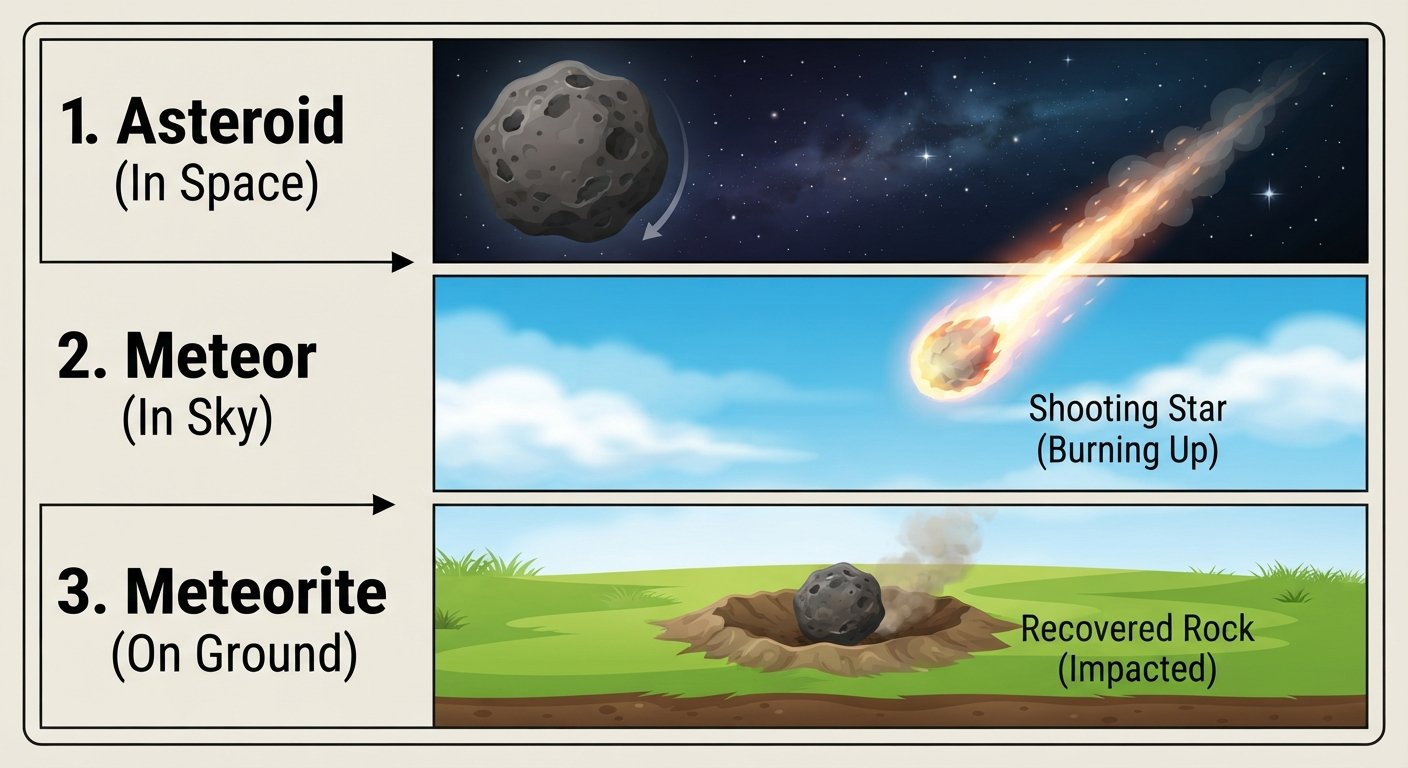
Here is the short answer to what is the difference between a meteor, meteorite and asteroid: an asteroid is a large rock orbiting the Sun in space, a meteor is the flash of light you see when a small space rock burns through Earth’s air, and a meteorite is any piece of that rock that survives and lands on the ground.
The big idea is simple. These words mostly describe where a space rock is, not what it’s made of. The same chunk of stone can carry three or four different names in a single day.
In this guide you’ll get clear definitions, an at-a-glance table, a step-by-step trip of one space rock, real US examples, a memory trick and a myths table.
Quick Info
| Topic | Detail |
|---|---|
| Short answer | Asteroid = big rock in space; meteor = light streak in the air; meteorite = rock that reaches the ground |
| The missing fourth word | Meteoroid: a small space rock, from a dust grain up to a small asteroid, still in space |
| Main rule | The name changes with location: space, sky or ground |
| Where most asteroids live | The main asteroid belt, between Mars and Jupiter |
| Common mistake | Calling a shooting star a “falling star” or an “asteroid” |
| Memory trick | -oid in the void, -or in the air, -ite: it hit the ground |
| Reading time | About 10 minutes |
Meteor vs Meteorite vs Asteroid: The Core Definitions
Before comparing them, let’s pin down each word in one sentence.
An asteroid is a rocky or metallic leftover from the birth of our solar system that orbits the Sun, usually between Mars and Jupiter.
A meteoroid is a smaller piece of space rock or dust, still traveling through space.
A meteor is the streak of light made when a meteoroid rushes into a planet’s atmosphere and burns up.
A meteorite is a meteoroid that survives the fall through the atmosphere and reaches the ground.
Notice that a meteor isn’t really a rock at all. It’s the glowing event, the same way lightning is an event and not an object.
Asteroids: the big leftovers
Asteroids are rocky remnants from about 4.6 billion years ago, when the planets formed. Most orbit the Sun in the main asteroid belt between Mars and Jupiter.
They come in a huge range of sizes. The biggest one NASA lists, Vesta, is about 329 miles (530 kilometers) across. The smallest ones are less than 33 feet (10 meters) wide.
NASA’s Asteroid Facts page estimates that the main belt holds 1.1 to 1.9 million asteroids wider than about 1 kilometer, plus millions of smaller ones.
Even with millions of them, they’re spread thin. All the asteroids put together weigh less than our Moon.
Meteoroids: the small rocks nobody mentions
Most people skip this word, but it’s the key that connects the others. A meteoroid is a space rock anywhere from a speck of dust to a small asteroid.
Many meteoroids are chips knocked off asteroids during collisions. Others are dusty crumbs left behind by comets. As long as the rock is still out in space, it’s a meteoroid.
Meteors: the flash in the sky
When a meteoroid crosses Earth’s path, it slams into the air at tens of thousands of miles per hour. The air in front of it gets squeezed and heated so fast that the rock and the air around it glow. That glowing streak is a meteor.
You probably know meteors by their nickname: shooting stars. They have nothing to do with real stars, which are distant suns. (If you’re curious why real stars sparkle, our guide on why stars twinkle but planets don’t explains it.)
An extra-bright meteor, one that outshines the planet Venus, is called a fireball.
Meteorites: the survivors
Most meteoroids are so small that they burn up completely, high above the ground. A few are big and tough enough to make it through. Whatever lands is a meteorite.
NASA’s Meteors and Meteorites Facts page says usually less than 5% of the original object reaches the ground, and most meteorites range from pebble size to fist size.
There are three main kinds:
- Stony meteorites, the most common kind to fall
- Iron meteorites, heavy and metallic, which are easier to spot on the ground and so are the type most often found long after they land
- Stony-iron meteorites, a mix of rock and metal
At a Glance: Asteroid, Meteoroid, Meteor, Meteorite and Comet
Comets often get mixed into this conversation, so they’re included here too.
| Name | What it is | Where it is | Typical size | Can you see it? |
|---|---|---|---|---|
| Asteroid | Rocky or metal leftover from planet formation | In space, mostly between Mars and Jupiter | Under 10 m up to about 530 km | Only with telescopes (a few with binoculars) |
| Meteoroid | Small chunk of rock or dust | In space | Dust grain to small asteroid | No |
| Meteor | Glowing streak from a burning meteoroid | In Earth’s atmosphere | It’s light, not an object | Yes, as a shooting star |
| Fireball | A very bright meteor | In Earth’s atmosphere | Brighter than Venus | Yes, sometimes even at dusk |
| Meteorite | Surviving piece of a meteoroid | On the ground | Usually pebble to fist size | Yes, you can hold one |
| Comet | Ball of ice, dust and rock | In space, often from the outer solar system | Solid core plus a long glowing tail near the Sun | Sometimes, as a fuzzy patch with a tail |
The quick difference between an asteroid and a comet: asteroids are mostly rock and metal, while comets carry lots of ice that turns into a glowing tail when they swing close to the Sun.
Worked Example: Follow One Space Rock From Space to the Ground
Let’s follow one imaginary rock and watch its name change. The rock and its weights are illustrative, but each stage matches how NASA describes the process.
Step 1: A collision in the asteroid belt
Far beyond Mars, two asteroids bump into each other. A chip about the size of a bowling ball, weighing roughly 10 kilograms (22 pounds), breaks off.
Name: meteoroid. It’s a small piece of space rock, no longer part of an asteroid.
Step 2: Millions of years drifting
Gravity from Jupiter and the Sun slowly nudges the chip into a new orbit. After a very long time, its path crosses Earth’s orbit, and one night Earth is right there.
Name: still a meteoroid. It’s in space, so nothing changes yet.
Step 3: Hitting the atmosphere
The rock hits the top of Earth’s air at tens of thousands of miles per hour. Squeezed air in front of it heats to a glow, and the outside of the rock starts to melt and peel away.
Name: meteor (and maybe a fireball). People on the ground see a bright streak, possibly brighter than Venus.
Step 4: Burning down
Most of the rock’s mass is stripped away as it falls. NASA says less than 5% of the original object usually reaches the ground. Here’s the math for our rock:
mass reaching the ground ≤ starting mass × 0.05
                         ≤ 10 kg × 0.05
                         ≤ 0.5 kg
Here, 0.05 is 5% written as a decimal. So at most about half a kilogram (about 1.1 pounds) survives.
Step 5: Landing in a field
A blackened stone about the size of a fist thumps into a farm field. It has a thin, dark, glassy skin from the melting.
Name: meteorite. It’s on the ground, and you could pick it up.
One rock, one trip, three names: meteoroid, meteor, meteorite.
How Much Space Rock Hits Earth?
More than you’d guess, but almost all of it arrives as dust. NASA estimates that about 48.5 tons (44,000 kilograms) of meteoritic material falls on Earth every day.
That figure is an average per day, so some days bring more and some less. Multiply it out and you get about 17,700 tons a year.
Most of that is tiny grains that drift down unnoticed. Rocks big enough to find are much rarer. NASA counts more than 50,000 meteorites found on Earth so far, and 99.8% of them came from asteroids. The rest are rare pieces of Mars and the Moon, blasted off by impacts long ago.
Real Examples in the United States
You don’t have to travel far to see what space rocks can do. These cases all come from NASA’s meteor and meteorite facts.
| Event | Where | What happened |
|---|---|---|
| Barringer Crater (Meteor Crater) | Arizona | An iron-nickel object about 164 feet (50 m) wide hit about 50,000 years ago and dug a crater about 0.6 miles (1 km) across |
| Ann Hodges meteorite (1954) | Sylacauga, Alabama | An 8-pound (3.6 kg) stony meteorite crashed through a roof and bruised a woman: the first documented injury of its kind in the US |
Space agencies also keep a close eye on asteroids that come near our planet. As of December 2025, NASA counted 39,123 known near-Earth asteroids, including 873 wider than 1 kilometer.
Those counts come from NASA’s Near-Earth Asteroids planetary defense page, which is updated as new discoveries come in.
The same page estimates about 50 near-Earth asteroids larger than 1 kilometer are still left to find, so scientists keep searching the sky every night.
A Simple Memory Trick
If you only remember one thing, remember the endings:
- -oid = out in the void (meteoroid, asteroid: both in space)
- -or = on fire in the air (meteor)
- -ite = it hit the ground (meteorite)
Ask yourself one question whenever you hear these words: where is the rock right now? Space, sky or ground. The answer gives you the right name.
Common Myths and Mix-Ups
| Myth | Reality |
|---|---|
| A shooting star is a star falling | It’s a meteor: a small space rock burning in our air |
| Meteors and asteroids are the same thing | An asteroid is a large rock in space; a meteor is a flash of light in the atmosphere |
| Meteorites land red-hot and start fires | Most cool quickly on the way down; the outer melted layer is thin |
| Most meteorites are giant boulders | Most range from pebble to fist size |
| Every meteor leaves a meteorite | Most meteoroids burn up completely; usually less than 5% of a falling object reaches the ground |
| All meteorites come from asteroids | About 99.8% do; a few come from Mars and the Moon |
Why Scientists Care About These Space Rocks
Meteorites are free samples from space. Many are older than any rock on Earth’s surface, so they show what the early solar system was made of.
Asteroids matter for safety, too. Tracking near-Earth asteroids lets scientists spot any that might come too close, years or even decades in advance.
The Moon tells the story of what happens without a protective atmosphere. With no air to burn up incoming rocks, its surface is covered in craters. (Our guide on why the Moon changes its shape covers what we see of that cratered surface from Earth each month.)
Frequently Asked Questions
Is a shooting star a meteor or a meteorite?
A shooting star is a meteor. It’s the bright streak of light you see when a small space rock, often no bigger than a grain of sand, burns up high in the atmosphere. If any piece were to survive and land, that piece would be called a meteorite. Most shooting stars leave nothing behind.
Can an asteroid become a meteorite?
Yes, but usually in pieces. Small fragments of asteroids, called meteoroids, sometimes cross Earth’s path. When one falls through the atmosphere, it glows as a meteor, and any part that survives becomes a meteorite. NASA says about 99.8% of known meteorites came from asteroids, so most meteorites are really tiny bits of asteroids.
What is the difference between a meteoroid and an asteroid?
Size is the main difference. Both are space rocks orbiting the Sun, but asteroids are large, from about 33 feet (10 meters) up to hundreds of miles wide. Meteoroids are smaller, ranging from dust grains to small asteroids. There’s no sharp cutoff everyone agrees on, so very small asteroids and large meteoroids overlap.
How can you tell if a rock is a meteorite?
Real meteorites are usually heavy for their size, often contain metal, and may have a thin, dark crust from melting during the fall. Many rocks that people think are meteorites turn out to be ordinary Earth rocks or slag from industry. If you think you’ve found one, contact a university geology department or a natural history museum to have it tested.
Is a fireball the same as a meteor?
A fireball is a type of meteor, just an unusually bright one. NASA defines a fireball as a meteor brighter than the planet Venus. Fireballs often come from larger meteoroids, so they’re more likely than ordinary meteors to drop meteorites, although most still burn up completely before reaching the ground.
Are asteroids dangerous to Earth?
Most asteroids stay far away in the main belt between Mars and Jupiter. Near-Earth asteroids are tracked closely, and NASA has already found most of those larger than 1 kilometer. Small rocks hit Earth’s atmosphere every day and burn up harmlessly. Large impacts are rare, which is why scientists track the sky so carefully.
Conclusion
An asteroid is a big rock in space, a meteoroid is a small one, a meteor is the light show when a small rock burns through our air, and a meteorite is the piece that makes it to the ground. They’re often the same object at different points in its trip.
So next time someone points at a streak of light, ask the question that settles it: is it in space, in the sky or on the ground?
References
- NASA Science, “Meteors and Meteorites: Facts”, last updated February 14, 2025, science.nasa.gov
- NASA Science, “Asteroid Facts”, last updated September 21, 2026, science.nasa.gov
- NASA Science, “Near-Earth Asteroids as of December 2025”, updated December 3, 2025, science.nasa.gov
Disclaimer
This article is for general educational purposes only. The rock and weights in the worked example are illustrative. If you think you have found a meteorite, contact a university geology department or a natural history museum for testing.