

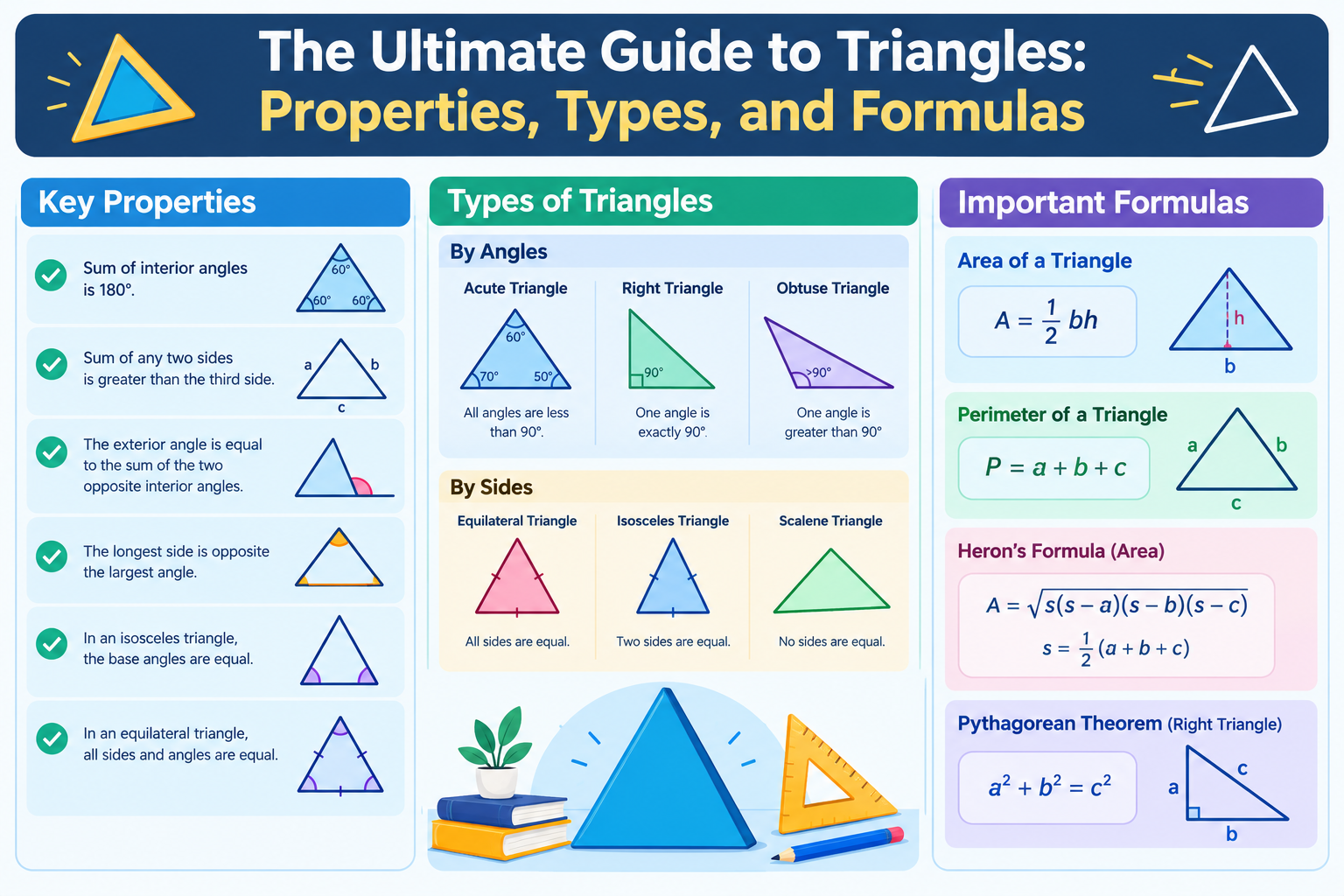
Triangles are everywhere. And there’s a good reason for that. A triangle is the strongest, most stable shape in geometry. Push on its corners, and it won’t change shape the way a square can.
Triangles are also the foundation of almost everything in geometry and trigonometry. Master them, and harder topics suddenly feel much easier.
This guide covers everything you need: what a triangle is, its key properties, every major type, all the important formulas, solved examples, and practice questions.
Triangles At a Glance
| Detail | Information |
|---|---|
| Subject | Geometry |
| Definition | A closed shape with 3 sides, 3 angles, and 3 vertices |
| Angle Sum | Always 180° |
| Types by Sides | Equilateral, Isosceles, Scalene |
| Types by Angles | Acute, Right, Obtuse |
| Area Formula | A = ½ × base × height |
| Perimeter Formula | P = a + b + c |
| Other Key Formulas | Heron’s formula, Pythagoras theorem, law of sines & cosines |
| Target Readers | Middle school, high school, exam takers, beginners |
What Is a Triangle?
A triangle is a flat, closed shape made of three straight sides. Where the sides meet, they form three corners (called vertices) and three angles.
Britannica’s entry on the triangle describes it as a three-sided polygon formed by three line segments whose end points meet at the vertices. It notes that this seemingly simple shape has countless properties that mathematicians have studied for thousands of years. Britannica also explains the standard naming system: a triangle with corners A, B, and C is written as ΔABC, and each side length is labeled with the lowercase letter of the angle opposite it.
Parts of a Triangle
- Vertices: The three corner points (A, B, C)
- Sides: The three line segments (AB, BC, CA), often labeled a, b, c
- Angles: The three inside angles (∠A, ∠B, ∠C)
- Base: Any side you choose as the “bottom”
- Height (Altitude): The straight-up distance from the base to the opposite corner, at a right angle
Naming tip: Side a sits across from angle A. Side b sits across from angle B. Side c sits across from angle C.
Key Properties of Triangles
These rules work for every triangle. Learn them, and you’ll solve most problems faster.
1. Angle Sum Property
The three inside angles always add up to 180°.
∠A + ∠B + ∠C = 180°This is the single most important triangle rule.
2. Triangle Inequality Rule
The sum of any two sides must be greater than the third side.
a + b > c
b + c > a
a + c > b
If this rule fails, the three sides can’t form a triangle.
Example: Can sides of 3 cm, 4 cm, and 8 cm make a triangle?
3 + 4 = 7, which is less than 8. So no, it’s impossible.
3. Exterior Angle Property
Extend one side of a triangle. The outside angle formed equals the sum of the two opposite inside angles.
Exterior Angle = Sum of the two opposite interior anglesExample: If two inside angles are 50° and 60°, the exterior angle at the third corner is 50° + 60° = 110°.
4. Largest Side, Largest Angle
The longest side is always opposite the largest angle. The shortest side is always opposite the smallest angle.
5. Only One Right or Obtuse Angle
A triangle can have at most one right angle or obtuse angle. Two would already add up to 180° or more, leaving nothing for the third angle.
Types of Triangles
Triangles are grouped in two ways: by their sides and by their angles.
Types of Triangles by Sides
1. Equilateral Triangle
- All three sides are equal
- All three angles are equal, and each one is exactly 60°
- Perfectly balanced and symmetrical
Real-life example: A warning road sign or a billiards rack
2. Isosceles Triangle
- Two sides are equal
- The two angles opposite those sides (the base angles) are also equal
Real-life example: The front of a house roof or a slice of pizza
3. Scalene Triangle
- No sides are equal
- No angles are equal
Real-life example: Many irregular rooftops or a broken piece of glass
Types of Triangles by Angles
To understand these, it helps to know your angle types first. Brush up with Understanding Angles: Acute, Obtuse, Right, and Straight Angles Explained.
1. Acute Triangle
- All three angles are less than 90°
- Every equilateral triangle is also an acute triangle
2. Right Triangle
- One angle is exactly 90°
- The longest side, across from the right angle, is called the hypotenuse
- The two shorter sides are called legs
3. Obtuse Triangle
- One angle is greater than 90°
- The other two angles must both be acute
Combining the Two Systems
A triangle always has one name from each group. For example:
| Combination | Possible? | Example Angles |
|---|---|---|
| Right Isosceles | ✅ Yes | 90°, 45°, 45° |
| Right Scalene | ✅ Yes | 90°, 60°, 30° |
| Obtuse Isosceles | ✅ Yes | 120°, 30°, 30° |
| Acute Scalene | ✅ Yes | 50°, 60°, 70° |
| Right Equilateral | ❌ No | Equilateral angles are always 60° |
| Obtuse Equilateral | ❌ No | Same reason |
Math is Fun’s triangle guide explains these classifications with clear diagrams and an interactive tool where you drag the corners to create different triangle types. It also shares a handy memory trick: equilateral, isosceles, and scalene appear in alphabetical order, matching their number of equal sides from three to two to none.
Quick Comparison Table
| Type | Sides | Angles |
|---|---|---|
| Equilateral | All 3 equal | All 60° |
| Isosceles | 2 equal | 2 equal |
| Scalene | None equal | None equal |
| Acute | Any | All less than 90° |
| Right | Any | One exactly 90° |
| Obtuse | Any | One greater than 90° |
Essential Triangle Formulas
Here’s every formula you’ll need, grouped by purpose.
1. Perimeter of a Triangle
The perimeter is the total distance around the triangle. Just add all three sides.
Perimeter (P) = a + b + cSemi-perimeter is half the perimeter, used in Heron’s formula:
s = (a + b + c) ÷ 22. Area of a Triangle (Base and Height)
The most common area formula:
Area = ½ × base × heightWhy the half? Any triangle is exactly half of a rectangle or parallelogram with the same base and height.
Important: The height must be measured at a right angle to the base. It’s not the slanted side.
3. Area Using Heron’s Formula
Use this when you know all three sides but not the height.
Step 1: s = (a + b + c) ÷ 2
Step 2: Area = √[s(s − a)(s − b)(s − c)]
4. Area of an Equilateral Triangle
A shortcut when all sides are equal (side = a):
Area = (√3 ÷ 4) × a²
Height = (√3 ÷ 2) × a
5. Area of a Right Triangle
The two legs act as the base and height:
Area = ½ × leg₁ × leg₂6. Pythagoras Theorem (Right Triangles Only)
a² + b² = c²Here, c is the hypotenuse. This lets you find any missing side of a right triangle. For a full step-by-step walkthrough, see How to Use the Pythagoras Theorem to Find Missing Sides.
7. Law of Sines (Any Triangle)
a ÷ sin A = b ÷ sin B = c ÷ sin CUseful when you know two angles and one side.
8. Law of Cosines (Any Triangle)
c² = a² + b² − 2ab × cos CUseful when you know two sides and the angle between them, or all three sides. Notice that when C = 90°, cos C = 0, and this becomes the Pythagoras theorem.
Master Formula Table
| What You Want | Formula | When to Use |
|---|---|---|
| Perimeter | P = a + b + c | Know all three sides |
| Area | A = ½ × b × h | Know base and height |
| Area (Heron’s) | A = √[s(s−a)(s−b)(s−c)] | Know all three sides |
| Area (Equilateral) | A = (√3/4) × a² | All sides equal |
| Missing side (right) | a² + b² = c² | Right triangle, 2 sides known |
| Missing angle | 180° − (∠A + ∠B) | Know two angles |
| Law of Sines | a/sin A = b/sin B | Any triangle, angle-side pairs |
| Law of Cosines | c² = a² + b² − 2ab cos C | Any triangle |
Solved Examples
Example 1: Finding a Missing Angle
A triangle has angles of 47° and 68°. Find the third angle.
∠C = 180° − (47° + 68°)
∠C = 180° − 115°
∠C = 65°
Answer: 65°. All three angles are under 90°, so it’s an acute triangle.
Example 2: Base Angles of an Isosceles Triangle
An isosceles triangle has a top (vertex) angle of 40°. Find the two base angles.
Step 1: Subtract the known angle from 180°.
180° − 40° = 140°Step 2: Split equally between the two base angles.
140° ÷ 2 = 70°Answer: Each base angle is 70°.
Example 3: Area Using Base and Height
A triangle has a base of 10 cm and a height of 6 cm. Find its area.
Area = ½ × 10 × 6
Area = ½ × 60
Area = 30 cm²
Answer: 30 cm².
Example 4: Area Using Heron’s Formula
A triangle has sides of 13 cm, 14 cm, and 15 cm. Find its area.
Step 1: Find the semi-perimeter.
s = (13 + 14 + 15) ÷ 2
s = 42 ÷ 2
s = 21
Step 2: Plug into Heron’s formula.
Area = √[21 × (21 − 13) × (21 − 14) × (21 − 15)]
Area = √[21 × 8 × 7 × 6]
Area = √7056
Area = 84 cm²
Answer: 84 cm².
Example 5: Area of an Equilateral Triangle
An equilateral triangle has sides of 6 cm. Find its area.
Area = (√3 ÷ 4) × 6²
Area = (√3 ÷ 4) × 36
Area = 9√3
Area ≈ 15.59 cm²
Answer: about 15.59 cm².
Example 6: Perimeter
A scalene triangle has sides of 7 m, 9 m, and 12 m.
P = 7 + 9 + 12
P = 28 m
Answer: 28 m.
Congruent and Similar Triangles
Congruent Triangles
Two triangles are congruent when they are exactly the same size and shape. All matching sides and angles are equal.
You can prove triangles are congruent using these rules:
| Rule | Meaning |
|---|---|
| SSS | All three sides are equal |
| SAS | Two sides and the angle between them are equal |
| ASA | Two angles and the side between them are equal |
| AAS | Two angles and a non-included side are equal |
| RHS | Right angle, hypotenuse, and one side are equal (right triangles only) |
Similar Triangles
Two triangles are similar when they have the same shape but different sizes. Their angles are equal, and their sides are in the same ratio.
Real-life example: Measuring a tree with shadows
A 2 m pole casts a 3 m shadow. At the same time, a tree casts a 15 m shadow. How tall is the tree?
The sun hits both at the same angle, so the triangles are similar.
Tree height ÷ 15 = 2 ÷ 3
Tree height = (2 ÷ 3) × 15
Tree height = 10 m
The tree is 10 meters tall. No climbing needed.
Special Points Inside a Triangle
Every triangle has four famous “centers”:
| Center | Formed By | Special Feature |
|---|---|---|
| Centroid | Three medians (corner to middle of opposite side) | Balance point of the triangle |
| Incenter | Three angle bisectors | Center of the circle that fits inside |
| Circumcenter | Three perpendicular bisectors of the sides | Center of the circle passing through all corners |
| Orthocenter | Three altitudes (heights) | Where all heights meet |
Fun fact: In an equilateral triangle, all four centers land on the exact same point.
Triangles and Trigonometry
Right triangles are the starting point of trigonometry. The sine, cosine, and tangent ratios all compare a triangle’s sides:
sin θ = Opposite ÷ Hypotenuse
cos θ = Adjacent ÷ Hypotenuse
tan θ = Opposite ÷ Adjacent
These ratios let you find missing sides and angles in ways the Pythagoras theorem alone can’t. Explore every trig formula in the Trigonometry Formulas Guide: Every Important Formula Explained.
Triangles in Real Life
- Construction: Bridges, roof trusses, and towers use triangles for strength
- Engineering: Cranes and electricity pylons rely on triangular frames
- Navigation: Ships and GPS use triangulation to pinpoint locations
- Art and design: Triangles create balance and movement in logos and layouts
- Sports: Bicycle frames use triangles to stay light but strong
- Nature: Mountains, crystals, and even some leaves form triangular shapes
Common Mistakes to Avoid
- Using a slanted side as the height. The height must be perpendicular to the base.
- Forgetting the ½ in the area formula. Without it, your answer doubles.
- Using Pythagoras on non-right triangles. It only works with a 90° angle. Use the law of cosines instead.
- Skipping the triangle inequality check. Not every three numbers can form a triangle.
- Mixing up isosceles and equilateral. Isosceles = two equal sides. Equilateral = all three.
- Wrong units. Area needs square units (cm², m²). Perimeter uses regular units (cm, m).
- Calculator in radian mode when using trig in degrees.
Practice Questions
- Two angles of a triangle are 35° and 85°. Find the third angle and name the triangle type.
- Can sides of 5 cm, 7 cm, and 13 cm form a triangle?
- Find the area of a triangle with base 14 m and height 9 m.
- Find the perimeter of an equilateral triangle with side 11 cm.
- An isosceles triangle has base angles of 52° each. Find the vertex angle.
- Use Heron’s formula to find the area of a triangle with sides 5, 12, and 13.
Answers:
- 180 − 120 = 60°, an acute triangle
- 5 + 7 = 12, which is less than 13 → No
- ½ × 14 × 9 = 63 m²
- 3 × 11 = 33 cm
- 180 − 104 = 76°
- s = 15 → √(15 × 10 × 3 × 2) = √900 = 30 square units (it’s also a right triangle!)
Frequently Asked Questions
What is the angle sum of a triangle?
The three interior angles of every triangle always add up to 180°.
What are the 6 types of triangles?
By sides: equilateral, isosceles, scalene. By angles: acute, right, obtuse.
What is the formula for the area of a triangle?
Area = ½ × base × height. If you know all three sides, use Heron’s formula.
Can a triangle have two right angles?
No. Two right angles already total 180°, leaving no room for a third angle.
What’s the difference between congruent and similar triangles?
Congruent triangles are identical in size and shape. Similar triangles share the same shape but can differ in size.
Why are triangles used in construction?
Triangles are rigid. Unlike squares, they don’t change shape when pressure is applied to their corners, which makes structures stronger.
Final Thoughts
Triangles may have just three sides, but they hold a huge amount of math. Remember the essentials:
- Angles always add to 180°
- Any two sides together are longer than the third
- Types by sides: equilateral, isosceles, scalene
- Types by angles: acute, right, obtuse
- Area = ½ × base × height, or Heron’s formula when you only know the sides
Practice a few problems each day, and triangles will become one of the easiest topics in your math toolkit. From here, you’re ready for trigonometry, coordinate geometry, and beyond.
Sources:
📘 Educational Disclaimer
This guide is for general informational and academic revision purposes only. While every effort has been made to ensure accuracy, students should always follow the specific methods, notation, rounding rules, and answer formats required by their teacher, textbook, or examination board. Decimal answers are rounded for simplicity and may differ slightly from exact values.