

Look around you right now. The corner of your phone. The open pages of a book. The hands on a clock. A slice of pizza.
Every one of them makes an angle.
Angles are one of the first building blocks of geometry. Once you understand them, triangles, shapes, and even trigonometry start to make sense. The good news? There are only a few main types, and each one has a simple rule.
This guide explains what an angle is, how to measure it, and how to tell acute, right, obtuse, and straight angles apart in seconds. You’ll also get worked examples, real-life spotting tips, and practice questions.
Angles At a Glance
| Detail | Information |
|---|---|
| Subject | Geometry |
| What an Angle Measures | The amount of turn between two lines |
| Unit of Measurement | Degrees (°); radians in advanced math |
| Measuring Tool | Protractor |
| Acute Angle | Less than 90° |
| Right Angle | Exactly 90° |
| Obtuse Angle | More than 90° but less than 180° |
| Straight Angle | Exactly 180° |
| Bonus Types | Reflex (180°–360°), Full Rotation (360°) |
| Target Readers | Middle school, high school, geometry beginners |
What Is an Angle?
An angle forms when two straight lines meet at a single point.
Think of it as a measure of turn. Open a door a little, and you create a small angle. Swing it wide open, and the angle grows.
Every angle has three parts:
- Vertex: The corner point where the two lines meet.
- Arms (or rays): The two straight lines that form the angle.
- The angle itself: The amount of turn between the two arms.
How Angles Are Named
You’ll see angles labeled in two common ways:
- With a single letter or symbol, such as ∠x, ∠a, or θ (theta).
- With three letters, such as ∠ABC. The middle letter is always the vertex. So in ∠ABC, the corner is at point B.
How Do We Measure Angles?
Angles are measured in degrees, written with the small symbol °.
A full turn, all the way around a circle, equals 360°. Every other angle is a portion of that full turn.
| Turn | Degrees |
|---|---|
| Quarter turn | 90° |
| Half turn | 180° |
| Three-quarter turn | 270° |
| Full turn | 360° |
Britannica’s explanation of the principles of trigonometry notes that the two most common units for measuring angles are the degree and the radian. It explains that a complete revolution contains 360°, and that each degree can be split further into 60 minutes, with each minute split into 60 seconds. For advanced and theoretical work, Britannica adds, mathematicians usually prefer radians.
For school geometry, though, degrees are all you need.
Using a Protractor: 4 Quick Steps
- Line up the center. Place the protractor’s center hole exactly on the vertex.
- Align the baseline. Lay the zero line along one arm of the angle.
- Pick the right scale. Use the scale that starts at 0° on the arm you aligned.
- Read the number. Follow the other arm up to the scale and read the degrees.
Tip: Before measuring, guess whether the angle looks bigger or smaller than a square corner. That quick guess stops you from reading the wrong scale.
The Four Main Types of Angles
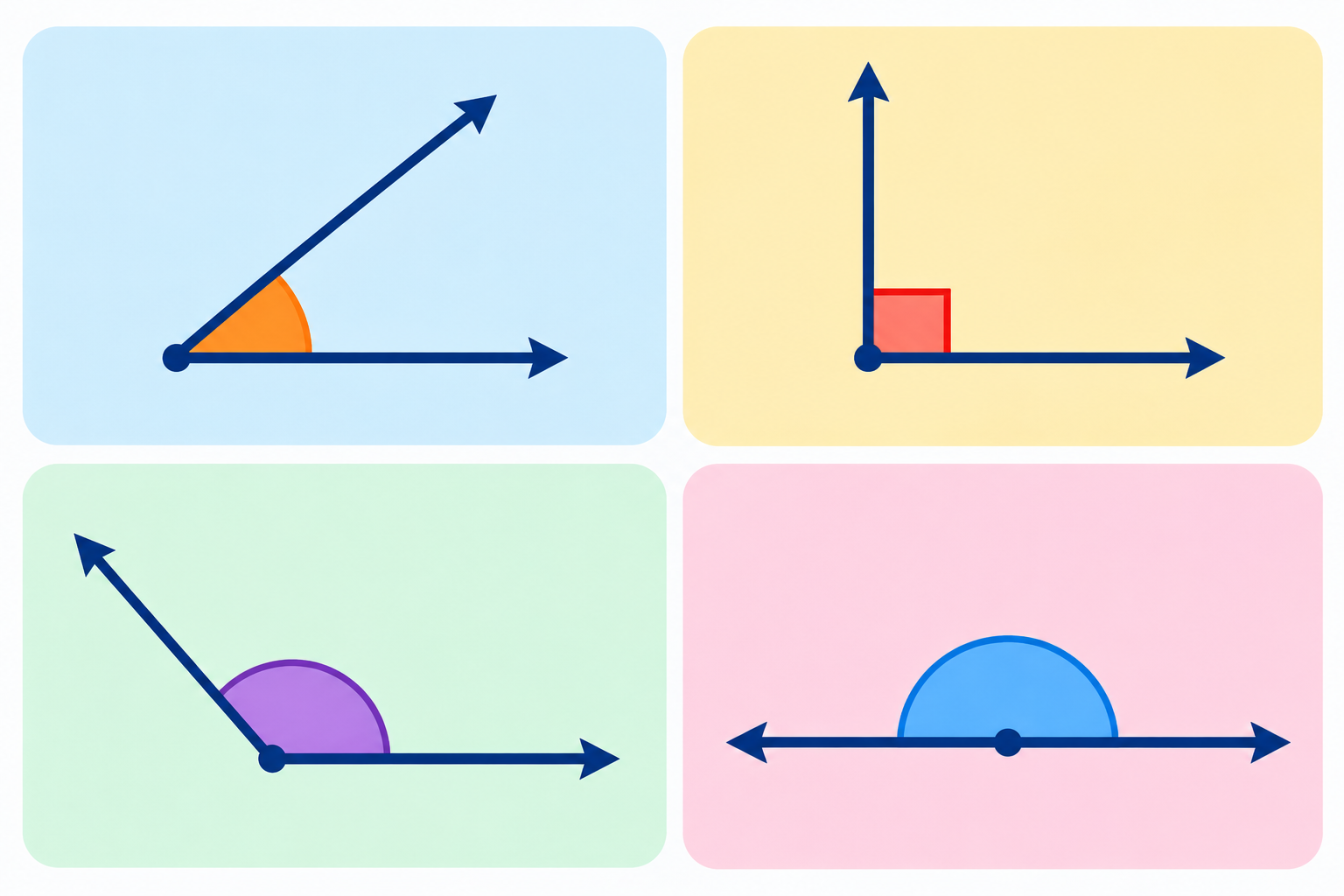
Here’s the simplest way to think about it: 90° and 180° are your landmarks. Every main angle type is defined by where it sits compared to these two numbers.
1. Acute Angle (Less Than 90°)
An acute angle is smaller than a right angle. It’s sharp and narrow.
0° < Acute Angle < 90°Examples: 15°, 30°, 45°, 60°, 89°
Where you’ll see it:
- The tip of a pizza slice
- The point of a pencil
- Clock hands at 1:00 (30°)
- The letter “V”
Memory trick: “Acute” sounds like “a cute” little angle. It’s small.
2. Right Angle (Exactly 90°)
A right angle is a perfect square corner. Exactly 90°, no more, no less.
Right Angle = 90°In diagrams, a right angle is marked with a small square in the corner instead of a curved arc. When you see that square, you know it’s 90° without measuring.
Where you’ll see it:
- Corners of a book, door, or phone screen
- Where a wall meets the floor
- Clock hands at 3:00
- The letter “L”
Right angles are hugely important. They’re the foundation of right-angled triangles, which lead straight into trigonometry. If you want to see how angles connect to sine, cosine, and tangent, explore the Trigonometry Formulas Guide: Every Important Formula Explained.
3. Obtuse Angle (Between 90° and 180°)
An obtuse angle is wider than a right angle but hasn’t opened up into a flat line yet.
90° < Obtuse Angle < 180°Examples: 91°, 120°, 135°, 150°, 179°
Where you’ll see it:
- A laptop screen tilted back
- A reclining chair
- Clock hands at 4:00 (120°)
- An open hand fan
Memory trick: Obtuse angles are “big and blunt.” They look lazy and stretched out.
4. Straight Angle (Exactly 180°)
A straight angle is a flat, straight line. The two arms point in exactly opposite directions.
Straight Angle = 180°It might not look like an angle at first. But it’s a half turn, exactly two right angles placed side by side.
Where you’ll see it:
- A fully open book lying flat
- Clock hands at 6:00
- A straight road or ruler edge
Bonus Types: Reflex Angle and Full Rotation
These go beyond the four main types, but they often appear in exams.
| Type | Measurement | Example |
|---|---|---|
| Reflex Angle | More than 180° but less than 360° | 200°, 270°, 300° |
| Full Rotation | Exactly 360° | One complete spin |
Watch out: Every angle has two sides. If two arms make a 120° obtuse angle on one side, the outside angle is 360° − 120° = 240°, which is reflex. Always check which angle a question is asking about.
Quick Comparison Table
| Angle Type | Degree Range | Looks Like | Clock Example |
|---|---|---|---|
| Acute | Less than 90° | Sharp, narrow | 1:00 (30°) |
| Right | Exactly 90° | Square corner | 3:00 (90°) |
| Obtuse | 90° to 180° | Wide, open | 4:00 (120°) |
| Straight | Exactly 180° | Flat line | 6:00 (180°) |
| Reflex | 180° to 360° | More than half a turn | — |
| Full Rotation | Exactly 360° | Complete circle | — |
Math is Fun’s guide to angles organizes these same types in a clear visual chart, showing how an angle’s name changes as it grows. It also includes an interactive tool where you drag one arm and watch the angle switch between acute, right, obtuse, straight, and reflex. Plus, it offers a handy memory hook: acute, obtuse, and reflex appear in alphabetical order, matching their order from smallest to largest.
Angle Pairs You Should Know
Once you know the main types, angle pairs become easy.
Complementary Angles
Two angles that add up to 90°. Together, they form a right angle.
∠A + ∠B = 90°Example: 30° and 60° are complementary.
Supplementary Angles
Two angles that add up to 180°. Together, they form a straight angle.
∠A + ∠B = 180°Example: 110° and 70° are supplementary.
Memory trick: C comes before S in the alphabet, and 90 comes before 180. So Complementary = 90°, Supplementary = 180°.
Worked Examples: Finding Missing Angles
Example 1: Complementary Angles
Two angles are complementary. One measures 35°. Find the other.
Step 1: Write the rule.
x + 35° = 90°Step 2: Subtract 35° from both sides.
x = 90° − 35°
x = 55°
Answer: 55°. It’s an acute angle.
Example 2: Angles on a Straight Line
A straight line is split into two angles. One measures 128°. Find the other.
Step 1: Angles on a straight line add up to 180°.
x + 128° = 180°Step 2: Subtract.
x = 180° − 128°
x = 52°
Answer: 52°. One obtuse angle plus one acute angle makes a straight angle.
Example 3: Using Algebra
Two supplementary angles measure 2x and 3x. Find both angles.
Step 1: Set up the equation.
2x + 3x = 180°
5x = 180°
Step 2: Divide both sides by 5.
x = 36°Step 3: Find each angle.
2x = 72°
3x = 108°
Answer: 72° (acute) and 108° (obtuse). Check: 72 + 108 = 180. ✓
Solving for x like this is basic algebra in action. For more practice, try Basic Algebra Practice Problems for Beginners (With Solutions).
Angles Inside Shapes
Angles become even more useful inside shapes:
- Triangle: All three angles add up to 180°.
- Square and rectangle: Four right angles, totaling 360°.
- Any quadrilateral: Four angles always add up to 360°.
So if a triangle has angles of 50° and 60°, the third angle must be 180° − 110° = 70°.
Want the area, perimeter, and volume formulas that go with these shapes? Keep the Geometry Formulas Cheat Sheet: Area, Volume & Perimeter Made Easy handy.
Common Mistakes to Avoid
- Reading the wrong protractor scale. Always start from 0° on the arm you lined up.
- Calling 90° acute or obtuse. 90° is only a right angle. Same with 180° being only straight.
- Mixing up complementary and supplementary. Complementary = 90°. Supplementary = 180°.
- Ignoring the reflex angle. Check whether the question means the inside or outside angle.
- Judging by line length. Longer arms don’t make a bigger angle. Only the amount of turn matters.
- Misplacing the vertex in ∠ABC. The middle letter is always the corner.
Practice Questions
Identify each angle type:
- 75°
- 90°
- 145°
- 180°
- 250°
Solve:
- Find the complement of 22°.
- Find the supplement of 95°.
- A triangle has angles of 40° and 85°. Find the third angle and name its type.
Answers:
- Acute
- Right
- Obtuse
- Straight
- Reflex
- 90° − 22° = 68°
- 180° − 95° = 85°
- 180° − 125° = 55°, which is acute
Frequently Asked Questions
Is 90° an acute angle?
No. Acute angles are strictly less than 90°. Exactly 90° is a right angle.
Can a triangle have two obtuse angles?
No. Two obtuse angles would already add up to more than 180°, leaving no room for a third angle.
Can a triangle have a right angle and an obtuse angle?
No, for the same reason. Together they’d exceed 180°.
Why is a full turn 360°?
The number dates back to ancient astronomers. 360 also divides evenly by many numbers, such as 2, 3, 4, 5, 6, 8, 9, 10, and 12, which makes calculations easier.
Is a straight line really an angle?
Yes. It’s a 180° angle, a half turn where the arms point in opposite directions.
Final Thoughts
Angles are all about turning. Keep your two landmarks in mind: 90° and 180°.
- Smaller than 90°? Acute.
- Exactly 90°? Right.
- Between 90° and 180°? Obtuse.
- Exactly 180°? Straight.
Start spotting angles in everyday objects, like clock hands, doors, and open books. Practice a few problems each day, and naming angles will soon feel automatic. From here, you’re ready for triangles, polygons, and trigonometry.
Sources:
- Trigonometry: Principles of trigonometry – Britannica
- Angles – Acute, Obtuse, Straight and Right – Math is Fun
📘 Educational Disclaimer
This guide is for general informational and academic revision purposes only. While every effort has been made to ensure accuracy, students should always follow the specific methods, notation, and answer formats required by their teacher, textbook, or examination board. Diagrams and examples are simplified for learning purposes.