

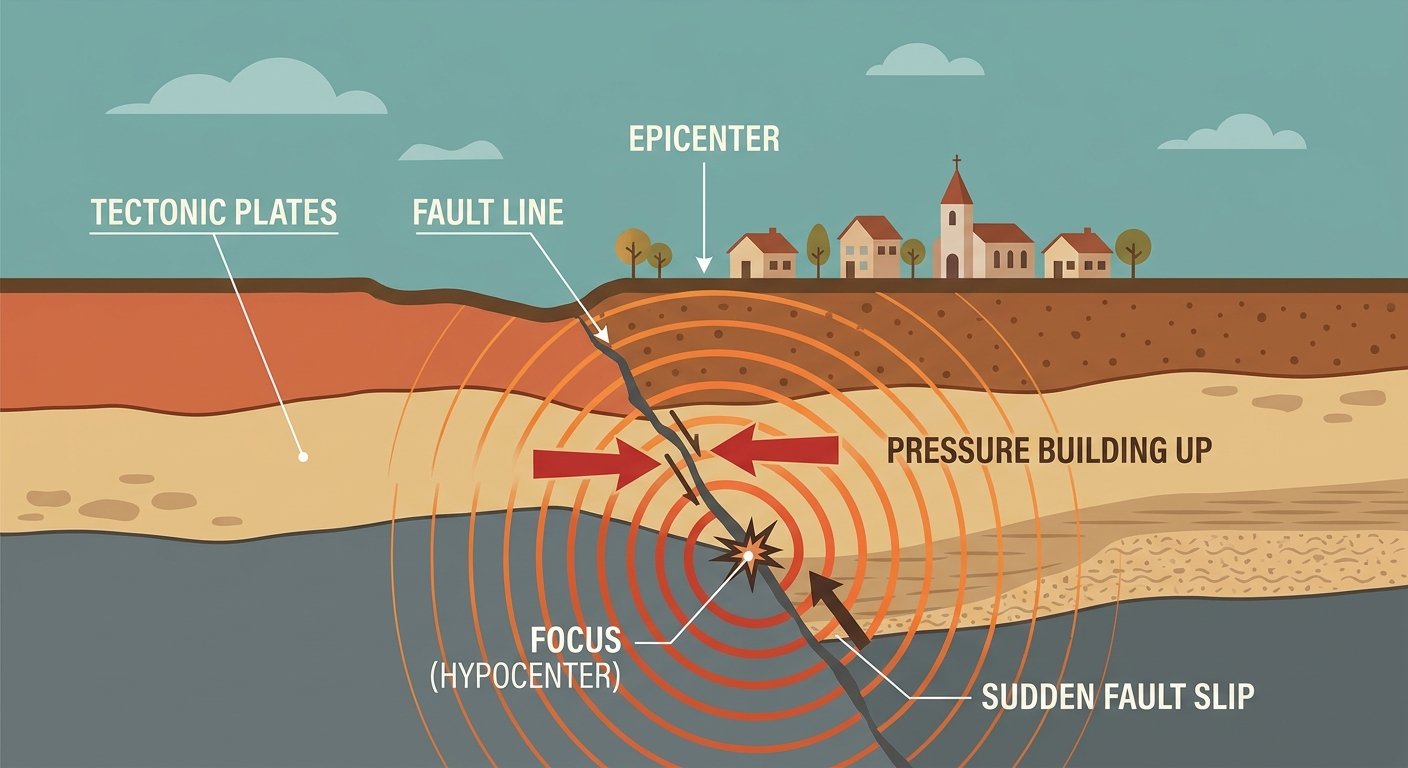
Why do earthquakes happen? Because pieces of Earth’s rocky outer shell keep moving, get stuck against each other, and then suddenly slip. That slip releases stored energy, and the energy travels outward as waves that shake the ground.
Earthquakes are far more common than most people think. National Geographic reports that thousands of them occur around the world every day, though nearly all are too small to feel.
The few big ones make the news because collapsing buildings, fires and tsunamis can follow. Knowing the cause helps you make sense of those headlines, and of the maps and warnings that come with them.
This guide walks through the process in seven plain steps, shows a worked example with numbers, and clears up a few popular myths.
Quick Info
| Topic | Detail |
|---|---|
| Short answer | Slowly moving plates lock together along faults, stress builds, and the rock suddenly slips |
| The process | 7 steps: plate motion, locking, stress, bending, rupture, waves, settling |
| Where most happen | Near plate boundaries (over 90% of earthquakes) |
| Key idea | Elastic rebound: rock bends, then snaps back |
| Common mistake | Mixing up the epicenter and the hypocenter |
| Key warning | A foreshock can only be recognized after the bigger quake arrives |
| Reading time | About 10 minutes |
What Is an Earthquake?
An earthquake is the shaking that happens when two blocks of Earth suddenly slip past each other along a fault. A fault is simply the surface where that slipping takes place.
The USGS explanation of earthquake science names the key locations. The hypocenter is the point underground where the quake starts, and the epicenter is the spot on the surface directly above it.
| Term | Meaning | Where you find it |
|---|---|---|
| Fault | The surface where two blocks slip | Underground, sometimes reaching the surface |
| Hypocenter (focus) | The point where the slip begins | Below the surface |
| Epicenter | The point directly above the hypocenter | On the surface |
| Seismic waves | Energy that spreads out from the slip | Through and along the Earth |
Earth’s Moving Outer Shell
Earth has four main layers: the inner core, the outer core, the mantle and the crust. The crust and the very top of the mantle form a thin, rigid shell. That shell is broken into giant pieces called tectonic plates, and the plates are always moving, just very slowly.
You can see the results of this motion all over the planet. The continents of the world ride on these plates, and when two plates push together over millions of years, the land between them can crumple upward. If you’re curious how tall, rugged landforms differ from smaller ones, our guide to the difference between a mountain and a hill covers the definitions.
Plates meet in three basic ways.
| Boundary type | What the plates do | Everyday picture |
|---|---|---|
| Convergent | Push toward each other, and one may slide under the other | Two people pushing a rug from opposite ends |
| Divergent | Pull away from each other | Tearing a loaf of bread in half |
| Transform | Slide sideways past each other | Rubbing your palms together in opposite directions |
Why Do Earthquakes Happen? The 7 Steps
Here is the whole chain at a glance. Each step is explained in detail below the table.
| Step | What happens | Simple picture |
|---|---|---|
| 1. Plates move | Plates drift slowly and constantly | A hand sliding across a table |
| 2. Edges catch | Rough fault edges lock together | Two sheets of sandpaper pressed together |
| 3. Stress builds | The rest of the plate keeps moving | Pulling harder on a stuck drawer |
| 4. Rock bends | The rock stores energy like a spring | Bending a wooden ruler |
| 5. Rupture | Friction loses and the fault slips | The ruler snaps |
| 6. Waves spread | Energy radiates outward | Ripples from a dropped stone |
| 7. Fault settles | Blocks move, then lock again; aftershocks follow | The drawer slides free, then rattles |
Step 1: The plates keep moving
The plates never stop. They drift in different directions, far too slowly for you to see or feel, but steadily enough to reshape the planet over millions of years.
Step 2: The edges catch and stick
Plate edges are not smooth. According to the USGS, they catch and stick while the rest of the plate keeps moving. A stuck stretch of fault is called a locked fault.
Step 3: Stress builds up
While the fault stays locked, the plates on both sides keep pushing or pulling. Energy piles up in the rock near the fault, a bit like winding a toy car’s spring one more turn each year.
Step 4: The rock bends
Rock looks rigid, yet under enough force it can flex. The USGS publication on how earthquakes happen explains that crustal rock can bend under stress and then break and snap to a new position once the stress exceeds its strength.
Step 5: The rock breaks and the fault slips
Eventually the force overcomes the friction holding the rough edges together. The fault slips, and the stored energy is released in seconds. The slip starts at the hypocenter and spreads across the fault surface.
Step 6: Seismic waves spread out
The released energy radiates outward as seismic waves. P waves travel faster and arrive first, and S waves follow more slowly. The time gap between the two tells scientists how far away the quake was, and three seismographs are enough to pinpoint its location.
Step 7: The fault settles
The blocks keep moving until friction locks them together again. Smaller quakes called aftershocks usually follow as the surrounding rock adjusts to its new position. Then the cycle starts over.
Elastic Rebound: The Idea Behind the Steps
Scientists call this stretch, snap and reset pattern the elastic rebound theory. Think of bending a plastic ruler. It flexes and stores energy, and when it finally breaks, the two halves spring back to straighter shapes.
The theory came from a real disaster. The USGS page on the 1906 San Francisco earthquake says that studies of the ground movement and strain from that quake led Reid to propose the elastic rebound theory in 1910, and that it remains the principal model of the earthquake cycle today.
The 1906 event also shows the scale of a rupture. It broke the northernmost 296 miles (477 kilometers) of the San Andreas fault, and a foreshock was felt about 20 to 25 seconds before the main shock.
A Worked Example With Numbers
Let’s put numbers on the cycle. The figures below are invented for teaching. They are not measurements of any real fault.
Step 1: Set up the scenario
Imagine two blocks of rock on either side of a fault. If the fault were free to move, the blocks would slide past each other at 1.5 inches per year. The fault is locked, so the blocks cannot slide.
Step 2: Count the stored slip
Over 100 years, the blocks try to move 1.5 × 100 = 150 inches. Dividing by 12 inches per foot gives 150 ÷ 12 = 12.5 feet of slip waiting to happen.
Step 3: Release it
If the fault finally breaks all at once, the blocks jump about 12.5 feet within seconds. That sudden jump is the earthquake.
Step 4: Reset the clock
The fault locks again, and the stress starts building from zero. Another 100 years at the same rate would store another 12.5 feet.
Real faults are messier than this. Slip varies from place to place, and a quake can release only part of the stored strain. Treat the example as a model of the idea, not a forecast.
The Three Main Types of Faults
The direction of the stress decides how the blocks move. The USGS publication mentioned earlier lists three main fault types.
| Fault type | Stress | How the blocks move | Typical setting |
|---|---|---|---|
| Normal | Tension (pulling apart) | The overlying block moves down | Spreading zones |
| Thrust (reverse) | Compression (pushing together) | The overlying block moves up | Subduction zones |
| Strike-slip | Sideways shearing | Blocks slide horizontally | Transform faults |
Where Do Earthquakes Happen?
Most earthquakes cluster along the edges of plates. The American Geosciences Institute states that over 90% of earthquakes, including almost all of the largest and most destructive ones, occur at or near plate boundaries.
The busiest belt circles the Pacific. National Geographic says about 80% of the planet’s earthquakes occur along the Pacific Ocean rim, the so-called Ring of Fire, which is also known for volcanoes. If you want to see how the Pacific fits among the planet’s big bodies of water, read our post on how many oceans there are in the world.
Quakes away from plate edges are rarer but real. The same National Geographic article notes a preliminary magnitude 3.8 quake near York Harbor, Maine, on January 27, 2025, which was felt as far south as Boston and Rhode Island.
How Big Is an Earthquake? Magnitude Basics
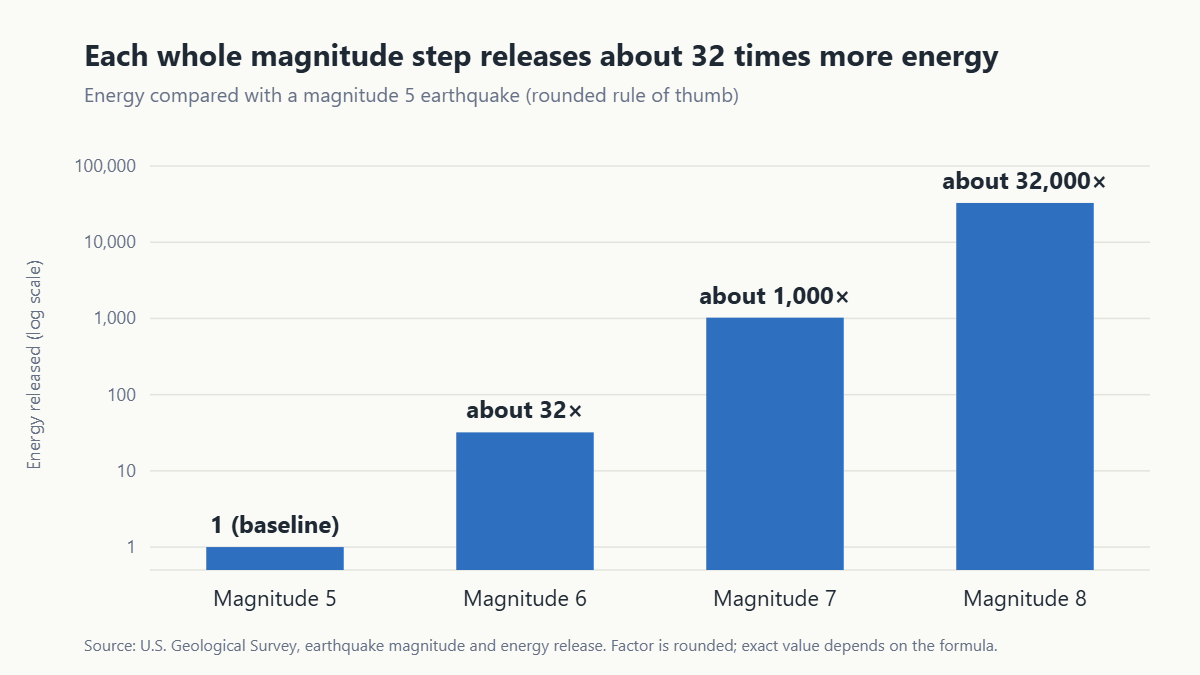
Magnitude is a number that describes the size of an earthquake. The scale is logarithmic, so small changes in the number hide big changes in energy. The USGS magnitude and energy page says each whole-number step means a tenfold increase in measured wave amplitude and about 32 times more energy release.
The table below applies that “about 32 times” rule, using a magnitude 5 quake as the starting point. The factor is a rounded rule of thumb, and the exact value depends on the formula used.
| Magnitude | Energy compared with magnitude 5 |
|---|---|
| 5 | 1 (baseline) |
| 6 | about 32 times |
| 7 | about 1,000 times (32 × 32) |
| 8 | about 32,000 times (32 × 32 × 32) |
For perspective, National Geographic notes that the strongest quake on record was a magnitude 9.5 in Chile in 1960, and no magnitude 10 quake has ever been recorded.
Foreshocks, Mainshocks and Aftershocks
A big earthquake is rarely a single event. Foreshocks are smaller quakes in the same area before the mainshock. Scientists can only identify a foreshock after the larger quake occurs, so a small tremor cannot be labeled a warning in the moment.
Every mainshock is followed by aftershocks, which are smaller quakes in the same area. Depending on the size of the mainshock, the USGS says aftershocks can continue for weeks, months or even years.
Common Myths About Earthquakes
| Myth | Reality |
|---|---|
| Earthquakes only happen on the West Coast | Less often, but they do happen elsewhere, such as the Maine quake mentioned above, and East Coast quakes can be felt over a wide area |
| The epicenter is where the quake starts | The quake starts at the hypocenter underground; the epicenter is the surface point above it |
| You can spot a foreshock in real time | A foreshock is only identified after a larger quake follows |
| Magnitude 8 is just a little bigger than magnitude 7 | Each whole step releases about 32 times more energy |
| Plates glide smoothly, so quakes are random | Plate edges catch and stick, and the stuck stress is what gets released |
Frequently Asked Questions
What is the main cause of earthquakes?
The main cause is the sudden slip of rock along a fault. Moving tectonic plates push and pull on rock until friction can no longer hold it, and the stored energy is released as seismic waves. Most of this happens near plate boundaries.
Can earthquakes happen away from plate boundaries?
Yes. The American Geosciences Institute says over 90% occur near plate boundaries, which means a smaller share happens elsewhere. The Maine quake in January 2025 is one example. These quakes are rarer, but faults inside plates can still slip.
What is the difference between magnitude and intensity?
Magnitude is one number describing the overall size of an earthquake. Intensity describes shaking at a specific place, so one quake has many intensity values. Distance from the fault, the ground beneath you and the direction of the rupture all change what you feel.
Which seismic waves arrive first?
P waves arrive first because they travel faster. S waves follow more slowly. Scientists use the time gap between the two to estimate how far away the quake was, and readings from three seismographs let them locate the source.
How long do aftershocks last?
It depends on the mainshock. A larger mainshock produces aftershocks for longer. The USGS says they can continue for weeks, months or even years, and they tend to become less frequent over time.
Why are there so many earthquakes around the Pacific Ocean?
Many plate boundaries line the Pacific rim, forming the Ring of Fire. National Geographic says about 80% of the world’s earthquakes occur there, along with many volcanoes, because plates keep catching, sticking and slipping in that belt.
Conclusion
Earthquakes happen because Earth’s plates keep moving while their rough edges stay stuck. Stress builds, the rock bends, and eventually the fault slips and sends out seismic waves. Aftershocks follow, and the cycle begins again.
Next time you hear a quake report, picture two stuck blocks and ask one question: how long had this fault been locked?
Disclaimer
This article is for general educational purposes only. The numbers in the worked example are illustrative and do not describe any real fault. For safety guidance and local earthquake hazard information, consult your local emergency management agency or the U.S. Geological Survey.