

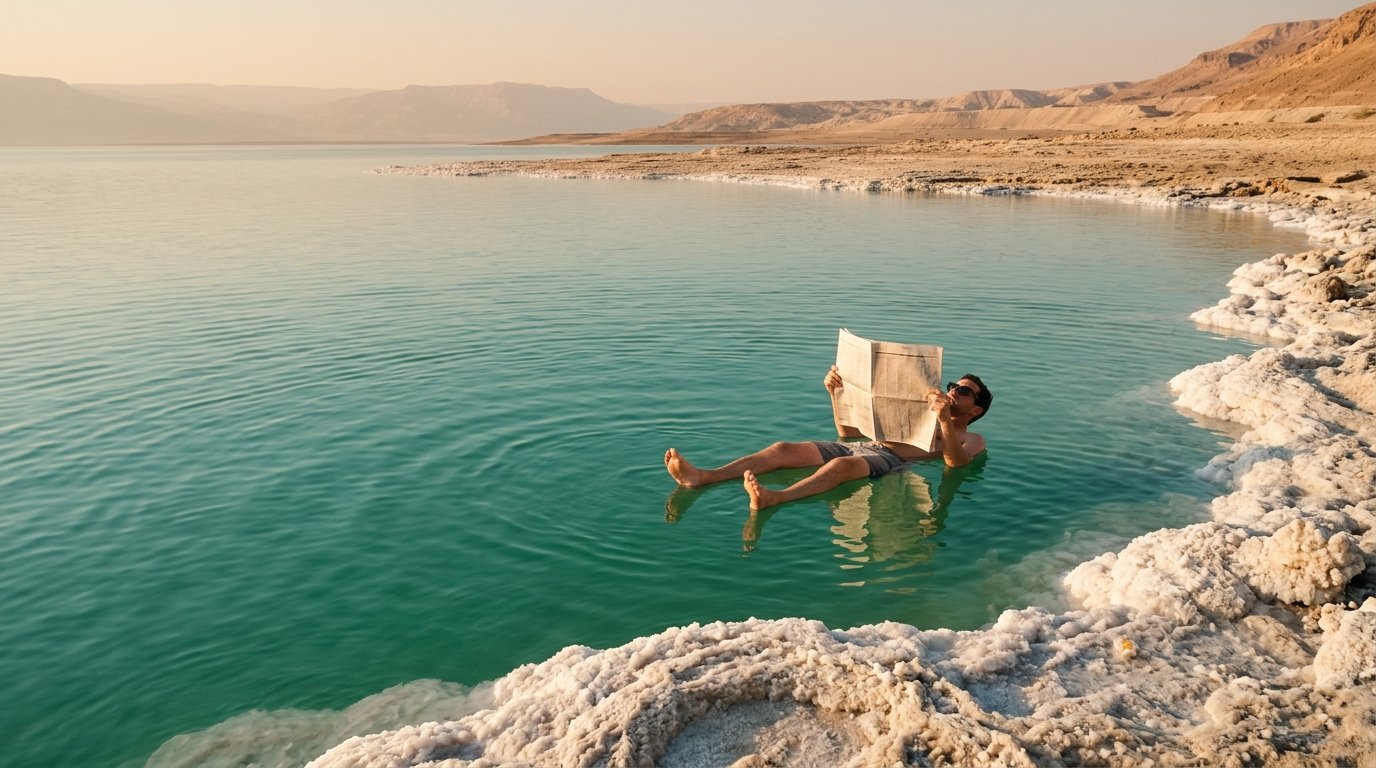
Wade into the Dead Sea and something odd happens. Your legs lift, your back leans on the water, and you can sit upright as if you were in a chair. Mark Twain visited in 1867 and reported that he could not sink.
Why is the Dead Sea so salty? Rivers and streams carry dissolved salts into the lake, the lake has no outlet, and the desert sun evaporates the water while the salt stays behind. That salty water is far denser than fresh water, so it pushes up on your body harder, and you float.
NOAA says the Dead Sea’s surface water is roughly five to nine times as salty as ocean water, and the saltiness keeps climbing as you go deeper.
This guide shows where the salt comes from, why it can’t leave, and how density holds you up. You’ll also get a worked example with real numbers, a look at why the lake is shrinking, and the safety facts people often miss.
Quick Info
| Topic | Detail |
|---|---|
| Short answer | No outlet plus heavy evaporation concentrates the salt that rivers and streams deliver |
| Salinity | About 5 to 9 times the ocean at the surface, nearly 10 times at depth (up to 332 parts per thousand) |
| Water density | About 1,240 kg/m³, against 1,000 for fresh water |
| Why you float | Your body’s density (about 970 kg/m³) is lower than the water’s |
| Elevation | About 1,410 feet (430 m) below sea level, the lowest lake surface on Earth |
| Common mistake | Thinking that floating means you can’t drown |
| Reading time | About 10 minutes |
What Is the Dead Sea?
The Dead Sea is a landlocked salt lake between Israel and Jordan. Despite the name, it is a lake, and it has no link to any ocean. For the real ones, see our guide to how many oceans there are.
Here are the basic facts. The size figures were measured before the water level fell, so today’s lake is smaller.
| Feature | Fact |
|---|---|
| Surface elevation | About 1,410 feet (430 m) below sea level in the mid-2010s |
| Length | About 50 miles (80 km) |
| Maximum width | About 11 miles (18 km) |
| Area | About 394 square miles (1,020 square km) |
| Depth | Northern basin reached about 1,300 feet (400 m) |
| Level change | Drops about 3 feet (1 m) per year |
Source: Britannica.
Why Is the Dead Sea So Salty?
Four steps explain it. Each one adds to the last.
Step 1: Rain and rivers deliver dissolved salt
Salt starts on land. Live Science explains that acids in rainwater dissolve rocks, and runoff carries the resulting ions, mainly sodium and chloride, toward low ground.
The Jordan River is the main delivery route. Britannica reports it once averaged about 1.3 billion cubic meters of water per year, and four smaller streams also enter from the east.
Step 2: The water has nowhere to go
Most lakes have an exit. The Dead Sea doesn’t. Water flows in and never flows out, so every grain of salt that arrives stays.
Think of a bathtub with no drain. Even when the lake stood about 200 meters higher in the past, it did not spill south, because a rise of about 30 meters in the Wadi Al-Arabah blocked the way.
Step 3: The desert sun removes only the water
The lake sits in a hot fault valley about 429 meters below sea level. Britannica’s hydrology section puts evaporation at about 1,400 millimeters (55 inches) per year.
Water vapor leaves. Salt doesn’t. Each year the leftover water holds a larger share of salt.
Step 4: Salt piles up, then settles
The saltiness isn’t even from top to bottom. Upper water holds slightly less than 300 parts per thousand, and below about 100 meters it reaches 332. At that point the water is saturated, so extra salt drops out and collects on the bottom, according to NOAA.
Over long ages this built thick layers of rock salt and gypsum, which Britannica says reach 1 to 4 miles thick in places.
Dead Sea vs ocean at a glance
| Feature | Typical ocean | Dead Sea |
|---|---|---|
| Salt content | About 3.5% (35 parts per thousand) | 5 to 9 times higher at the surface, up to 332 parts per thousand deep down |
| Outlet | Connected to the world ocean | None |
| Water loss | Evaporation, mixing and currents | Evaporation only |
| Surface elevation | Sea level | About 430 m below sea level |
Sources: NOAA, Live Science, Britannica (links above).
If you’re curious what light does in all that water, our explainer on why the ocean looks blue covers the physics.
Why Can You Float on the Dead Sea?
Floating comes down to one comparison: is your body lighter or heavier than the water around it, volume for volume? Salt changes that answer.
Archimedes’ principle in plain words
Water pushes up on anything you put in it. The push equals the weight of the water your body moves aside.
OpenStax’s physics text states the rule this way: an object floats when its average density is lower than the fluid’s, and it sinks when its density is higher.
Why salt makes water denser
Density is mass per volume. Dissolved salt adds mass to every liter of water, so salty water weighs more than fresh water in the same space.
| Water | Density (kg/m³) |
|---|---|
| Fresh water | 1,000 |
| Ocean surface water | About 1,025 |
| Dead Sea water | About 1,240 |
Hypertextbook lists surface seawater at about 1,025 kg/m³. For the lake, a review by Meiburg and Lensky gives a typical density of about 1.24 g/cm³, which is 1,240 kg/m³.
Why you sit up like in a chair
A human body is only slightly less dense than fresh water. OpenStax works an example of a woman with lungs full of air whose density is about 970 kg/m³. In fresh water, almost all of her stays under the surface.
In denser water, far more of her rises above it. The USGS notes that the Dead Sea is denser than sea water, and floaters seem to sit up as if in a chair.
Here is the rule as a formula:
fraction submerged = body density ÷ water density
The top is your body’s density, and the bottom is the water’s density. A denser liquid makes the bottom bigger, so the fraction gets smaller and less of you sits underwater.
Worked Example: How Much of You Stays Above Water?
Let’s put numbers on it. We’ll float a 70 kg person in three kinds of water. The body density of 970 kg/m³ follows the OpenStax example, so treat the person as illustrative. Real bodies vary with lung air, muscle and fat.
Step 1: Gather the densities
| Item | Density (kg/m³) | Source |
|---|---|---|
| Fresh water | 1,000 | OpenStax |
| Ocean surface water | 1,025 | Hypertextbook |
| Dead Sea water | 1,240 | Meiburg and Lensky |
| Floating body (illustrative) | 970 | OpenStax example |
Step 2: Find the fraction submerged
Divide the body’s density by the water’s density:
- Fresh water: 970 ÷ 1,000 = 0.970
- Ocean water: 970 ÷ 1,025 ≈ 0.946
- Dead Sea water: 970 ÷ 1,240 ≈ 0.782
Step 3: Turn it into the share above the surface
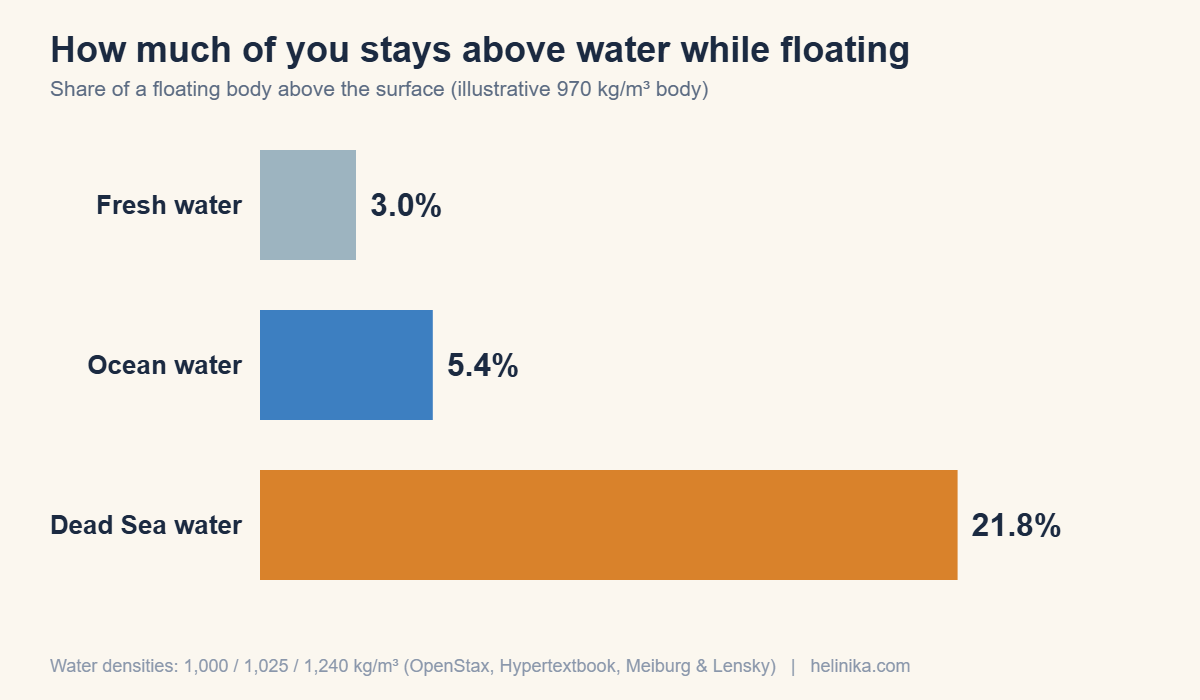
Subtract each fraction from 1 and convert to a percent:
Need a refresher on percentages? See our guide to calculating a percentage.
| Water | Submerged | Above the surface |
|---|---|---|
| Fresh water | 97.0% | 3.0% |
| Ocean water | 94.6% | 5.4% |
| Dead Sea water | 78.2% | 21.8% |
Step 4: Convert to liters
A 70 kg person at 970 kg/m³ has a volume of 70 ÷ 970 ≈ 0.0722 m³, or about 72.2 liters. Multiply by the shares above:
- Fresh water: about 2.2 liters above the surface
- Ocean water: about 3.9 liters
- Dead Sea water: about 15.7 liters
Step 5: Read the result
Here’s the surprise. Ocean water is only 2.5% denser than fresh water, so it lifts you just a little more. The Dead Sea is 24% denser than fresh water, so it lifts about 7 times as much of your body as fresh water does (21.8 ÷ 3.0 ≈ 7.3).
Another way to see it: compared with fresh water, the Dead Sea adds 240 kg of extra mass per cubic meter, while the ocean adds 25. That is about 9.6 times more. Salt doesn’t make a small difference here. It changes the whole picture.
Note: this uses one illustrative body density. Your own numbers will differ a little.
Why the Dead Sea Is Shrinking and Getting Saltier
The lake is losing water faster than it gains it. Britannica says the level drops by about 3 feet (1 meter) per year.
CNN reports a drop of roughly 4 feet a year, a surface area that has shrunk by about one third over five decades, and river inflow that fell from about 1.3 billion cubic meters to roughly 100 million. That is a cut of about 92%.
Three forces drive it: dams and diversions on the Jordan River and its tributary the Yarmouk, mineral companies pumping lake water into evaporation pools, and longer droughts. Less fresh water arriving means the same salt sits in less water. Britannica notes that reduced Jordan inflow raised the salinity of the upper layer.
The falling level also leaves unstable ground behind. CNN counts more than 6,000 sinkholes around the lake.
Staying Safe When You Float
Floating feels effortless, so people relax too much. Science Times advises these basics:
- Don’t dive or splash. Salt water in the eyes and mouth hurts.
- Don’t swallow the water.
- Skip the lake if you have significant open wounds.
- Follow the safety instructions at designated bathing areas.
The same source stresses that buoyancy doesn’t make drowning impossible. A person can roll face down, panic or lose control of their position.
Long soaks affect your skin too. Our article on why fingers wrinkle in water explains what your nerves are doing.
Common Myths About the Dead Sea
| Myth | Reality |
|---|---|
| You can’t sink or drown in it | Floating helps, but you can still flip face down, panic or swallow water |
| Nothing at all lives there | Fish and water plants can’t survive, but a 2011 dive found microbes around deep freshwater springs |
| Ocean water flows in and makes it salty | It has no ocean link. Salt comes from rock runoff carried by rivers and streams |
| It will always stay the same size | The level falls about 1 meter (3 feet) or more each year |
| Any salty water floats you the same | Ocean water adds little (5.4% of you above the surface in our example). The Dead Sea adds a lot (21.8%) |
Frequently Asked Questions
Is the Dead Sea saltier than the ocean?
Yes, by a wide margin. NOAA puts its surface water at five to nine times as salty as the ocean, and deep water near 332 parts per thousand, close to ten times. Ocean water averages about 35 parts per thousand. The gap exists because the lake loses water only to the air, so salt keeps building up.
Can you actually sink in the Dead Sea?
Almost never on purpose, because the dense water holds most adults up. Trouble can still happen. If you flip face down, buoyancy can make it hard to roll back, and swallowed water or salt in your eyes can cause panic. Float on your back and follow lifeguard rules.
Why can’t fish live in the Dead Sea?
The salt level is too high for fish and water plants, according to How It Works. Some microbes cope. Live Science reports that divers in 2011 found freshwater springs on the deep floor ringed by microbial colonies.
Is the Dead Sea a sea or a lake?
It’s a lake. Britannica calls it a landlocked salt lake, and it connects to no ocean. The word “sea” is just part of its traditional name, much like the Caspian Sea, which is also a salt lake.
Is the Dead Sea disappearing?
It’s shrinking fast but won’t vanish overnight. Britannica says the level falls about 1 meter (3 feet) a year, and CNN reports about 4 feet a year and a one-third loss of surface area in five decades. River diversion, mineral extraction and drought are the main causes.
Is it safe to swim in the Dead Sea?
Most healthy visitors enjoy it, but take care. Avoid diving, keep water out of your mouth and eyes, and skip it with open wounds, since salt stings. Follow the rules at designated beaches. Sinkholes have also closed some shores, such as Mineral Beach in 2015, per CNN.
Conclusion
The Dead Sea is salty because salt flows in, no water flows out, and the desert sun removes the water while leaving the salt behind. That dense, mineral-heavy water is about 24% denser than fresh water, so it lifts about 7 times as much of your body, and you float.
Next time you see a white crust at the edge of a puddle, ask yourself where the water went. In the Dead Sea, the answer is up into the sky, and the salt stays.
Disclaimer
This article is for general educational purposes only. The body density and the 70 kg person in the worked example are illustrative, and source figures for the Dead Sea vary by year and depth. If you plan to swim there, follow local safety guidance, and ask a doctor first if you have skin conditions, open wounds or heart or kidney concerns.