

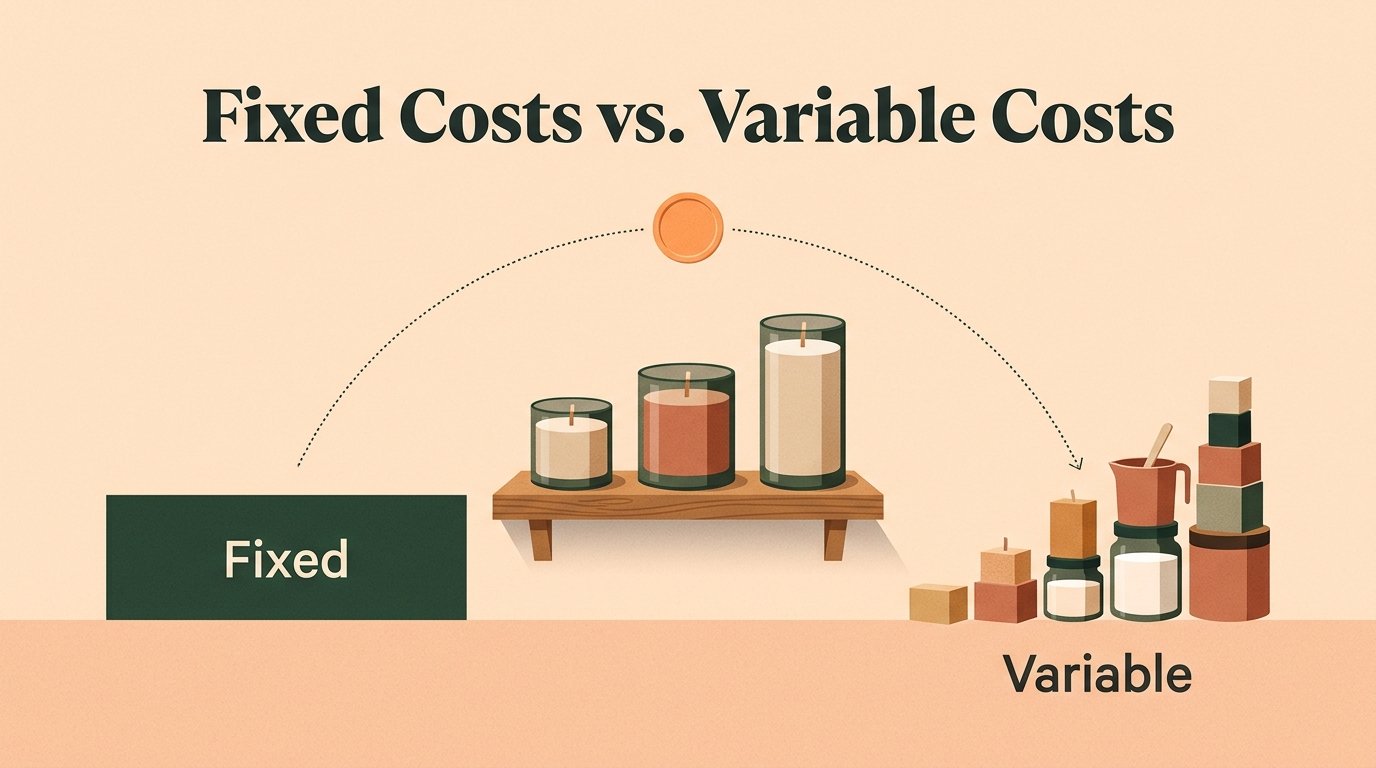
A candle maker pays $1,200 in studio rent whether she pours 10 candles this month or 500. The wax, though, is a different story: the more candles she makes, the more wax she buys. That difference is the heart of fixed costs vs variable costs.
Knowing which costs hold still and which ones move tells you how much you must sell to avoid a loss. It also explains why two businesses with the same sales can earn very different profits. If you have read our guides on gross margin vs net margin and the difference between revenue and profit, this article shows the cost behavior hiding behind those numbers.
Below, you’ll learn the definitions, four simple rules for sorting any cost, a worked example with a candle shop, and how to find a break-even point.
Quick Info
| Topic | Detail |
|---|---|
| Fixed costs | Costs that stay the same in total when output changes, such as rent and insurance |
| Variable costs | Costs that rise and fall in total with output, such as materials and packaging |
| Key formula | Total cost = Fixed costs + (Variable cost per unit × Units) |
| Break-even formula | Fixed costs ÷ (Price minus Variable cost per unit) |
| Common mistake | Assuming a cost is fixed forever, when it can step up as you grow |
| Reading time | About 10 minutes |
What Are Fixed Costs?
Fixed costs are expenses that stay the same in total over a period, no matter how many units you make or sell.
Think of a gym membership. You pay the same monthly fee whether you go twice or twenty times. Businesses have the same kind of bills: rent, insurance, loan payments, software subscriptions and salaried pay.
In math terms, a fixed cost behaves like a constant: its value does not change when the activity level changes. Only its cost per unit moves. Spread $2,000 of rent over 100 candles and each candle carries $20. Spread it over 400 candles and each carries $5.
OpenStax, the free college textbook publisher, describes the same pattern: fixed costs hold steady in total, so the amount per unit falls as output rises.
OpenStax, “Identify and Apply Basic Cost Behavior Patterns”
What Are Variable Costs?
Variable costs are expenses that rise and fall in total as output rises and falls, while the cost per unit stays the same.
Total variable cost = Variable cost per unit × Number of unitsVariable cost per unit is what one more unit costs you, such as the wax and jar for one candle. Number of units is how many you make or sell. Make zero units and the total variable cost is zero too.
The quantity of units is a variable in math, a value that changes. That is why these costs earn the name. Raw materials, packaging, shipping, sales commissions and card processing fees are common examples.
Four Rules for Sorting Any Cost
When a cost does not label itself, run it through these four checks.
| Rule | Question to ask | If yes |
|---|---|---|
| 1. The zero-sales test | Would I still pay this if I sold nothing this month? | Likely fixed |
| 2. The per-unit test | Does the cost per unit stay the same as I make more? | Likely variable |
| 3. The range test | Does the cost stay flat only up to a certain output? | Possibly a step cost |
| 4. The time test | Could I cancel or change it within the period I’m planning? | It may be variable over a longer time |
The zero-sales test settles most cases. Rent passes it, so it is fixed. Wax fails it, so it is variable.
Rule 4 is a reminder that “fixed” depends on the time frame. A lease is fixed for the year, but over five years you can move to a smaller space. Accountants call this the short run and the long run.
Fixed Costs vs Variable Costs at a Glance
| Feature | Fixed costs | Variable costs |
|---|---|---|
| Total when output rises | Stays the same | Rises |
| Cost per unit when output rises | Falls | Stays the same |
| Cost at zero output | Still owed | Zero |
| Typical examples | Rent, insurance, salaries, loan payments | Materials, packaging, shipping, commissions |
| Where they often appear | Operating expenses | Cost of goods sold |
Mixed Costs and Step Costs
Not every bill fits neatly into one box. Two extra types show up often.
Mixed costs
A mixed cost has a fixed part and a variable part. A phone plan with a flat monthly fee plus a charge per extra gigabyte is one. So is a studio electric bill with a base charge plus usage.
The pattern follows a straight line, so it can be written as a cost equation:
Total cost = Fixed part + (Rate per unit × Units)Suppose Maple Street Candles pays a $60 base fee plus $0.15 of electricity per candle. At 300 candles, the bill is $60 + (0.15 × 300) = $105. If this shape looks familiar, it is the same form as the linear equations you solve in algebra: a starting value plus a rate times a quantity.
Step costs
A step cost stays flat across a range of output, then jumps to a higher level once you pass a limit. Imagine the studio can pour about 600 candles a month. To make more, the owner must rent a second workspace for $800 a month. Fixed costs step up from $2,000 to $2,800.
This is why accountants talk about a relevant range: the band of output where a cost keeps behaving the way you expect. OpenStax explains both ideas in its chapter on cost behavior, linked above. Step up past the range and a “fixed” cost changes.
Worked Example: Maple Street Candles
Let’s put numbers on a small business. Maple Street Candles is an imaginary shop that sells hand-poured candles for $18 each. Every figure here is illustrative. To keep the math clear, this example leaves out the electric bill from the mixed cost section.
Step 1: List the fixed costs
These are owed each month, even with zero sales.
| Fixed cost | Monthly amount |
|---|---|
| Studio rent | $1,200 |
| Equipment lease | $250 |
| Insurance | $100 |
| Website and software | $80 |
| Marketing retainer | $370 |
| Total fixed costs | $2,000 |
Step 2: Find the variable cost per candle
These costs show up only when a candle is made and sold.
| Variable cost | Per candle |
|---|---|
| Wax and wick | $3.00 |
| Glass jar | $1.50 |
| Label and box | $1.00 |
| Card processing fee | $0.50 |
| Variable cost per candle | $6.00 |
Step 3: Write the total cost equation
Total cost = $2,000 + ($6 × candles)At 300 candles, total cost is $2,000 + $1,800 = $3,800.
Step 4: Watch the cost per candle change
Fixed costs get spread thinner as volume grows, which pulls down the total cost per candle.
| Candles sold | Fixed cost per candle | Variable cost per candle | Total cost per candle |
|---|---|---|---|
| 100 | $20.00 | $6.00 | $26.00 |
| 200 | $10.00 | $6.00 | $16.00 |
| 400 | $5.00 | $6.00 | $11.00 |
At 100 candles, each one costs $26 to make and sells for $18, so the shop loses money on every sale after spreading rent. At 200 candles, each costs $16, and the shop finally earns something.
Step 5: Calculate profit at 300 candles
Revenue = 300 × $18 = $5,400
Total cost = $2,000 + $1,800 = $3,800
Profit = $5,400 minus $3,800 = $1,600
The variable costs rose with every candle, and the fixed costs did not move. That gap is where profit comes from.
Why It Matters: Finding Your Break-Even Point
The break-even point is the sales level where revenue exactly covers total costs, leaving zero profit and zero loss. Splitting costs into fixed and variable is what makes it calculable.
First you need the contribution margin: the amount each sale leaves over after its own variable cost. That leftover “contributes” to paying the fixed costs, and once those are covered, it becomes profit. A college managerial accounting course from SUNY and Lumen Learning lays out these formulas and a full example.
SUNY and Lumen Learning, “Finding the break-even point”
Contribution margin per unit = Price minus Variable cost per unit
Break-even units = Fixed costs ÷ Contribution margin per unit
Break-even sales = Fixed costs ÷ Contribution margin ratio
The contribution margin ratio is the contribution margin divided by the price, shown as a percentage. If you want a refresher on that step, see our guide on how to calculate percentage.
Break-even for Maple Street Candles
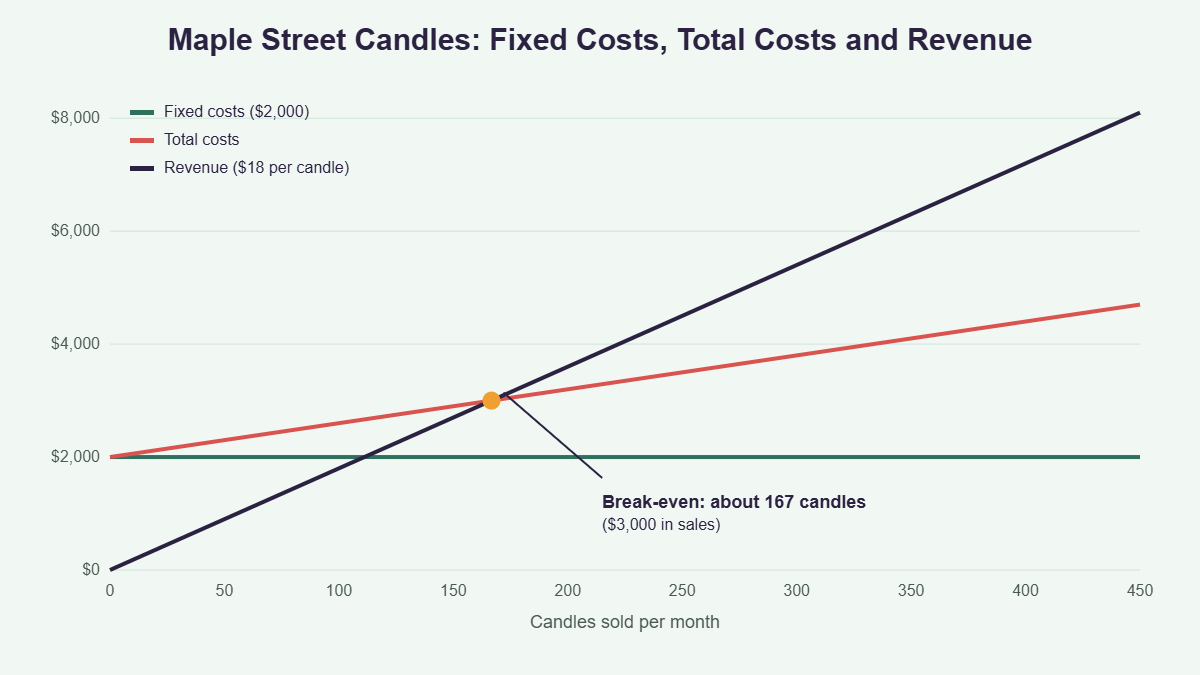
Contribution margin = $18 minus $6 = $12 per candle
Contribution margin ratio = $12 ÷ $18 = 66.7%
Break-even units = $2,000 ÷ $12 = 166.7, so 167 candles
Break-even sales = $2,000 ÷ 0.667 = about $3,000
Sell 167 candles and the shop earns nothing and loses nothing. Candle number 168 starts producing profit, $12 at a time.
How changes move the break-even point
Each lever below changes one input and leaves the rest alone.
| Change | New contribution margin | New break-even |
|---|---|---|
| Today (price $18, variable cost $6, fixed $2,000) | $12 | 167 candles |
| Price cut to $15 | $9 | 223 candles |
| Variable cost cut to $5 | $13 | 154 candles |
| Fixed costs cut to $1,700 | $12 | 142 candles |
A price cut looks friendly to customers, but it pushes break-even up by 56 candles because each sale contributes less.
Which Cost Structure Is Riskier?
Two shops can sell the same candle at the same price and still face different risks. Shop A makes its candles in-house, so it carries high fixed costs ($2,000) and low variable costs ($6 per candle). Shop B pays another company to pour its candles, so it carries low fixed costs ($600) and high variable costs ($12 per candle).
| Candles sold | Shop A profit | Shop B profit |
|---|---|---|
| 100 | minus $800 | $0 |
| 300 | $1,600 | $1,200 |
| 500 | $4,000 | $2,400 |
Shop B breaks even at 100 candles ($600 ÷ $6), so a slow month hurts it less. Shop A needs 167 candles, but once past that, it keeps $12 of every extra sale instead of $6. Neither is better in every case. It depends on how steady your sales are.
Cost Examples by Business Type
The same sorting rules work everywhere. These are typical classifications, and your own numbers will vary.
| Business | Typical fixed costs | Typical variable costs |
|---|---|---|
| Restaurant | Rent, loan payments, insurance | Food, drinks, takeout packaging |
| Online store | Platform subscription, software | Product cost, shipping, payment fees |
| Freelance designer | Software subscriptions, insurance | Contractor fees for extra projects |
| Delivery driver | Vehicle lease, insurance | Fuel, tolls, tire wear |
Common Mistakes and Myths
| Myth | Reality |
|---|---|
| Fixed costs never change | They stay flat only within a range and over a period. Rent can rise, and step costs jump with growth |
| Variable costs are always direct labor | Labor can be fixed (salaried staff) or variable (paid per piece) |
| Cutting fixed costs is always better than cutting variable costs | Both help. Which one lowers break-even more depends on your numbers |
| Cost per unit stays the same at any volume | Fixed cost per unit falls as volume rises, so total cost per unit falls too |
| Break-even means the business is doing well | Break-even is the floor. Profit starts only after it |
Frequently Asked Questions
What is the main difference between fixed and variable costs?
Fixed costs stay the same in total when your output changes, while variable costs rise and fall with every unit you make or sell. Rent is fixed, and packaging is variable. The easy test: if you sold nothing this month, would you still pay it? If yes, it is probably fixed.
What are examples of fixed and variable costs?
Fixed costs include rent, insurance, loan payments, software subscriptions and salaried pay. Variable costs include raw materials, packaging, shipping, sales commissions and card processing fees. A candle shop, for example, pays the same studio rent every month but buys more wax for every extra candle it pours.
Is labor a fixed or variable cost?
It can be either. Salaried staff paid the same amount each month are a fixed cost. Workers paid per piece, or hourly staff whose hours follow demand, are a variable cost. Many businesses have both, and some labor is mixed, such as a base salary plus a commission on each sale.
How do you calculate total cost?
Add total fixed costs to total variable costs. Total variable cost is the variable cost per unit multiplied by the number of units. For example, $2,000 in fixed costs plus 300 units at $6 each gives a total cost of $2,000 + $1,800 = $3,800.
What is a mixed cost?
A mixed cost has both a fixed part and a variable part. A utility bill with a base charge plus a usage charge is a common example. Businesses often split mixed costs into their two parts so they can plan and calculate break-even more accurately.
How do fixed and variable costs affect the break-even point?
Break-even equals fixed costs divided by the contribution margin per unit, which is price minus variable cost per unit. Higher fixed costs raise the break-even point. Higher variable costs shrink the contribution margin, which also raises it. Lowering either one, or raising your price, brings break-even down.
Conclusion
Fixed costs hold still while variable costs follow your output. Sorting every expense into one bucket or the other, or splitting it when it is mixed, lets you calculate cost per unit, contribution margin and break-even. Those three numbers turn a pile of bills into a plan.
Here is a rule to carry with you: ask what you would still pay if sales dropped to zero tomorrow. Those are your fixed costs, and covering them is your first goal.
Disclaimer
This article is for general educational purposes only and is not financial, tax or accounting advice. The Maple Street Candles scenario and its figures are illustrative. Real costs vary by business, location and time period. For decisions about your own business, consult a qualified accountant.