

Look at a globe and you’ll notice something right away. Most of it is blue.
Water covers about 71% of Earth’s surface. That’s why astronauts call our home the “Blue Planet.” But how many oceans actually make up all that water?
If you learned the answer in school a few decades ago, you probably said four. Today, most people say five. And some scientists will tell you there’s really only one.
Confusing? It doesn’t have to be. This guide explains the correct answer, why it changed, and the most important facts about every ocean on Earth.
Oceans At a Glance
| Detail | Information |
|---|---|
| Most Common Answer | 5 oceans |
| The 5 Oceans (Largest to Smallest) | Pacific, Atlantic, Indian, Southern, Arctic |
| Scientific View | One connected global ocean |
| Older Answer | 4 oceans (before the Southern Ocean was widely recognized) |
| Largest Ocean | Pacific Ocean |
| Smallest Ocean | Arctic Ocean |
| Newest Named Ocean | Southern (Antarctic) Ocean |
| Ocean Coverage | About 71% of Earth’s surface |
| Average Ocean Depth | About 3,688 meters (12,100 feet) |
| Target Readers | Students, quiz lovers, curious readers, general knowledge learners |
The Short Answer: There Are 5 Oceans
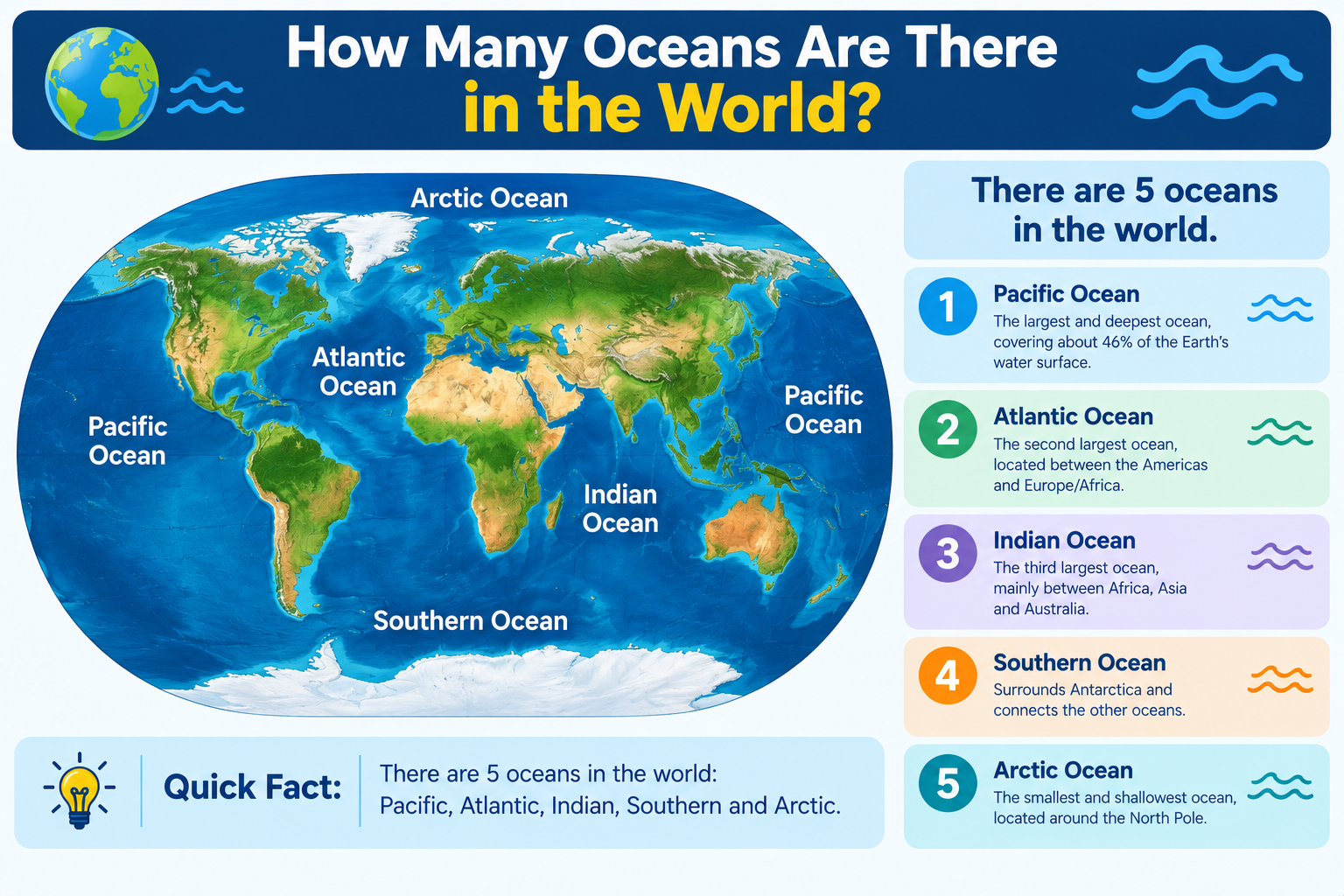
Today, the most widely accepted answer is five oceans:
- Pacific Ocean
- Atlantic Ocean
- Indian Ocean
- Southern (Antarctic) Ocean
- Arctic Ocean
But there’s an interesting twist.
NOAA’s National Ocean Service explains that there is actually only one global ocean. This vast body of water covers 71% of Earth, but people divide it into named regions for historical, cultural, geographical, and scientific reasons. NOAA notes that historically there were four named oceans: the Atlantic, Pacific, Indian, and Arctic. Most countries, including the United States, now recognize the Southern Ocean as the fifth.
So both answers are right:
- Scientifically: One connected world ocean
- Geographically: Five named oceans
Why Did the Answer Change From 4 to 5?
For a long time, most maps showed just four oceans. The cold waters around Antarctica were simply treated as the southern parts of the Pacific, Atlantic, and Indian Oceans.
Then things changed:
- 2000: NOAA notes that boundaries for the Southern Ocean were proposed to the International Hydrographic Organization (IHO). However, not all member countries agreed, so the proposal still hasn’t been formally ratified.
- The U.S. Board on Geographic Names recognizes the Southern Ocean as the waters stretching from Antarctica’s coast to 60° South latitude.
- June 8, 2021: On World Oceans Day, National Geographic officially began recognizing the Southern Ocean as Earth’s fifth ocean on its maps.
The main reason? The Southern Ocean has its own powerful current, the Antarctic Circumpolar Current, which flows all the way around Antarctica and gives the region distinct temperatures, wildlife, and ecosystems.
The 5 Oceans in Order of Size
| Rank | Ocean | Approx. Area | Key Feature |
|---|---|---|---|
| 1 | Pacific | ≈ 165 million km² | Largest and deepest ocean |
| 2 | Atlantic | ≈ 106 million km² | Separates the Americas from Europe and Africa |
| 3 | Indian | ≈ 70 million km² | Warmest ocean |
| 4 | Southern | ≈ 20 million km² | Surrounds Antarctica |
| 5 | Arctic | ≈ 14–15 million km² | Smallest and shallowest ocean |
Note: Area figures are approximate and vary between sources depending on where boundaries and marginal seas are drawn.
Easy memory trick: “Please Ask If Sally’s Arrived” = Pacific, Atlantic, Indian, Southern, Arctic.
A Closer Look at Each Ocean
1. Pacific Ocean: The Giant
- Largest and deepest ocean on Earth
- Covers about one-third of the planet’s surface
- Bigger than all the land on Earth combined
- Stretches from the Arctic in the north to the Southern Ocean in the south
- Borders Asia and Australia on the west, and the Americas on the east
- Home to the Mariana Trench and its Challenger Deep, the deepest known point on Earth at nearly 11,000 meters
Name origin: Explorer Ferdinand Magellan named it Mar Pacífico, meaning “peaceful sea,” because its waters seemed calm during his voyage.
Fun fact: If you dropped Mount Everest into the Challenger Deep, its peak would still be more than 2 km underwater.
2. Atlantic Ocean: The Connector
- Second-largest ocean
- Separates North and South America from Europe and Africa
- Shaped roughly like the letter “S”
- Contains the Mid-Atlantic Ridge, one of the longest underwater mountain ranges on Earth
- Home to the Gulf Stream, a warm current that helps keep Western Europe milder than other places at the same latitude
Fun fact: The Atlantic is slowly getting wider, by a few centimeters each year, as the plates beneath it pull apart.
3. Indian Ocean: The Warm Ocean
- Third-largest ocean
- Bordered by Africa, Asia, and Australia
- The warmest ocean in the world
- The only ocean named after a country (India)
- Controls the powerful monsoon system that brings seasonal rains to South Asia
- Important shipping routes carry oil and goods between the Middle East, Asia, and Africa
Fun fact: Countries like Pakistan, India, Sri Lanka, and the Maldives all depend on the Indian Ocean for trade, fishing, and rainfall.
4. Southern Ocean: The Newest Ocean
- Fourth-largest ocean
- Surrounds Antarctica completely
- Extends from the Antarctic coast north to 60° South latitude
- Driven by the Antarctic Circumpolar Current, the strongest current in the world
- The only ocean that touches three other oceans (Pacific, Atlantic, and Indian)
- Home to whales, penguins, seals, and huge amounts of krill
Fun fact: Unlike other oceans, which are surrounded by continents, the Southern Ocean surrounds a continent.
5. Arctic Ocean: The Frozen North
- Smallest and shallowest ocean
- Located around the North Pole
- Mostly covered by sea ice, especially in winter
- Bordered by North America, Europe, and Asia
- Home to polar bears, walruses, seals, and Arctic whales
- Its sea ice is shrinking due to rising global temperatures
Fun fact: The North Pole has no land beneath it. It sits on floating sea ice in the middle of the Arctic Ocean.
Quick Comparison Table
| Feature | Pacific | Atlantic | Indian | Southern | Arctic |
|---|---|---|---|---|---|
| Size Rank | 1st | 2nd | 3rd | 4th | 5th |
| Location | Between Asia/Australia & Americas | Between Americas & Europe/Africa | Between Africa, Asia & Australia | Around Antarctica | Around North Pole |
| Known For | Largest and deepest | S-shape, Gulf Stream | Warmest, monsoons | Newest, strongest current | Smallest, sea ice |
| Temperature | Varies widely | Varies widely | Mostly warm | Very cold | Very cold |
Ocean vs Sea: What’s the Difference?
People often use these words interchangeably, but they’re not the same.
| Ocean | Sea |
|---|---|
| Huge, open body of salt water | Smaller body of salt water |
| Usually borders several continents | Often partly enclosed by land |
| Very deep | Usually shallower |
| Only 5 named oceans | Dozens of seas worldwide |
| Examples: Pacific, Atlantic | Examples: Arabian Sea, Mediterranean Sea, Caribbean Sea |
Most seas are actually parts of oceans. For example:
- The Arabian Sea is part of the Indian Ocean
- The Mediterranean Sea connects to the Atlantic Ocean
- The South China Sea is part of the Pacific Ocean
What about the “Seven Seas”? It’s an old expression from ancient times meaning “all the world’s waters.” The exact list of seven changed depending on the culture and era, so it isn’t a scientific count.
Amazing Ocean Facts
Britannica’s article on the ocean describes it as a continuous body of salt water held in enormous basins on Earth’s surface. Britannica notes that although there is one “world ocean,” researchers often divide it into the Pacific, Atlantic, Indian, Southern, and Arctic oceans. It also states that the oceans cover nearly 71% of the planet and have an average depth of about 3,688 meters (12,100 feet).
Here are more facts worth knowing:
- 🌊 The ocean holds about 97% of all water on Earth.
- 🐋 The blue whale, the largest animal ever known, lives in the ocean.
- 🌍 More than 80% of the ocean remains unmapped in high detail and largely unexplored.
- 🌬️ Ocean plants like phytoplankton produce a large share of the oxygen we breathe.
- 🌡️ The ocean absorbs huge amounts of heat from the atmosphere, helping regulate Earth’s climate.
- 🏔️ The world’s longest mountain range is the mid-ocean ridge system, almost entirely underwater.
- 🧂 If all the salt in the ocean were spread over land, it would form a thick layer covering every continent.
Oceans by the Numbers
Let’s do a little math with Earth’s oceans.
Earth’s total surface area is about 510 million km². If oceans cover about 71%, then:
Ocean area = 510 × 0.71
Ocean area ≈ 362 million km²
That leaves about 148 million km² for land, roughly 29%. Want to practice calculations like this? See How to Calculate Percentage: A Step-by-Step Guide with Examples.
Here’s another fun one. A ship sailing around Earth along the Equator travels roughly the planet’s circumference. Using Earth’s equatorial radius of about 6,378 km:
C = 2πr
C = 2 × 3.14 × 6,378
C ≈ 40,054 km
That’s about 40,000 km around the middle of the planet. Learn how this formula works in How to Calculate the Area and Circumference of a Circle.
How Ocean Boundaries Are Drawn
Ocean borders aren’t walls. They’re imaginary lines that geographers agree on. Many are based on latitude and longitude, which are measured in degrees.
For example:
- The Southern Ocean begins at 60° South latitude
- The Arctic Circle sits at about 66.5° North
- The Equator at 0° divides the North and South Pacific and Atlantic
Latitude is simply the angle between a place and the Equator, measured from Earth’s center. To understand angles better, read Understanding Angles: Acute, Obtuse, Right, and Straight Angles Explained.
Why Oceans Matter
Oceans aren’t just big pools of water. They keep our planet alive.
- Climate control: Oceans absorb heat and carbon dioxide, slowing climate change.
- Weather: Ocean currents and evaporation drive rainfall, storms, and monsoons.
- Food: Billions of people rely on seafood as a key source of protein.
- Oxygen: Marine plants produce a major share of the world’s oxygen.
- Trade: Most global goods travel by ship across the oceans.
- Medicine: Many marine organisms provide compounds used in medical research.
- Biodiversity: Oceans are home to millions of species, many still undiscovered.
Threats Facing Our Oceans
Oceans face serious challenges today:
- Plastic pollution harming marine life
- Overfishing reducing fish populations
- Rising temperatures bleaching coral reefs
- Ocean acidification from absorbed carbon dioxide
- Melting sea ice in the Arctic and around Antarctica
- Oil spills and chemical runoff
Protecting oceans means protecting the whole planet, including ourselves.
Quick Quiz: Test Your Knowledge
- How many oceans are recognized today?
- Which is the largest ocean?
- Which is the smallest ocean?
- Which ocean was most recently recognized?
- Which ocean is named after a country?
- Where is the deepest point on Earth?
Answers:
- Five (though scientifically, it’s one connected ocean)
- Pacific Ocean
- Arctic Ocean
- Southern Ocean
- Indian Ocean
- Challenger Deep, in the Mariana Trench (Pacific Ocean)
Frequently Asked Questions
How many oceans are there in the world?
Five: the Pacific, Atlantic, Indian, Southern, and Arctic. Scientifically, they all connect to form one global ocean.
Why did we used to say there were 4 oceans?
The Southern Ocean was not widely recognized until recent decades. Earlier maps treated its waters as part of the Pacific, Atlantic, and Indian Oceans.
When was the Southern Ocean recognized?
Boundaries were proposed to the International Hydrographic Organization in 2000, and National Geographic began officially recognizing it on June 8, 2021. However, the IHO has not yet formally ratified the boundaries.
Which is the largest ocean?
The Pacific Ocean. It covers about one-third of Earth’s surface and is larger than all the land on the planet combined.
Which is the smallest ocean?
The Arctic Ocean, which is also the shallowest.
What is the difference between an ocean and a sea?
Oceans are huge, deep, open bodies of salt water. Seas are smaller and often partly enclosed by land, and most are parts of larger oceans.
What percentage of Earth is covered by oceans?
About 71%.
Final Thoughts
So, how many oceans are there? The modern answer is five: the Pacific, Atlantic, Indian, Southern, and Arctic.
But the deeper truth is even more fascinating. All five are connected, forming one vast global ocean that covers most of our planet, shapes our weather, feeds billions of people, and supports countless forms of life.
Next time someone asks this question, you can give the quick answer and the surprising story behind it.
Sources:
- How many oceans are there? – NOAA National Ocean Service
- Ocean – Britannica
- National Geographic recognizes Southern Ocean as Earth’s 5th ocean – ABC7 News
📘 Disclaimer
This article is for general informational and educational purposes only. Ocean boundaries, area figures, and naming conventions can vary between sources, countries, and international organizations. Some measurements are approximate and may be updated as scientific research advances. For academic work, always follow the definitions and figures used by your teacher, textbook, or examination board.