

Look up tonight and you might see a thin silver curve. A week later, it’s a half-circle. A week after that, a bright round disk. Then, slowly, it shrinks away until one night it seems to vanish completely.
Quick Info
| Topic | Detail |
|---|---|
| Short answer | The Moon doesn’t really change shape. As it orbits Earth, we see different amounts of its sunlit half |
| Does the Moon make light? | No. It reflects sunlight |
| Number of phases | 8 (new moon to waning crescent) |
| Full lunar cycle | About 29.5 days (new moon to new moon) |
| One orbit of Earth | About 27.3 days |
| Waxing | Lit part growing (new → full) |
| Waning | Lit part shrinking (full → new) |
| Reading time | About 8 minutes |
For thousands of years, people tracked time by this changing Moon. The word “month” even comes from “moon.” But here’s the surprise: the Moon itself never changes shape. It’s always a round ball of rock. What changes is how much of its sunlit side we can see from Earth.
In this article, we’ll explain why. We’ll start with sunlight and how it lights the Moon, walk through all eight Moon phases one by one, and then look at the lunar cycle that ties them together. We’ll also clear up the most common myth: that Earth’s shadow causes the phases. (It doesn’t.)
Sunlight: The Moon’s Borrowed Glow
The Moon looks bright at night, but it doesn’t make any light of its own. It’s a dusty, rocky world, and it shines only because sunlight bounces off its surface. Moonlight is really sunlight, reflected back towards Earth.
NASA’s Space Place guide to the Moon’s phases puts it simply: the Moon does not produce its own light, and its shape isn’t changing during the month. What changes is how much of its lit side we can see.
Half the Moon Is Always Lit
Think of a ball held up next to a lamp in a dark room. The side facing the lamp is bright. The far side is dark. The Moon works exactly the same way: at any moment, the half facing the Sun is in daylight and the other half is in night.
That’s true every single day of the month, including the night of a “new moon” when we can’t see it at all. The Moon is never more or less than half-lit. The only thing that changes is our angle of view.
Try It Yourself: The Lamp-and-Ball Experiment
This is the best way to see the phases with your own eyes.
- In a dark room, place a single lamp (without a shade) on one side. This is the Sun.
- Hold a ball or an orange at arm’s length. This is the Moon. Your head is Earth.
- Face the lamp, with the ball just above your head. You see only the dark side: new moon.
- Slowly turn to your left, keeping the ball in front of you. A thin sliver of light appears, then grows.
- When the lamp is behind you (ball held slightly above your head’s shadow), the whole face is lit: full moon.
- Keep turning, and the light shrinks back down until you’re facing the lamp again.
You’ve just made a whole lunar month in about 30 seconds, and the ball never changed shape once.
The 8 Phases of the Moon
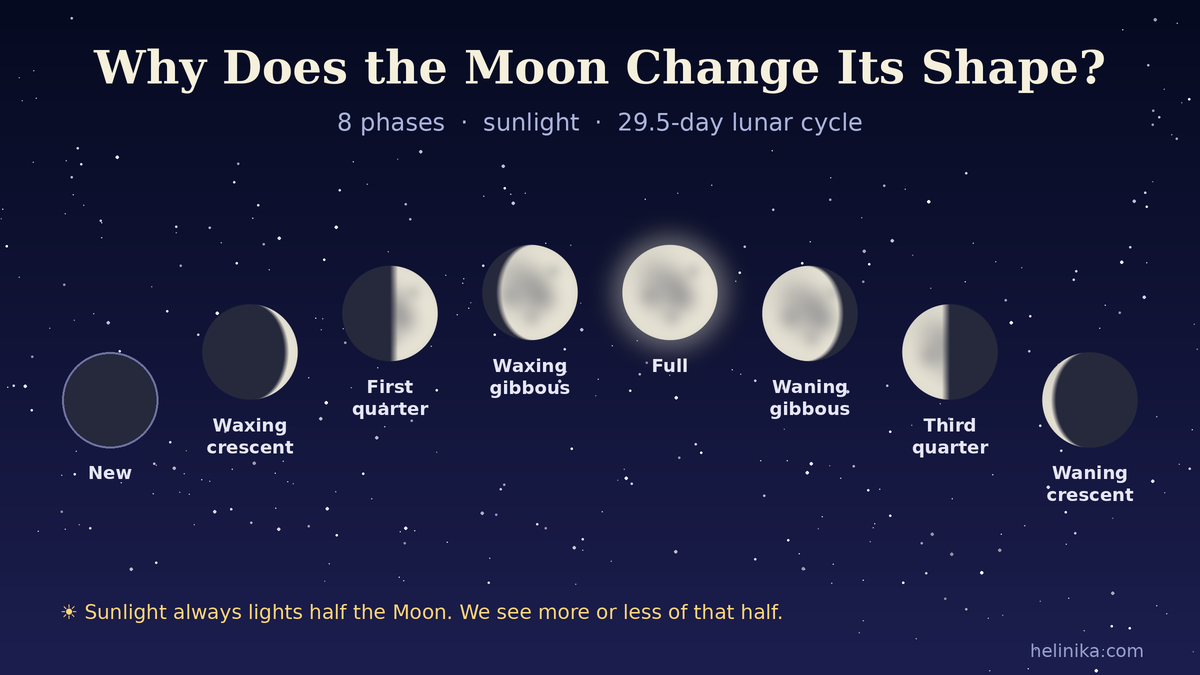
Astronomers split the Moon’s monthly changes into eight named phases. The NASA Science page on Moon phases lists them in this order: new moon, waxing crescent, first quarter, waxing gibbous, full moon, waning gibbous, third quarter and waning crescent. Then the cycle starts again.
| # | Phase | How much looks lit | Where the Moon is | Roughly when it’s visible |
|---|---|---|---|---|
| 1 | New moon | None (0%) | Between Earth and Sun | Not visible; up during the day, lost in the Sun’s glare |
| 2 | Waxing crescent | A thin, growing sliver | A little past the Sun | Early evening, low in the west after sunset |
| 3 | First quarter | Half (right side*) | 90° from the Sun | Afternoon to around midnight |
| 4 | Waxing gibbous | More than half, growing | Approaching the far side of Earth | Late afternoon to early morning |
| 5 | Full moon | All (100%) | Earth between Sun and Moon | Rises at sunset, sets at sunrise |
| 6 | Waning gibbous | More than half, shrinking | Past the far side of Earth | Late evening to morning |
| 7 | Third (last) quarter | Half (left side*) | 90° from the Sun on the other side | Around midnight to midday |
| 8 | Waning crescent | A thin, shrinking sliver | Nearly back between Earth and Sun | Before dawn, low in the east |
*As seen from the Northern Hemisphere, including Pakistan and India. From the Southern Hemisphere, left and right are swapped.
Decoding the Names
- Crescent: less than half lit, a thin curved shape.
- Quarter: exactly half the face is lit. It’s called a “quarter” because the Moon is a quarter of the way (or three-quarters) through its orbit, not because a quarter is lit.
- Gibbous: more than half but not fully lit, a rounded, bulging shape.
- Waxing: growing. The lit part gets bigger each night.
- Waning: shrinking. The lit part gets smaller each night.
The Quarter Moons and Right Angles
At first and third quarter, the Sun, Earth and Moon form a right angle: the line from Earth to the Moon sits at 90° to the line from Earth to the Sun. That’s why we see exactly half of the Moon’s sunlit side. (Need a refresher on right angles? See our guide to acute, obtuse, right and straight angles.) At full moon, the three line up in a straight line, a 180° straight angle, with Earth in the middle.
The Lunar Cycle: One Trip Around Earth
The phases repeat in a steady loop called the lunar cycle (or synodic month). It runs from one new moon to the next and takes about 29.5 days.
A Rough Timeline of One Cycle
| Day of cycle (approx.) | Phase |
|---|---|
| Day 0 | New moon |
| Days 1–6 | Waxing crescent |
| Day 7–8 | First quarter |
| Days 8–14 | Waxing gibbous |
| Day 14–15 | Full moon |
| Days 15–21 | Waning gibbous |
| Day 22 | Third quarter |
| Days 23–29 | Waning crescent |
| Day 29.5 | New moon again |
The main four phases (new, first quarter, full, third quarter) each arrive about a week apart. The in-between phases fill the gaps.
Why 29.5 Days and Not 27.3?
Here’s a puzzle that catches many people out. The Moon goes once around Earth in about 27.3 days. So why does a full cycle of phases take 29.5?
It’s because Earth isn’t standing still. While the Moon circles us, Earth is also travelling around the Sun. After 27.3 days, the Moon is back in the same spot relative to the distant stars, but the Sun has “moved” in our sky because Earth has shifted along its own orbit. The Moon needs about two extra days to catch up and line up with the Sun again for the next new moon.
| Measure | Length | What it means |
|---|---|---|
| Sidereal month | About 27.3 days | One orbit compared with the background stars |
| Synodic month (lunar cycle) | About 29.5 days | New moon to new moon; the phase cycle |
Why the Moon Rises Later Each Day
In one lunar cycle, the Moon moves a full circle (360°) around our sky compared with the Sun. Spread over 29.5 days, that’s about 360 ÷ 29.5 ≈ 12° per day. (Circles and degrees are covered in our guide to the area and circumference of a circle.) Because Earth has to spin a little extra each day to catch up with the Moon, moonrise comes roughly 50 minutes later every day on average.
That’s why a full moon rises around sunset, but a week later the third-quarter Moon doesn’t come up until around midnight.
Waxing and Waning
The first half of the cycle is the waxing half. The lit part grows each evening as the Moon’s orbit carries more of its sunlit side into our view. After full moon comes the waning half, when the lit part shrinks as the sunlit side turns away from us. NASA describes it this way: the lighted side appears to shrink, but the Moon’s orbit is simply carrying it out of view.
Common Questions About the Moon’s Shape
Myth: Earth’s Shadow Causes the Phases
This is the most widespread mistake, and it’s easy to see why people believe it. But it’s wrong. Earth’s shadow always points straight away from the Sun. During a crescent or quarter moon, the Moon is off to the side of Earth, nowhere near that shadow. So the shadow can’t be what’s hiding part of it.
Earth’s shadow only falls on the Moon during a lunar eclipse, which happens a few times a year at most, and only at full moon. The everyday phases are caused purely by our changing view of the Moon’s sunlit half.
| Moon phases | Lunar eclipse | |
|---|---|---|
| Cause | Our viewing angle of the sunlit half | Earth’s shadow falling on the Moon |
| How often | Every night, in a 29.5-day cycle | A few times a year at most |
| Phase when it happens | All phases | Only at full moon |
| Typical colour | Bright silver-white | Often coppery red |
Why Isn’t There an Eclipse Every Month?
The Moon’s orbit is tilted by about 5° compared with Earth’s path around the Sun. So most months, at new moon and full moon, the Moon passes slightly above or below the Sun–Earth line. Eclipses only happen when everything lines up exactly.
Why Do We Always See the Same Face?
The Moon spins on its axis exactly once for every trip around Earth, about 27.3 days for each. This matching is called tidal locking. The result: one side always faces us, and the “far side” is never visible from Earth. The far side isn’t permanently dark, though. It gets just as much sunlight; we simply never see it.
Why Can We Sometimes See the “Dark” Part Faintly?
During a thin crescent, you can often make out the rest of the Moon glowing dimly. This is earthshine: sunlight reflected off Earth’s clouds and oceans onto the Moon, then back to us. Our planet’s huge oceans, which cover about 71% of its surface, help bounce that light into space.
Does the Moon Look the Same Everywhere?
The phase is the same everywhere on Earth on a given night. But the Moon looks flipped in the Southern Hemisphere: a waxing crescent lit on the right in Pakistan is lit on the left in Australia. Near the equator, crescents often look like a smile, lying almost on their back.
The Moon and Calendars
Because the lunar cycle is so regular, many calendars are built on it. The Islamic Hijri calendar is fully lunar: each month begins with the sighting of the new crescent moon, which is why Ramadan and Eid move about 10–11 days earlier each year in the solar calendar. Twelve lunar months add up to about 354 days, compared with 365 days for a solar year.
Frequently Asked Questions
Why does the Moon change its shape in simple words? It doesn’t really. Half the Moon is always lit by the Sun. As the Moon orbits Earth, we see more or less of that lit half.
How many phases does the Moon have? Eight: new moon, waxing crescent, first quarter, waxing gibbous, full moon, waning gibbous, third quarter and waning crescent.
How long does one lunar cycle take? About 29.5 days, from one new moon to the next.
What is the difference between waxing and waning? Waxing means the lit part is growing (before full moon). Waning means it’s shrinking (after full moon).
Can you see the Moon during the day? Yes. Except near new moon, the Moon is above the horizon for part of the day too. A first-quarter Moon is often easy to spot in the afternoon sky.
Does the Moon make its own light? No. Moonlight is sunlight reflected off the Moon’s surface.
Conclusion
The Moon’s changing shape is one of the oldest puzzles people have looked up at, and the answer is beautifully simple. The Sun always lights half of the Moon. As the Moon travels around Earth over about 29.5 days, we see that lit half from different angles, giving us eight phases: from the dark new moon, through growing crescents and quarters, to the bright full moon, and back again.
It isn’t Earth’s shadow, and the Moon never actually changes shape. Next time you spot a thin crescent in the evening sky, you’ll know you’re looking at a sliver of sunlit ground, and that in about a week, you’ll see half of it.
References
Disclaimer
This article is for general educational purposes only. Day counts, angles and rise times are rounded averages; exact phase dates and moonrise times vary by location and date. For precise times, check an official astronomical almanac or your local observatory. Moon sighting for religious calendars follows the guidance of the relevant religious authorities.