

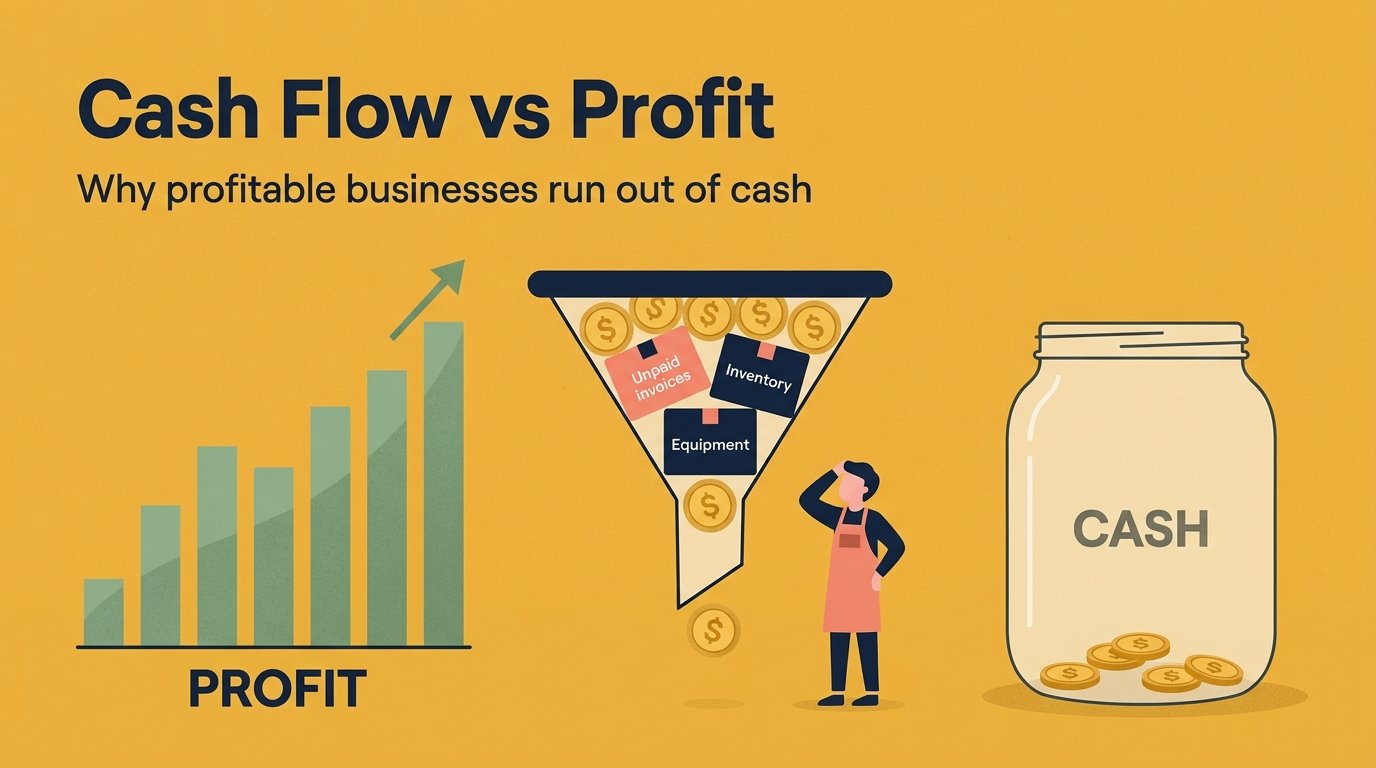
A business can show a profit every single month and still struggle to make payroll. That sounds impossible until you look at when the money actually moves.
Cash flow vs profit comes down to one idea: profit tells you whether you earned more than you spent on paper, while cash flow tells you whether the money is sitting in your bank account right now. The two numbers measure different things, run on different clocks, and can point in opposite directions for a whole year.
This is not a rare problem for a few careless owners.
In the Federal Reserve Banks’ survey of 7,625 small employer firms, 51% said uneven cash flow was a financial challenge in the prior 12 months, second only to rising costs and paying operating expenses on the list of common problems.
Below, you’ll see the exact difference between the two numbers, follow a profitable sign shop that ended its “best year ever” $12,000 short of cash, learn the one formula that measures the gap, and finish with a checklist you can run on any business.
Quick Info
| Topic | Detail |
|---|---|
| Short answer | Profit is earnings on paper; cash flow is money actually entering and leaving the bank |
| Profit formula | Revenue minus all expenses, recorded when earned or incurred |
| Cash flow formula | Cash received minus cash paid out during a period |
| Why they split apart | Unpaid customer invoices, inventory, equipment purchases, loan principal, owner draws, taxes |
| Key warning sign | Profit rising while the bank balance falls |
| Best tool | A weekly cash forecast plus the cash conversion cycle |
| Reading time | About 12 minutes |
What Is the Difference Between Cash Flow and Profit?
Profit is what’s left after you subtract expenses from revenue for a period, counted when a sale is earned and when a cost is incurred, not when money changes hands. If you need a refresher on how sales turn into gross, operating and net profit, see our guide to the difference between revenue and profit.
Cash flow is the actual money that comes into and goes out of your business bank account during that same period.
Think of profit as a report card and cash as the gas in the tank. A great report card won’t get your car across town if the tank is empty.
| Feature | Profit | Cash flow |
|---|---|---|
| Question it answers | Did we earn more than we spent? | Can we pay the bills this week? |
| When an item counts | When a sale is made or a cost is incurred | When money actually moves |
| Where you find it | Income statement (profit and loss) | Statement of cash flows, bank balance |
| Unpaid customer invoices | Counted as revenue right away | Count only when the customer pays |
| A $45,000 machine | Spread over years as depreciation | The full $45,000 leaves the day you pay |
| Loan principal payments | Not an expense | A real cash outflow |
Why accrual accounting creates the gap
Most growing businesses use accrual accounting, which records revenue when you earn it and expenses when you incur them. That gives a fair picture of performance over time, but it ignores timing. The cash method does the opposite: it records money only when it’s received or paid.
The U.S. Small Business Administration’s guide to managing finances lists “potentially deceiving figures” among the drawbacks of accrual accounting, and it credits the cash method with showing cash flow more clearly.
Neither method is wrong. They answer different questions, which is exactly why you need to watch both.
Six Places Profit Hides Before It Becomes Cash
Every dollar of profit has to pass through a few “holding tanks” before it reaches your bank account. Here’s where it tends to get stuck.
1. Customers who haven’t paid yet
When you send an invoice with Net 30 or Net 60 terms, the sale counts as profit immediately. The cash shows up a month or two later, if the customer pays on time. Money owed to you is called accounts receivable, and it’s the most common reason profitable firms run short.
2. Inventory sitting on shelves
Buying materials or stock drains cash today. It only becomes an expense on the income statement when the item is sold. A bulk order to grab a supplier discount can make perfect sense for margins and still empty your account.
3. Equipment and other big purchases
A new truck, oven or machine is recorded as an asset, then expensed bit by bit through depreciation over several years. Your profit barely moves in year one, but the full price leaves your account the day you pay.
4. Loan principal payments
Interest on a loan is an expense. The principal portion is not, because you’re paying back money you already received. So a $1,000 monthly loan payment might lower profit by only $200 while lowering cash by the full $1,000.
5. Owner draws and distributions
Money an owner takes out of the business doesn’t reduce profit on the books. It still reduces the bank balance dollar for dollar.
6. Taxes on profit you haven’t collected
Taxes are calculated on profit, not on cash received. If a large share of your profit is still tied up in receivables, you can owe tax on money you haven’t seen yet.
| Item | Changes profit? | Changes cash? | Effect on cash |
|---|---|---|---|
| Sale on credit (unpaid invoice) | Yes, right away | Not until paid | Delayed inflow |
| Buying inventory | Only when sold | Yes, right away | Early outflow |
| Buying equipment | Slowly, via depreciation | Yes, in full | Large early outflow |
| Loan principal | No | Yes | Outflow |
| Owner draw | No | Yes | Outflow |
| Depreciation | Yes, lowers it | No | None (cash already spent) |
| Paying suppliers later | No | Yes, delays outflow | Helps cash for now |
Worked Example: Bluewater Sign Co.’s “Best Year Ever”
Bluewater Sign Co. is a fictional six-person shop that makes storefront and wayfinding signs. It starts the year with $70,000 in the bank. In the spring, it wins its biggest contract ever: signs for a school district that pays on Net 60 terms.
By December, the income statement looks great: $600,000 in revenue and $60,000 in net profit, a 10% net margin. (Our guide to gross margin vs net margin explains how that percentage is calculated.)
Then the owner checks the bank account and finds an overdraft. Here’s how that happened, step by step. All figures are illustrative.
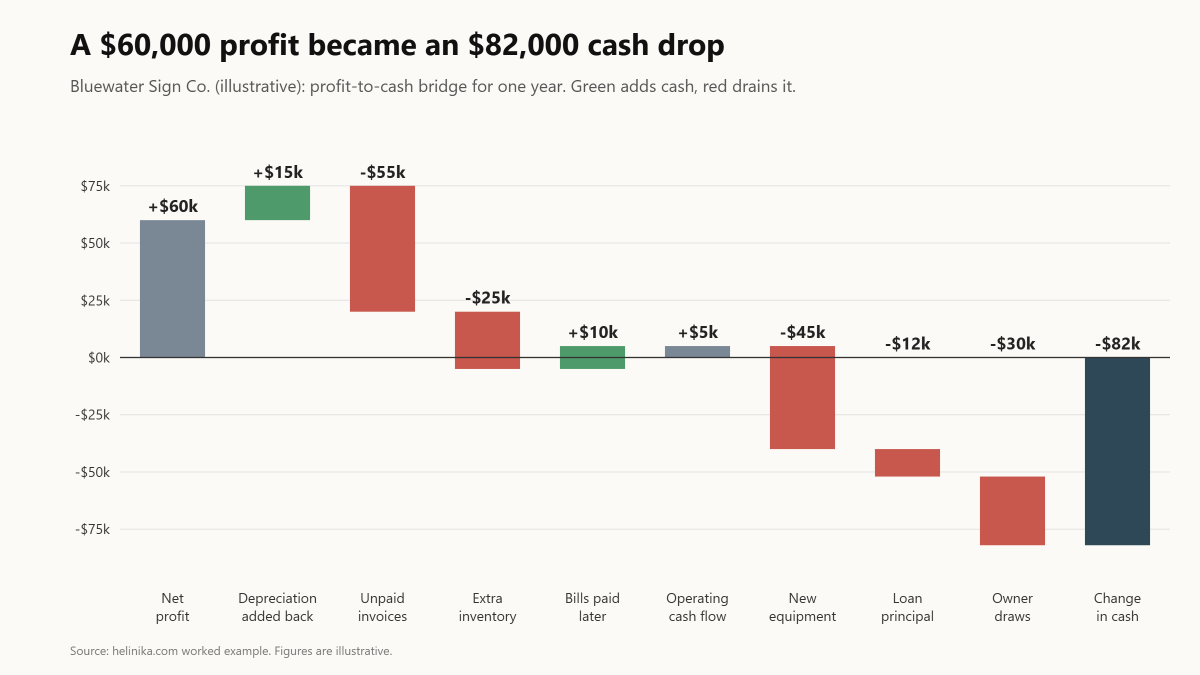
Step 1: Start with net profit
Bluewater earned $60,000 in profit. That’s the starting point, not the answer.
Step 2: Add back non-cash expenses
The income statement included $15,000 of depreciation on older equipment. Depreciation lowers profit but costs no cash this year, so you add it back.
Running total: $60,000 + $15,000 = $75,000
Step 3: Adjust for working capital
This is where the school contract bites.
- Accounts receivable grew from $50,000 to $105,000, so $55,000 of “profit” is still sitting in unpaid invoices.
- Inventory grew from $15,000 to $40,000 because the shop stocked up on aluminum and vinyl. That’s $25,000 of cash turned into material.
- Accounts payable (bills Bluewater hasn’t paid yet) rose from $20,000 to $30,000, which kept $10,000 in the bank for now.
Running total: $75,000 minus $55,000 minus $25,000 plus $10,000 = $5,000
That $5,000 is Bluewater’s operating cash flow. A $60,000 profit produced only $5,000 of cash from day-to-day business.
Step 4: Subtract investing and financing cash
- A new CNC router to keep up with demand: $45,000
- Principal payments on an existing equipment loan: $12,000
- Owner draws: $30,000
Running total: $5,000 minus $45,000 minus $12,000 minus $30,000 = negative $82,000
Step 5: Find the ending cash balance
Ending cash = Starting cash + Change in cash
Ending cash = $70,000 + (-$82,000) = -$12,000
Bluewater made a $60,000 profit and still ended the year $12,000 overdrawn. Nothing was fraudulent and no one made a math error. Profit and cash simply measured different things.
| Bridge line | Amount |
|---|---|
| Net profit | +$60,000 |
| Depreciation added back | +$15,000 |
| Increase in accounts receivable | -$55,000 |
| Increase in inventory | -$25,000 |
| Increase in accounts payable | +$10,000 |
| Operating cash flow | +$5,000 |
| New equipment | -$45,000 |
| Loan principal | -$12,000 |
| Owner draws | -$30,000 |
| Change in cash for the year | -$82,000 |
Here’s the full bridge as one formula you can reuse:
Change in cash = Net profit
               + Non-cash expenses (depreciation)
               - Increase in receivables
               - Increase in inventory
               + Increase in payables
               - Equipment purchases
               - Loan principal paid
               - Owner draws
The Cash Conversion Cycle: One Number That Measures the Gap
The worked example shows what happened. The cash conversion cycle (CCC) shows why, in days. It measures how long a dollar spent on materials takes to come back as cash from a customer.
CCC = DSO + DIO - DPO

DSO (days sales outstanding)     = Accounts receivable / Revenue x 365
DIO (days inventory outstanding) = Inventory / Cost of goods sold x 365
DPO (days payables outstanding)  = Accounts payable / Cost of goods sold x 365
In plain words: DSO is how long customers take to pay you, DIO is how long materials sit before they’re sold, and DPO is how long you take to pay your own suppliers.
Bluewater’s cost of goods sold was $360,000. Using its year-end numbers:
| Measure | Calculation | Result |
|---|---|---|
| DSO | $105,000 / $600,000 x 365 | About 64 days |
| DIO | $40,000 / $360,000 x 365 | About 41 days |
| DPO | $30,000 / $360,000 x 365 | About 30 days |
| CCC | 64 + 41 – 30 | About 74 days |
Before the school contract, Bluewater’s customers paid in about 30 days. The new Net 60 deal more than doubled its DSO, and that one change explains most of the cash drain.
The growth trap
Here’s the part that surprises many owners: growing faster can make the cash problem worse. At a 64-day DSO, every extra $100,000 of annual sales ties up about $17,500 in unpaid invoices (100,000 x 64 / 365). Meanwhile, fixed costs like rent and salaries keep coming due every month whether customers have paid or not.
A shorter cycle frees cash. A longer one swallows it. If your CCC climbs from one quarter to the next, find out which of the three parts moved. Our walkthrough on how to calculate percentage change is handy for tracking that shift over time.
How Much Cash Cushion Is Enough?
A simple way to measure your safety net is cash buffer days: how many days your business could keep paying its bills if every customer payment suddenly stopped.
Cash buffer days = Cash balance / Average daily cash outflowsThe JPMorgan Chase Institute studied about 597,000 small businesses and found that the typical one held only 27 cash buffer days, with restaurants at just 16 days.
Bluewater actually started the year with a better cushion than that. Its cash outflows for the year came to about $627,000, or roughly $1,720 a day, so its $70,000 opening balance covered about 41 days. It still ran dry, because a cushion that size can’t absorb $82,000 of cash tied up in growth, equipment and draws. The buffer has to match your plans, not just your current bills.
Warning Signs: A Quick Cash Health Checklist
Run through these once a month. Two or more red flags mean it’s time to build a cash forecast before the bank balance forces the issue.
| Warning sign | What to check | Healthy direction |
|---|---|---|
| Profit up, bank balance down | Compare the two each month | Both rising together |
| Customers paying slower | DSO trend | Flat or falling |
| Stock piling up | DIO trend and slow-moving items | Flat or falling |
| Paying suppliers late to survive | Overdue bills and late fees | No late payments |
| Using the credit line for payroll | Credit line balance | Paid down regularly |
| Owner draws based on profit, not cash | Draws vs operating cash flow | Draws below operating cash flow |
How to Keep a Profitable Business From Running Dry
1. Forecast cash weekly, not just profit monthly
List expected cash in and cash out for each of the next 8 to 13 weeks, starting from today’s bank balance. Assume customers pay a little late and bills arrive on time. The goal is to see a shortfall a month before it happens, not the day it happens.
2. Match your payment terms
If customers pay you in 60 days, try to pay your biggest suppliers in 45 to 60 days too. Giving Net 60 while paying Net 15 means you’re financing your customers out of your own pocket.
3. Ask for deposits and progress payments
For large jobs, request a deposit up front and bill in stages as work is completed. Bluewater could have billed the school district at 30%, 60% and 100% completion instead of waiting for one final invoice.
4. Finance long-lived equipment over its life
Paying cash for a machine that lasts ten years drains a year’s worth of cushion at once. Spreading the cost over the asset’s useful life keeps payments in line with the cash it helps produce.
5. Set aside tax money every month
Move a fixed share of each month’s profit into a separate account for taxes, so a tax bill never lands on a thin balance.
6. Pay owners a steady amount
A fixed owner salary, adjusted a few times a year, is far easier to plan around than large draws taken whenever profit looks good.
7. Open a credit line before you need it
Banks lend more willingly to a business that doesn’t need the money yet. A line of credit set up in a strong month gives you a backstop for a slow one.
Common Myths About Cash Flow and Profit
| Myth | Reality |
|---|---|
| “If we’re profitable, we have cash.” | Profit can be stuck in receivables, inventory and equipment for months. |
| “More sales always fix cash problems.” | Sales on long credit terms can widen the gap before they close it. |
| “Depreciation costs us cash every year.” | The cash left when the asset was bought; depreciation only spreads the cost on paper. |
| “Positive cash flow means the business is healthy.” | Cash can rise from a new loan or selling equipment while the core business loses money. |
| “Cash flow only matters for struggling businesses.” | Fast-growing firms often feel the tightest squeeze. |
Frequently Asked Questions
Can a business be profitable but have negative cash flow?
Yes, and it happens often. Profit counts sales when they’re made, even if customers haven’t paid. If a business sells on long payment terms, buys inventory ahead of demand, or pays cash for equipment, money leaves the bank faster than it arrives. Over a full year, that can turn a solid profit into a falling bank balance, as the Bluewater example shows.
Which is more important, cash flow or profit?
You need both, but on different timelines. Cash flow decides whether you survive the next few months, because bills, payroll and loan payments must be paid in cash. Profit decides whether the business is worth running over the long term. A company can live for a while without profit if it has cash, but it can’t last a week without cash.
Can cash flow be positive while a business loses money?
Yes. A business can take out a loan, collect old invoices, sell equipment, or delay paying its suppliers, and its bank balance will rise even though it’s losing money on its actual operations. That’s why lenders look at operating cash flow separately from total cash flow before deciding whether a business is healthy.
Is EBITDA the same as cash flow?
No. EBITDA (earnings before interest, taxes, depreciation and amortization) adds back depreciation, but it ignores changes in receivables, inventory and payables, as well as equipment purchases, loan principal and taxes actually paid. A business can have strong EBITDA and still burn cash, especially while it’s growing quickly.
Where can I see cash flow in financial statements?
Look at the statement of cash flows. It splits cash into three groups: operating activities (day-to-day business), investing activities (equipment and other long-term assets) and financing activities (loans, owner contributions and draws). The operating section usually starts with net profit and adjusts it, exactly like the bridge in the worked example.
How often should a small business check its cash flow?
Check your bank balance and upcoming bills at least weekly, and review a short cash forecast every week if money is tight. Compare profit and operating cash flow every month when you close your books. If the two drift apart for more than a couple of months, find out where the cash is stuck before it becomes an emergency.
Conclusion
Profit and cash flow aren’t rivals. They are two views of the same business: profit shows whether the work pays off, and cash flow shows whether you can keep the doors open while you wait to get paid. Bluewater Sign Co. did nothing wrong except assume the first number told the whole story.
So the next time your income statement looks great, ask one more question before you celebrate: where is that profit sitting right now?
Disclaimer
This article is for general educational purposes only and is not financial, tax or accounting advice. Bluewater Sign Co. is a fictional business, and the figures in the worked example are illustrative. For decisions about your own business, consult a qualified accountant or financial advisor.