

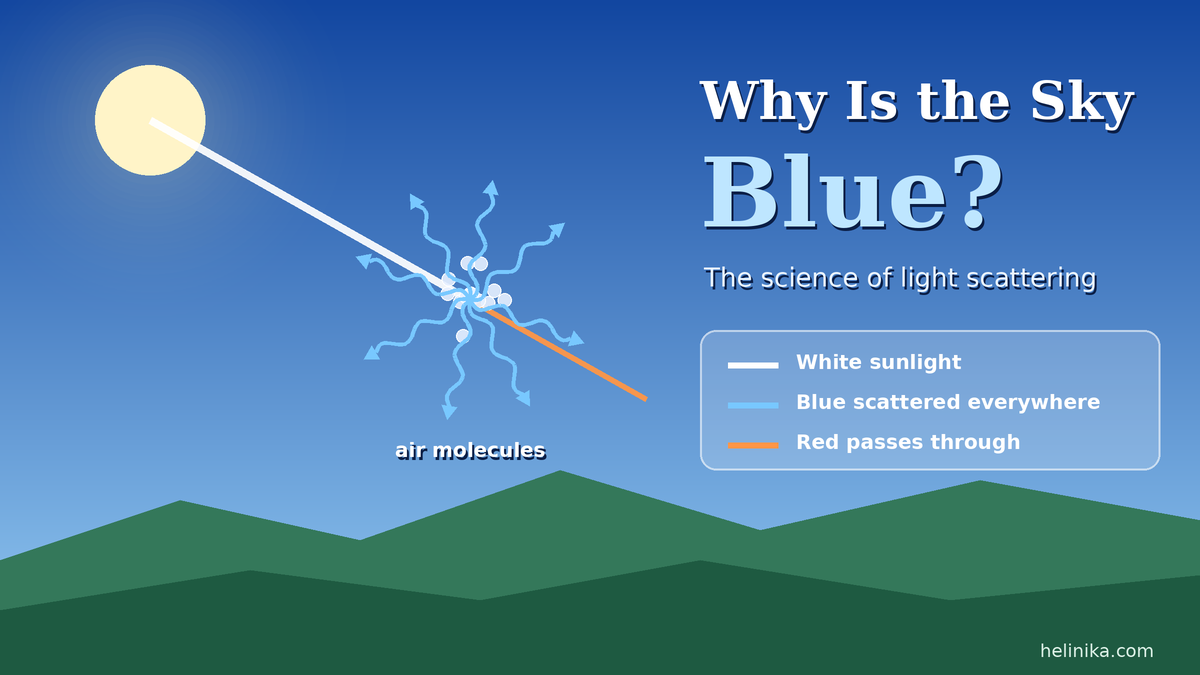
Step outside on a clear afternoon and look up. The sky stretches above you in shades of blue, from one horizon to the other. It is such a familiar sight that most people rarely stop to ask why it looks that way.
Quick Info
| Topic | Detail |
|---|---|
| Short answer | Air molecules scatter shorter blue wavelengths of sunlight more strongly than longer red wavelengths. |
| Scientific process | Rayleigh scattering |
| Main particles involved | Nitrogen and oxygen molecules |
| Why not violet? | Sunlight contains less violet than blue, and human eyes are less sensitive to violet. |
| Why red sunsets? | Sunlight travels through more atmosphere, scattering much of the blue light out of our direct line of sight. |
| Reading time | About 8 minutes |
The answer involves sunlight, tiny molecules in Earth’s atmosphere, and the way human eyes detect colour.
Here is the surprising part: sunlight looks white, and the air around us is colourless. Yet when sunlight enters the atmosphere, the sky appears blue.
This happens because air molecules scatter different colours of sunlight by different amounts. A process called Rayleigh scattering sends shorter blue wavelengths in many directions, allowing blue light to reach our eyes from across the sky.
Let’s explore how this works and why it also explains red sunsets, white clouds, and the dark sky in space.
Sunlight Is a Mix of Colours
Sunlight looks white, but it contains all the colours of the visible spectrum. These include red, orange, yellow, green, blue, and violet.
You can see this when sunlight passes through a glass prism. The prism separates white light into its different colours. A rainbow works in a similar way, with water droplets bending and separating sunlight.
Each colour has a different wavelength. Wavelength is the distance between two consecutive peaks of a light wave. It is measured in nanometres (nm), where one nanometre equals one-billionth of a metre.
Colours Have Different Wavelengths
| Colour | Approximate wavelength |
|---|---|
| Red | 620–700 nm |
| Orange | 590–620 nm |
| Yellow | 570–590 nm |
| Green | 495–570 nm |
| Blue | 450–495 nm |
| Violet | 380–450 nm |
These ranges are approximate because the colours of visible light blend into one another rather than having perfectly fixed boundaries.
The important difference is that red light has a longer wavelength, while blue and violet light have shorter wavelengths. This difference helps explain why the atmosphere scatters some colours more strongly than others.
The Atmosphere: Earth’s Invisible Filter
Before sunlight reaches the ground, it travels through Earth’s atmosphere. The atmosphere is the layer of gases surrounding our planet.
Although air looks empty, it contains enormous numbers of tiny molecules. These molecules interact with sunlight and scatter some of it in different directions.
What Is Air Made Of?
Dry air near Earth’s surface is made up mainly of nitrogen and oxygen.
| Gas | Approximate share of dry air |
|---|---|
| Nitrogen | 78% |
| Oxygen | 21% |
| Argon | Just under 1% |
| Carbon dioxide and other gases | Small traces |
The atmosphere also contains water vapour, dust, smoke, salt particles, and other tiny materials. These larger particles can affect the sky’s appearance, especially when the air is hazy or polluted.
Why Molecule Size Matters
Nitrogen and oxygen molecules are much smaller than the wavelengths of visible light. When sunlight interacts with these tiny molecules, the light is scattered in different directions.
Think of sunlight as a stream travelling through the atmosphere. When it encounters gas molecules, some of its light changes direction instead of continuing straight ahead.
This redirection is called scattering. It is the key to understanding why the sky appears blue.
Rayleigh Scattering: Why the Sky Looks Blue
The scattering of sunlight by particles much smaller than the wavelength of light is known as Rayleigh scattering. It is named after the British physicist Lord Rayleigh, who studied the phenomenon in the nineteenth century.
All colours of sunlight can be scattered by air molecules, but shorter wavelengths are scattered much more strongly than longer wavelengths.
Blue and violet light have shorter wavelengths than red and orange light. As a result, they are scattered more strongly by the gases in Earth’s atmosphere.
This scattered light travels in many directions. When you look at the sky away from the Sun, much of the light reaching your eyes is sunlight that has been scattered by the atmosphere.
The sky is not the only thing that can appear blue. Earth’s oceans also look blue for different reasons. To learn more about the world’s oceans, read our guide on how many oceans there are in the world.
How Much More Is Blue Light Scattered?
For ideal Rayleigh scattering, the intensity of scattering is inversely proportional to the fourth power of wavelength:
[ \text{Scattering} \propto \frac{1}{\lambda^4} ]
Here, (\lambda) represents the wavelength of light.
This means that shorter wavelengths are scattered much more strongly. For example, compare blue light with a wavelength of about 450 nm and red light with a wavelength of about 700 nm:
[ \left(\frac{700}{450}\right)^4 \approx 5.9 ]
Under this simplified comparison, blue light is scattered roughly six times as strongly as red light.
This is an idealized comparison based on the Rayleigh scattering relationship. It does not mean that the real sky always appears six times brighter in blue than in red. Actual sky colour also depends on sunlight, atmospheric conditions, and the way our eyes perceive light.
The Blue Sky, Step by Step
- White sunlight enters the atmosphere. It contains all the colours of visible light.
- Sunlight interacts with air molecules. Nitrogen and oxygen are the main gases involved.
- Shorter wavelengths scatter more strongly. Blue and violet light are redirected more than longer red wavelengths.
- Scattered light travels in many directions. Some of this light reaches your eyes when you look up.
- Your eyes perceive the scattered light as blue. Blue becomes the dominant colour we associate with a clear daytime sky.
The important point is that you are not looking directly at the Sun when you look at a patch of blue sky. You are seeing sunlight that has been scattered by the atmosphere.
Why Isn’t the Sky Violet?
Violet light has an even shorter wavelength than blue light. According to the Rayleigh scattering relationship, violet is scattered more strongly.
So why does the sky look blue instead of violet?
There are two important reasons:
- Sunlight contains less violet than blue: The amount of violet light available to be scattered is lower than the amount of blue light.
- Human eyes are less sensitive to violet: Our eyes respond more strongly to blue light, so we perceive the scattered light as blue rather than violet.
Together, these factors explain why a clear daytime sky generally appears blue.
Why Does the Sun Look Yellowish?
When sunlight passes through the atmosphere, some blue and violet light is scattered away from its direct path.
As a result, the sunlight travelling straight from the Sun towards an observer can appear slightly warmer or more yellowish than the original white sunlight.
However, the Sun does not always look the same colour. Its appearance changes with atmospheric conditions and its position in the sky. Near sunrise and sunset, it can appear orange or red.
Never look directly at the Sun to check its colour. Direct sunlight can permanently damage your eyes, even when the Sun appears dim.
Why Are Sunsets Red and Orange?
During midday, the Sun is usually high in the sky. Its light travels through a relatively shorter path in the atmosphere before reaching you.
At sunrise and sunset, the Sun appears close to the horizon. Its light must travel through a much longer path across the atmosphere to reach your eyes.
Along this longer path, much of the shorter-wavelength blue and violet light is scattered out of the direct beam. More of the longer-wavelength red and orange light remains along the direction in which you see the Sun.
This is why sunsets often display warm colours such as orange, red, and pink.
Dust, smoke, pollution, and other particles can also change how sunlight is scattered. Depending on atmospheric conditions, they can make sunset colours more intense or more muted.
How the Sky Changes Throughout the Day
| Time of day | Sun’s position | Typical sky appearance |
|---|---|---|
| Midday | High overhead | Bright blue |
| Late afternoon | Lower in the sky | Softer or paler blue |
| Sunset | Near the horizon | Orange, red, or pink |
| Night | Below the horizon | Dark |
These are common patterns, not fixed rules. Clouds, haze, dust, and local weather can change the colours you see.
Why Is the Sky Paler Near the Horizon?
Look straight up on a clear day and the sky may appear deep blue. Look towards the horizon, and the colour often becomes lighter or almost white.
This happens partly because sunlight travelling towards you from the horizon passes through more atmosphere than light coming from directly overhead.
As light travels through this longer path, blue light is scattered repeatedly in different directions. Some of it is redirected away from your line of sight, while light scattered by particles and haze can add a pale or whitish appearance.
The result is often a lighter blue near the horizon than directly overhead.
Why Are Clouds White, Not Blue?
Clouds are made of tiny water droplets and sometimes ice crystals. These particles are much larger than individual gas molecules in the atmosphere.
Unlike Rayleigh scattering, which affects shorter wavelengths more strongly, scattering by cloud droplets generally affects the different colours of visible light more evenly. This is commonly associated with Mie scattering.
When red, green, blue, and other visible wavelengths are scattered together, the combined light appears white.
Thick clouds often look grey because less sunlight passes through them. The thicker the cloud, the less light may reach its lower parts.
Why Is Space Black?
Space looks black because it contains far fewer particles than Earth’s atmosphere.
On Earth, air molecules scatter sunlight in many directions, making the daytime sky appear bright. In space, there are not enough atmospheric molecules to scatter sunlight across the sky in the same way.
That is why astronauts can see a black sky even when the Sun is shining.
The Moon also has virtually no atmosphere, so its daytime sky appears black rather than blue.
Is the Sky Blue on Other Planets?
No. The colour of a planet’s sky depends on the gases and particles in its atmosphere.
For example, Mars has a thin atmosphere containing fine reddish dust. Its daytime sky can look butterscotch or pinkish-tan rather than blue.
Martian sunsets can also appear bluish near the Sun, which is different from the red and orange sunsets commonly seen on Earth.
This shows that the colour of a planet’s sky depends on more than sunlight alone. The atmosphere’s composition and the size of its particles also matter.
Common Myths About the Blue Sky
| Myth | The truth |
|---|---|
| The sky is blue because it reflects the ocean. | No. The sky appears blue over deserts, mountains, and inland areas too. Atmospheric scattering is the main reason. |
| Air itself is blue. | A small amount of air is colourless. The blue appearance develops when sunlight interacts with many molecules across the atmosphere. |
| Blue is the only colour scattered. | All visible colours can be scattered, but shorter wavelengths are scattered more strongly by air molecules. |
| Oxygen alone makes the sky blue. | Both nitrogen and oxygen scatter sunlight. Nitrogen is the most abundant gas in dry air. |
Frequently Asked Questions
Why is the sky blue in simple words?
Sunlight contains many colours. Tiny molecules in Earth’s atmosphere scatter blue light more strongly than longer-wavelength colours, so blue light reaches our eyes from across the sky.
What is Rayleigh scattering?
Rayleigh scattering is the scattering of light by particles much smaller than its wavelength. It explains why air molecules scatter shorter wavelengths, such as blue and violet, more strongly than longer wavelengths.
Why isn’t the sky purple?
Violet light is scattered strongly, but sunlight contains less violet than blue, and human eyes are less sensitive to violet. This is why we usually perceive the sky as blue.
Why does the sky turn red at sunset?
At sunset, sunlight travels through a longer path in the atmosphere. Much of the blue and violet light is scattered out of the direct beam, allowing more red and orange light to reach our eyes.
Is the sky the same shade of blue everywhere on Earth?
No. The sky’s appearance changes with altitude, weather, dust, smoke, pollution, and other atmospheric conditions. Clean air can produce a deeper blue, while haze and particles can make the sky look pale or whitish.
Why is the sky dark at night?
At night, your location on Earth faces away from the Sun. Without direct sunlight reaching the atmosphere above you, there is very little scattered sunlight to make the sky appear bright.
Conclusion
The sky looks blue because of the way sunlight interacts with Earth’s atmosphere. Sunlight contains all the colours of the visible spectrum, but tiny air molecules scatter shorter blue and violet wavelengths more strongly than longer red wavelengths.
This process, known as Rayleigh scattering, sends blue light in many directions. Our eyes are more sensitive to blue than violet, which is why we usually see a blue daytime sky.
The same basic science helps explain other familiar sights: red and orange sunsets, pale horizons, white clouds, and the black sky in space.
The next time you look up on a clear day, remember that the blue above you is sunlight scattered by the air around our planet.
References
- NOAA NESDIS – Why Is the Sky Blue?
- National Weather Service – Why Is the Sky Blue?
- NASA Space Place – Why Is the Sky Blue?
Disclaimer
This article is for general educational purposes only. Wavelength values and scattering comparisons are approximate and are included to explain the science clearly. For more detailed information, consult the scientific resources listed below. Never look directly at the Sun, even during sunrise or sunset.