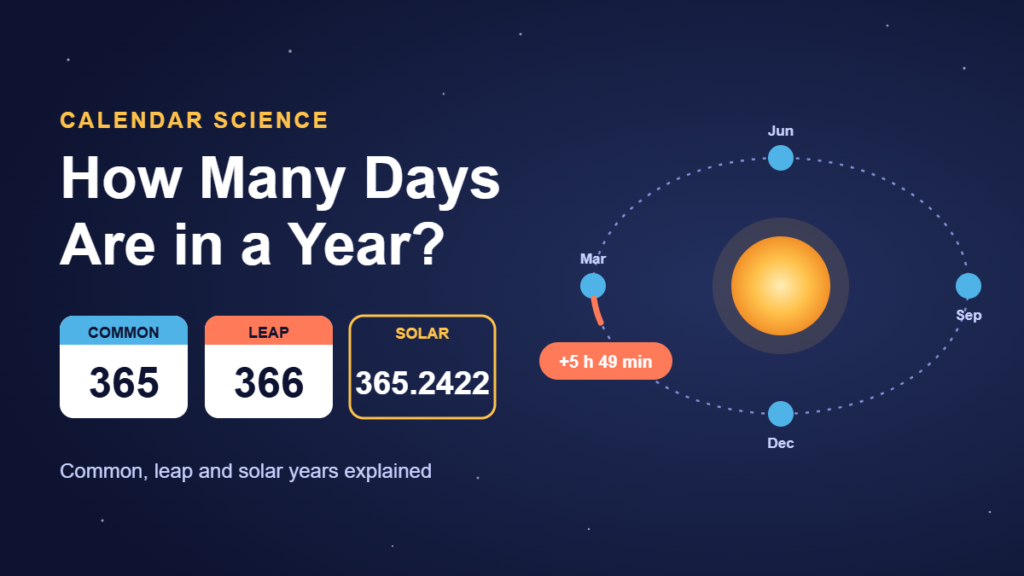
A calendar year has 365 days, and a leap year has 366 days. That’s the short answer to how many days in a year, and it’s the one you need for a school form, a rent contract or a countdown.
The longer answer is more interesting. Earth doesn’t finish its trip around the Sun in a whole number of days. The real solar year runs about 365 days, 5 hours and 49 minutes, and that leftover chunk of time is the reason February sometimes gets a 29th day.
Get the count wrong and small things break: a project deadline lands a day early, an interest calculation is off, or a “one year from today” date shifts. Below, you’ll see the exact numbers for every kind of year, a worked example for counting days across several years, and a chart of how long real solar years have actually lasted.
Quick Info
| Topic | Detail |
|---|---|
| Short answer | 365 days in a common year, 366 in a leap year |
| Real solar year | About 365.2422 days (365 d 5 h 48 min 45 s) |
| Calendar average | 365.2425 days over the 400-year Gregorian cycle |
| Leap year rule | Divisible by 4, except century years not divisible by 400 |
| Weeks in a year | 52 weeks + 1 day (common) or + 2 days (leap) |
| Common mistake | Assuming every fourth year is a leap year (1900 and 2100 aren’t) |
| Reading time | About 11 minutes |
How Many Days Are in a Year? The Short Answer
A year in the Gregorian calendar, the calendar used in the United States and most of the world, has 365 days, or 366 days in a leap year.
The current year, 2026, is a common year with 365 days. So is 2027. The next leap year is 2028, which will have 366 days because February 29 is added.
Here’s how the two kinds of calendar year compare in other units:
| Unit | Common year (365 days) | Leap year (366 days) |
|---|---|---|
| Weeks | 52 weeks + 1 day | 52 weeks + 2 days |
| Months | 12 | 12 |
| Hours | 8,760 | 8,784 |
| Minutes | 525,600 | 527,040 |
| Seconds | 31,536,000 | 31,622,400 |
| Days in February | 28 | 29 |
That extra day beyond 52 full weeks explains a small calendar quirk you’ve probably noticed. January 1, 2026 fell on a Thursday, and January 1, 2027 falls on a Friday. After a common year, each date moves forward one weekday. After a leap year, it jumps two.
Why a Year Isn’t a Whole Number of Days
Two separate motions set our calendar. A day comes from Earth spinning on its axis. A year comes from Earth orbiting the Sun. Nothing ties those two motions together, so one doesn’t divide evenly into the other.
Think of two gears with teeth that don’t match. The small gear (the day) turns 365 times, but the big gear (the year) isn’t quite back to its starting point yet. It needs roughly another quarter turn.
That quarter turn is about 5 hours and 49 minutes. Ignore it for four years and you’ve lost almost a full day. Ignore it for a century and the calendar is off by about 24 days, enough to push the start of spring from March 20 to mid-April.
Britannica lists the tropical year at 365.242190 days at the end of the 20th century, and notes it shrinks very slowly over time. The same page gives the Gregorian calendar’s average year as 365.2425 days.
Source: Britannica, “Lengths of years and months”
The 6 Kinds of “Year” and How Many Days Each Has
Scientists and calendar makers measure a year in more than one way. Each version answers a slightly different question, so each has a slightly different length.
| Type of year | Length in days | What it measures |
|---|---|---|
| Common calendar year | 365 | Ordinary Gregorian year |
| Leap calendar year | 366 | Gregorian year with February 29 |
| Tropical (solar) year | About 365.24219 | One full cycle of the seasons |
| Sidereal year | About 365.25636 | One orbit measured against distant stars |
| Julian year | 365.25 | Average year in Julius Caesar’s calendar |
| Lunar year (12 moon cycles) | About 354.37 | 12 cycles of the Moon’s phases |
Tropical year: the one that matters for seasons
The tropical year is the time from one March equinox to the next. Because it tracks the seasons, it’s the year our calendar tries to match. If the calendar follows this year closely, March stays in spring and December stays in winter, year after year. You can see how seasons connect to long-term patterns in our guide to weather and climate.
Sidereal year: measured against the stars
The sidereal year is how long Earth takes to return to the same spot relative to distant stars. It’s about 20 minutes longer than the tropical year. The gap comes from a slow wobble of Earth’s axis called precession, which shifts the equinox point a tiny bit each year.
Lunar year: why some calendars drift through the seasons
One cycle of the Moon’s phases lasts about 29.53 days. Twelve of those cycles add up to roughly 354 days, about 11 days short of a solar year. (That figure is 12 × 29.531, our own arithmetic from Britannica’s average month length.) Calendars built only on the Moon, such as the Islamic calendar, slide through the seasons as a result. If you’ve ever wondered why the Moon changes shape on that roughly monthly schedule, see moon phases explained.
How Leap Years Fix the Missing Quarter Day
A leap year adds one day, February 29, to soak up the extra time that builds up each year. The Gregorian calendar uses three rules to decide which years get it:
- Divisible by 4? It’s a leap year (2024, 2028, 2032).
- Also divisible by 100? It’s not a leap year (1900, 2100, 2200).
- Also divisible by 400? It is a leap year after all (1600, 2000, 2400).
Why the extra rules for century years? Adding a full day every four years overshoots. A leap day is 24 hours, but four years only build up about 23 hours and 15 minutes of extra time.
NASA’s Jet Propulsion Laboratory puts the overshoot at about 45 minutes every four-year cycle, which grows to roughly three extra days every 400 years. Skipping three century leap days per 400 years cancels that out.
Source: NASA JPL Education, “Doing the Math on Why We Have Leap Day” (Jan. 16, 2024)
The result: 97 leap years in every 400 years, not 100. Spread across the full cycle, that gives an average year of 365 + 97 ÷ 400 = 365.2425 days.
Worked Example: Counting the Days Across Several Years
Suppose you sign a lease on January 1, 2026 that runs for exactly five years, through December 31, 2030. How many days is that? Here’s how to count it by hand.
Step 1: List each year
The lease covers 2026, 2027, 2028, 2029 and 2030.
Step 2: Mark the leap years
Check each year with the rules above. Only 2028 divides evenly by 4, and it isn’t a century year, so it’s the only leap year in the span.
Step 3: Add the days
2026: 365
2027: 365
2028: 366   (leap year)
2029: 365
2030: 365
Total = 4 × 365 + 366 = 1,826 days
Step 4: Sanity-check with a shortcut
Five years × 365 = 1,825 days, plus one leap day = 1,826. Both methods agree.
The same logic scales up. Any 10-year span has either 3,652 or 3,653 days, depending on whether it holds two or three leap years. The century from 2001 to 2100 has 36,524 days, not 36,525, because 2100 skips its leap day.
Counting from a birth date works the same way, which is how you get an exact age in days. Our step-by-step guide on calculating age from date of birth shows that method with borrowing.
How Long Does a Real Solar Year Actually Last?
The figure 365.2422 is an average. Individual solar years wander around it because the Moon and the other planets tug on Earth and change its motion a little. The chart below plots ten real years, each measured from one March equinox to the next.
How long was each real solar year? (March equinox to March equinox)
Time beyond 365 days, compared with the calendar averages. Hover or tap a dot.
Data: timeanddate.com tropical year table (March 2020 to March 2030). Averages: Britannica, NASA JPL.
A few things stand out. The shortest year in this stretch (March 2026 to March 2027) ran about 5 hours 39 minutes past 365 days, while the longest (March 2021 to March 2022) ran almost 5 hours 56 minutes. That's a spread of about 17 minutes. Every single year, though, stays well below the old Julian assumption of a full 6 hours.
The equinox timing table from timeanddate.com is where these year lengths come from. The site gives the average tropical year as 365 days, 5 hours, 48 minutes and 45 seconds, and the sidereal year as about 365.25636 days.
Source: timeanddate.com, "How Long Is a Tropical Year / Solar Year?"
A Quick History: From 365.25 to 365.2425
The Roman Julian calendar, which took effect under Julius Caesar in 45 BCE, added a leap day every four years with no exceptions. That makes its average year exactly 365.25 days, about 11 minutes too long.
Eleven minutes sounds harmless. Over centuries, it piled up. By our own rough math, the Julian year runs ahead of the solar year by about 1 day every 128 years. By the 1500s, the March equinox had crept to around March 11 instead of March 21.
In 1582, Pope Gregory XIII introduced the calendar we use today. It removed 10 days at once (October 4, 1582 was followed by October 15) and added the century rule. Britain and its American colonies switched much later, in 1752, by which point they had to skip 11 days.
The Gregorian average of 365.2425 days is still slightly longer than the solar year, but only by about 27 seconds. At that rate, it would take roughly 3,200 years for the calendar to drift a single day.
Common Myths About the Number of Days in a Year
| Myth | Reality |
|---|---|
| A year is exactly 365.25 days. | That's the Julian average. The real solar year is about 365.2422 days, roughly 11 minutes shorter. |
| Every fourth year is a leap year. | Century years skip it unless divisible by 400. The year 1900 had 365 days; 2100 will too. |
| A year is exactly 52 weeks. | 52 weeks is only 364 days, so one or two days are always left over. |
| A year is one full rotation of Earth around the Sun, nothing more to it. | "One orbit" can mean the tropical or the sidereal year, and they differ by about 20 minutes. |
| Leap years make the calendar perfect. | The Gregorian calendar is still off by about one day every 3,200 years. |
Where the Day Count Shows Up in Everyday Life
You'll run into the 365 versus 366 question more often than you might expect:
- Finance: Some loans and savings accounts calculate daily interest using 365 days, others use 360. The convention changes how much you pay or earn.
- Payroll and leases: A "daily rate" based on 365 days gives a slightly different number in a leap year.
- School calendars: Planning around the number of instructional days starts with knowing how many weekdays fall in the year.
- Birthdays: People born on February 29 only see their exact birth date once every four years. Rules on whether they legally turn a year older on February 28 or March 1 can vary, so check locally if it matters.
- Day numbers: November 22 is day 326 in a common year but day 327 in a leap year, which matters for software and logbooks that use day-of-year numbers.
For one-off counts, a calculator saves time. The Day of the Week Calculator tells you which weekday any date falls on, handy for checking the one-day and two-day shifts described above.
Frequently Asked Questions
How many days are in 2026?
The year 2026 has 365 days. It isn't divisible by 4, so it's a common year and February has 28 days. The year 2027 also has 365 days. The next year with 366 days is 2028, and after that, 2032. A quick check for any year: if it divides evenly by 4 and isn't a century year like 2100, it has 366 days.
Why do we have 365 days in a year and not 360?
A 360-day year would fall out of step with the seasons by more than 5 days every single year. The number 365 comes from how long Earth takes to circle the Sun, measured in Earth's own days. Some ancient calendars used 360 days plus five extra "leftover" days to make the math easier, but nature sets the real total.
How many days are in a year without weekends?
A common year has 260 or 261 weekdays (Monday to Friday), and a leap year has between 260 and 262. Fifty-two full weeks always hold 260 weekdays; the one or two leftover days add to that only if they land on weekdays. U.S. federal holidays, 11 in all, lower the count of working days further.
Is a leap year 366 or 365.25 days?
A leap year on the calendar has exactly 366 days. The figure 365.25 is the average length of a year in the old Julian calendar, which had one leap year every four years. The modern Gregorian calendar averages 365.2425 days, because it skips three leap days every 400 years.
How many days are in a school year in the U.S.?
Many U.S. states set a minimum of about 180 instructional days, though some require fewer and others count required hours instead of days. That's roughly half of the 365 calendar days, since weekends, summer break and holidays take up the rest. Your state education department publishes the official minimum.
How many days are in 100 years?
It depends on the century. From 2001 to 2100 there are 36,524 days, because that span has 24 leap years (2100 is skipped). From 1901 to 2000 there were 36,525 days, since 2000 was a leap year and gave that century 25 of them.
Conclusion
A year has 365 days, or 366 in a leap year, but the real solar year sits in between at about 365.2422 days. Leap years with the century rule keep the calendar within one day of the seasons for thousands of years. When you count days across several years, mark the leap years first, then add.
Here's a rule of thumb to keep: divisible by 4, yes; by 100, no; by 400, yes again. If you remember that line, you'll never miscount a year.
References
- Britannica, "Time: Lengths of years and months." https://www.britannica.com/science/time/Lengths-of-years-and-months
- NASA Jet Propulsion Laboratory Education, "Doing the Math on Why We Have Leap Day," January 16, 2024. https://www.jpl.nasa.gov/edu/news/doing-the-math-on-why-we-have-leap-day/
- timeanddate.com, "How Long Is a Tropical Year / Solar Year?" https://www.timeanddate.com/astronomy/tropical-year.html
Disclaimer
This article is for general educational purposes only. Tropical year lengths are taken from the cited equinox table; drift figures labeled as our own math are rounded estimates. For legal or financial date calculations (contracts, interest, leap-day birthdays), check the rules that apply in your state or with a qualified professional.