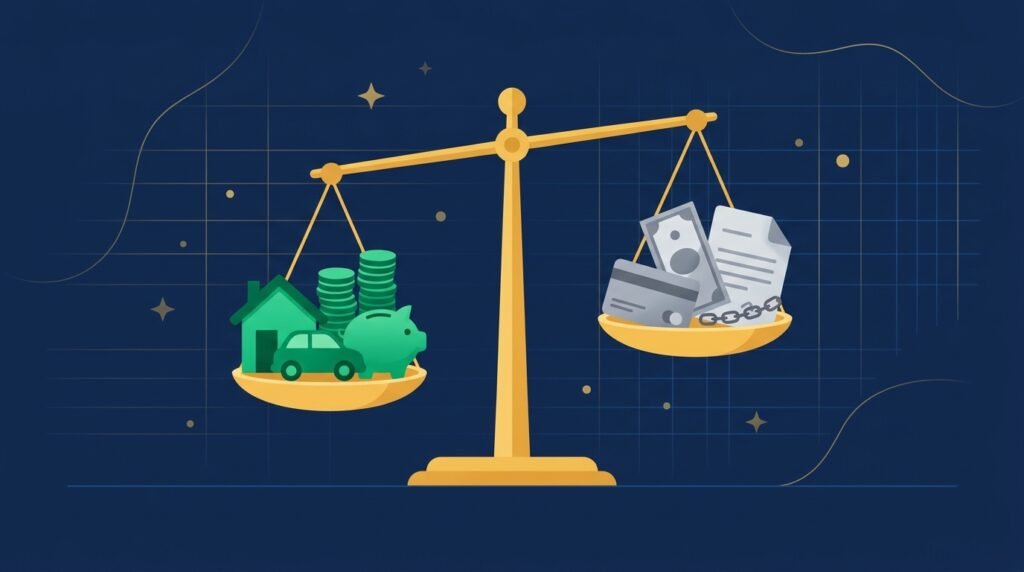
Take a quick look at your own life. You probably own a few things worth money: some cash in a bank account, maybe a car, a phone, a bit saved for retirement. You probably also owe a few things: a credit card balance, a car payment, maybe a student loan.
That’s the whole idea behind assets vs. liabilities. An asset is something you own that has value. A liability is money you owe to someone else. Subtract what you owe from what you own, and you get your net worth.
Every business, from a corner bakery to a giant tech company, keeps score the same way. So does every household. Once you understand these two words, balance sheets, loan applications and money headlines start to make sense.
In this guide you’ll get plain-English definitions, the main types of each, the one equation that ties them together, a step-by-step personal example, real US numbers, and the myths that confuse most beginners.
Quick Info
| Topic | Detail |
|---|---|
| Asset | Something you own that has value (cash, a car, equipment, investments) |
| Liability | Money you owe to others (loans, credit card balances, unpaid bills) |
| Key equation | Assets = Liabilities + Equity |
| Personal version | Net worth = Assets − Liabilities |
| Main types | Current (within one year) and long-term (more than one year) |
| Common mistake | Calling something a liability just because it costs money to keep |
| Reading time | About 12 minutes |
What Are Assets and Liabilities?
Let’s start with clear, one-line definitions.
An asset is anything a person or business owns that has value and could be turned into money.
A liability is any amount of money a person or business owes to someone else and must pay back.
The US Securities and Exchange Commission (SEC) uses almost the same wording in its beginner guide: assets are “things that a company owns that have value,” and liabilities are “amounts of money that a company owes to others.”
You can read those definitions in the SEC’s “Beginners’ Guide to Financial Statements”, which explains how companies report what they own and owe.
Assets vs. liabilities side by side
| Assets | Liabilities | |
|---|---|---|
| Simple meaning | What you own | What you owe |
| Effect on net worth | Adds to it | Subtracts from it |
| Personal examples | Cash, savings, retirement account, car, home | Credit card balance, car loan, student loan, mortgage |
| Business examples | Cash, inventory, equipment, buildings, patents | Bank loans, unpaid supplier bills, wages owed, taxes due |
| Where it sits on a balance sheet | Left side (or top) | Right side (or middle) |
| Good or bad? | Generally good to have, but value can drop | Not always bad; it depends on what the debt pays for |
A simple way to remember it
Picture a backpack and an IOU note. Everything in the backpack that you could sell is an asset. Every IOU note you’ve signed promising to pay someone back is a liability.
Your financial position is simply: what’s in the backpack minus what’s on the IOUs.
Types of Assets
Accountants sort assets in a few ways. The two most useful for beginners are by time and by form.
Current assets vs. long-term assets
Current assets are things you expect to turn into cash within one year. Long-term assets (also called noncurrent assets) are things you plan to keep and use for longer than a year.
| Type | Meaning | Personal examples | Business examples |
|---|---|---|---|
| Current assets | Expected to become cash within a year | Checking and savings, money a friend owes you | Cash, inventory, money customers owe (accounts receivable) |
| Long-term assets | Kept and used for more than a year | Car, home, retirement account | Buildings, vehicles, machinery, office furniture |
Tangible vs. intangible assets
Tangible assets are physical things you can touch, like a delivery van or a laptop. Intangible assets have value but no physical form, such as patents, trademarks, software and brand names.
A small bakery’s oven is a tangible asset. Its secret recipe and well-known logo are intangible ones.
Why some assets lose value
Many physical assets wear out or go out of date. A car or laptop is worth less each year. In accounting, spreading that loss of value over the item’s useful life is called depreciation.
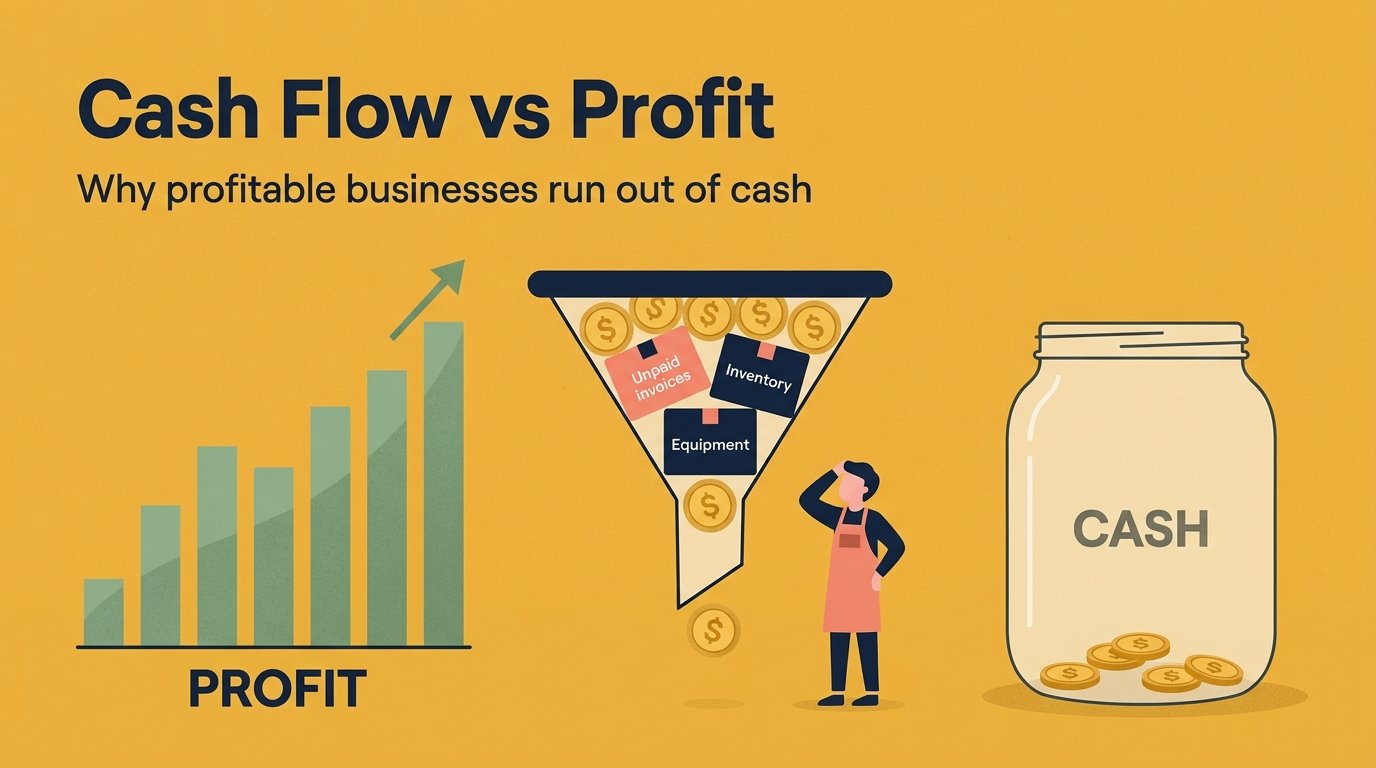
Our guide on cash flow vs. profit shows how a business records a new truck or machine as an asset and then spreads its cost over several years.
Types of Liabilities
Liabilities are sorted by time too.
Current liabilities vs. long-term liabilities
Current liabilities are debts due within one year. Long-term liabilities are debts due more than a year from now.
| Type | Meaning | Personal examples | Business examples |
|---|---|---|---|
| Current liabilities | Due within one year | This month’s credit card balance, upcoming utility bills | Supplier bills (accounts payable), wages owed, taxes due soon |
| Long-term liabilities | Due more than one year away | Mortgage, student loan, multi-year car loan | Long-term bank loans, bonds the company issued |
Many debts have both parts. A five-year car loan, for example, has a current portion (the payments due in the next 12 months) and a long-term portion (the rest).
Good debt vs. bad debt?
You’ll often hear that some debt is “good” and some is “bad.” A rough way to think about it: debt that helps you buy something that holds or grows its value, or raises your income, tends to be more useful than debt for things that lose value quickly.
That’s a general idea, not a rule. Interest rates, your income and how quickly you can repay all matter. The key point for beginners is that a liability is not automatically bad. It’s just money owed.
The Equation That Connects Them
Assets and liabilities are linked by one simple formula that every balance sheet follows:
Assets = Liabilities + Equity
Here’s what each part means:
- Assets are everything owned.
- Liabilities are everything owed to outsiders.
- Equity is what’s left over for the owner. For a person, it’s called net worth.
The SEC describes equity as “the money that would be left if a company sold all of its assets and paid off all of its liabilities.” That’s why the two sides always balance.
For your own finances, it’s easier to flip the formula around:
Net worth = Assets − Liabilities
If your assets are bigger than your liabilities, your net worth is positive. If you owe more than you own, your net worth is negative. A negative number is common for young adults with student loans, and it isn’t a permanent label. It’s a starting point.
A car example
Say you own a car worth $18,000 and still owe $14,000 on the loan.
Equity in the car = $18,000 − $14,000 = $4,000
The car is an asset worth $18,000. The loan is a liability of $14,000. The $4,000 difference is the part of the car you truly “own.”
Worked Example: Build a Personal Balance Sheet
Let’s build a simple balance sheet for a fictional 25-year-old named Jordan. All figures are illustrative, made up to show how the math works.
Step 1: List everything Jordan owns
| Asset | Value |
|---|---|
| Checking account | $1,200 |
| Savings account | $3,500 |
| 401(k) retirement account | $6,800 |
| Car (current resale value) | $14,000 |
| Laptop and phone (resale value) | $900 |
| Total assets | $26,400 |
Notice that the car and electronics use what they’d sell for today, not what Jordan paid.
Step 2: List everything Jordan owes
- Car loan: $11,000
- Credit card balance: $1,400
- Student loan: $22,000
- Total liabilities: $34,400
Step 3: Calculate net worth
Net worth = Total assets − Total liabilities
          = $26,400 − $34,400
          = −$8,000
Jordan’s net worth is negative $8,000. That’s mostly because of the student loan, which paid for an education rather than something Jordan can sell.
Step 4: See what paying off the credit card does
Jordan uses $1,400 from savings to pay off the credit card.
New assets      = $26,400 − $1,400 = $25,000
New liabilities = $34,400 − $1,400 = $33,000
New net worth   = $25,000 − $33,000 = −$8,000
Surprise: net worth didn’t change. Cash went down and debt went down by the same amount. What did change is that Jordan stopped paying credit card interest, which helps future months.
Step 5: Check again one year later
Over the next year, Jordan pays down $2,600 on the car loan and $2,400 on the student loan, saves another $3,000, and the 401(k) grows by $2,000. Meanwhile, the car loses $2,000 in value.
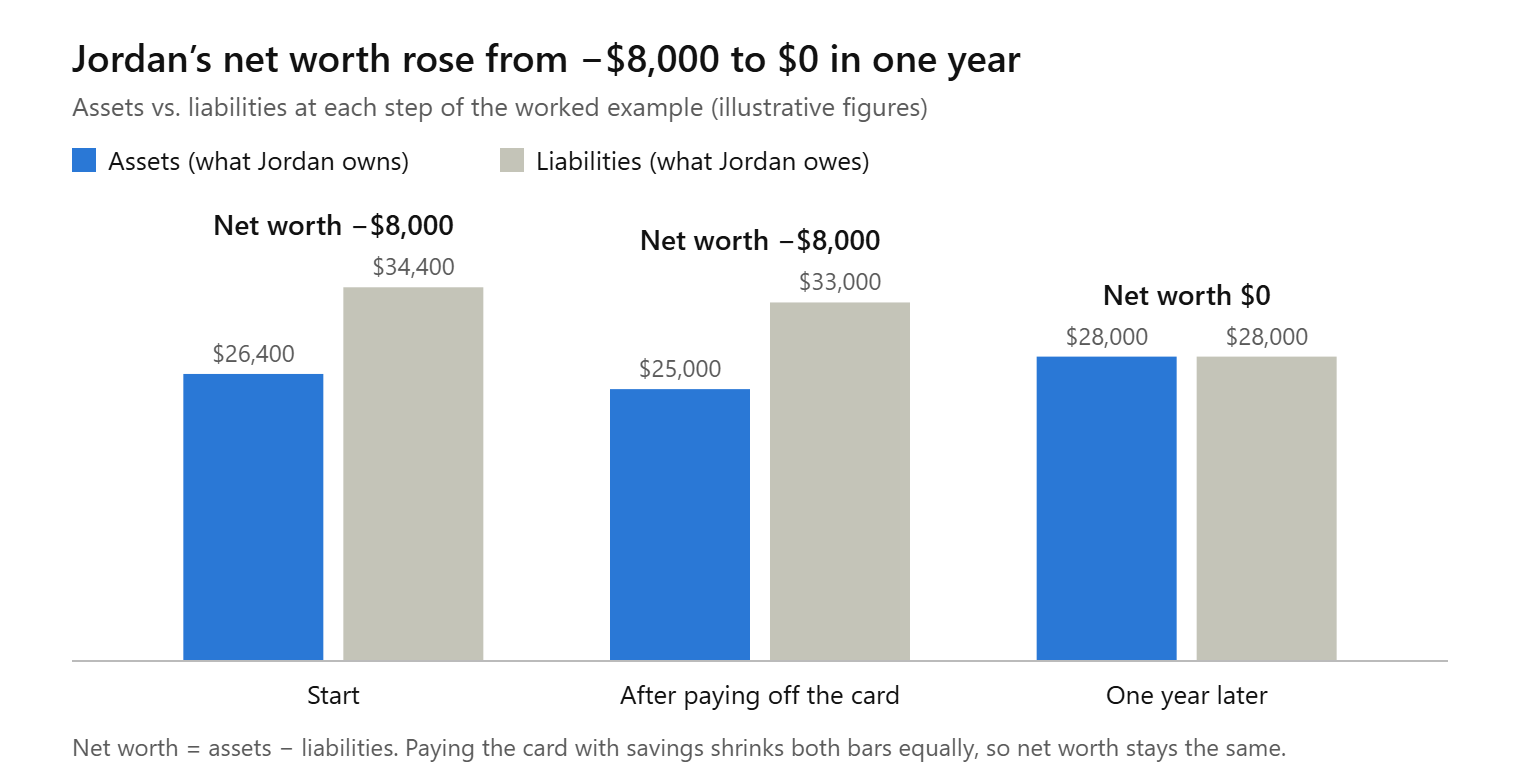
Jordan went from negative $8,000 to zero in one year, even though the car lost value. Net worth moves up from two directions: growing assets and shrinking liabilities.
Real Numbers: Assets and Liabilities in US Households
How does this look across the country? Every three years, the Federal Reserve runs the Survey of Consumer Finances, one of the most detailed looks at what American families own and owe.
| Measure (2022) | Result |
|---|---|
| Median family net worth | $192,900 (up 37% from $141,100 in 2019) |
| Average (mean) family net worth | $1,063,700 |
| Families with any debt | 77.4% |
| Families who own their home | 66.1% |
| Families with retirement accounts | 54.3% |
Those figures come from the Federal Reserve’s “Changes in U.S. Family Finances from 2019 to 2022”, which defines net worth as the difference between families’ assets and liabilities.
Look at the gap between the two net worth figures. The average is more than five times the median because a small number of very wealthy families pull the average way up. That’s why researchers often prefer the median, the middle value, when they describe a typical family.
The debt figure matters too. More than three out of four families carry some liability. Having debt is normal. What matters is how it compares to what you own and earn.
Assets and Liabilities in a Business
Businesses use the same idea, just with more line items. A company’s balance sheet lists its assets on one side and its liabilities and owner’s equity on the other, at a single point in time.
Here’s how a few everyday business events change each side:
| Event | Effect on assets | Effect on liabilities |
|---|---|---|
| Buy a $5,000 oven with cash | Cash −$5,000, equipment +$5,000 (total unchanged) | No change |
| Buy $2,000 of flour on credit from a supplier | Inventory +$2,000 | Accounts payable +$2,000 |
| Take a $20,000 bank loan | Cash +$20,000 | Loan payable +$20,000 |
| Pay the supplier the $2,000 owed | Cash −$2,000 | Accounts payable −$2,000 |
| Sell $3,000 of bread, customer pays later | Accounts receivable +$3,000 | No change |
Notice how the equation always stays balanced. Each event changes both sides by the same amount, or shifts value around on one side.
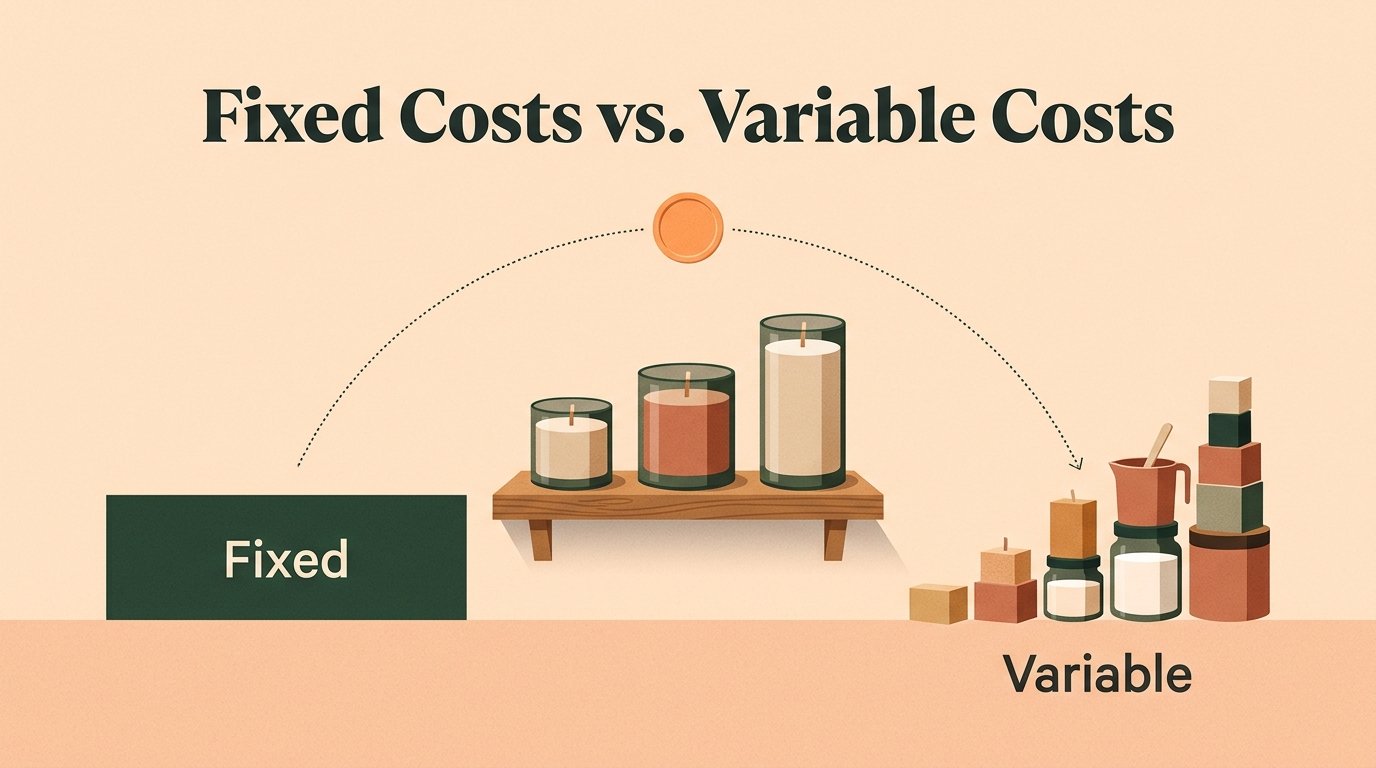
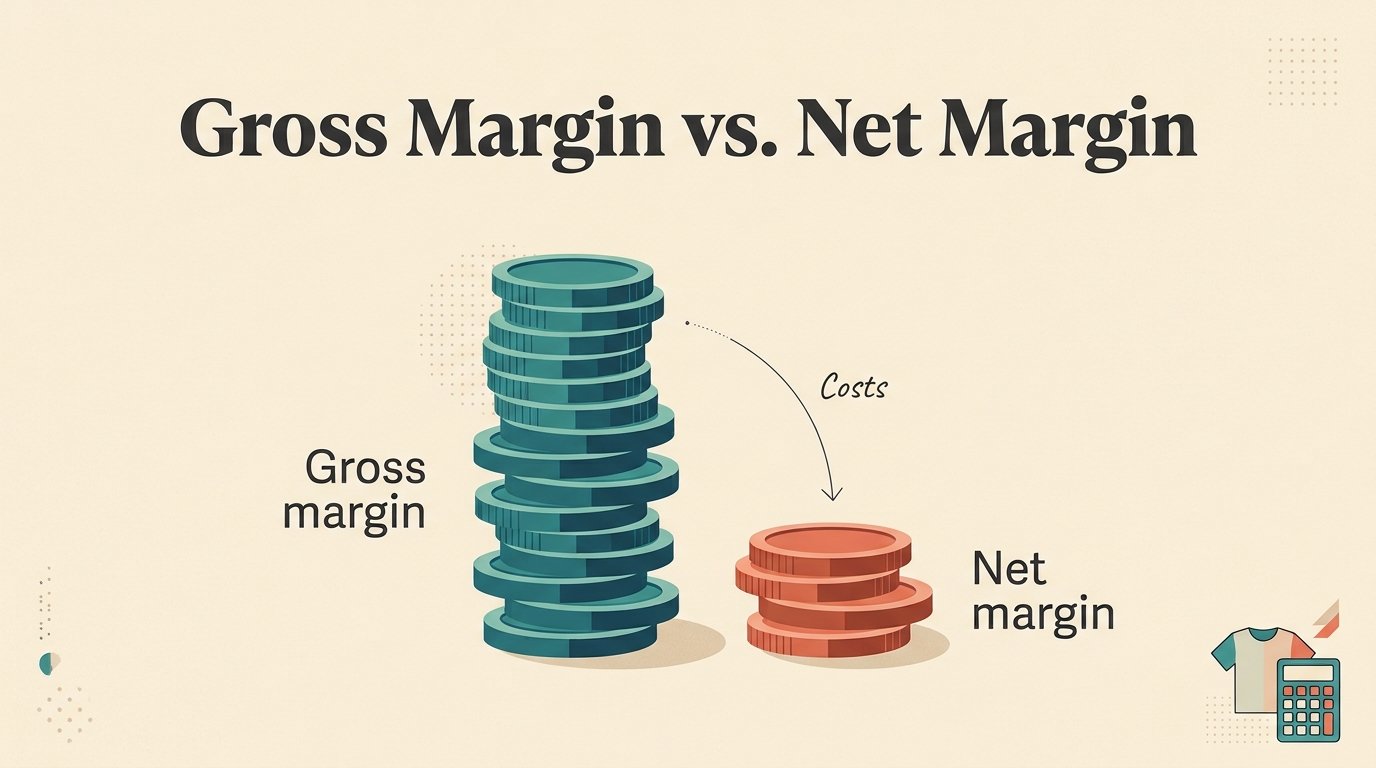
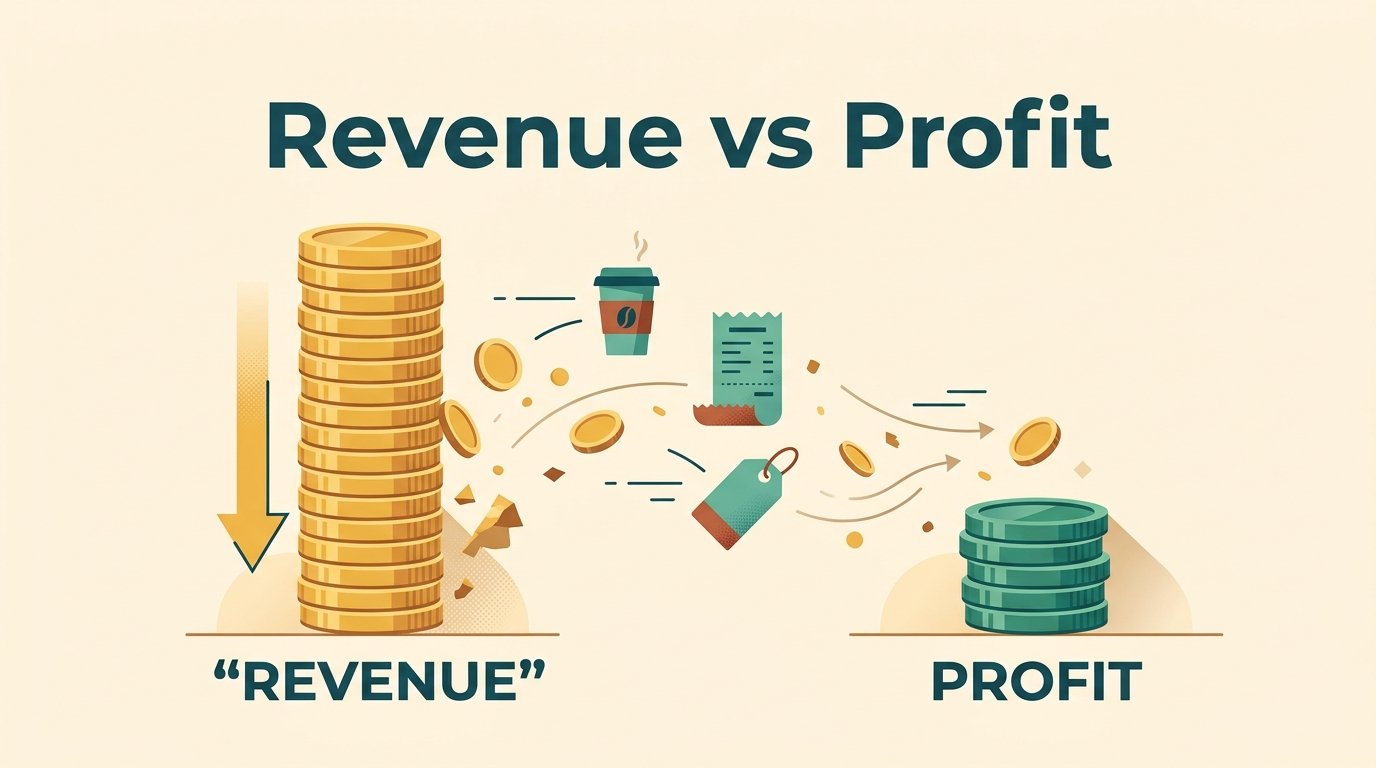
A balance sheet is a snapshot. It’s different from the income statement, which shows money earned and spent over time. If those words still feel fuzzy, start with our guide on the difference between revenue and profit. Two other ideas that pair well with this one are fixed vs variable costs and gross margin vs net margin.
How to Tell an Asset From a Liability
Not sure which side something belongs on? Ask these questions in order.
- Do I own it, or do I owe it? If you own it, it’s probably an asset. If it’s a promise to pay someone, it’s a liability.
- Could I sell it for money? If yes, it’s an asset, valued at what you could sell it for today.
- Is someone expecting a payment from me? If yes, it’s a liability.
- When is it due or used up? Within a year means current; longer means long-term.
- Is it both? Many big purchases create an asset and a liability at once, like a car with a car loan. List both separately.
Ongoing bills like rent, groceries and streaming services are usually neither. They’re expenses, money spent on things used up right away. They only become liabilities if you owe them and haven’t paid yet.
Common Myths About Assets and Liabilities
| Myth | Reality |
|---|---|
| “Anything that costs you money is a liability.” | That’s a popular personal-finance slogan, not the accounting meaning. A liability is money you owe; a car you fully own is still an asset, even if it costs money to run |
| “Your house is a liability.” | The house is an asset. The mortgage on it is a liability. Your home equity is the difference |
| “All debt is bad.” | Debt is a tool. Some debt helps people buy homes, start businesses or pay for education |
| “Paying off debt raises your net worth right away.” | If you pay with savings, assets and liabilities drop equally, so net worth stays the same; the benefit is less interest later |
| “Assets are always worth what you paid.” | Many assets lose value over time; list them at what they’d sell for now |
| “A negative net worth means you’re failing.” | It’s common early in adult life, especially with student loans, and it can improve steadily |
Frequently Asked Questions
Is a car an asset or a liability?
A car is an asset because you own it and could sell it. If you have a car loan, the loan is a separate liability. Your true ownership is the car’s value minus what you still owe. Keep in mind that most cars lose value each year, so the asset shrinks over time even as you pay the loan down.
What is net worth in simple terms?
Net worth is what you’d have left if you sold everything you own and paid off everything you owe. You find it with one subtraction: total assets minus total liabilities. It can be positive, zero or negative. Tracking it once or twice a year shows whether your overall financial position is moving in the right direction.
Is a credit card an asset or a liability?
The card itself isn’t either. The balance you owe on it is a liability. If you pay your balance in full each month, that liability resets to zero. If you carry a balance, it’s a current liability that usually comes with high interest, which is why many people choose to pay it down first.
Are expenses the same as liabilities?
No. An expense is money spent on something used up, like groceries, rent for this month or a phone bill. A liability is money you owe but haven’t paid yet. If your electric bill arrives and you haven’t paid it, it’s a liability until you do. Once paid, it was an expense.
What is the difference between assets, liabilities and equity?
Assets are what you own, liabilities are what you owe, and equity is the difference between them. For a business, equity is the owners’ share. For a person, it’s called net worth. The three always fit together in one formula: assets equal liabilities plus equity, which is why a balance sheet always balances.
How can a beginner start tracking assets and liabilities?
Make two lists on a single page. On one side, write every account and item of value you own, using today’s balances or resale values. On the other, list every debt and its current balance. Subtract to get your net worth, write down the date, and repeat in six or twelve months to see the trend.
Conclusion
Assets are what you own, liabilities are what you owe, and the difference is your net worth (or a business’s equity). Every balance sheet, from a family budget to a public company’s annual report, is built on that same simple equation. Debt isn’t automatically bad, and a negative net worth isn’t permanent. What matters is the direction you’re heading.
Here’s a rule of thumb to carry with you: before you call something an asset or a liability, ask “Do I own it, or do I owe it?” That single question sorts almost everything.
Disclaimer
This article is for general educational purposes only and is not financial, accounting, tax or legal advice. The person, balances and business events in the examples are illustrative. For decisions about your own money or business, consult a qualified financial advisor or certified public accountant.