

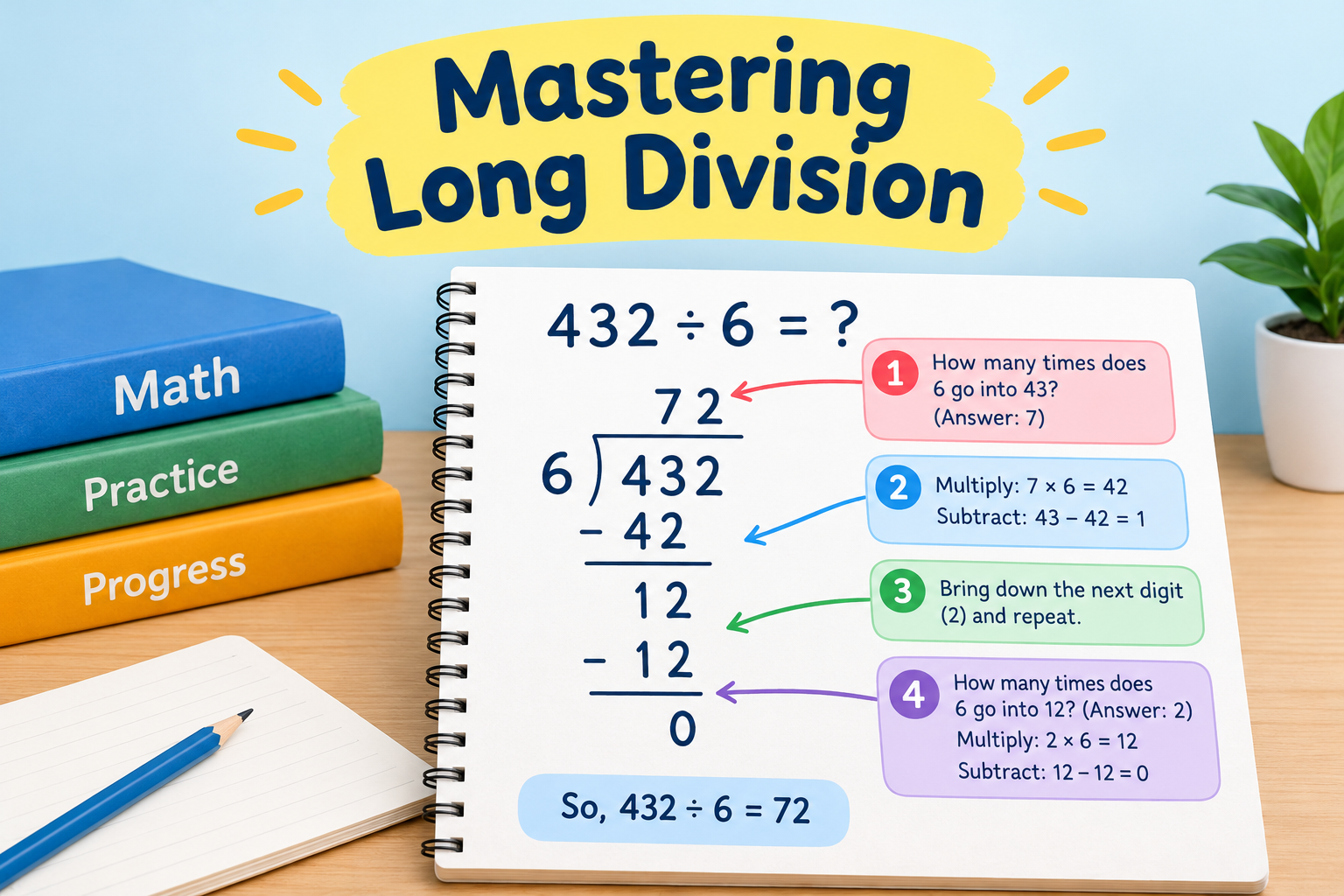
Long division looks scary. All those numbers stacked up, a strange bracket, and a pile of tiny subtractions.
Here’s the secret: it’s just a short routine repeated again and again. Learn the routine once and you can divide big numbers on paper without a calculator.
This guide walks you through every step. You’ll learn the vocabulary, a silly memory trick that actually works, and two fully solved examples. By the end, you’ll know how to avoid the mistakes that trip up most beginners. Grab a pencil and some paper. You’ll learn faster by writing along.
Quick Overview
| Detail | Information |
|---|---|
| Subject | Arithmetic / Basic Math |
| Core Terms | Dividend, Divisor, Quotient, Remainder |
| Core Method | DMSB: Divide, Multiply, Subtract, Bring Down |
| Prerequisites | Times tables, basic subtraction |
| Target Audience | Elementary and middle school students, parents, adult learners |
| Difficulty | Beginner |
Why Learn Long Division?
Calculators are handy. But long division builds something a calculator can’t: number sense.
When you divide by hand, you see how numbers break apart. That skill helps with fractions, decimals, ratios, and even algebra later on. It also helps in daily life. Splitting a restaurant bill, sharing 175 cookies among 6 classrooms, or working out how many boxes you need all use the same idea.
Division Vocabulary: Know Your Four Terms
Every long division problem has four key players. Learn their names first. The steps will make much more sense.
Take this problem: 156 ÷ 12 = 13
- Dividend is the number being divided. Here, it’s 156.
- Divisor is the number you divide by. Here, it’s 12.
- Quotient is the answer. Here, it’s 13.
- Remainder is what’s left over when the division isn’t perfect. Here, there’s none.
How a Problem Is Written
In long division, the setup looks like this:
     quotient
    ----------
divisor ) dividend
The dividend sits inside the bracket. The divisor sits outside on the left. The quotient is written on top.
That answer on top of the bracket has a special name. If you want a deeper look at the term, read What Is a Quotient in Math? Simple Explanation.
The Memory Trick: DMSB
Long division follows four steps, and they repeat in a loop. To remember them, use this goofy question:
Does McDonalds Sell Burgers?
Each word stands for one step:
| Letter | Word | Step | What You Do |
|---|---|---|---|
| D | Does | Divide | See how many times the divisor fits |
| M | McDonalds | Multiply | Multiply that number by the divisor |
| S | Sell | Subtract | Subtract the result from the number above |
| B | Burgers | Bring Down | Bring down the next digit |
Then you repeat. Divide, multiply, subtract, bring down. Keep going until there are no more digits to bring down.
A Quick Tip for the “Divide” Step
The hardest part is guessing how many times the divisor fits. Don’t guess blindly. List the first few multiples of the divisor. For example, the multiples of 12 are 12, 24, 36, 48, 60. You can then see right away that 36 holds exactly three 12s. If multiples feel fuzzy, What Is a Multiple in Math? Examples and Practice will sharpen that skill.
Example 1: Long Division With No Remainder
Solve: 156 ÷ 12
Here, the dividend is 156 and the divisor is 12.
Set It Up
12 ) 156Round 1
Divide. Look at the first digits of 156. The digit 1 is too small for 12. So take the first two digits: 15. How many times does 12 fit into 15? Once. Write 1 on top, above the 5.
Multiply. 1 × 12 = 12. Write 12 under the 15.
Subtract. 15 − 12 = 3.
Bring down. Bring down the next digit, which is 6. Now you have 36.
       1
     ------
 12 ) 156
     -12
     ----
       36
Round 2
Divide. How many times does 12 fit into 36? Check the multiples: 12, 24, 36. That’s 3 times. Write 3 on top, next to the 1.
Multiply. 3 × 12 = 36.
Subtract. 36 − 36 = 0.
Bring down. No digits are left. We’re done.
The Finished Work
       13
     ------
 12 ) 156
     -12
     ----
       36
      -36
      ----
        0
Answer: 156 ÷ 12 = 13, with no remainder.
Check Your Answer
Always verify. Multiply the quotient by the divisor:
13 × 12 = 156 ✔It matches the dividend. The answer is right.
Example 2: Long Division With a Remainder
Sometimes numbers don’t divide evenly. Something gets left over. That leftover piece is the remainder.
Solve: 175 ÷ 6
Set It Up
6 ) 175Round 1
Divide. The digit 1 is smaller than 6. So use the first two digits: 17. How many times does 6 fit into 17? Check the multiples of 6: 6, 12, 18. Eighteen is too big, so the answer is 2. Write 2 on top, above the 7.
Multiply. 2 × 6 = 12.
Subtract. 17 − 12 = 5.
Bring down. Bring down the 5. Now you have 55.
Round 2
Divide. How many times does 6 fit into 55? Try 9: 6 × 9 = 54. That’s just under 55. So the answer is 9. Write 9 on top.
Multiply. 9 × 6 = 54.
Subtract. 55 − 54 = 1.
Bring down. Nothing left to bring down. The 1 that remains is our remainder.
The Finished Work
      29
    ------
 6 ) 175
    -12
    ----
      55
     -54
     ----
       1
Answer: 175 ÷ 6 = 29 R 1 (read as “29 remainder 1”).
Check Your Answer
For problems with remainders, use this formula:
(Quotient × Divisor) + Remainder = Dividend
(29 × 6) + 1 = 174 + 1 = 175 ✔
Perfect. The numbers add up.
What to Do With a Remainder
A remainder doesn’t always have to stay a remainder. You can write it in different ways, depending on what the question asks.
| Form | How It Looks | When to Use It |
|---|---|---|
| Remainder form | 29 R 1 | Early school math |
| Fraction form | 29 1/6 | When you need an exact answer |
| Decimal form | 29.1666… | Money, measurements, calculators |
To write the remainder as a fraction, put the remainder on top and the divisor on the bottom. Here, that’s 1/6. Since the 1 is smaller than the 6, it’s a proper fraction. If you want to learn more about this kind of fraction, see What Is a Proper Fraction? Examples Explained.
So 175 ÷ 6 can be written as 29 and 1/6.
Common Mistakes to Avoid
Almost every beginner makes these mistakes. Spot them early and you’ll save yourself a lot of frustration.
1. Place Value Misalignment
Digits must line up in their proper columns. If your numbers drift left or right, your subtraction goes wrong. Use graph paper or turn lined paper sideways to keep columns neat.
2. Forgetting to Bring Down Zeros
Say you’re dividing 618 ÷ 6. After the first step, you bring down the 1. But 6 doesn’t fit into 1, so you must write a 0 in the quotient. Many students skip that zero and get the wrong answer.
     103
    ------
 6 ) 618
    -6
    --
     01
     -0
     --
      18
     -18
     ----
       0
Answer: 618 ÷ 6 = 103. Skip the zero and you’d write 13. That’s way off.
3. Confusing the Quotient With the Remainder
The quotient is your main answer. It sits on top. The remainder is the small leftover at the bottom. In 175 ÷ 6, the quotient is 29. The remainder is 1. Don’t mix them up.
4. Choosing a Number That’s Too Big
If your multiplication result is bigger than the number above it, your guess was too high. Go one number lower and try again. That’s not a failure. Estimating is part of the process.
5. Skipping the Check
It takes ten seconds to multiply back. It catches nearly every error. Make it a habit.
Practice Problems
Try these yourself. Answers are listed below.
- 84 ÷ 7
- 238 ÷ 7
- 500 ÷ 8
- 905 ÷ 5
Answers:
- 12
- 34
- 62 R 4
- 181
Want to see the steps animated? The MathisFun Long Division Guide shows each step with clear visuals. For more interactive practice with instant feedback, the Khan Academy Division Lessons include multi-digit division modules you can work through at your own pace.
Tips for Parents Helping With Homework
Helping a child with long division? Keep it calm and simple.
- Let them say the steps out loud. “Divide, multiply, subtract, bring down.”
- Use graph paper. It keeps columns tidy.
- Practice times tables first. Fast multiplication makes division much smoother.
- Celebrate small wins. Getting one tricky step right is progress.
- Don’t rush. Accuracy first, speed later.
Final Thoughts
Long division isn’t about being fast. It’s about following the same four steps, in the same order, every time.
Remember DMSB: Divide, Multiply, Subtract, Bring Down. Keep your digits lined up. Check your answer by multiplying back. Do that, and you’ll solve almost any division problem put in front of you.
Start with small numbers. Work up to bigger ones. Within a week or two, the process will feel natural. Pick a problem and give it a go.
Educational Disclaimer:
This guide is provided for general informational and academic learning purposes only. While every effort has been made to ensure accuracy, readers should verify methods and answers against their official textbooks, course materials, or advice from a qualified teacher. This content does not replace professional instruction.