

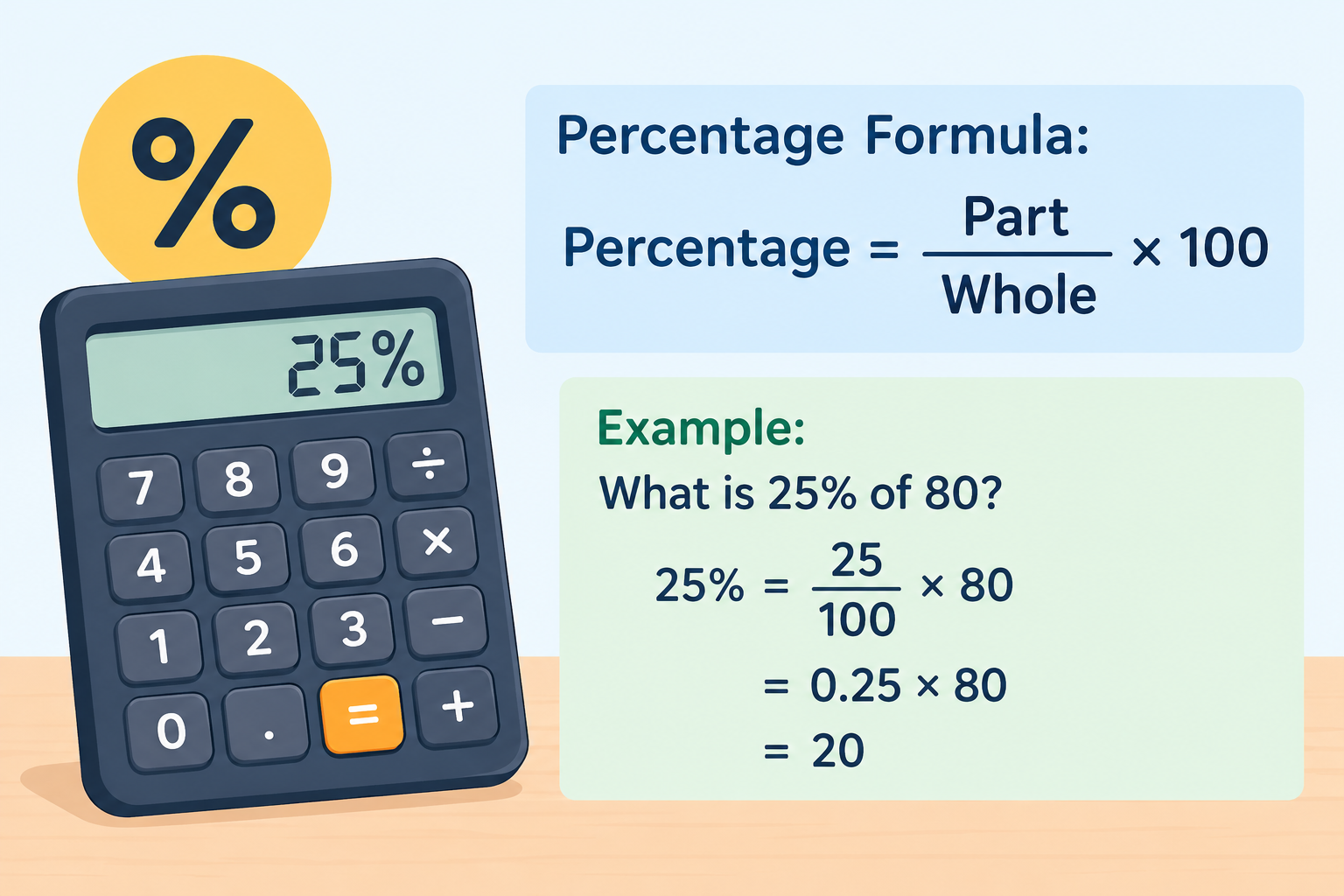
You see percentages everywhere. A 20% discount on shoes. A 75% score on a test. A 5% tip at a restaurant.
Yet many people freeze when they have to work one out. The good news? Percentages are simpler than they look. You only need one idea and one formula.
This guide walks you through both. You’ll learn what a percentage really is, how to calculate it, and how to handle the three situations you’ll meet most often. Every example shows each step, so you can follow along with a pencil or a calculator.
Quick Overview
| Detail | Information |
|---|---|
| Subject | Basic Mathematics |
| Core Formula | Percentage = (Part ÷ Whole) × 100 |
| Everyday Applications | Shopping discounts, test scores, tips, taxes, interest rates, nutrition labels |
| Key Skills | Dividing, multiplying by 100, converting decimals |
| Target Audience | School students, parents, and everyday learners |
| Difficulty | Beginner |
What Is a Percentage?
The word “percent” comes from Latin. It means “per hundred.”
So a percentage is simply a number out of 100. That’s it.
- 50% means 50 out of every 100
- 25% means 25 out of every 100
- 100% means the whole thing
Picture a chocolate bar split into 100 tiny squares. If you eat 30 squares, you’ve eaten 30% of the bar. If you eat all 100, you’ve eaten 100%.
The percent sign (%) is a shortcut. It tells you the number is being measured against 100.
Why 100?
Because 100 is easy to work with. It’s a clean base number, built from multiples of 10. If you’d like a refresher on how numbers scale up and down, read What Is a Multiple in Math? Examples and Practice. Understanding multiples makes it much easier to see why 25% is a quarter and 50% is a half.
Here are some percentages worth knowing by heart:
| Percentage | As a Fraction | As a Decimal |
|---|---|---|
| 10% | 1/10 | 0.10 |
| 25% | 1/4 | 0.25 |
| 50% | 1/2 | 0.50 |
| 75% | 3/4 | 0.75 |
| 100% | 1 | 1.00 |
For a nice visual model, the Math is Fun Percentage Guide shows percentages as shaded grids and number lines. It’s a great companion if you learn best by seeing.
The Core Percentage Formula
Here is the one formula you need:
Percentage = (Part ÷ Whole) × 100Let’s break it down:
- Part is the piece you’re looking at.
- Whole is the total amount.
- × 100 turns your answer into a percentage.
Why Does It Work?
Think of a percentage as a fraction in disguise. A fraction like 3/4 compares a part to a whole. When the top number (numerator) is smaller than the bottom number (denominator), it’s a proper fraction. You can read more in What Is a Proper Fraction? Examples Explained.
To turn that fraction into a percentage, you do two things:
- Divide the top by the bottom.
- Multiply by 100.
Try it with 3/4:
3 ÷ 4 = 0.75
0.75 × 100 = 75%
So 3/4 equals 75%.
The First Step: Finding the Quotient
When you divide the part by the whole, the result is called a quotient. In the example above, 0.75 is the quotient. If that word is new to you, What Is a Quotient in Math? Simple Explanation explains it in plain language.
This quotient is the key. Multiply it by 100, and you have your percentage.
Scenario 1: How to Find a Percentage of a Number
This is the most common question. You know the percentage and the total. You want to find the amount.
Example: What is 20% of $150?
You’ll see this when working out discounts, tips, or taxes.
The Formula
Amount = (Percentage ÷ 100) × WholeStep-by-Step Solution
Step 1: Write down what you know.
- Percentage = 20%
- Whole = $150
Step 2: Turn the percentage into a decimal. Divide 20 by 100.
20 ÷ 100 = 0.20Step 3: Multiply the decimal by the whole.
0.20 × 150 = 30Answer: 20% of $150 = $30
A Faster Mental Trick
Want to skip the calculator? Use the 10% method.
- Find 10% by moving the decimal one place left: 10% of 150 = 15
- Double it to get 20%: 15 × 2 = 30
Same answer, no calculator needed.
This trick works for other numbers too. For 30%, multiply your 10% by 3. For 5%, cut your 10% in half.
Scenario 2: How to Find What Percentage One Number Is of Another
Now flip it around. You know the part and the whole. You want the percentage.
Example: You scored 45 out of 60 on a test. What is your percentage?
This is the classic school question. It uses the core formula directly.
Step-by-Step Solution
Step 1: Identify the part and the whole.
- Part = 45 (your score)
- Whole = 60 (the total marks)
Step 2: Divide the part by the whole.
45 ÷ 60 = 0.75Step 3: Multiply by 100.
0.75 × 100 = 75Answer: You scored 75%
Quick Check
Does the answer make sense? 45 is more than half of 60, so the percentage should be above 50%. And 75% fits. Always run a sanity check like this. It catches silly mistakes.
Another Quick Example
A class has 25 students. 10 of them walk to school. What percentage walk?
10 ÷ 25 = 0.40
0.40 × 100 = 40
Answer: 40% of the students walk to school.
Scenario 3: Percentage Increase and Decrease
Prices go up. Prices go down. Populations grow. Temperatures drop. Percentage change tells you how big that shift is compared with where you started.
The Formula
Percentage Change = (Change ÷ Original Value) × 100Where Change = New Value − Original Value.
- A positive result means an increase.
- A negative result means a decrease.
Example A: Percentage Decrease (Store Discount)
A jacket costs $80. It’s on sale for $60. What is the discount percentage?
Step 1: Find the change.
60 − 80 = −20The price dropped by $20.
Step 2: Divide the change by the original price.
20 ÷ 80 = 0.25Step 3: Multiply by 100.
0.25 × 100 = 25Answer: The jacket is 25% off.
Example B: Percentage Increase (Price Hike)
A pizza costs $50. The price rises to $65. What is the percentage increase?
Step 1: Find the change.
65 − 50 = 15Step 2: Divide by the original value.
15 ÷ 50 = 0.30Step 3: Multiply by 100.
0.30 × 100 = 30Answer: The price went up by 30%.
Example C: Finding the Sale Price Directly
Sometimes you know the discount and want the final price.
A pair of shoes costs $120. There’s a 15% discount. What do you pay?
Step 1: Find the discount amount.
0.15 × 120 = 18Step 2: Subtract it from the original price.
120 − 18 = 102Answer: You pay $102.
Shortcut: Multiply by what’s left. If you save 15%, you pay 85%. So 0.85 × 120 = $102.
Quick Reference Table
| What You Want | Formula | Example |
|---|---|---|
| Percentage of a number | (% ÷ 100) × Whole | 20% of 150 = 30 |
| Percentage from two numbers | (Part ÷ Whole) × 100 | 45 of 60 = 75% |
| Percentage change | (Change ÷ Original) × 100 | 80 to 60 = 25% decrease |
| Find the whole | Part ÷ (% ÷ 100) | 18 is 30% of 60 |
Common Mistakes to Avoid
Even confident students slip up here. Watch out for these:
- Mixing up the part and the whole. The whole is always the total, the number you divide by.
- Forgetting to multiply by 100. Without that step, you only have a decimal.
- Using the wrong starting value. For percentage change, always divide by the original number, not the new one.
- Thinking increases and decreases cancel out. A 50% rise followed by a 50% drop does not bring you back. Start at $100, rise 50% to $150, then drop 50% to $75.
Practice Questions
Try these on your own. Answers are at the bottom.
- What is 15% of 200?
- You got 18 out of 24 on a quiz. What is your percentage?
- A phone costs $400 and drops to $340. What is the percentage decrease?
- A bus pass rises from $40 to $46. What is the percentage increase?
Answers:
- 30
- 75%
- 15% decrease
- 15% increase
Want more? The Khan Academy Practice on Percentages offers interactive exercises with instant feedback. It’s perfect for building speed and confidence.
Final Thoughts
Percentages feel tricky only until you see the pattern. Every problem comes back to one idea: a part compared with a whole, scaled to 100.
Remember the three moves. Find a percentage of a number. Find what percentage one number is of another. Measure how much something has gone up or down.
Practice a few problems each day. Soon you’ll work out discounts in your head while shopping, and you’ll check test scores before the teacher announces them. Pick a problem and give it a go.
Educational Disclaimer:
This guide is provided for general informational and academic learning purposes only. While every effort has been made to ensure accuracy, readers should verify calculations and methods against their official textbooks, course materials, or advice from a qualified teacher. This content does not replace professional instruction, and it should not be used as the sole basis for financial, legal, or business decisions.