

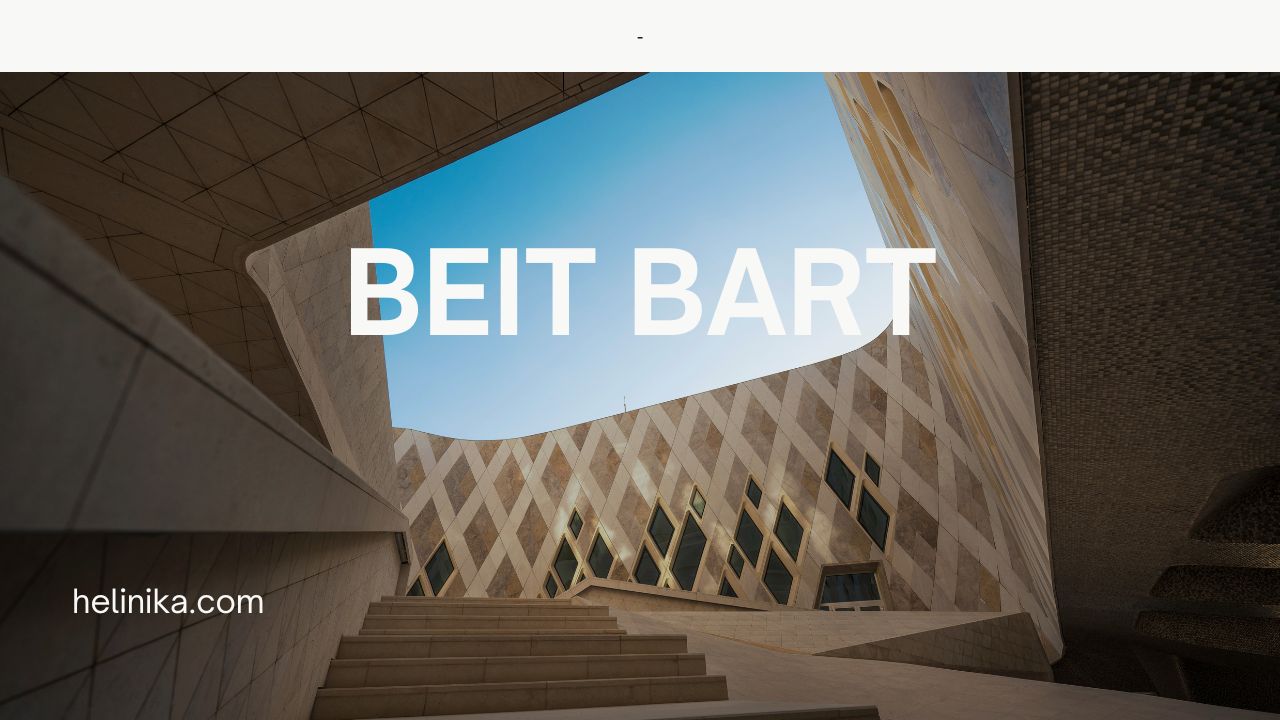
Beit Bart: A Unique Architectural Fusion of Past and Present
Architecture is more than the creation of physical space — it is the embodiment of culture, history, identity, and innovation. In a world where globalization often threatens to blur local identity, there are rare built works that stand as living bridges between the legacy of the past and the promise of the future. One such masterpiece is Beit Bart — a structure that captivates not only by its aesthetic brilliance but also by its deep narrative of continuity, adaptation, and cultural dialogue.
A Living Dialogue Between Eras
Located amid verdant landscapes and framed by horizons that breathe timelessness, Beit Bart is not merely a building; it is an architectural narrative. Its design tells the story of human settlement, cultural evolution, and the inexorable pull between tradition and innovation. In Beit Bart, architectural language from different eras does not clash — it converses.
This dialogue is evident in the materials used. Traditional stone, sourced locally, graces the lower levels of the structure, grounding it in the earth and anchoring it to the history of its surroundings. Above, sleek glass panels and steel frames rise, catching light and reflecting the future. The result is a building that seems both ancient and futuristic, as if it were always meant to stand at the intersection of time.
Context and Vision
Beit Bart’s conception was rooted in a bold vision: to create a space that honors historical architectural motifs while embracing contemporary design principles. The name “Beit Bart” itself carries meaning — “Beit” is derived from the ancient word for “house,” symbolizing hospitality, belonging, and rootedness. “Bart,” meanwhile, evokes openness, transformation, and perspective.
From the outset, the architects approached the project with respect for local history and a keen eye for global relevance. Extensive research was conducted into traditional building techniques, regional patterns, and the climatic wisdom encoded in vernacular architectures of the past. The aim was not to replicate historic forms but to reinterpret them — to craft something authentic rather than imitative.
Form and Function
Walk up to Beit Bart, and the first thing that catches your attention is its façade — a rhythm of solid stone and luminous glass. The lower stonework features textured blocks arranged in patterns reminiscent of ancient fortifications, suggesting stability and endurance. These robust walls shield the inner spaces from harsh sunlight, creating a passive climate control system that reflects the wisdom of traditional desert-region architecture.
Above this stone foundation, horizontal ribbons of glass open up the structure to the landscape. During the day, natural light floods interior spaces; at night, warm internal illumination transforms Beit Bart into a beacon that celebrates both transparency and sanctuary.
Inside, the fusion continues. Courtyards, a hallmark of ancient Middle Eastern homes where families once gathered under open skies, are reimagined as green pockets of calm, integrated with water features and shaded walkways. These courtyards not only provide natural ventilation but also foster a sense of community — echoing the social rhythms of the past.
Open-plan interiors contrast with intimate alcoves and traditional niches. Where once niches served as practical spaces for storing lamps and utensils, here they house art installations, books, and curated collections that celebrate the continuity of culture and craft. The circulation paths within Beit Bart encourage exploration rather than mere movement — a gentle reminder that architecture can shape experience and reflection.
Material Poetry: Past Meets Present
One of the most compelling features of Beit Bart is its material palette. Local stone — quarried with sustainable methods — forms both structure and ornament. Its rough-hewn texture connects the building to the land, making it seem as though it has grown from the soil itself. Each stone tells a story: of the earth, of human labor, and of the ancient traditions of masonry passed down through generations.
Contrasting this grounding presence are elements of modernity — steel beams, polished concrete, and expansive glass walls. These materials are not deployed for mere spectacle; they serve purpose. Steel provides structural clarity and flexibility, while glass blurs boundaries between interior and exterior, inviting nature into the living environment.
The juxtaposition of heavy stone and transparent glass is more than an aesthetic choice — it symbolizes a philosophy. Heavy stone represents the weight of history; transparent glass acknowledges the openness of the future. In Beit Bart, both weight and lightness coexist in a carefully calibrated balance.
Climate Sensitivity and Sustainability
Beit Bart’s architectural fusion extends into its environmental performance. The design does not treat sustainability as an add-on but as an intrinsic principle. The building’s orientation was meticulously studied to maximize natural ventilation and daylighting while minimizing heat gain. Deep overhangs and shaded courtyards reduce solar exposure, creating cool, comfortable interior spaces without excessive reliance on mechanical cooling.
Water is another resource treated with reverence. Inspired by ancient systems of water conservation, Beit Bart incorporates rainwater harvesting and greywater recycling. Collected water irrigates courtyard gardens, creating microclimates that moderate temperature and enrich the sensory experience of the building’s inhabitants.
Energy efficiency is enhanced by solar panels discreetly integrated into the upper roof planes — a modern touch that reinforces the building’s commitment to sustainability without compromising its architectural poise.
Cultural Continuity and Craft Revival
Beyond bricks and mortar, Beit Bart serves as a catalyst for cultural and artistic revival. The project brought together local artisans, stonemasons, glassworkers, and contemporary designers. By weaving traditional craft techniques into the construction process, the project not only preserved these skills but renewed interest in them among younger generations.
Workshops hosted on site invited community participation — from pattern carving on stone to exploring new digital fabrication techniques. In this way, Beit Bart became more than a structure; it became a living center of cultural transmission.
Even the landscape architecture draws from ancient agrarian practices, with terraces and planting schemes informed by local ecological knowledge. Native plants dot the grounds, requiring minimal irrigation and inviting birds and pollinators into the space.
A Place of Encounter and Reflection
Today, Beit Bart functions as a cultural hub — hosting exhibitions, talks, and gatherings that celebrate the intersections of art, history, and innovation. Its flexible interior spaces can transform from intimate lecture halls to expansive galleries. With its layered architecture, Beit Bart encourages visitors to slow down, observe, and reflect — whether on the patterns of light that dance across stone walls or on the centuries of architectural wisdom it embodies.
Visitors from around the world often describe Beit Bart as a place where time feels fluid. One steps into an environment that feels familiar yet novel — like revisiting a dream of a home one has never seen before. This emotional resonance arises not from nostalgia alone, but from the building’s ability to relate human experience across cultures and epochs.
Lessons for Modern Architecture
The success of it offers valuable insights for contemporary architecture:
-
Contextual Intelligence Matters
Rather than importing styles without reference, architecture that responds to local climate, materials, and cultural patterns creates deeper meaning and environmental resilience. -
Tradition Is Not Static
Traditional design principles, when reinterpreted thoughtfully, can inform sustainable solutions for modern challenges. -
Craft and Technology Can Coexist
Digital tools and ancient techniques need not be opposed; instead, they can enrich each other — combining precision with human touch. -
Architecture as Narrative
Buildings become more powerful when they tell stories — of place, of people, and of the continuous thread of human creativity.
Conclusion
it stands as a testament to the transformative potential of architecture — when it respects history without being confined by it, when it embraces innovation without discarding wisdom, and when it seeks not to dominate its environment but to harmonize with it. In a world increasingly dominated by homogenized design and fleeting trends, it is a reminder that architecture can be poetry — rooted in the earth yet reaching for the skies.
More than a structure, it is an idea made visible: that the best of the past and the promise of the future can coexist not as opposites, but as companions in space, light, material, and human experience.