

Fractions are everywhere in mathematics. You encounter them when measuring ingredients in a recipe, reading a ruler, calculating test scores, and solving algebra problems. Before you can work confidently with fractions, you need to understand the different types, and one of the most fundamental types is the proper fraction.
If you have ever looked at a fraction and wondered what makes it “proper,” or struggled to tell the difference between a proper fraction and an improper fraction, this article is for you. By the time you finish reading, you will know exactly what a proper fraction is, how to recognize one instantly, how to work with proper fractions in calculations, and why they matter in broader mathematics.
The explanation starts from the very beginning, so no prior knowledge of fraction types is required.
Quick Answer: What Is a Proper Fraction?
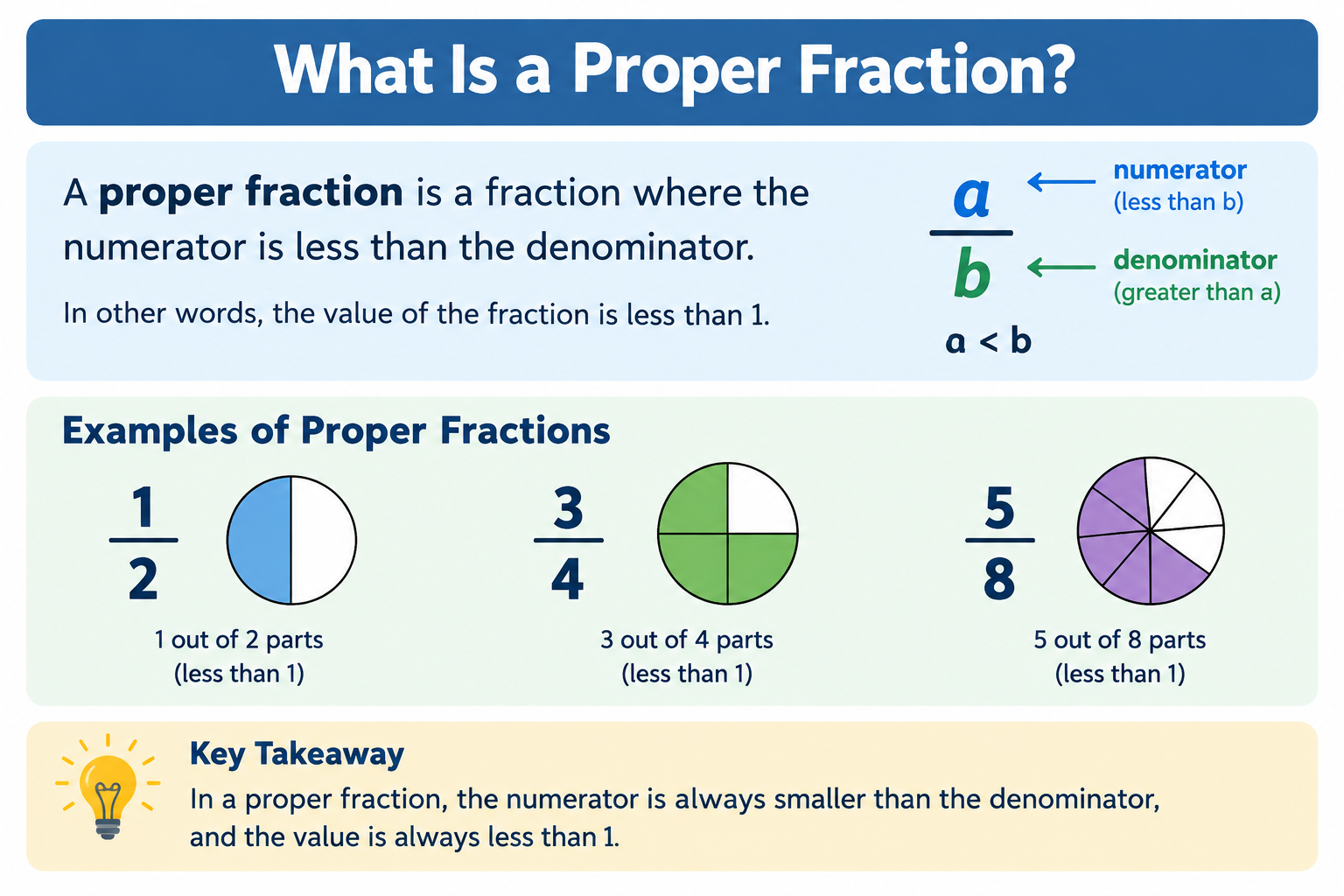
A proper fraction is a fraction in which the numerator is smaller than the denominator. Because the top number is less than the bottom number, a proper fraction always has a value between 0 and 1.
For example, 3/4 is a proper fraction. The numerator is 3 and the denominator is 4. Since 3 is less than 4, this fraction is proper.
Other examples include 1/2, 5/8, and 7/10. In every case, the numerator is smaller than the denominator, and the fraction represents a part of a whole rather than a whole number or more.
Understanding Fractions: A Quick Foundation
Before diving deeper into proper fractions, it helps to make sure the basic idea of a fraction is clear.
A fraction represents a part of a whole. It is written with two numbers separated by a horizontal line:
Numerator / Denominator
The numerator is the top number. It tells you how many parts you have.
The denominator is the bottom number. It tells you how many equal parts the whole is divided into.
So in the fraction 3/8, the whole has been divided into 8 equal parts, and you have 3 of them.
This relationship between numerator and denominator is what determines the type of fraction you are working with. When the numerator is smaller than the denominator, the fraction is proper. When the numerator is equal to or larger than the denominator, the fraction falls into a different category entirely.
What Makes a Fraction “Proper”?
The defining characteristic of a proper fraction is simple:
The numerator is less than the denominator.
That single rule tells you everything you need to know about whether a fraction is proper.
Because the numerator is smaller, a proper fraction always represents something less than one complete whole. If you imagine a pizza cut into 8 equal slices, having 5 of those slices gives you 5/8. You have part of the pizza, but not all of it. That is exactly what a proper fraction represents.
Here is a clear list of proper fractions:
- 1/2
- 3/4
- 2/5
- 7/9
- 4/11
- 11/20
- 99/100
In every example, the top number is smaller than the bottom number, and the value of each fraction falls somewhere between 0 and 1.
The closer the numerator is to the denominator, the closer the fraction is to 1. The fraction 99/100 is very close to 1 but still less than it. The fraction 1/100 is very close to 0.
Proper Fractions vs. Improper Fractions
To fully understand proper fractions, it is important to know what they are being distinguished from.
An improper fraction is a fraction where the numerator is equal to or greater than the denominator.
For example:
- 5/4 — the numerator (5) is greater than the denominator (4). This is improper.
- 9/9 — the numerator equals the denominator. This equals exactly 1. Also improper.
- 13/6 — the numerator is much larger than the denominator. Definitely improper.
An improper fraction has a value of 1 or greater. It represents one whole or more than one whole.
Here is the key comparison:
- Proper fraction: numerator < denominator — value is between 0 and 1
- Improper fraction: numerator ≥ denominator — value is 1 or greater
Both types are valid fractions. Neither is mathematically wrong. The terms “proper” and “improper” simply describe the relationship between the numerator and denominator.
Proper Fractions vs. Mixed Numbers
A mixed number is another way to express a quantity greater than 1. It combines a whole number with a proper fraction.
For example, 2 3/4 is a mixed number. It means 2 complete wholes plus the proper fraction 3/4.
Mixed numbers and improper fractions are related. The improper fraction 11/4 is the same value as the mixed number 2 3/4.
Proper fractions are different because they are always less than 1. They do not have a whole number part.
When you convert an improper fraction into a mixed number, the fractional part of the mixed number will always be a proper fraction. That is a natural consequence of the relationship between the two types.
How to Identify a Proper Fraction
Identifying a proper fraction takes just one step: compare the numerator and the denominator.
If the numerator is smaller, the fraction is proper.
If the numerator is equal to or larger, the fraction is not proper.
Examples:
Is 7/12 a proper fraction?
Numerator: 7. Denominator: 12. Since 7 < 12, yes, 7/12 is a proper fraction.
Is 15/11 a proper fraction?
Numerator: 15. Denominator: 11. Since 15 > 11, no, 15/11 is not a proper fraction. It is improper.
Is 8/8 a proper fraction?
Numerator: 8. Denominator: 8. Since 8 = 8, no, 8/8 is not a proper fraction. It equals 1.
Is 3/100 a proper fraction?
Numerator: 3. Denominator: 100. Since 3 < 100, yes, 3/100 is a proper fraction.
The comparison takes only a moment once you know what to look for.
The Value of a Proper Fraction
Every proper fraction represents a number between 0 and 1 on the number line. This is one of the most useful things to understand about proper fractions because it gives you a sense of their size without doing any calculation.
When you see a proper fraction, you know immediately that:
- It is greater than 0.
- It is less than 1.
- It represents a part of a whole rather than a complete whole.
You can also get a sense of where a proper fraction falls between 0 and 1 by comparing the numerator to the denominator.
- If the numerator is much smaller than the denominator, the fraction is close to 0. For example, 1/20 = 0.05.
- If the numerator is close to the denominator, the fraction is close to 1. For example, 19/20 = 0.95.
- If the numerator is exactly half the denominator, the fraction equals 1/2 = 0.5, which is the midpoint between 0 and 1.
This sense of relative size helps when comparing fractions, ordering them on a number line, or estimating calculations.
Simplifying Proper Fractions
A proper fraction can often be simplified, also called reducing, by dividing both the numerator and denominator by their greatest common factor.
Example: Simplify 6/8
Find the greatest common factor of 6 and 8. The factors of 6 are 1, 2, 3, 6. The factors of 8 are 1, 2, 4, 8. The greatest common factor is 2.
Divide both numbers by 2:
6 ÷ 2 = 3
8 ÷ 2 = 4
Simplified fraction: 3/4
Both 6/8 and 3/4 are proper fractions. Simplifying does not change the type of fraction. It only makes the numbers smaller and easier to work with.
A proper fraction is in its simplest form (also called lowest terms) when the numerator and denominator share no common factor other than 1.
Example: Simplify 15/25
Greatest common factor of 15 and 25 is 5.
15 ÷ 5 = 3
25 ÷ 5 = 5
Simplified: 3/5
Still a proper fraction. Still represents the same value.
Adding Proper Fractions
Adding proper fractions requires attention to the denominator. The process varies slightly depending on whether the fractions share the same denominator.
Adding Proper Fractions With the Same Denominator
When denominators are the same, add the numerators and keep the denominator.
Example: 2/7 + 3/7
Add the numerators: 2 + 3 = 5
Keep the denominator: 7
Result: 5/7
The result is still a proper fraction.
Example: 4/9 + 3/9
Add the numerators: 4 + 3 = 7
Keep the denominator: 9
Result: 7/9
Adding Proper Fractions With Different Denominators
When denominators are different, you must first find a common denominator before adding.
Example: 1/3 + 1/4
Find the least common denominator of 3 and 4. The least common multiple of 3 and 4 is 12.
Convert each fraction:
1/3 = 4/12
1/4 = 3/12
Add:
4/12 + 3/12 = 7/12
Result: 7/12
This is a proper fraction because 7 < 12.
Note that adding two proper fractions does not always result in a proper fraction. For example, 5/6 + 4/6 = 9/6, which is improper. Always check the result.
Subtracting Proper Fractions
Subtraction of proper fractions follows the same logic as addition. Match the denominators first if they differ, then subtract the numerators.
Example: 5/8 − 2/8
Same denominator. Subtract numerators:
5 − 2 = 3
Result: 3/8
Example: 3/4 − 1/3
Least common denominator of 4 and 3 is 12.
Convert:
3/4 = 9/12
1/3 = 4/12
Subtract:
9/12 − 4/12 = 5/12
Result: 5/12 — a proper fraction.
Multiplying Proper Fractions
Multiplying proper fractions is one of the more straightforward fraction operations. You multiply the numerators together and the denominators together.
Example: 2/3 × 3/5
Multiply numerators: 2 × 3 = 6
Multiply denominators: 3 × 5 = 15
Result: 6/15
Simplify: Greatest common factor of 6 and 15 is 3.
6 ÷ 3 = 2
15 ÷ 3 = 5
Simplified result: 2/5
An important property of proper fractions is that multiplying two proper fractions always produces a result smaller than either of the original fractions. This makes sense because you are taking a fraction of a fraction, which is an even smaller part of the whole.
Example: 1/2 × 1/2 = 1/4
One half of one half is one quarter. The result (1/4) is smaller than both 1/2 values you started with.
This connects naturally to the idea of a product in multiplication — when both values being multiplied are between 0 and 1, the product is always smaller than either factor.
Dividing Proper Fractions
To divide one fraction by another, you multiply the first fraction by the reciprocal of the second fraction. The reciprocal is simply the fraction flipped upside down.
Example: 3/4 ÷ 1/2
Reciprocal of 1/2 is 2/1.
Multiply:
3/4 × 2/1 = 6/4
Simplify: 6/4 = 3/2
The result here is 3/2, which is an improper fraction. Dividing a proper fraction by another proper fraction can produce a result greater than 1.
Example: 2/5 ÷ 4/5
Reciprocal of 4/5 is 5/4.
Multiply:
2/5 × 5/4 = 10/20 = 1/2
Result: 1/2 — a proper fraction.
Proper Fractions and Factors
Understanding factors is closely tied to working with fractions. When you simplify a proper fraction, you are dividing both the numerator and denominator by a shared factor. The ability to identify common factors quickly makes simplifying fractions much faster.
For example, to simplify 18/24, you need to find the greatest common factor of 18 and 24, which is 6. Knowing what a factor is in math makes this process straightforward and helps you work with proper fractions more efficiently across all types of problems.
Proper Fractions and Multiples
Multiples play an important role when adding or subtracting proper fractions with different denominators. To find a common denominator, you need to find the least common multiple of the two denominators.
For example, when adding 1/4 + 1/6, you need the least common multiple of 4 and 6, which is 12. Understanding multiples in math gives you the tools to find common denominators quickly and accurately, making fraction addition and subtraction considerably easier.
Proper Fractions in Equations
Proper fractions appear frequently in mathematical equations, from simple arithmetic to algebra. Recognizing them within equations helps you decide how to approach the problem.
A simple equation with a proper fraction might look like:
x + 1/4 = 3/4
To solve, subtract 1/4 from both sides:
x = 3/4 − 1/4 = 2/4 = 1/2
The solution is the proper fraction 1/2.
In algebra, you will encounter equations where a proper fraction is a coefficient, a constant, or an unknown value. Understanding what an equation is in math provides the foundational framework for solving these problems step by step.
Converting Proper Fractions to Decimals
Every proper fraction can be expressed as a decimal by dividing the numerator by the denominator. Because proper fractions are always less than 1, their decimal equivalents will always be between 0 and 1.
Examples:
- 1/2 = 1 ÷ 2 = 0.5
- 3/4 = 3 ÷ 4 = 0.75
- 2/5 = 2 ÷ 5 = 0.4
- 7/8 = 7 ÷ 8 = 0.875
- 1/3 = 1 ÷ 3 = 0.333… (repeating decimal)
Some proper fractions produce terminating decimals that end after a certain number of digits, like 3/4 = 0.75. Others produce repeating decimals that continue infinitely with a repeating pattern, like 1/3 = 0.333…
Both are valid decimal representations of proper fractions. Knowing how to convert between fraction and decimal form is a useful skill across many areas of math and science.
Converting Proper Fractions to Percentages
A percentage is simply a fraction expressed out of 100. To convert a proper fraction to a percentage, convert it to a decimal first and then multiply by 100.
Example: Convert 3/4 to a percentage
3/4 = 0.75
0.75 × 100 = 75%
Example: Convert 2/5 to a percentage
2/5 = 0.4
0.4 × 100 = 40%
Example: Convert 7/20 to a percentage
7/20 = 0.35
0.35 × 100 = 35%
Because proper fractions are always less than 1, their percentage equivalents are always less than 100%. This makes sense — a proper fraction is always a partial amount, never a complete whole.
Comparing Proper Fractions
Comparing proper fractions helps you determine which is larger or smaller. There are two main approaches.
When the denominators are the same, compare the numerators directly. The larger numerator means the larger fraction.
3/8 vs. 5/8
Same denominator. Compare numerators: 5 > 3. Therefore 5/8 > 3/8.
When the denominators are different, convert to a common denominator first, then compare numerators.
2/3 vs. 3/5
Common denominator of 3 and 5 is 15.
2/3 = 10/15
3/5 = 9/15
Compare: 10 > 9. Therefore 2/3 > 3/5.
You can also convert both to decimals to compare.
2/3 ≈ 0.667
3/5 = 0.6
0.667 > 0.6, confirming that 2/3 > 3/5.
Common Mistakes With Proper Fractions
Students make predictable errors when working with proper fractions. Knowing these mistakes in advance helps you avoid them.
Adding denominators when adding fractions. When adding 1/3 + 1/4, some students write 2/7. This is incorrect. Denominators are never added together. You must find a common denominator before adding the numerators.
Forgetting to simplify. After performing a calculation, the result may not be in its simplest form. Always check whether the numerator and denominator share a common factor and simplify if they do.
Confusing proper and improper fractions. Students sometimes assume that any fraction with larger numbers is improper. The classification depends entirely on whether the numerator is smaller or larger than the denominator, not on the size of the numbers themselves. The fraction 3/1000 is proper even though 1000 is a large number.
Incorrectly applying fraction multiplication rules to addition. When multiplying fractions, you multiply straight across. When adding, you must use common denominators. Mixing up these procedures is a common source of errors.
Not checking whether a result is a proper or improper fraction. After adding or subtracting fractions, students sometimes assume the result must still be proper. This is not guaranteed. For example, 5/6 + 2/6 = 7/6, which is improper.
Misidentifying the numerator and denominator. In a fraction written vertically or in mixed notation, some students occasionally identify the wrong number as the numerator. The numerator is always on top (or before the slash), and the denominator is always on the bottom (or after the slash).
Real-World Examples of Proper Fractions
Proper fractions appear constantly outside of the classroom.
Cooking and baking: A recipe calls for 3/4 cup of sugar or 2/3 cup of flour. These are proper fractions representing partial measurements of a full cup.
Time: Fifteen minutes is 15/60 = 1/4 of an hour. Forty-five minutes is 45/60 = 3/4 of an hour. Both are proper fractions of a full hour.
Money: If something costs $3 and you have $4, you have enough to pay, but the cost represents 3/4 of your total money. That relationship is a proper fraction.
Sports and statistics: A basketball player who makes 7 out of 10 free throws has a success rate of 7/10. This proper fraction directly represents their performance.
Discounts and sales: A 25% discount is the same as 25/100, which simplifies to the proper fraction 1/4. A 40% sale means you are paying 60/100 = 3/5 of the original price, another proper fraction.
Maps and scale: If a map scale shows that 1 cm represents 50 km, a distance of 3/4 cm on the map represents 37.5 km in reality. The proper fraction describes a partial unit of measurement.
Why Proper Fractions Matter in Mathematics
A solid understanding of proper fractions is not just useful for fraction worksheets. It builds directly into many other areas of mathematics.
In ratio and proportion, comparing quantities often produces proper fractions that describe relationships between parts and wholes.
In probability, the likelihood of an event happening is always expressed as a proper fraction (or its decimal/percentage equivalent) when the event is not certain and not impossible. The probability of rolling a 3 on a six-sided die is 1/6, a proper fraction.
In algebra, proper fractions appear as coefficients, solutions to equations, and values within expressions. Being comfortable with them at the arithmetic level makes algebraic manipulation far more manageable.
In geometry, proper fractions appear in formulas, scale factors, and measurements involving partial units.
In data interpretation, fractions of totals — such as what fraction of a class passed a test — are typically proper fractions.
Tips for Students Working With Proper Fractions
Know your multiplication tables well. Strong multiplication knowledge helps you simplify fractions, find common denominators, and convert between fractions and decimals with much less effort.
Always identify the numerator and denominator clearly before performing any operation. Label them if it helps, especially in complex problems.
When simplifying a proper fraction, look for the greatest common factor rather than dividing by small numbers repeatedly. Finding it in one step is faster and reduces the chance of error.
Draw a visual model when you are struggling with a concept. Circles or rectangles divided into equal parts can make the meaning of a proper fraction tangible and easier to understand.
Practice converting proper fractions to decimals and percentages regularly. Fluency in all three forms gives you flexibility in solving different types of problems.
When adding or subtracting fractions with different denominators, write out the common denominator step explicitly rather than doing it mentally. Skipping steps leads to errors.
Always check your final answer. Ask yourself: does this answer make sense given the problem? If you added two fractions that were both close to 1/2 and got an answer less than 1/2, something went wrong.
Practice Problems
Work through these problems independently, then check your answers and explanations below.
Problem One: Is 9/11 a proper fraction? Explain why or why not.
Problem Two: Simplify the proper fraction 12/18.
Problem Three: Add 2/5 + 1/3.
Problem Four: Multiply 3/4 × 2/5.
Problem Five: Convert 3/8 to a decimal and a percentage.
Problem Six: Which is larger: 4/7 or 5/9?
Problem Seven: A class of 30 students has 18 students who passed a quiz. Write this as a proper fraction in its simplest form.
Answers and Explanations:
Problem One: Yes, 9/11 is a proper fraction. The numerator (9) is less than the denominator (11), so the fraction represents a value between 0 and 1.
Problem Two: The greatest common factor of 12 and 18 is 6. Divide both: 12 ÷ 6 = 2, 18 ÷ 6 = 3. Simplified: 2/3.
Problem Three: Common denominator of 5 and 3 is 15. Convert: 2/5 = 6/15 and 1/3 = 5/15. Add: 6/15 + 5/15 = 11/15.
Problem Four: Multiply numerators: 3 × 2 = 6. Multiply denominators: 4 × 5 = 20. Result: 6/20. Simplify (GCF = 2): 3/10.
Problem Five: 3 ÷ 8 = 0.375. As a percentage: 0.375 × 100 = 37.5%.
Problem Six: Common denominator of 7 and 9 is 63. Convert: 4/7 = 36/63 and 5/9 = 35/63. Since 36 > 35, 4/7 is larger.
Problem Seven: 18 out of 30 = 18/30. GCF of 18 and 30 is 6. Simplified: 3/5.
FAQs About Proper Fractions
What is a proper fraction?
A proper fraction is a fraction where the numerator is smaller than the denominator. Because of this, a proper fraction always has a value between 0 and 1. Examples include 1/2, 3/4, and 7/10.
What is the difference between a proper fraction and an improper fraction?
In a proper fraction, the numerator is less than the denominator, and the value is less than 1. In an improper fraction, the numerator is equal to or greater than the denominator, and the value is 1 or more. For example, 3/5 is proper and 7/5 is improper.
Can a proper fraction be negative?
Yes. A fraction like −3/4 has a numerator smaller in absolute value than the denominator and represents a value between −1 and 0. Whether negative fractions are called “proper” depends on the curriculum, but the same structural rule applies: the absolute value of the numerator is less than the absolute value of the denominator.
Is 1/1 a proper fraction?
No. In 1/1, the numerator equals the denominator. This fraction equals exactly 1, which means it is not a proper fraction. A proper fraction must be strictly less than 1.
How do you simplify a proper fraction?
Find the greatest common factor of the numerator and denominator and divide both by it. For example, 8/12 simplifies to 2/3 because the greatest common factor is 4. The simplified fraction is still a proper fraction.
Can adding two proper fractions give an improper fraction?
Yes. For example, 5/8 + 5/8 = 10/8, which is improper because the numerator (10) is greater than the denominator (8). Adding proper fractions does not guarantee a proper result, so always check the answer.
What is an example of a proper fraction in real life?
A common real-life example is measuring ingredients. If a recipe calls for 3/4 cup of milk, that is a proper fraction. Other examples include describing time (3/4 of an hour is 45 minutes), probability (1/6 chance of rolling a specific number on a die), and discounts expressed as fractions of the original price.
How do you convert a proper fraction to a decimal?
Divide the numerator by the denominator. Since the numerator is always smaller in a proper fraction, the result will always be a decimal between 0 and 1. For example, 3/4 = 3 ÷ 4 = 0.75.
What is the smallest proper fraction?
There is no single smallest proper fraction. You can always create a smaller proper fraction by making the numerator smaller relative to the denominator. For example, 1/1000 is very small, but 1/1000000 is even smaller, and this process has no end.
Conclusion
A proper fraction is any fraction in which the numerator is smaller than the denominator. This means a proper fraction always represents a value between 0 and 1 — a part of a whole rather than a whole number or more.
Recognizing a proper fraction is as simple as comparing the top and bottom numbers. If the top is smaller, the fraction is proper. If the top is equal to or larger, it is not.
Proper fractions are a foundational concept in mathematics. They appear in arithmetic, algebra, probability, geometry, and countless real-world situations. Learning to add, subtract, multiply, divide, simplify, and compare them gives you a powerful set of tools that carry through every level of math education.
Rather than simply memorizing the definition, take time to understand what a proper fraction represents: a genuine portion of something whole. That understanding makes every calculation involving fractions more meaningful and far easier to navigate.
Sources and References
- Khan Academy: Fractions — Comprehensive beginner-to-intermediate coverage of fraction types, operations, and applications.
- Encyclopaedia Britannica: Fraction — Overview of fractions in mathematics including historical context and definitions.
- OpenStax: Prealgebra 2e — Chapters covering fractions, proper and improper fractions, mixed numbers, and fraction operations. Available at openstax.org.
- National Council of Teachers of Mathematics (NCTM): nctm.org — Standards and research-based guidance on teaching fractions across K–12 mathematics education.
Disclaimer
This article is provided for general educational and informational purposes only. While every effort is made to keep the information accurate and clear, mathematical methods and explanations may vary depending on the curriculum or educational context. Students should follow the instructions and methods provided by their teachers, textbooks, or educational institutions when completing coursework or examinations.
About the Author
Farzan is an education writer who focuses on mathematics, learning concepts, and easy-to-understand explanations for students. His work aims to make challenging academic topics clearer through simple explanations, practical examples, and well-structured educational content.