

Introduction
The word “product” comes up constantly in math, but students sometimes confuse it with other results like sums or differences. Understanding exactly what a product is — and how it connects to multiplication — makes working through math problems much easier.
Here is a simple example:
6 × 5 = 30
The number 30 is the product. It is what you get when 6 and 5 are multiplied together. The numbers 6 and 5 are the factors — the numbers doing the multiplying. The product is always the result of that multiplication.
This guide explains what a product is, how to find it, how it connects to factors and other mathematical ideas, and where products show up in real math problems.
Quick Answer: What Is a Product in Math?
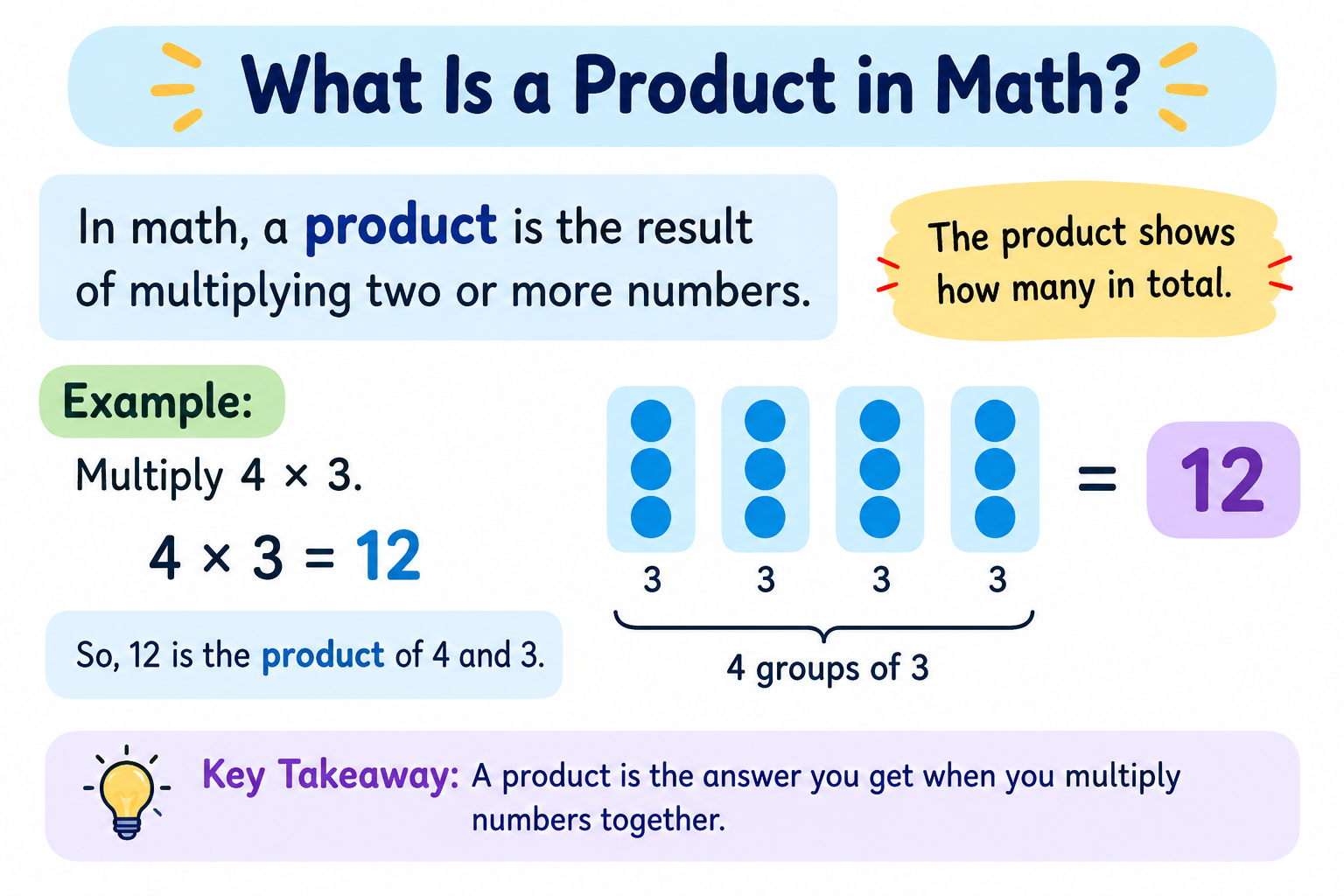
A product is the result you get when two or more numbers are multiplied together. For example, when you multiply 4 × 3, the answer 12 is the product. The numbers being multiplied — in this case 4 and 3 — are called factors. Every multiplication problem produces a product.
What Is a Product in Math?
A product is the result of multiplying two or more numbers together. In any multiplication sentence, the product is the final answer — the number you arrive at after the multiplication is carried out.
Here is the basic structure of a multiplication sentence:
Factor × Factor = Product
Let’s look at several examples:
3 × 4 = 12
The product is 12. The factors are 3 and 4.
7 × 5 = 35
The product is 35. The factors are 7 and 5.
9 × 6 = 54
The product is 54. The factors are 9 and 6.
2 × 8 = 16
The product is 16. The factors are 2 and 8.
10 × 10 = 100
The product is 100. The factors are 10 and 10.
In every case, the product is what you get after multiplication. It does not matter how many factors are involved — the product is always the final result of multiplying them all together.
You can also find the product of three or more numbers:
2 × 3 × 4 = 24
Multiply 2 × 3 first to get 6, then multiply 6 × 4 to get 24. The product is 24.
5 × 2 × 3 = 30
Multiply 5 × 2 = 10, then 10 × 3 = 30. The product is 30.
What Are the Parts of a Multiplication Sentence?
To fully understand what a product is, it helps to know what each part of a multiplication sentence is called.
Consider this example:
6 × 7 = 42
Factors: The numbers being multiplied — in this case, 6 and 7. Factors are the inputs of a multiplication operation. Every multiplication sentence has at least two factors.
Multiplication sign (×): The operator that tells you to multiply. It can also be written as a dot (·) or represented by placing a number directly next to a variable or parenthesis, such as 3(4) or 3x.
Product: The result of the multiplication — in this case, 42. The product is always on the right side of the equal sign in a standard multiplication sentence.
The relationship between factors and products is closely connected. Understanding what is a factor in math makes working with products much clearer, because every product comes from its factors and every factor pair points back to a product.
How to Find the Product of Two Numbers
Finding the product means performing the multiplication. Depending on the numbers involved, this can be done mentally, using a written method, or with a calculator.
Example one: Small numbers
8 × 3 = ?
Count 8 three times: 8, 16, 24.
Or recall the multiplication fact directly.
Product = 24
Example two: Two-digit numbers
12 × 5 = ?
Break it down: 10 × 5 = 50 and 2 × 5 = 10.
Add the results: 50 + 10 = 60.
Product = 60
Example three: Larger numbers
24 × 6 = ?
Break it down: 20 × 6 = 120 and 4 × 6 = 24.
Add the results: 120 + 24 = 144.
Product = 144
Example four: Three factors
3 × 4 × 5 = ?
Multiply left to right: 3 × 4 = 12, then 12 × 5 = 60.
Product = 60
In each case, the product is simply the answer to the multiplication — regardless of how you calculate it.
Examples of Products in Math
Here is a broader set of multiplication examples to help you recognize products across different situations:
2 × 9 = 18 → Product is 18
6 × 6 = 36 → Product is 36
11 × 4 = 44 → Product is 44
7 × 8 = 56 → Product is 56
15 × 3 = 45 → Product is 45
20 × 5 = 100 → Product is 100
0 × 9 = 0 → Product is 0 (any number multiplied by 0 gives a product of 0)
1 × 14 = 14 → Product is 14 (any number multiplied by 1 gives a product equal to that number)
6 × 7 × 2 = 84 → Multiply 6 × 7 = 42, then 42 × 2 = 84. Product is 84.
Each of these follows the same rule: the product is what results from the multiplication of the factors involved.
Product vs Sum vs Difference vs Quotient
Students often need to identify which operation a word refers to. Here is how the product fits alongside other key math results:
A sum is the result of addition.
4 + 5 = 9 → The sum is 9.
A difference is the result of subtraction.
9 − 4 = 5 → The difference is 5.
A product is the result of multiplication.
4 × 5 = 20 → The product is 20.
A quotient is the result of division.
20 ÷ 4 = 5 → The quotient is 5.
Here is a simple comparison:
| Operation | Name of Result | Example | Answer |
|---|---|---|---|
| Addition | Sum | 6 + 3 | 9 |
| Subtraction | Difference | 6 − 3 | 3 |
| Multiplication | Product | 6 × 3 | 18 |
| Division | Quotient | 6 ÷ 3 | 2 |
When a math problem uses the word “product,” it is always asking about multiplication. If a question says “find the product of 7 and 8,” that means calculate 7 × 8, which equals 56.
Product and Factors: How They Connect
Products and factors are directly connected. A product is what you get from multiplying factors together. Factors are the numbers that multiply to produce the product.
This relationship works in both directions:
Multiplication direction:
3 × 8 = 24 → The product of 3 and 8 is 24.
Factor direction:
The factors of 24 include 3 and 8, because 3 × 8 = 24.
Every product can be traced back to its factors, and every pair of factors points to a product. This two-way relationship is what makes multiplication and factorization so closely linked in mathematics.
For example, the number 36 is the product of several different factor pairs:
- 1 × 36 = 36
- 2 × 18 = 36
- 3 × 12 = 36
- 4 × 9 = 36
- 6 × 6 = 36
In each case, 36 is the product. The factors differ, but the product stays the same.
Special Cases of Products
The Product of Any Number and Zero
When any number is multiplied by 0, the product is always 0. This is called the zero property of multiplication.
7 × 0 = 0
0 × 25 = 0
0 × 0 = 0
No matter how large the other factor is, multiplying by zero always gives a product of zero.
The Product of Any Number and One
When any number is multiplied by 1, the product is always that same number. This is called the identity property of multiplication.
9 × 1 = 9
1 × 47 = 47
1 × 1 = 1
The number 1 is called the multiplicative identity because multiplying by it leaves any number unchanged.
The Product of a Number and Itself
When a number is multiplied by itself, the result is called a perfect square.
4 × 4 = 16 → 16 is a perfect square
5 × 5 = 25 → 25 is a perfect square
9 × 9 = 81 → 81 is a perfect square
This concept connects directly to exponents — 4 × 4 can also be written as 4², which is read as “four squared.”
The Product of a Number and a Negative Number
When a positive number is multiplied by a negative number, the product is negative.
6 × (−3) = −18
When two negative numbers are multiplied, the product is positive.
(−4) × (−5) = 20
These rules about signs are important as students move into working with integers and algebra.
Products in Algebra
In algebra, the word “product” still means the result of multiplication — but the factors may include variables and expressions rather than just plain numbers.
When a number and a variable are written next to each other, multiplication is implied:
3x means 3 × x. The product of 3 and x is 3x.
5y means 5 × y. The product of 5 and y is 5y.
Understanding what is a variable in math is helpful here, because variables are the unknown quantities that appear as factors in algebraic products.
A coefficient is the number multiplied by a variable in an algebraic term. In 3x, the coefficient is 3 and the variable is x. Their product is 3x. You can explore this further in this guide on what is a coefficient in math.
Products of expressions can also appear in algebra:
(x + 2)(x + 3)
This is the product of two expressions: (x + 2) and (x + 3). When multiplied out, the product is:
x² + 5x + 6
Each part of an algebraic product follows the same fundamental idea — multiply the factors together to find the product.
Products in Expressions and Equations
Products appear inside mathematical expressions and equations all the time. Recognizing them helps students understand the structure of what they are working with.
In the expression 4x + 7, the term 4x is itself a product — the product of 4 and x. The number 7 is a constant in math that stands on its own as a separate term.
In the equation 3x = 15, the left side is a product of 3 and x. Solving this equation means finding the value of x that makes the product equal to 15.
Understanding what a term in math is also helps here — in many expressions and equations, individual terms are themselves products of coefficients and variables.
Why Is the Product Important in Math?
The product is one of the four fundamental results in arithmetic, alongside the sum, difference, and quotient. It appears in virtually every area of mathematics and has practical uses in daily life.
In multiplication tables, every cell in the table is a product. Learning multiplication facts means learning products.
In area and volume calculations, formulas produce products. The area of a rectangle is length × width — the result is a product.
In algebra, terms like 5x and expressions like (x + 1)(x + 2) are built from products. Factoring — one of the key skills in algebra — is the process of working backward from a product to find its factors.
In fractions, multiplying fractions produces a product. For example, 1/2 × 3/4 = 3/8. The numerator 3 and denominator 8 in the result are both products of the corresponding parts.
In science, many formulas involve products. Distance = speed × time. Force = mass × acceleration. Both of these produce a product on the left side of the formula.
In everyday life, calculating total costs, areas, quantities, and rates all involve multiplication — and every multiplication gives a product.
Real-World Examples of Products
Example one: Buying items
A student buys 6 notebooks that each cost $4. What is the total cost?
6 × 4 = 24
The product is 24. The total cost is $24.
Example two: Tiling a floor
A rectangular room is 8 meters long and 5 meters wide. What is the area of the floor?
8 × 5 = 40
The product is 40. The area of the floor is 40 square meters.
Example three: Packing boxes
A factory packs 12 bottles into each box. If there are 15 boxes, how many bottles are there in total?
12 × 15 = 180
The product is 180. There are 180 bottles in total.
Example four: Distance traveled
A car travels at a speed of 60 miles per hour for 3 hours. How far does it travel?
60 × 3 = 180
The product is 180. The car travels 180 miles.
Each of these examples shows a multiplication — and every multiplication produces a product that answers a real question.
Common Mistakes Students Make With Products
Confusing the product with the sum
The product is the result of multiplication, not addition. A common mistake is writing 3 × 4 = 7 (which is 3 + 4) instead of the correct answer, 12. When you see the word “product,” always think multiplication.
Confusing the product with the factors
In the sentence 5 × 6 = 30, the product is 30 — not 5 or 6. The factors are 5 and 6. Students sometimes identify one of the factors as the product when asked.
Forgetting the zero property
Any number multiplied by 0 gives a product of 0. Some students multiply the other factor by itself or write the other factor as the answer when 0 is involved.
Sign errors with negative numbers
When multiplying negative numbers, students sometimes forget the sign rules. A positive times a negative gives a negative product. A negative times a negative gives a positive product.
Multiplying only part of a multi-factor problem
When finding the product of three or more numbers, all factors must be multiplied. In 2 × 3 × 5, some students multiply only the first two numbers and report 6 as the product instead of the correct answer, 30.
Misidentifying the product in an equation
In an equation like 4x = 28, the left side (4x) is a product of 4 and x. Some students confuse the structure and do not recognize the product relationship within the equation.
How to Identify a Product
When reading a math problem, look for these clues that a product is involved:
- The word “product” is used directly. (“Find the product of 9 and 7.”)
- A multiplication sign (×, ·) appears between two numbers.
- A number is written directly next to a variable (such as 5x), implying multiplication.
- Parentheses are used without an operator between a number and a group, such as 3(4 + 2), which means 3 multiplied by (4 + 2).
When any of these appear, the result of the multiplication is the product.
Examples:
- “The product of 8 and 6” → 8 × 6 = 48
- “Find the product of 3, 4, and 5” → 3 × 4 × 5 = 60
- “What is 7 multiplied by 9?” → 7 × 9 = 63
Frequently Asked Questions
What is a product in math in simple words?
A product is the answer you get when you multiply two or more numbers together. For example, the product of 4 and 5 is 20, because 4 × 5 = 20.
What is the product of 6 and 7?
The product of 6 and 7 is 42, because 6 × 7 = 42.
What is the difference between a product and a sum?
A product is the result of multiplication. A sum is the result of addition. For example, the product of 3 and 4 is 12, while the sum of 3 and 4 is 7.
What are the factors and the product in a multiplication sentence?
In the sentence 5 × 8 = 40, the factors are 5 and 8 — the numbers being multiplied. The product is 40 — the result of the multiplication.
What is the product of any number and zero?
The product of any number and zero is always zero. For example, 100 × 0 = 0. This is the zero property of multiplication.
What is the product of any number and one?
The product of any number and one is always that same number. For example, 15 × 1 = 15. This is the identity property of multiplication.
Can a product be negative?
Yes. If one factor is positive and the other is negative, the product is negative. For example, 6 × (−4) = −24. If both factors are negative, the product is positive. For example, (−3) × (−5) = 15.
What is a product in algebra?
In algebra, a product is still the result of multiplication. When a number is written next to a variable, such as 5x, it means 5 multiplied by x, and 5x is the product. Expressions like (x + 1)(x + 2) are also products — of two binomial expressions.
How do you find the product of three numbers?
Multiply the first two numbers together, then multiply that result by the third number. For example, to find the product of 2, 5, and 6: 2 × 5 = 10, then 10 × 6 = 60. The product is 60.
Why is the product important in math?
The product is the fundamental result of multiplication, which appears in nearly every area of math — from basic arithmetic and fractions to algebra, geometry, and science. Understanding products is essential for working with formulas, equations, and real-world calculations.
Sources and References
- Khan Academy — Multiplication and Division — khanacademy.org
- OpenStax Prealgebra 2e, Chapter 1: Whole Numbers — Multiply Whole Numbers — openstax.org
- OpenStax Elementary Algebra 2e, Chapter 1: Foundations — Properties of Real Numbers — openstax.org
- Encyclopaedia Britannica — Multiplication — britannica.com
Disclaimer
The content in this article is provided for general educational purposes only. While every effort has been made to ensure mathematical accuracy, students should consult their teacher, textbook, or a qualified educator for guidance specific to their individual coursework or curriculum.
About the Author
Farzan is an education writer who focuses on mathematics, learning concepts, and easy-to-understand explanations for students. He enjoys breaking down challenging math topics into clear, practical examples that make learning easier.