

Introduction
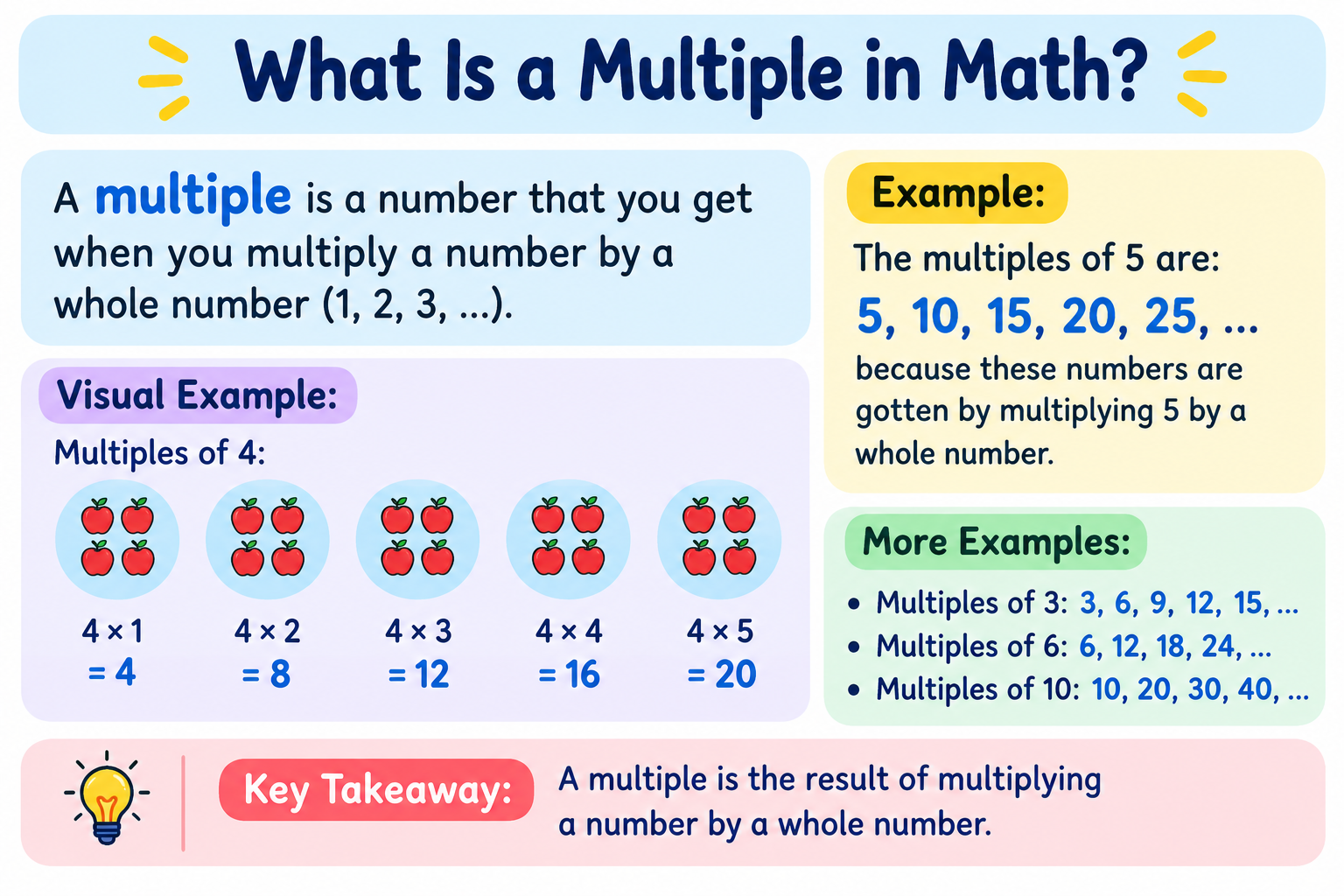
If you have ever skip-counted — 5, 10, 15, 20, 25 — you have already worked with multiples. Those numbers are all multiples of 5 because each one is produced by multiplying 5 by a whole number.
Multiples appear in multiplication tables, fraction problems, scheduling, patterns, and many areas of everyday math. Before students can work with the least common multiple, add fractions with different denominators, or recognize number patterns, they need a solid understanding of what multiples are and how to find them.
This guide explains what a multiple is, how multiples are generated, how they differ from factors, and how they are used in real math problems — with plenty of examples and practice along the way.
Quick Answer: What Is a Multiple in Math?
A multiple is the result you get when you multiply a number by any whole number. For example, the multiples of 4 are 4, 8, 12, 16, 20, and so on — because 4 × 1 = 4, 4 × 2 = 8, 4 × 3 = 12, and the pattern continues without end. Every number has infinitely many multiples because the multiplication never stops.
What Is a Multiple in Math?
A multiple of a number is the product you get when that number is multiplied by any whole number — 1, 2, 3, 4, 5, and so on.
The basic structure looks like this:
Number × Whole Number = Multiple
Here are some examples using the number 3:
- 3 × 1 = 3
- 3 × 2 = 6
- 3 × 3 = 9
- 3 × 4 = 12
- 3 × 5 = 15
The results — 3, 6, 9, 12, 15 — are all multiples of 3. Each one is produced by multiplying 3 by a whole number.
Here are examples using the number 7:
- 7 × 1 = 7
- 7 × 2 = 14
- 7 × 3 = 21
- 7 × 4 = 28
- 7 × 5 = 35
The multiples of 7 are 7, 14, 21, 28, 35, and so on.
A key point about multiples: they never end. Because you can always multiply by the next whole number, every number has an infinite list of multiples. This is what separates multiples from factors — factors form a finite, limited list, while multiples go on forever.
How to Find the Multiples of a Number
Finding multiples is straightforward. Start with the number itself (which is its first multiple, since any number multiplied by 1 equals itself), then keep adding that number to find the next multiple, or simply multiply by 2, 3, 4, and so on.
Find the first six multiples of 5.
- 5 × 1 = 5
- 5 × 2 = 10
- 5 × 3 = 15
- 5 × 4 = 20
- 5 × 5 = 25
- 5 × 6 = 30
The first six multiples of 5 are: 5, 10, 15, 20, 25, 30
You will notice that finding multiples of 5 is the same as skip-counting by 5. That connection makes multiples easy to visualize.
Find the first six multiples of 8.
- 8 × 1 = 8
- 8 × 2 = 16
- 8 × 3 = 24
- 8 × 4 = 32
- 8 × 5 = 40
- 8 × 6 = 48
The first six multiples of 8 are: 8, 16, 24, 32, 40, 48
Find the first six multiples of 11.
- 11 × 1 = 11
- 11 × 2 = 22
- 11 × 3 = 33
- 11 × 4 = 44
- 11 × 5 = 55
- 11 × 6 = 66
The first six multiples of 11 are: 11, 22, 33, 44, 55, 66
The method is the same for any number — simply multiply by 1, 2, 3, and so on, or skip-count by the number itself.
How to Check Whether a Number Is a Multiple
To check whether a specific number is a multiple of another number, divide the larger number by the smaller one. If the result is a whole number with no remainder, then the larger number is a multiple of the smaller one.
Is 36 a multiple of 9?
36 ÷ 9 = 4
The result is a whole number with no remainder. Yes, 36 is a multiple of 9.
This also means that 9 is a factor of 36 — and that 9 × 4 = 36.
Is 50 a multiple of 6?
50 ÷ 6 = 8 remainder 2
There is a remainder. No, 50 is not a multiple of 6.
Is 72 a multiple of 8?
72 ÷ 8 = 9
No remainder. Yes, 72 is a multiple of 8.
Is 45 a multiple of 7?
45 ÷ 7 = 6 remainder 3
There is a remainder. No, 45 is not a multiple of 7.
This division test works reliably for any pair of numbers. If the division is clean and exact, it is a multiple. If there is any remainder, it is not.
Examples of Multiples
Here are the first ten multiples of several common numbers. Every list here has been verified by multiplication.
Multiples of 2:
2, 4, 6, 8, 10, 12, 14, 16, 18, 20
Multiples of 3:
3, 6, 9, 12, 15, 18, 21, 24, 27, 30
Multiples of 4:
4, 8, 12, 16, 20, 24, 28, 32, 36, 40
Multiples of 5:
5, 10, 15, 20, 25, 30, 35, 40, 45, 50
Multiples of 6:
6, 12, 18, 24, 30, 36, 42, 48, 54, 60
Multiples of 7:
7, 14, 21, 28, 35, 42, 49, 56, 63, 70
Multiples of 9:
9, 18, 27, 36, 45, 54, 63, 72, 81, 90
Multiples of 10:
10, 20, 30, 40, 50, 60, 70, 80, 90, 100
Multiples of 12:
12, 24, 36, 48, 60, 72, 84, 96, 108, 120
Looking at these lists, you can see patterns forming. Multiples of 2 are all even numbers. Multiples of 5 always end in 0 or 5. Multiples of 10 always end in 0. These patterns are useful for quickly identifying multiples without calculating each one.
Multiples and the Multiplication Table
Every multiplication table is simply a list of multiples. When you look at the row for 6 in a multiplication table, you are reading the multiples of 6 in order:
6, 12, 18, 24, 30, 36, 42, 48, 54, 60
Each entry in that row is 6 multiplied by the column number — 6 × 1, 6 × 2, 6 × 3, and so on. The multiplication table is essentially a compact reference for the multiples of every number from 1 to 10 (or 1 to 12, depending on the table).
This connection means that knowing multiplication facts gives you an immediate head start when working with multiples. If you know that 7 × 6 = 42, you already know that 42 is a multiple of both 7 and 6.
Multiples and Factors: What Is the Difference?
Multiples and factors are closely related, but they point in opposite directions. This distinction is one of the most important things to understand clearly in elementary number theory.
A factor of a number divides that number exactly, with no remainder. Factors are always less than or equal to the number. Every number has a finite, limited set of factors.
A multiple of a number is produced by multiplying that number by any whole number. Multiples are always greater than or equal to the number itself. Every number has an infinite list of multiples.
Using the number 6 as an example:
Factors of 6: 1, 2, 3, 6
(These are the numbers that divide 6 evenly. There are exactly four of them.)
Multiples of 6: 6, 12, 18, 24, 30, 36, 42 …
(These are produced by multiplying 6 by 1, 2, 3, 4, 5, 6, 7 … They go on forever.)
Here is a simple comparison:
| Feature | Factors | Multiples |
|---|---|---|
| Direction | Divide into the number | Multiply out from the number |
| Size compared to the number | Always ≤ the number | Always ≥ the number |
| Finite or infinite | Finite — a limited count | Infinite — they never end |
| Example for 4 | 1, 2, 4 | 4, 8, 12, 16, 20 … |
A helpful memory trick: factors fit inside the number, multiples march beyond it.
The relationship also works in reverse. If 18 is a multiple of 6, then 6 is a factor of 18. Every multiple-factor relationship is a two-way connection. Understanding what is a factor in math makes this two-way relationship much easier to follow.
What Are Common Multiples?
A common multiple is a number that is a multiple of two or more different numbers at the same time.
For example, find the common multiples of 4 and 6.
Multiples of 4: 4, 8, 12, 16, 20, 24, 28, 32, 36, 40 …
Multiples of 6: 6, 12, 18, 24, 30, 36, 42 …
The numbers that appear in both lists are common multiples of 4 and 6:
12, 24, 36 … (and so on — there are infinitely many)
Common multiples are useful when you need to find a shared base for two numbers — for example, when adding fractions with different denominators.
What Is the Least Common Multiple?
The Least Common Multiple (LCM) is the smallest number that is a multiple of two or more given numbers. It is also sometimes called the Lowest Common Multiple.
Using the example above:
Common multiples of 4 and 6: 12, 24, 36 …
The smallest of these is 12.
So the LCM of 4 and 6 is 12.
Here is another example:
Find the LCM of 5 and 8.
Multiples of 5: 5, 10, 15, 20, 25, 30, 35, 40, 45 …
Multiples of 8: 8, 16, 24, 32, 40, 48 …
The first number that appears in both lists is 40.
The LCM of 5 and 8 is 40.
The LCM is used frequently when adding or subtracting fractions with different denominators. For example, to add 1/4 + 1/6, you need to find a common denominator — and the LCM of 4 and 6 (which is 12) gives you the smallest one to use.
Is Zero a Multiple of Every Number?
Yes. Zero is considered a multiple of every number, because any number multiplied by 0 equals 0.
- 5 × 0 = 0
- 9 × 0 = 0
- 100 × 0 = 0
So 0 is technically a multiple of 5, 9, 100, and every other number. In most school contexts, however, when students are asked to list multiples, they typically start from the first positive multiple (the number multiplied by 1) rather than from zero. Your teacher or textbook may specify whether to include zero in a list of multiples.
Is a Number a Multiple of Itself?
Yes. Every number is a multiple of itself, because any number multiplied by 1 gives that same number.
- 7 × 1 = 7, so 7 is a multiple of 7
- 15 × 1 = 15, so 15 is a multiple of 15
- 100 × 1 = 100, so 100 is a multiple of 100
The first multiple in any list is always the number itself.
Multiples in Algebra
In algebra, multiples still follow the same definition — they are the products of a number or expression multiplied by whole numbers. The language just extends to include variables.
When you see an expression like 5x, this means 5 multiplied by x. The expression 5x is a multiple of both 5 and x.
If x = 3, then 5x = 15. In this case, 15 is a multiple of 5.
If x = 7, then 5x = 35. Here, 35 is a multiple of 5.
Understanding what is a variable in math helps clarify how multiples extend into algebraic expressions. Variables represent unknown or changing values, so algebraic multiples like 5x represent a whole family of multiples depending on what x equals.
The concept also connects to what is a coefficient in math — in the term 5x, the coefficient 5 tells you which multiples of x are being referred to.
Multiples in Expressions and Equations
Multiples appear naturally inside mathematical expressions and equations.
In the expression 6x + 3, the term 6x represents a multiple of 6 — specifically, 6 multiplied by whatever x equals. The number 3 is a constant in math that does not change.
In an equation like 3x = 24, you are being asked: which multiple of 3 equals 24? Since 3 × 8 = 24, the answer is x = 8.
Each term in math that involves a coefficient and a variable is, in effect, expressing a multiple relationship. Recognizing this connection makes algebraic thinking more intuitive.
Why Are Multiples Important in Math?
Multiples are used across many different areas of mathematics and everyday life.
In multiplication, listing multiples is the same as reading down a column or row in a multiplication table. Fluency with multiples supports faster and more accurate arithmetic.
In fractions, finding a common denominator when adding or subtracting fractions requires finding common multiples of the denominators. For example, to add 1/3 and 1/4, you need to find the LCM of 3 and 4, which is 12, and convert both fractions to twelfths.
In number patterns, multiples produce predictable, regular sequences. Recognizing patterns based on multiples helps with mental math and number sense.
In divisibility, knowing multiples helps you quickly determine whether one number divides another. If you know the multiples of 9, you can immediately recognize that 81 is divisible by 9.
In scheduling and real-life problems, multiples help solve problems that involve events repeating at regular intervals — like buses arriving every 6 minutes and trains arriving every 9 minutes, and figuring out when both arrive at the same time.
In algebra, multiples form the basis for understanding terms, coefficients, and expressions. When students later study polynomials and factoring, multiples remain foundational.
Real-World Examples of Multiples
Example one: Bus scheduling
Bus A arrives every 4 minutes. Bus B arrives every 6 minutes. Both buses arrive together at the start. When is the next time both buses arrive at the same time?
Multiples of 4: 4, 8, 12, 16, 20, 24 …
Multiples of 6: 6, 12, 18, 24 …
The first common multiple is 12.
Both buses will arrive together again after 12 minutes.
Example two: Packing supplies
A store sells notebooks in packs of 5 and pens in packs of 3. A teacher wants to buy the same number of notebooks and pens with no leftovers. What is the smallest number of each she should buy?
Multiples of 5: 5, 10, 15, 20 …
Multiples of 3: 3, 6, 9, 12, 15 …
The LCM of 5 and 3 is 15.
The teacher should buy 15 notebooks (3 packs of 5) and 15 pens (5 packs of 3).
Example three: Tiling a floor
A designer wants to use square tiles of two different sizes — one type is 8 cm wide and another is 12 cm wide — and have them line up evenly along a wall with no gaps or overhang. What is the shortest wall length where both tiles line up evenly?
Multiples of 8: 8, 16, 24, 32, 40, 48 …
Multiples of 12: 12, 24, 36, 48 …
The LCM of 8 and 12 is 24.
The shortest wall length where both tiles fit perfectly is 24 cm.
Practice: Finding Multiples
Try these practice exercises to check your understanding. Work through each one using the multiplication method or skip-counting.
Practice one:
List the first eight multiples of 6.
Answer: 6, 12, 18, 24, 30, 36, 42, 48
Practice two:
List the first eight multiples of 9.
Answer: 9, 18, 27, 36, 45, 54, 63, 72
Practice three:
Is 56 a multiple of 7?
56 ÷ 7 = 8. No remainder. Yes, 56 is a multiple of 7.
Practice four:
Is 38 a multiple of 6?
38 ÷ 6 = 6 remainder 2. There is a remainder. No, 38 is not a multiple of 6.
Practice five:
Find the LCM of 4 and 10.
Multiples of 4: 4, 8, 12, 16, 20 …
Multiples of 10: 10, 20, 30 …
First common multiple: 20
LCM of 4 and 10 = 20
Practice six:
Find the LCM of 3 and 7.
Multiples of 3: 3, 6, 9, 12, 15, 18, 21 …
Multiples of 7: 7, 14, 21 …
First common multiple: 21
LCM of 3 and 7 = 21
Common Mistakes Students Make With Multiples
Confusing multiples with factors
This is the most common mistake. Multiples extend outward from a number through multiplication — they are always greater than or equal to the number. Factors divide into the number — they are always less than or equal to it. Multiples of 5 are 5, 10, 15, 20 and so on. Factors of 5 are just 1 and 5.
Thinking multiples end at the multiplication table
The multiplication table shows the first 10 or 12 multiples of each number. But multiples continue indefinitely. The multiples of 7 do not stop at 70 — they keep going: 77, 84, 91, and beyond.
Forgetting that the number itself is a multiple
Every number is its own first multiple. Students sometimes start their list at the second multiple and miss the first. The multiples of 8 begin at 8, not 16.
Including numbers that are not exact multiples
Only numbers that divide evenly into the given number count as multiples. For example, 14 is not a multiple of 4 because 14 ÷ 4 = 3 remainder 2. Always verify using the division test.
Mixing up LCM and GCF
The Least Common Multiple (LCM) is the smallest shared multiple. The Greatest Common Factor (GCF) is the largest shared factor. These are different concepts with different methods. Students sometimes apply one method when they need the other.
Listing multiples out of order
When listing multiples to find an LCM, it helps to list them in order from smallest to largest. Listing them out of order makes it harder to identify the first common multiple correctly.
How to Identify a Multiple
Use these steps to confirm whether a given number is a multiple of another:
- Divide the larger number by the smaller number.
- If the result is a whole number with no remainder, it is a multiple.
- If there is any remainder, it is not a multiple.
Examples:
Is 63 a multiple of 9?
63 ÷ 9 = 7. No remainder. Yes.
Is 50 a multiple of 8?
50 ÷ 8 = 6 remainder 2. No.
Is 100 a multiple of 4?
100 ÷ 4 = 25. No remainder. Yes.
Is 29 a multiple of 3?
29 ÷ 3 = 9 remainder 2. No.
Frequently Asked Questions
What is a multiple in math in simple words?
A multiple is what you get when you multiply a number by any whole number. For example, the multiples of 3 are 3, 6, 9, 12, 15, and so on — because 3 × 1 = 3, 3 × 2 = 6, and the list continues without end.
What is an example of a multiple?
The multiples of 5 are 5, 10, 15, 20, 25, and so on. Each of these is produced by multiplying 5 by a whole number: 5 × 1, 5 × 2, 5 × 3, and so on.
How many multiples does a number have?
Every number has infinitely many multiples. Because you can always multiply by the next whole number, the list of multiples never ends.
What is the difference between a multiple and a factor?
A factor divides into a number evenly and is always less than or equal to that number. A multiple is produced by multiplying a number and is always greater than or equal to that number. Factors of 6 are 1, 2, 3, and 6. Multiples of 6 are 6, 12, 18, 24, and so on.
Is every number a multiple of itself?
Yes. Every number multiplied by 1 gives that same number, so every number is its own first multiple.
Is zero a multiple of every number?
Yes, mathematically. Any number multiplied by 0 equals 0, making 0 a multiple of every number. In most school exercises, however, lists of multiples typically begin with the number multiplied by 1 rather than by 0.
What is a common multiple?
A common multiple is a number that is a multiple of two or more different numbers. For example, 12 is a common multiple of 3 and 4 because it appears in the multiples of both.
What is the least common multiple?
The least common multiple (LCM) is the smallest number that is a multiple of two or more given numbers. For example, the LCM of 4 and 6 is 12, because 12 is the smallest number that both 4 and 6 divide into evenly.
How do you check if a number is a multiple?
Divide the number in question by the given number. If the result is a whole number with no remainder, it is a multiple. If there is a remainder, it is not.
Why are multiples important in math?
Multiples are used in finding the LCM, adding and subtracting fractions, solving word problems, recognizing number patterns, and understanding divisibility. They form a foundation for many areas of arithmetic and algebra.
Sources and References
- Khan Academy — Factors and Multiples — khanacademy.org
- Khan Academy — Least Common Multiple — khanacademy.org
- OpenStax Prealgebra 2e, Chapter 2: The Language of Algebra — Multiples and Factors — openstax.org
- OpenStax Elementary Algebra 2e, Section on Greatest Common Factor and Least Common Multiple — openstax.org
- Encyclopaedia Britannica — Arithmetic — britannica.com
Disclaimer
The content in this article is provided for general educational purposes only. While every effort has been made to ensure mathematical accuracy, students should consult their teacher, textbook, or a qualified educator for guidance specific to their individual coursework or curriculum.
About the Author
Farzan is an education writer who focuses on mathematics, learning concepts, and easy-to-understand explanations for students. He enjoys breaking down challenging math topics into clear, practical examples that make learning easier.